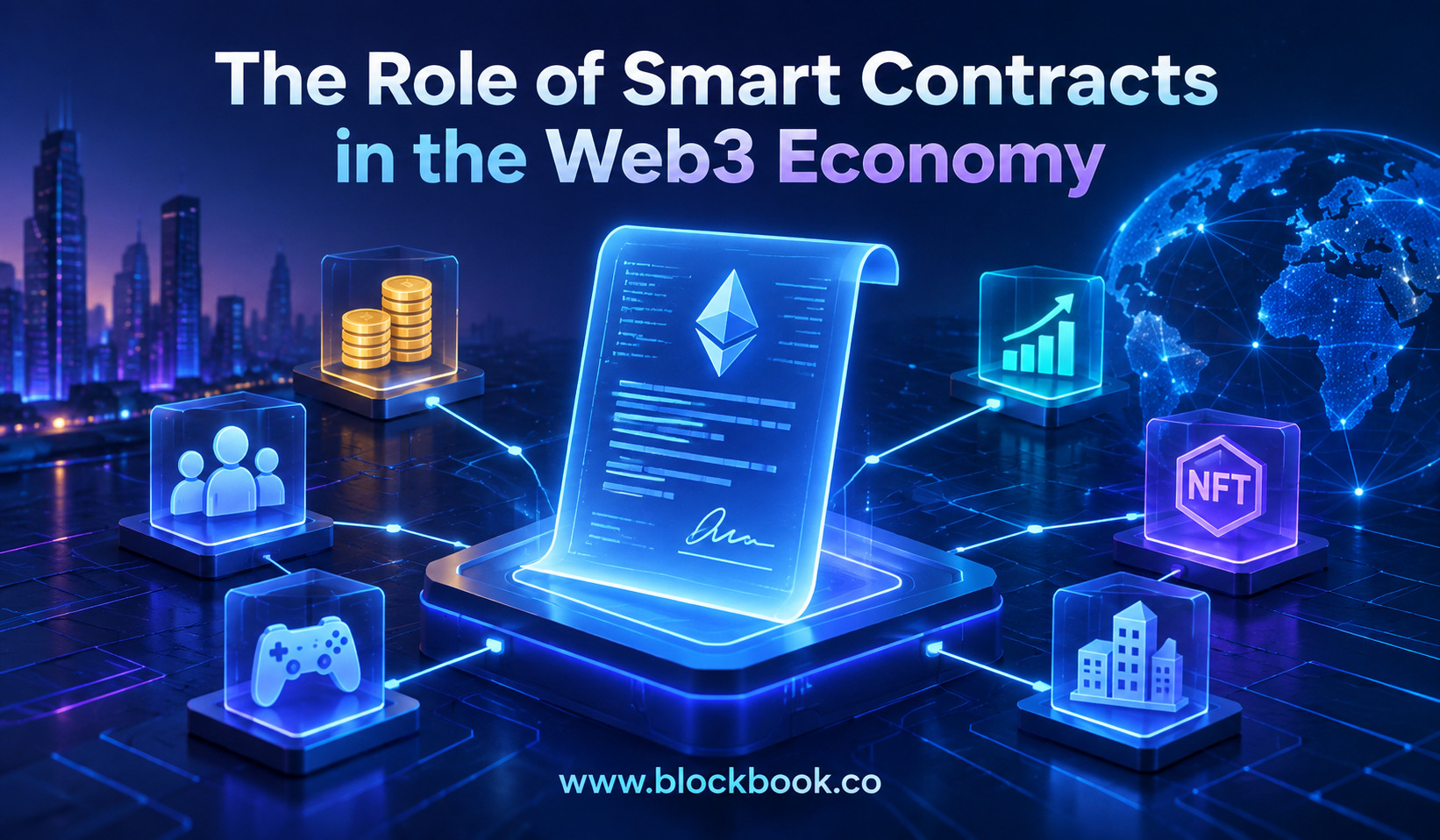
The growth of Web3 is changing how digital services, financial applications, online communities, and blockchain-based platforms operate. At the center of many of these systems are smart contracts, software programs that can automatically execute predefined rules on a blockchain network.
Smart contracts have become an important part of decentralized applications because they can perform transactions and enforce programmed conditions without requiring a traditional intermediary to process every step. They are used across decentralized finance, digital assets, gaming, decentralized organizations, marketplaces, and other blockchain-based services.
The technology is also evolving. Developers are working on ways to make smart contracts more efficient, secure, scalable, and easier to integrate with applications. As the Web3 economy develops, smart contracts could remain an important infrastructure layer for managing digital transactions and programmable agreements.
What Are Smart Contracts?
A smart contract is a computer program deployed on a blockchain that executes according to rules written in its code.
Unlike a conventional contract, a smart contract does not depend entirely on a person or organization to manually carry out every agreed action. When predefined conditions are satisfied, the program can automatically execute the relevant transaction or operation.
For example, a decentralized marketplace can use a smart contract to transfer a digital asset to a buyer after the required payment is received. The contract can enforce the programmed conditions without requiring an employee to approve each transaction.
This automation is one of the main reasons smart contracts have become fundamental to Web3 applications.
How Smart Contracts Work
Smart contracts operate through blockchain networks. Developers write the contract using a programming language supported by the chosen blockchain and then deploy it to the network.
Once deployed, the contract has a blockchain address and can interact with users and other applications. Transactions sent to the contract trigger specific functions according to its code.
A simplified smart-contract process generally involves:
- A developer writes and tests the contract.
- The contract is deployed to a blockchain network.
- A user interacts with the contract through an application.
- The blockchain validates and records the resulting transaction.
The exact process differs between blockchain networks, but the basic principle is programmable execution on decentralized infrastructure.
Smart Contracts and the Web3 Economy
The Web3 economy includes decentralized applications, digital assets, token-based ecosystems, decentralized finance, blockchain games, and other services.
Smart contracts provide much of the underlying logic for these applications. They can determine how tokens are transferred, how assets are exchanged, how rewards are distributed, and how certain community decisions are implemented.
This gives developers a way to build applications where important rules are represented directly in software.
However, smart contracts do not eliminate organizations or human decision-making. Developers still write the code, communities may govern certain systems, and companies may operate interfaces or supporting infrastructure.
Smart Contracts in Decentralized Finance
Decentralized finance, or DeFi, is one of the largest areas of smart-contract usage.
DeFi applications can allow users to exchange tokens, lend digital assets, provide liquidity, or interact with other financial mechanisms through blockchain-based protocols.
Instead of relying entirely on a traditional financial institution to maintain the system, smart contracts can manage selected operations automatically.
For example, a decentralized exchange can use smart contracts to facilitate token swaps based on programmed rules. Lending protocols can use contracts to manage deposits, borrowing conditions, collateral, and repayments.
These applications demonstrate how smart contracts can turn financial rules into executable software.
Smart Contracts and Digital Assets
Smart contracts also support the creation and management of blockchain-based digital assets.
Fungible tokens can represent digital units that are interchangeable with one another, while NFTs can represent unique tokens. Smart contracts can define how these assets are created, transferred, or interacted with.
This has created applications across digital collectibles, gaming, memberships, event access, creator economies, and virtual worlds.
For creators, token-based systems can provide new ways to distribute digital products. For users, blockchain records can provide a verifiable history of asset transactions.
The actual rights associated with a token still depend on its terms and the application using it.
Smart Contracts in Blockchain Gaming
Blockchain gaming is another area where smart contracts are being explored.
A game can use smart contracts to manage selected digital assets, marketplace transactions, rewards, or player ownership. Instead of storing every item exclusively inside a game developer’s database, certain assets can be represented on a blockchain.
This can allow players to transfer compatible assets between wallets or marketplaces.
However, putting every gaming action directly on a blockchain can create performance and cost limitations. Many developers therefore use a hybrid approach in which fast gameplay runs through conventional infrastructure while smart contracts handle selected ownership and economic functions.
Smart Contracts and DAOs
Decentralized autonomous organizations, or DAOs, can use smart contracts to establish rules for community governance and treasury management.
A governance system may allow eligible participants to submit proposals and vote on decisions. If a proposal meets predefined requirements, a smart contract can execute the resulting action.
This can create a transparent process where governance activity is recorded on a blockchain.
However, governance design remains complicated. Voting power can be distributed unevenly, and communities may need additional procedures for handling emergencies, technical upgrades, and disputes.
Smart contracts can automate governance rules, but they do not automatically guarantee effective decision-making.
Web3 Applications Compared With Traditional Digital Services
| Feature | Traditional Digital Service | Smart-Contract-Based Web3 Service |
| Main logic | Centralized application/server | Blockchain program plus application |
| Transactions | Processed by service provider | Can be executed by smart contracts |
| Records | Usually controlled by provider | Blockchain records can be publicly verifiable |
| Automation | Application-dependent | Rules can execute automatically |
| Intermediary role | Often central | Can be reduced for selected operations |
| User control | Usually account-based | Can include wallet-based interaction |
These differences are general and do not apply equally to every Web3 application.
Smart Contracts and Transparency
Transparency is another important characteristic. Public blockchains can allow users and developers to inspect transactions and, depending on the network and contract, examine contract activity.
This can make certain financial and governance operations easier to audit than systems where users have no access to the underlying transaction records.
However, transparency does not mean that every aspect of a decentralized application is automatically understandable. Smart-contract code can be complicated, and users may rely on third-party interfaces to interact with it.
Clear documentation and independent security reviews therefore remain important.
Security Is a Major Concern
Smart contracts can automate transactions, but their code can contain vulnerabilities. If a programming error creates an unintended behavior, attackers may potentially exploit it.
Unlike conventional applications, blockchain transactions may be difficult to reverse after execution. This makes security testing particularly important before contracts are deployed.
Developers can use audits, automated testing, formal verification, bug-bounty programs, and controlled deployments to reduce risks.
Some important security practices include:
- Extensive testing before mainnet deployment
- Independent smart-contract audits
- Careful management of administrative permissions
- Continuous monitoring for unusual activity
Security remains an ongoing process rather than a one-time development task.
Smart Contracts and Oracles
Smart contracts operate within blockchain environments, but many real-world applications require information from outside the blockchain.
For example, an insurance application may need weather information, while a financial application may require market prices.
Blockchain oracles can provide external data to smart contracts. They act as bridges between blockchain networks and information outside the chain.
This introduces another trust consideration. If an application depends on inaccurate or manipulated external information, the smart contract may execute correctly while producing an undesirable outcome.
Therefore, reliable data infrastructure is important for advanced Web3 applications.
Scalability and Transaction Costs
Blockchain networks have historically faced scalability limitations. High activity can increase transaction fees or create delays.
For smart-contract-based applications, this can affect user experience. A small transaction may become expensive during periods of network congestion.
Developers are addressing these problems through Layer-2 networks, optimized contract code, alternative blockchain architectures, and other scaling technologies.
As blockchain infrastructure improves, smart contracts may become practical for a broader range of applications.
The Growing Importance of Smart-Contract Developers
The expansion of Web3 applications is increasing demand for developers who understand smart-contract programming and blockchain architecture.
Developers need more than basic programming knowledge. They must understand blockchain transactions, cryptographic concepts, security vulnerabilities, gas optimization, testing, and deployment.
Programming languages vary by ecosystem. Solidity is widely associated with Ethereum-compatible smart contracts, while other blockchain platforms use languages such as Rust.
As blockchain ecosystems become more specialized, developers may need to understand multiple programming environments.
Future Applications
Smart contracts could expand into areas beyond cryptocurrency and digital collectibles.
Potential applications include digital identity, supply-chain verification, decentralized marketplaces, tokenized assets, creator platforms, and automated business processes.
Several developments could influence their future adoption:
- Improved smart-contract security and development tools.
- Greater blockchain scalability and lower transaction costs.
- Better integration with real-world data.
- Easier user interfaces that hide technical complexity.
The success of these applications will depend on whether smart contracts provide practical advantages over conventional software.
Challenges Facing Smart Contracts
Despite their potential, smart contracts face technical and practical limitations.
Code errors can have serious consequences. Blockchain transactions can be difficult to reverse, and users may struggle to understand complex contract interactions.
Regulation is another consideration. Applications involving financial products, digital assets, or consumer transactions may operate under different legal requirements depending on jurisdiction.
There is also a usability challenge. Many Web3 applications still require users to understand wallets, network fees, transaction approvals, and blockchain addresses.
For wider adoption, developers will need to make these systems easier to use without compromising transparency and security.
Conclusion
Smart contracts are becoming a foundational technology within the Web3 economy. By converting predefined rules into blockchain-based software, they can automate transactions, manage digital assets, support decentralized financial applications, and provide infrastructure for blockchain games and community governance.
Their value comes from programmable execution and the ability to operate on decentralized networks. At the same time, smart contracts are not a replacement for every traditional business process. Security, scalability, regulation, external data, and user experience remain important challenges.
The next phase of Web3 development will likely focus on making smart contracts safer, faster, cheaper, and easier to use. Better developer tools and scaling technologies could allow more applications to adopt blockchain-based automation.
As the Web3 economy expands, smart contracts may increasingly operate behind the scenes. Users may not always know when a smart contract is being used, but these programmable systems could continue to provide the infrastructure for digital transactions, assets, and decentralized services.
Frequently Asked Questions
1. What is a smart contract?
A smart contract is a computer program deployed on a blockchain that automatically executes predefined rules when the required conditions are met.
2. Why are smart contracts important for Web3?
They provide programmable infrastructure for decentralized applications. They can automate transactions, manage digital assets, and enforce certain rules without requiring a centralized intermediary for every operation.
3. Where are smart contracts used?
Smart contracts are used in areas such as decentralized finance, token creation, NFTs, blockchain gaming, decentralized organizations, marketplaces, and other Web3 applications.
4. Are smart contracts completely secure?
No. Smart contracts can contain programming errors or vulnerabilities. Testing, audits, monitoring, and careful development are important for reducing security risks.
5. Can smart contracts access real-world information?
They can receive external information through blockchain oracle systems. Oracles connect smart contracts with data sources outside the blockchain.
About the Author