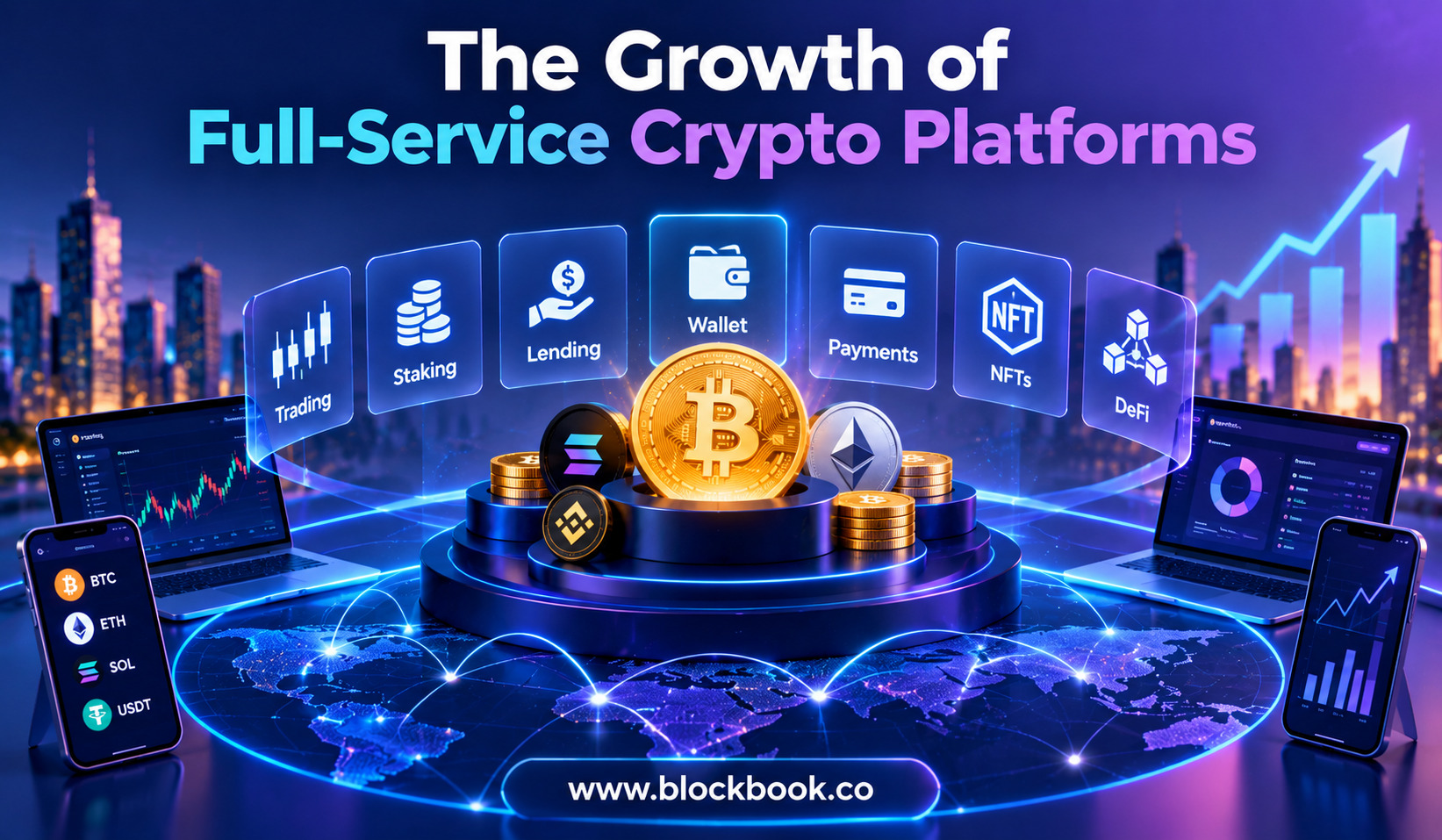
The cryptocurrency industry is entering a broader phase as full-service crypto platforms expand the range of financial and blockchain services they provide. What once required users to rely on separate exchanges, wallets, payment services and custody providers can increasingly be accessed through connected digital-asset ecosystems.
The shift is changing the role of cryptocurrency companies. Instead of concentrating exclusively on buying and selling digital assets, platforms are developing services covering spot trading, derivatives, staking, custody, payments, institutional finance, Web3 wallets and tokenized assets.
This development is being driven by changes in customer expectations, growing institutional participation and the continued development of blockchain technology. Regulatory changes are also influencing how platforms structure their products and where those products can be offered.
In 2026, the growth of full-service platforms is becoming an important trend because digital assets are increasingly being discussed as part of a broader financial infrastructure rather than as a standalone technology sector.
What Is a Full-Service Crypto Platform?
A full-service crypto platform is a digital-asset company that provides multiple services through one connected ecosystem. The exact combination varies from company to company, but the objective is generally to give customers access to several crypto-related activities without requiring them to use a separate provider for every function.
A traditional exchange may focus primarily on buying and selling cryptocurrencies. A full-service platform can add services such as digital-asset custody, staking, derivatives, payments and blockchain wallets.
For customers, this can make digital-asset management more convenient. Instead of moving funds between several applications, users may be able to manage multiple activities from one account.
For companies, the model creates opportunities to build longer-term relationships with customers and diversify revenue beyond trading fees.
Why Full-Service Platforms Are Growing
The growth of these platforms reflects the increasing maturity of the digital-asset market.
In the early stages of cryptocurrency adoption, exchanges primarily focused on creating simple markets for Bitcoin and other digital assets. As the user base expanded, demand developed for more advanced financial products and services.
Retail users increasingly expect mobile applications, easy deposits, wallet functionality and access to multiple digital assets. Experienced traders may want derivatives, advanced order types and professional market data. Businesses may require payment processing, while institutions often need custody, compliance and reporting infrastructure.
Full-service platforms are attempting to address these different requirements through integrated products.
Another factor is competition. As more companies enter the digital-asset market, platforms are looking for ways to differentiate their businesses. Providing a wider range of services can help them serve customers across different stages of their digital-asset journey.
Trading Remains the Foundation
Despite the expansion into other services, trading remains central to most crypto platforms.
Spot markets allow users to purchase and sell digital assets directly. Modern platforms are also adding professional tools such as advanced order types, charting, market-depth information and APIs.
Derivatives have become another important part of the market. Futures, perpetual contracts and options can provide eligible users with additional methods of gaining exposure to digital-asset prices.
However, these products can involve leverage, liquidation and other risks that are different from simply buying an asset. Regulatory requirements can also restrict access depending on the user’s country and classification.
The combination of spot and derivatives markets allows platforms to serve both casual users and more experienced market participants.
Custody Becomes a Core Service
As the digital-asset market grows, secure custody is becoming increasingly important.
Cryptocurrencies are controlled through cryptographic keys, meaning the security of those keys is fundamental to asset ownership. Retail users can manage their own wallets, but businesses and institutions may prefer professional custody arrangements.
Full-service platforms can provide custody systems alongside trading accounts. These systems may include cold storage, multi-signature controls, transaction approval procedures and other security mechanisms.
Institutional customers often require additional governance and reporting capabilities. They may want clear procedures for authorising transactions, segregating assets and managing operational risks.
The expansion of custody services is therefore helping crypto platforms become more relevant to professional financial institutions.
Staking Adds Another Revenue and Utility Layer
Staking has also become part of the broader crypto-service ecosystem.
Certain proof-of-stake blockchains allow users to participate in network operations by committing eligible assets. Participants may receive rewards according to the blockchain’s rules.
Platforms can simplify the process by offering staking directly through customer accounts. Users do not necessarily need to operate their own infrastructure to participate.
However, staking conditions can vary significantly. Reward mechanisms, fees, lock-up periods and withdrawal rules depend on the blockchain and service provider.
Regulatory treatment is another consideration. A staking service that is available in one market may have different conditions or restrictions elsewhere.
Crypto Payments and Stablecoins
Payments represent another major area of development.
Full-service crypto platforms can provide infrastructure for moving digital assets between individuals, businesses and merchants. Stablecoins are particularly relevant because they are designed to maintain a value linked to a reference currency or asset.
For businesses, stablecoins can potentially support cross-border settlement and digital payments. A company operating internationally may use blockchain infrastructure to move funds between different markets.
Crypto payment services can also connect merchants with customers who prefer digital assets.
However, payment adoption depends on factors including transaction costs, liquidity, regulatory requirements, merchant acceptance and the reliability of supporting infrastructure.
The growth of payment services means crypto platforms are increasingly participating in the movement of value rather than simply facilitating investment.
Web3 Wallets Expand Platform Use
Full-service platforms are also becoming gateways to Web3 applications.
A Web3 wallet can allow users to interact directly with blockchain networks and decentralized applications. These can include decentralized finance protocols, NFT marketplaces, blockchain games and other on-chain applications.
By adding wallet functionality, a crypto platform can connect its centralized trading services with decentralized blockchain ecosystems.
This creates additional opportunities for users but also introduces different security considerations. Customers interacting with smart contracts or decentralized applications need to understand risks that may not exist in conventional exchange trading.
Platforms therefore need to focus on both accessibility and user education as Web3 services become more integrated.
Institutional Services Are Driving Expansion
Institutional adoption is one of the strongest forces behind the development of full-service crypto platforms.
Professional investors can require much more than a trading interface. They may need deep liquidity, custody, trading APIs, reporting, compliance systems and dedicated support.
Crypto platforms are responding by creating institutional products designed to meet these requirements.
Some are also connecting trading and custody services so institutions can manage different aspects of digital-asset exposure through one provider.
This trend is important because institutional participation can influence the standards expected across the broader industry. Requirements around security, governance and reporting can encourage service providers to develop more sophisticated infrastructure.
Tokenization Could Broaden the Market
Tokenization is another development that could influence the growth of full-service platforms.
Tokenization involves representing assets or financial interests through blockchain-based tokens. The concept can potentially be applied to securities, funds, real-world assets and other financial instruments.
If tokenized assets become more widely adopted, platforms could provide services for their issuance, trading, custody and settlement.
Regulation will play an important role. In September 2026, the U.S. Securities and Exchange Commission announced a five-year conditional exemption involving certain tokenized stock trading activities. The framework included specific conditions related to qualifying tokenized stocks and investor rights.
Such regulatory developments could encourage further experimentation with blockchain-based financial products while also increasing compliance responsibilities for platforms.
The Role of Regulation
The expansion of services is happening alongside stronger regulatory oversight.
Crypto platforms can face requirements involving customer identification, anti-money-laundering controls, licensing, custody and consumer protection.
The Financial Action Task Force continues to encourage jurisdictions to establish appropriate licensing or registration and supervision for relevant virtual asset service providers.
Regulation can affect the structure of full-service platforms because not every product can be offered to every customer in every country.
A platform may therefore provide spot trading in one market while restricting derivatives, staking or other services elsewhere.
This geographic variation is likely to remain an important feature of the global crypto industry.
Full-Service Crypto Platform Ecosystem
| Service | Primary Purpose | Potential Users |
| Spot Trading | Buying and selling digital assets | Retail and professional users |
| Derivatives | Futures, options and perpetual contracts | Experienced and institutional traders |
| Custody | Safeguarding digital assets | Businesses and institutions |
| Staking | Participating in supported blockchain networks | Asset holders |
| Payments | Digital-asset transfers and settlement | Consumers and businesses |
| Web3 Wallets | Connecting with blockchain applications | Web3 users |
| Tokenization | Supporting blockchain-based assets | Financial institutions and businesses |
| Institutional Services | Professional trading and infrastructure | Investment firms and corporations |
Not every full-service platform offers all of these products, and availability can vary by jurisdiction.
Security Becomes More Important
As platforms add more services, security becomes increasingly complex.
An exchange offering trading alone has one primary operational environment. A full-service platform may simultaneously manage trading accounts, custody systems, payment infrastructure, wallets and blockchain applications.
Each additional service creates new security considerations.
Platforms can use multi-factor authentication, cold storage, encryption, transaction monitoring, withdrawal controls and other security measures. Users also need to protect their own credentials and verify transactions before approving them.
A security incident involving a full-service platform could potentially affect several parts of a customer’s financial activity. This makes operational resilience increasingly important.
Benefits and Challenges of the Full-Service Model
The full-service model offers several potential benefits. Customers can access multiple services from one ecosystem, while companies can create more diversified business models.
However, greater integration can also create complexity. Users may find it harder to understand the differences between trading, staking, custody and derivatives. Platforms also have to manage more regulatory requirements and technology systems.
The major considerations include:
- Convenience: Multiple services can be managed through one ecosystem.
- Integration: Trading, custody, payments and wallets can work together.
- Complexity: More products require greater customer understanding.
- Risk management: Platforms must secure several interconnected systems.
The success of the model will depend on how effectively companies manage this balance.
Conclusion
The growth of full-service crypto platforms reflects the changing nature of the digital-asset industry. Exchanges are increasingly moving beyond basic trading and developing ecosystems that combine trading, custody, staking, payments, Web3 wallets, institutional services and emerging tokenization capabilities.
This expansion can make digital assets more accessible while creating new opportunities for businesses and financial institutions. At the same time, it increases the importance of security, regulatory compliance, transparency and user education.
As the industry develops in 2026, full-service platforms could become important bridges between blockchain networks and traditional financial infrastructure. Their future will depend on their ability to offer useful services while managing the technical, regulatory and security challenges that come with operating increasingly complex digital financial ecosystems.
FAQs
What is a full-service crypto platform?
A full-service crypto platform provides multiple digital-asset services through one ecosystem. These can include trading, custody, staking, payments, wallets and institutional services.
Why are crypto platforms adding more services?
Platforms are responding to customer demand, institutional adoption, technological development and competition within the digital-asset industry.
What services can a full-service crypto platform provide?
Depending on the company and jurisdiction, services can include spot trading, derivatives, staking, custody, payments, Web3 wallets, tokenization-related services and institutional trading.
Are full-service crypto platforms regulated?
Many crypto platforms operate under regulatory requirements, but the rules and licensing arrangements vary between countries and services.
What is the role of stablecoins?
Stablecoins are digital assets designed to maintain a value linked to a reference asset. They are being explored for payments, transfers and settlement.
About the Author