
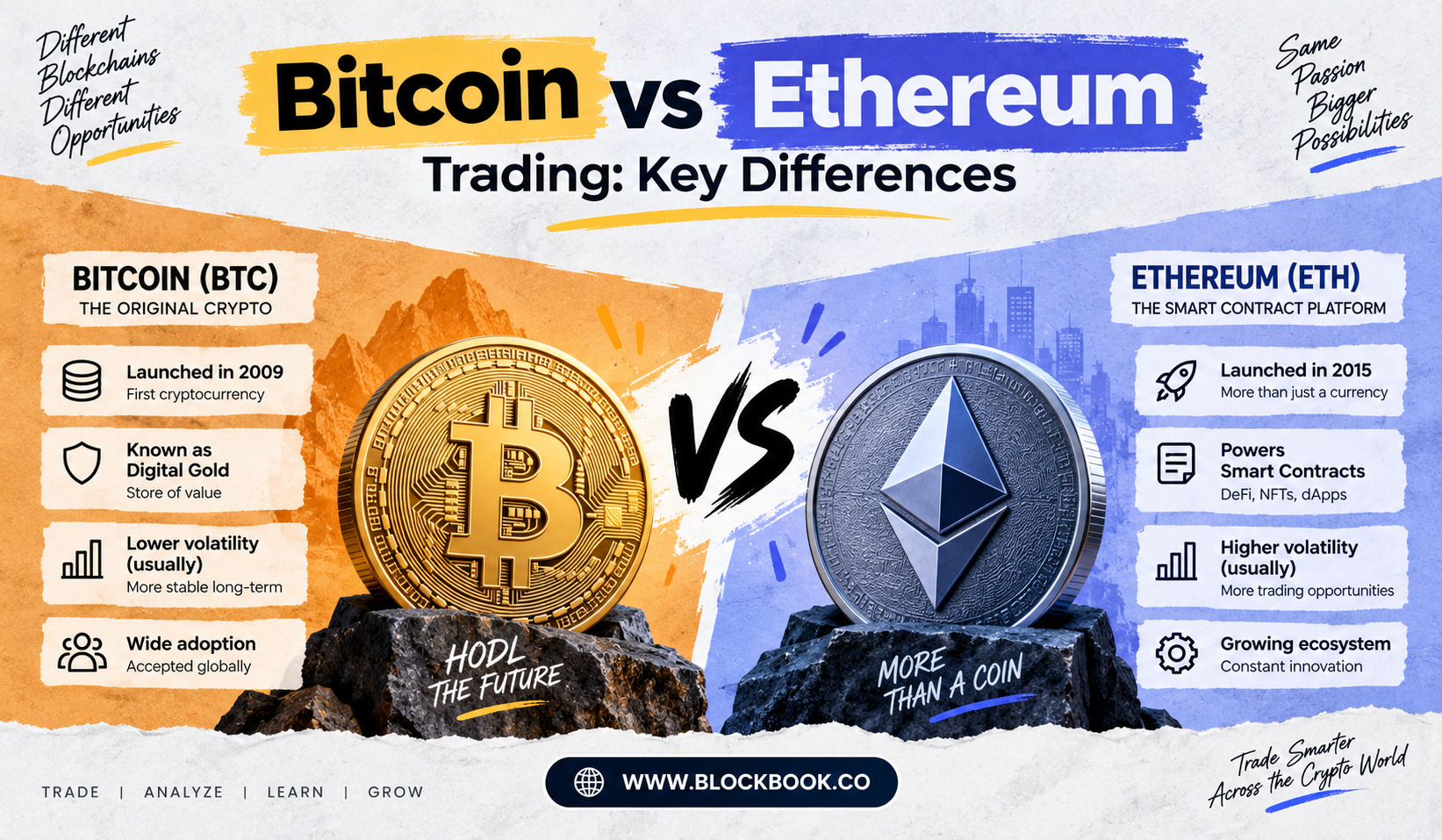
Treating Bitcoin and Ethereum as interchangeable trades is a common beginner mistake. They share a market, and their prices often move in the same direction, but the details underneath are different enough to matter. This comparison of Bitcoin vs Ethereum trading breaks down where the two diverge and what that means for how you approach each one.
Two Different Assets, Two Different Trading Personalities
Bitcoin is generally viewed as the more established, store-of-value asset in the crypto market. Its price behavior tends to reflect that reputation, often moving with a bit more stability during calm periods.
Ethereum carries a broader identity, tied to smart contracts, decentralized applications, and an entire ecosystem built on top of its network. That added dimension can make its price behavior more reactive to ecosystem-specific news, on top of the general crypto market sentiment that affects both coins.
Volatility: How Much Each One Moves
Volatility measures how much and how quickly a price moves.
- Ethereum has historically shown a tendency toward sharper short-term swings compared to Bitcoin, though this relationship can shift depending on the broader market cycle.
- Bitcoin’s larger market size and longer track record generally contribute to somewhat steadier price behavior, particularly during less turbulent periods.
- Both assets can experience significant volatility during major market events, regardless of their usual tendencies.
Traders comfortable with sharper price swings may find Ethereum’s typical behavior appealing, while those preferring steadier movement may lean toward Bitcoin.
What Drives Price Movement for Each
The two assets respond to some shared factors and some that are more specific to each.
Shared Drivers
- Broader crypto market sentiment, which tends to affect nearly every major coin simultaneously.
- Macroeconomic conditions, including interest rates and overall risk appetite in financial markets.
- Regulatory news, which can move the entire market, not just one coin.
Ethereum-Specific Drivers
- Network upgrades and changes to how the Ethereum blockchain itself operates.
- Activity within its decentralized application ecosystem, including decentralized finance and non-fungible tokens.
- Gas fees and network usage, which can influence sentiment around the network’s practical usability.
Bitcoin-Specific Drivers
- Its position as a macro asset, sometimes discussed alongside gold as a store of value.
- Institutional adoption, including large-scale purchases or investment products tied to Bitcoin specifically.
- Its halving cycle, a scheduled reduction in new supply that historically draws significant trader attention.
Liquidity and Market Depth
Liquidity refers to how easily an asset can be bought or sold without significantly moving its price.
Both Bitcoin and Ethereum generally rank among the most liquid assets in the crypto market, with deep order books on major exchanges. This liquidity tends to reduce slippage on large trades compared to smaller, less established coins.
Between the two, Bitcoin has historically carried the larger overall market capitalization, which can translate into slightly deeper liquidity during typical trading conditions, though Ethereum remains highly liquid in its own right.
Correlation: Do They Move Together?
Correlation measures how closely two assets move in relation to each other.
Bitcoin and Ethereum have historically shown a fairly high correlation, often moving in the same general direction during major market swings. That said, correlation is not identical to moving in lockstep. Ethereum can outperform or underperform Bitcoin over shorter periods, depending on ecosystem-specific news or shifts in trader sentiment toward each asset individually.
Traders holding both should understand that diversification benefits between the two are more limited than diversifying into an entirely uncorrelated asset class.
Which One Suits Which Trading Style?
Neither asset is inherently better. The fit depends on the trader.
- Bitcoin may suit traders who prefer a somewhat steadier asset, with price drivers tied more to macro sentiment and adoption trends.
- Ethereum may suit traders comfortable with sharper swings, who want exposure to ecosystem-specific catalysts like upgrades or shifts in decentralized application activity.
- Traders following broader market trends often watch both, since strength or weakness in one can signal something about overall market sentiment.
Key Takeaways
- Bitcoin is generally viewed as the steadier, macro-oriented asset within the crypto market.
- Ethereum carries added complexity tied to its smart contract ecosystem, which can influence its price independently of Bitcoin.
- Volatility has historically tended to run somewhat higher for Ethereum, though this can shift across market cycles.
- Both assets rank among the most liquid in the crypto market, reducing slippage compared to smaller coins.
- Correlation between the two is generally high, though not identical, leaving room for one to outperform the other over shorter periods.
Frequently Asked Questions
Is Ethereum more volatile than Bitcoin?
Historically Ethereum has tended to show sharper short-term swings, though the relationship can shift depending on market conditions.
Do Bitcoin and Ethereum always move in the same direction?
Generally yes, they show a fairly high correlation, though they can diverge over shorter periods due to asset-specific news.
Which asset has deeper liquidity?
Both are highly liquid, though Bitcoin’s larger overall market size has historically translated into slightly deeper liquidity.
Are the same trading strategies effective for both assets?
Many strategies transfer between the two reasonably well, though traders often adjust position sizing to account for Ethereum’s typically sharper volatility.
Should beginners trade both Bitcoin and Ethereum?
Many beginners do trade both, though understanding that they are highly correlated helps set realistic expectations around diversification.
Conclusion
Bitcoin vs Ethereum trading comes down to two assets that share a market but do not behave identically within it. Bitcoin tends toward a steadier, more macro-driven personality, while Ethereum carries added sensitivity to its own ecosystem and upgrade cycle. Understanding these differences helps traders set realistic expectations for volatility, price drivers, and how much true diversification holding both actually provides.
About the Author