Scalability has become one of the most important priorities in blockchain development. As decentralized applications move toward larger user bases and more frequent transactions, developers need infrastructure that can handle increasing activity without creating excessive costs or complicated user experiences. NEAR Protocol is approaching this challenge through a combination of sharding, efficient transaction processing, developer-focused infrastructure and technologies designed to connect applications across different blockchain networks.
NEAR was built with scalability as a central part of its architecture. Rather than relying on a single execution environment to process every transaction, the protocol uses sharding to distribute network workloads. This allows the network to expand its processing capacity as demand increases.
The project’s development has also moved beyond basic blockchain throughput. NEAR is increasingly focused on chain abstraction, cross-chain applications and AI-related infrastructure. These developments suggest that scalability is being considered not only in terms of transaction volume but also in terms of how easily applications can serve users across multiple blockchain ecosystems.
Understanding NEAR’s Sharding Architecture
The foundation of NEAR’s scalability approach is its sharded architecture.
In a traditional blockchain design, validators may need to process a large portion of network activity. As the number of users and transactions grows, this can create competition for computational resources.
Sharding takes a different approach by dividing blockchain activity into separate segments. NEAR’s Nightshade architecture distributes computation and storage across shards, allowing different parts of the network to handle different workloads.
This means the network does not have to treat every transaction as part of one enormous processing queue. Instead, activity can be distributed across the network’s infrastructure.
For developers, this creates an important advantage: application growth does not necessarily have to translate directly into a single shared processing bottleneck.
Nightshade and Network Expansion
NEAR’s Nightshade architecture has evolved through multiple development stages.
The network has moved toward a model where shards can process transactions independently while validators participate in securing the overall system. NEAR’s current technical materials describe the protocol as fully sharded and emphasize dynamic scaling as part of its long-term infrastructure strategy.
Dynamic scaling is important because blockchain demand is rarely constant. An application might experience modest activity during normal periods and significantly higher activity during a major launch or event.
A scalable architecture needs to respond to these changing workloads without requiring developers to redesign their applications every time demand changes.
NEAR’s development roadmap includes continued work on dynamic resharding, which is intended to make network capacity more responsive to changing demand.
Fast Transaction Processing
Transaction speed is another part of NEAR’s scalability strategy.
NEAR currently describes block production at roughly 600 milliseconds and finality at approximately 1.2 seconds. The network also presents a long-term scalability target of up to one million transactions per second. These figures describe protocol-level capabilities or targets rather than guaranteed performance for every application.
Fast confirmation can be useful for decentralized applications where users expect immediate feedback.
For example, financial applications may require rapid transaction confirmation, while games and consumer applications may need frequent blockchain interactions without making users wait for long periods.
However, transaction speed alone does not determine whether an application scales effectively. Developers must also consider application architecture, smart-contract execution, data storage and the number of blockchain interactions required for each user action.
Parallel Processing and Application Design
NEAR’s architecture also allows developers to think about blockchain applications in terms of distributed workloads.
When applications are designed efficiently, different activities can potentially be processed without creating unnecessary dependencies. This can help reduce bottlenecks as application usage grows.
The principle is especially relevant to applications with many independent users. If thousands of users are performing similar actions, the underlying architecture needs to handle those operations efficiently.
Developers therefore need to consider scalability during the design phase rather than waiting until an application becomes popular.
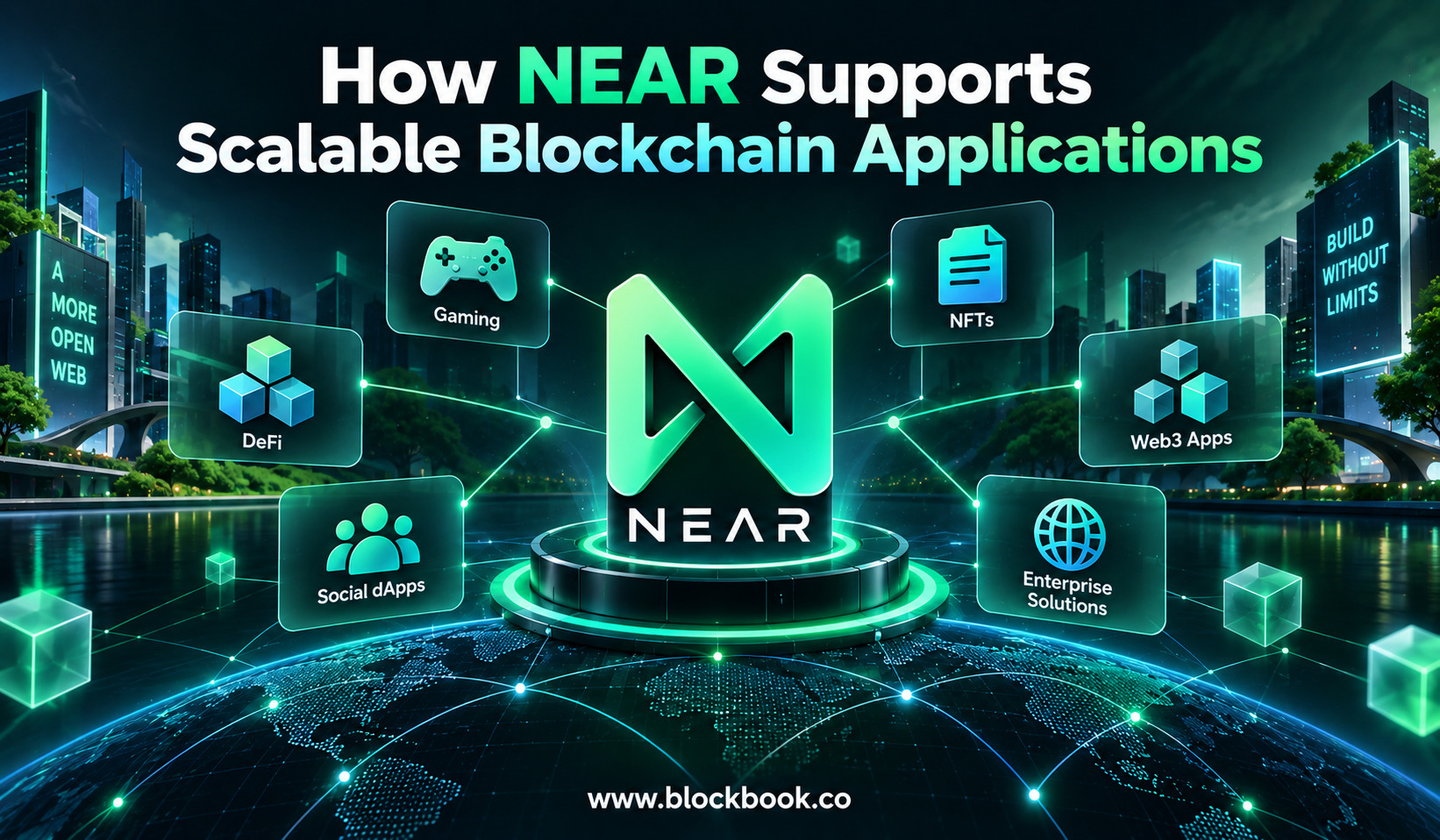
Application areas that can benefit from scalable blockchain infrastructure include:
- Decentralized finance and trading
- Blockchain gaming
- Consumer applications
- Payments and digital asset platforms
Each category has different requirements, but all can generate significant transaction activity when adoption increases.
Low-Cost Transactions and Scalability
Transaction costs are closely connected to blockchain scalability.
When network resources become scarce, users can face increased fees or delays. This can make certain applications difficult to use, particularly those involving frequent or low-value transactions.
NEAR’s architecture is designed to support relatively low transaction costs, making it possible to explore applications where users may need to interact with blockchain infrastructure regularly.
This is particularly relevant for gaming and consumer applications. Asking users to pay substantial fees for every small action can create friction and discourage participation.
Developers can therefore use lower-cost blockchain infrastructure to design applications with more frequent on-chain interactions.
Nevertheless, developers should still monitor resource consumption and transaction patterns. Lower fees do not eliminate the need for efficient application architecture.
Developer Tools Make Scaling Easier
A scalable blockchain also needs development tools that help teams build reliable applications.
NEAR supports smart-contract development using Rust and JavaScript, with contracts compiled to WebAssembly. This gives developers access to established programming languages while allowing applications to operate within the blockchain’s execution environment.
For development teams, familiar languages can reduce the initial learning barrier.
Rust is commonly associated with performance and memory safety, while JavaScript is widely used in Web development. Supporting both gives teams different options depending on their technical background and project requirements.
NEAR also provides developer documentation, testing resources and tools for interacting with the network.
A good developer experience can indirectly contribute to scalability because teams can spend more time optimizing application logic and less time solving basic infrastructure problems.
Human-Readable Accounts Improve User Scalability
Scalability is not only a technical issue.
An application may be capable of handling thousands or millions of transactions, but if users struggle to understand how to interact with it, adoption can still remain limited.
NEAR has incorporated human-readable account names into its ecosystem. Instead of relying exclusively on long wallet addresses, users can interact with recognizable account identifiers.
This can make Web3 applications more approachable, particularly for people who are new to blockchain technology.
NEAR also supports transaction-fee mechanisms that can allow applications to provide gasless experiences in certain circumstances.
These features can reduce the number of blockchain concepts that users need to understand before using an application.
Chain Abstraction Extends Scalability Beyond One Blockchain
NEAR’s current development strategy also approaches scalability from a broader perspective.
The Web3 industry contains numerous blockchain networks, each with its own assets, transaction systems and developer environments. Applications that need to interact with multiple chains can become increasingly complex as they expand.
NEAR’s Chain Abstraction strategy attempts to make this multichain environment easier to use.
Chain Signatures allows NEAR-based applications to sign transactions on other supported blockchain networks through a multi-party computation system. This allows developers to create applications capable of interacting with assets outside the NEAR network.
From a scalability perspective, this means developers can potentially build applications that reach users and assets across several blockchain ecosystems without creating completely separate user experiences for every network.
NEAR Intents and Scalable Cross-Chain Applications
NEAR Intents is another component of this strategy.
Rather than requiring users to specify every technical step involved in a blockchain transaction, an intent allows a user or application to describe the desired result.
Infrastructure and solvers can then determine how to execute that request.
For example, a user could request an asset exchange without manually selecting each blockchain, bridge or execution route. This can simplify the application interface and potentially reduce the amount of blockchain-specific logic developers need to expose to users.
NEAR describes Intents as an infrastructure layer for cross-chain transactions, swaps, payments and other applications.
As Web3 becomes more multichain, this type of abstraction could become increasingly important for application scalability.
AI Creates New Scalability Requirements
Artificial intelligence is adding another dimension to blockchain scalability.
AI agents may eventually need to interact with blockchain applications, make payments, manage digital assets or execute predefined tasks. Such systems could potentially generate transactions at a different scale and frequency from ordinary human users.
NEAR’s current development roadmap includes a strong focus on AI agents and an emerging agent economy. The project connects this direction with cross-chain infrastructure and autonomous transactions.
For blockchain infrastructure, this creates new requirements. Networks need to support automated interactions while applications must establish clear permissions and security controls.
NEAR’s approach combines its scalable blockchain infrastructure with chain-abstraction technologies that could allow autonomous applications to operate across multiple networks.
Scalability for DeFi Applications
Decentralized finance is one of the areas where blockchain scalability is particularly important.
Trading, lending, liquidity provision and other financial activities can generate large numbers of transactions. If users experience slow confirmations or unpredictable costs, the application can become less practical.
NEAR’s transaction processing and sharding architecture provide infrastructure for developers building financial applications.
Cross-chain functionality can also become important because liquidity is distributed across multiple blockchain ecosystems. Through Chain Signatures and Intents, developers can explore applications capable of interacting with assets beyond a single network.
However, financial applications require particularly strong security and economic design. Scalability should therefore be considered alongside smart-contract safety and market risks.
Scalability in Blockchain Gaming
Gaming presents a different set of requirements.
A blockchain game may need to process asset transfers, marketplace activity, rewards and other transactions while maintaining a responsive user experience.
NEAR’s low-cost transaction environment can make frequent blockchain interactions more practical. Developers can decide which elements of a game should use blockchain infrastructure and which should remain off-chain.
This hybrid approach can reduce unnecessary blockchain activity while preserving decentralized ownership where it provides value.
The goal is not necessarily to put every game action on-chain. Instead, developers can use blockchain infrastructure selectively for ownership, payments and digital assets.
Data Infrastructure Also Matters
As applications scale, blockchain data becomes increasingly difficult to manage.
Developers need reliable access to account information, transaction histories and application activity. Indexing and data services can help applications retrieve information without processing the entire blockchain themselves.
This infrastructure is particularly important for analytics dashboards, wallets, financial applications and consumer platforms.
A scalable blockchain therefore requires an ecosystem of supporting services, not just a high-throughput base layer.
| Scalability Component | Role |
| Sharding | Distributes network workloads |
| Fast finality | Supports responsive applications |
| Low transaction costs | Makes frequent interactions more practical |
| Developer tools | Helps teams build and optimize applications |
| Chain Abstraction | Connects applications with multiple networks |
| Data infrastructure | Supports efficient access to blockchain information |
Security Must Scale Alongside Performance
Higher transaction capacity is useful only when applications remain secure.
Developers need to validate accounts, control permissions and test smart-contract behavior under unusual conditions. Cross-chain applications introduce additional dependencies that need to be reviewed carefully.
AI-enabled applications create another security challenge because autonomous software may be able to initiate transactions.
Development teams should pay attention to:
- Smart-contract testing and audits
- Account authorization and permissions
- Cross-chain transaction security
- AI-agent access controls
Security should be designed into the application from the beginning rather than treated as a final deployment step.
Conclusion
NEAR Protocol is addressing blockchain scalability through a combination of sharding, efficient transaction processing, developer tooling and user-focused infrastructure. Its Nightshade architecture distributes network workloads, while relatively fast finality and transaction costs can support applications that require frequent blockchain interactions.
The ecosystem’s development is also moving beyond the scalability of a single blockchain. Chain Abstraction, Chain Signatures and NEAR Intents are designed to help applications interact with multiple networks while reducing complexity for users.
At the same time, NEAR’s growing focus on AI introduces new possibilities for applications involving autonomous agents and blockchain-based transactions.
For developers, the broader significance of NEAR is its attempt to combine scalable infrastructure with simpler application experiences. As Web3 continues to expand, successful applications will need more than high transaction capacity. They will also require security, reliable data infrastructure, intuitive interfaces and the ability to operate across an increasingly connected blockchain landscape.
Frequently Asked Questions
1. How does NEAR support blockchain scalability?
NEAR uses a sharded architecture based on Nightshade to distribute computation and storage across different parts of the network. This is designed to allow the network to handle increasing workloads more efficiently.
2. What is NEAR sharding?
Sharding divides blockchain workloads into separate segments called shards. NEAR uses this architecture to distribute processing and storage rather than requiring all network activity to be handled in one execution environment.
3. Does NEAR have low transaction costs?
NEAR is designed to provide relatively low transaction costs, although actual costs can vary depending on network conditions and application requirements.
4. What programming languages can be used on NEAR?
NEAR supports smart-contract development using Rust and JavaScript, with contracts compiled to WebAssembly.
5. How does Chain Abstraction help developers?
Chain Abstraction is designed to reduce the complexity of interacting with multiple blockchain networks. NEAR’s Chain Signatures infrastructure can allow applications to sign transactions on supported external networks.
About the Author