
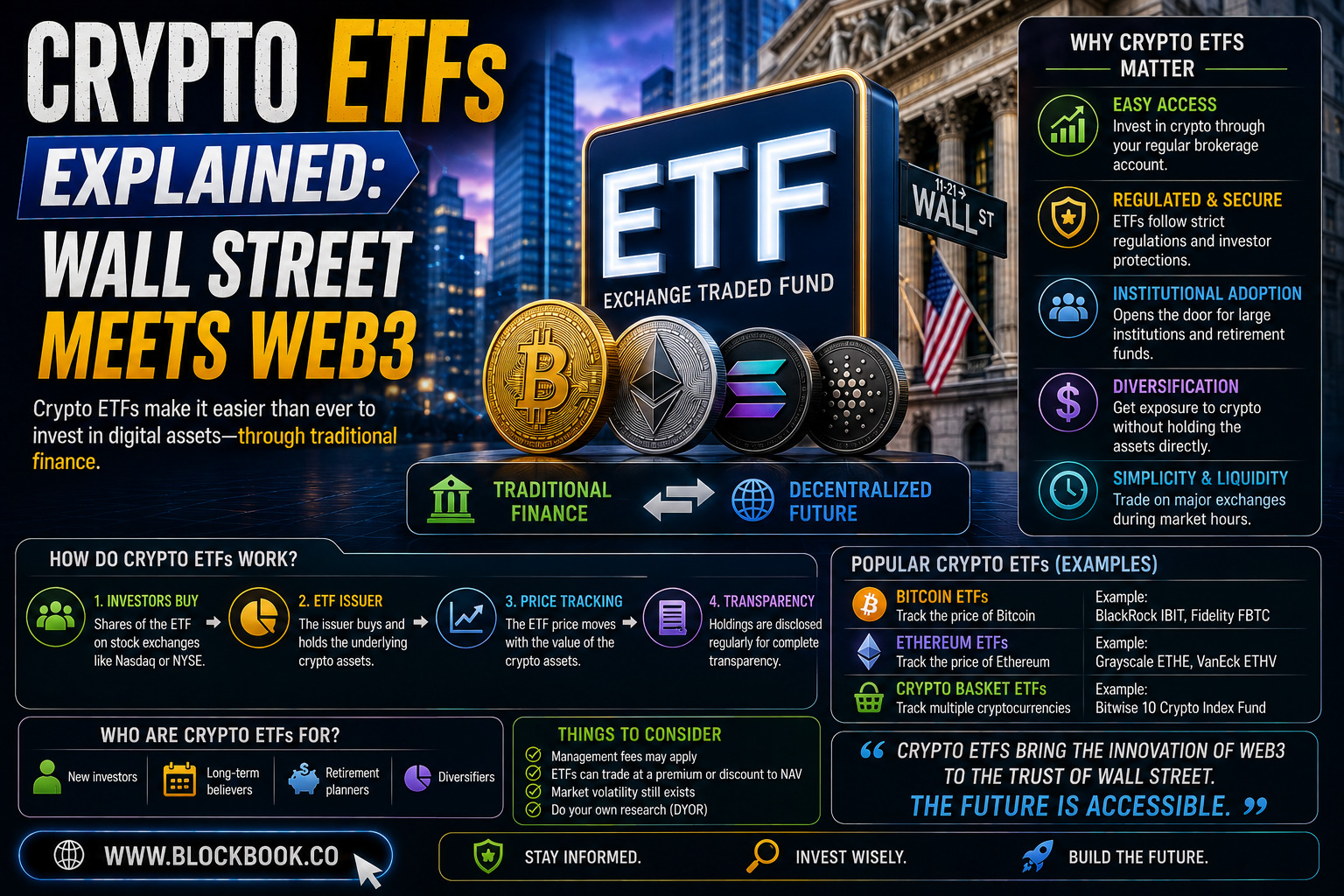
In January 2024, something happened that would have sounded like a joke five years earlier: the same regulator that once called Bitcoin a speculative gamble approved a way to buy it through a regular brokerage account. That’s the short version of why crypto ETFs matter right now, and it’s the reason your parents’ financial advisor is suddenly comfortable saying the word “Bitcoin” out loud.
This piece breaks down what crypto ETFs actually are, why they exist, and whether they deserve a spot in your portfolio.
What exactly is a crypto ETF?
An exchange traded fund is a basket of assets that trades on a regular stock exchange, just like a share of Apple or Microsoft. A crypto ETF does the same thing, except the asset inside the basket is a digital currency, or a set of contracts tied to one.
Instead of setting up a wallet, guarding a seed phrase, and hoping you never fat-finger a transaction, you buy a ticker symbol through your normal brokerage app. The fund manager handles custody, security, and the messy technical side. You just own shares.
There are two broad flavors worth knowing. Spot crypto ETFs hold the actual underlying asset, like real Bitcoin sitting in cold storage with a custodian. Futures-based crypto ETFs hold contracts that track the future price of the asset, without ever touching the coin itself.
The distinction matters more than it sounds. Spot funds tend to track the real market price more closely, while futures-based products can drift due to something called contango, where rolling contracts forward slowly eats into returns.
Why Wall Street suddenly cares about Web3
For years, big institutions wanted exposure to digital assets but couldn’t justify the operational risk. Compliance teams don’t love the idea of a portfolio manager personally holding private keys. Custody solutions were immature, insurance was thin, and the reputational risk of a hack wasn’t worth it.
The spot Bitcoin ETF approval changed the calculus entirely. Suddenly a pension fund, an endowment, or a financial advisor managing retirement accounts could add digital asset exposure without ever touching a crypto exchange. That’s the bridge this whole conversation keeps coming back to: regulated, familiar infrastructure meeting an asset class that used to live entirely outside it.
Asset managers like BlackRock and Fidelity didn’t enter this space because they suddenly became crypto believers overnight. They entered because client demand reached a point where ignoring it started to look like a competitive disadvantage. When the largest asset manager in the world files paperwork for a Bitcoin ETF, other firms notice, and clients start asking their own advisors why they aren’t offering something similar.
Once one major player gets approval, the floodgates tend to open, and that’s exactly what happened here. A handful of approvals turned into a dozen competing products within months, all fighting over fees and marketing dollars. Lower fees are good for investors, but they also signal something else: this is no longer a niche product built for crypto diehards. It’s being treated like any other commoditized fund category.
How crypto ETFs actually work under the hood
Here’s the mechanism in plain terms. The fund issuer buys and holds the actual digital asset (for spot funds) through a regulated custodian. Shares of the fund are then created and redeemed by authorized participants, large financial institutions that keep the fund’s market price in line with the value of its holdings.
Think of it like a shipping container. The container itself (the ETF share) is standardized, easy to move, and works within existing ports and logistics systems (the stock exchange). What’s inside the container (Bitcoin, Ethereum, or a basket of tokens) can be exotic and hard to handle on its own, but once it’s packaged into that standard container, the entire existing shipping infrastructure can move it without any special handling.
That packaging is the entire value proposition of digital asset investing through ETFs. You get exposure to the volatility and upside of crypto markets, wrapped inside something your 401(k) provider already knows how to process.
A few operational details worth knowing: expense ratios vary widely, often between 0.2% and 1.5% annually, and they eat into returns over time. Tracking error can occur too, especially with futures-based products, meaning the fund doesn’t perfectly mirror the coin’s price movement. Trading hours follow the stock exchange, not the crypto market, so a fund can’t react to a weekend price crash the same way a spot holding can. And tax treatment generally follows standard securities rules in most jurisdictions, which can be simpler than reporting individual crypto transactions, though this depends heavily on where you live.
The case for crypto ETFs
The appeal isn’t complicated once you strip away the jargon.
Security is the biggest one. Self-custody sounds empowering until you lose a hardware wallet or send funds to the wrong address. There’s no customer service line for a blockchain transaction gone wrong. An ETF removes that entire category of risk from the individual investor’s plate.
Simplicity matters too. Buying a spot Bitcoin ETF takes the same three clicks as buying any other stock. No exchange account, no KYC process on a separate platform, no separate app to monitor.
There’s also the retirement account angle. Many retirement accounts and employer-sponsored plans can’t hold crypto directly, but they can often hold ETFs. That single fact opened digital asset exposure to a massive pool of money that was previously locked out entirely.
The case against, or at least the fine print
None of this makes crypto ETFs risk-free, and anyone telling you otherwise is selling something.
You don’t actually own the underlying crypto. You own a share of a fund. That distinction matters if you believe in the “not your keys, not your coins” philosophy that a lot of the crypto community was built on. Web3 ideology is partly about removing intermediaries, and an ETF reinserts one right back into the equation.
Fees add up, too. A 0.25% annual expense ratio doesn’t sound like much until you’re holding for a decade and comparing it to zero-cost self-custody.
Volatility doesn’t disappear just because the wrapper is regulated. Digital asset investing through an ETF still means riding out 20%, 30%, even 50% drawdowns that crypto markets are known for. The packaging is different, the risk underneath is not.
And finally, these funds only trade when the stock market is open. A major price move over a weekend won’t be reflected in your ETF share price until Monday’s opening bell, which can feel disorienting if you’re used to crypto’s 24/7 nature.
Where this is headed
Ethereum spot ETFs followed the Bitcoin approvals in 2024, and speculation about products tracking other major tokens has continued since. The pattern seems clear: as regulatory clarity improves in individual markets, more asset managers will package more of the crypto ecosystem into familiar ETF structures.
Some analysts expect basket products tracking multiple tokens at once, similar to how a total market index fund tracks thousands of stocks instead of one. Others expect more specialized products targeting specific sectors within Web3, like decentralized finance or tokenized real-world assets. Exact timelines and approval odds shift often, so treat any specific prediction here with a healthy dose of skepticism.
Frequently asked questions
Are crypto ETFs safer than buying Bitcoin directly?
They remove custody risk, meaning you cannot lose access through a forgotten password or a hacked wallet. They do not remove market risk. Price volatility is the same whether you hold the coin directly or hold shares of a fund tracking it.
Can I hold a crypto ETF in a retirement account?
In many cases, yes. This is one of the main reasons these products exist. Availability depends on your specific plan provider and country, so check with your account administrator before assuming it’s an option.
Do crypto ETFs pay dividends?
No. Digital assets like Bitcoin and Ethereum don’t generate income the way stocks or bonds can, so there’s nothing to distribute to shareholders. Any returns come purely from price appreciation.
What is the difference between a spot ETF and a futures ETF?
A spot ETF holds the actual underlying asset. A futures ETF holds contracts betting on the asset’s future price. Spot products generally track the real market price more accurately over long periods.
About the Author