Blockchain technology has expanded into a large collection of networks, each designed with different technical goals and applications. Ethereum supports a broad smart-contract ecosystem, Bitcoin focuses on decentralized digital money, while other Layer-1 networks emphasize speed, scalability or application-specific functionality. As the number of blockchain environments continues to grow, one challenge has become increasingly important: how can these separate networks communicate?
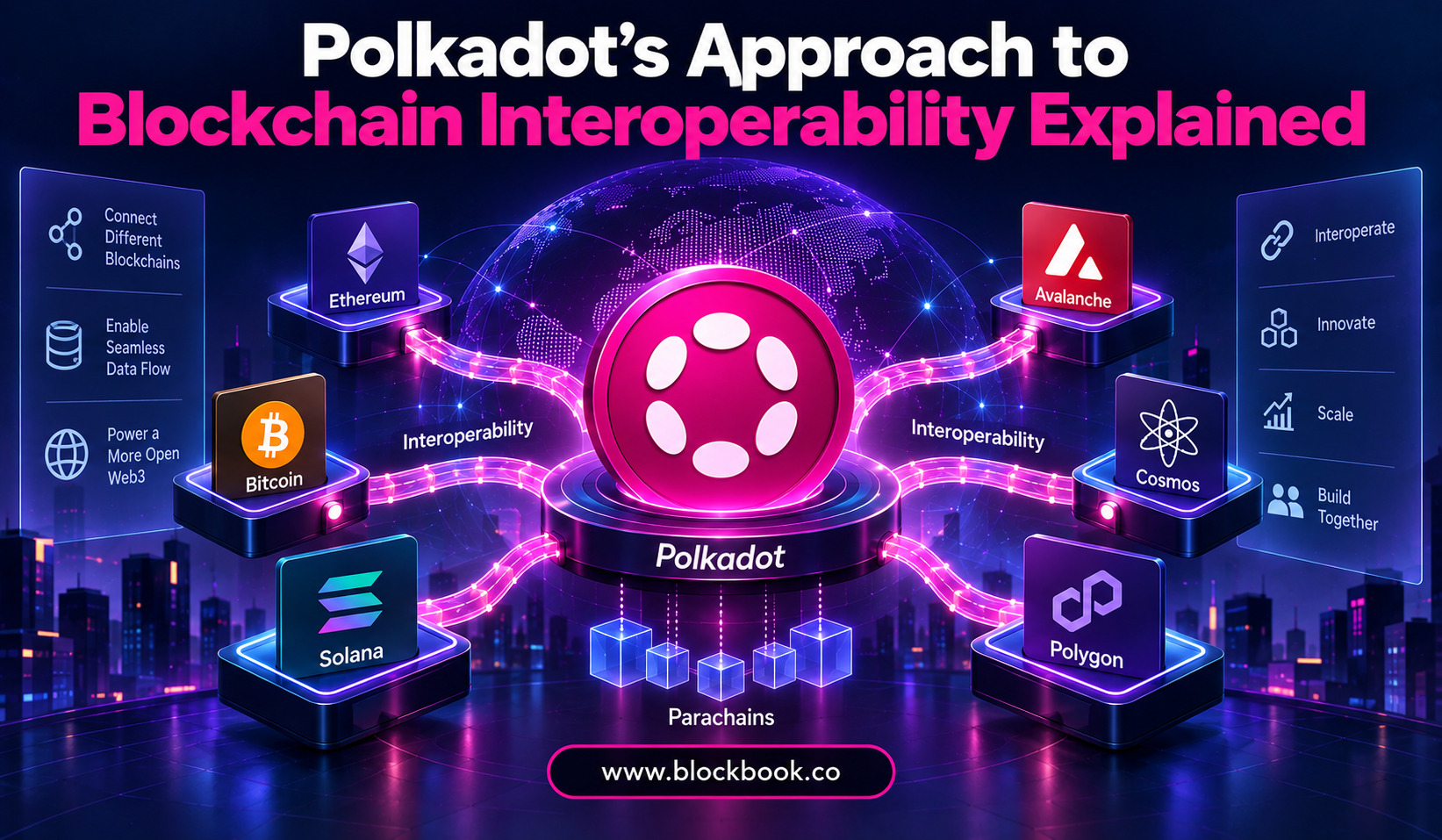
Polkadot was designed with this problem at the center of its architecture. Rather than treating interoperability as an optional feature added through external tools, Polkadot builds communication between different blockchain environments into its broader network design. Its architecture combines specialized chains, shared security and cross-consensus messaging to create a connected environment for Web3 applications.
This approach is becoming increasingly relevant as decentralized applications move toward multichain models. Users may hold assets on different networks, while developers may want applications to access services and information from several blockchain environments. Polkadot’s technology attempts to provide infrastructure for these interactions while allowing individual networks to retain their own specialized functions.
Why Blockchain Interoperability Matters
Blockchain networks were initially developed largely as independent systems. Each network could have its own consensus mechanism, transaction model, tokens and applications. While this independence encouraged experimentation, it also created fragmentation.
Imagine a Web3 application that needs access to assets or information stored on another blockchain. Without interoperability infrastructure, developers may have to create additional systems to move assets or communicate between networks. Users can then face complicated transactions, multiple wallets and different fee structures.
Interoperability attempts to reduce these barriers by allowing independent blockchain systems to exchange information or initiate actions.
Polkadot approaches this challenge by creating a network architecture in which specialized blockchain environments can communicate through standardized mechanisms. The objective is not necessarily to make every blockchain identical. Instead, different networks can retain their individual designs while gaining the ability to interact.
Polkadot’s Multichain Architecture
The foundation of Polkadot’s interoperability model is its multichain architecture. The relay chain provides core network functions, while connected chains can focus on specialized applications.
These connected environments, commonly known as parachains, can be designed for different purposes. One may focus on decentralized finance, another on gaming, and another on digital assets or identity. Rather than forcing all applications into one execution environment, Polkadot allows specialized networks to operate in parallel.
Polkadot documentation describes the relay chain as responsible for key functions including validator coordination, block production, data availability and shared security.
This structure creates an important foundation for interoperability. Because connected environments participate in a common ecosystem, communication does not have to be treated as an entirely separate concept from the blockchain architecture itself.
The Role of XCM
One of the most important technologies in Polkadot’s interoperability system is XCM, or Cross-Consensus Message Format.
XCM is designed to provide a standardized language for communicating instructions between different consensus systems. It does not simply represent a basic bridge for moving tokens. Instead, it provides a way to describe what one system wants another system to do.
This distinction is important because interoperability can involve much more than transferring an asset.
For example, a message could represent instructions associated with an asset transfer, a call to another application or another type of cross-chain operation. The receiving environment can interpret the message according to its own rules.
XCM therefore focuses on the meaning of cross-consensus communication rather than limiting interoperability to a single type of transaction.
XCM can support a range of cross-chain activities, including:
- Asset-related operations between connected environments.
- Communication between applications operating on different chains.
- Instructions that trigger actions across consensus systems.
- More complex composable interactions between blockchain applications.
The exact functionality available depends on the networks, applications and infrastructure involved.
Shared Security and Interoperability
Security is another important part of Polkadot’s interoperability approach.
A collection of connected blockchains needs more than a messaging system. Participants must also have confidence that messages and state transitions are being validated correctly.
Polkadot’s shared-security model allows connected parachains to benefit from the network’s validator infrastructure. Instead of every parachain having to create a completely independent security system, the wider network provides the underlying validation framework.
This creates a relationship between interoperability and security. Connected chains can communicate within an environment where their participation is supported by a shared security model.
However, shared security does not eliminate every security risk. Smart contracts, applications, bridges and cross-chain systems can still contain vulnerabilities. Developers therefore need to consider application-level and interoperability-specific security separately.
How Polkadot Differs From Simple Blockchain Bridges
The word “interoperability” is often associated with blockchain bridges. Bridges can connect two blockchain networks and allow assets or messages to move between them.
Polkadot’s architecture takes a broader approach. XCM provides a standardized messaging format, while the relay chain and connected environments provide a framework for communication within the ecosystem.
A bridge is primarily concerned with connecting separate blockchain systems. Polkadot’s native architecture is instead designed around multiple connected environments from the beginning.
This distinction does not mean bridges are unnecessary. External blockchains that do not participate in Polkadot’s shared-security environment require separate interoperability mechanisms.
| Feature | Polkadot’s Approach | Traditional Bridge Model |
| Main purpose | Communication across connected consensus systems | Connect two or more separate networks |
| Messaging | XCM provides standardized instructions | Depends on bridge implementation |
| Security | Shared security for connected parachains | Depends on bridge architecture |
| Architecture | Designed as a multichain ecosystem | Usually an additional connection |
| External networks | Requires bridge or other interoperability mechanism | Primary purpose |
This is a simplified comparison because bridge architectures vary considerably.
Connecting Specialized Blockchain Environments
Interoperability becomes more useful when different networks provide complementary services.
A decentralized finance application may need access to assets from another specialized environment. A gaming ecosystem might use a separate network for digital assets. A decentralized identity system could provide credentials that applications elsewhere can use.
Polkadot’s architecture allows these environments to remain specialized while providing mechanisms for communication.
This model can support what is often called composability. Instead of building every component from scratch, developers can create applications that interact with services available elsewhere.
The result can be a more interconnected Web3 environment in which individual blockchain networks function as components of a larger system.
Flexible Computing and Polkadot 2.0
Polkadot’s interoperability strategy is developing alongside changes to the way network computing resources are allocated.
Polkadot 2.0 introduced concepts such as Agile Coretime, asynchronous backing and elastic scaling. These developments are intended to make access to network resources more flexible and improve the efficiency of the multichain architecture.
Agile Coretime allows projects to access computing resources through different mechanisms, including bulk and on-demand approaches. This is a shift from the earlier model associated with long-term parachain slot auctions.
For interoperability, flexible computing is relevant because connected applications can have different workloads. Some may require continuous capacity, while others may need additional resources only during periods of high activity.
The combination of flexible resource allocation and cross-chain communication gives developers more options when designing multichain applications.
Interoperability Beyond Polkadot
Polkadot’s native interoperability features primarily address communication within its connected ecosystem. Connecting to external blockchains introduces a different set of challenges.
External networks may use different consensus mechanisms, transaction formats and finality models. They also do not automatically share Polkadot’s security assumptions.
Bridges and other interoperability technologies can therefore act as connections between Polkadot and outside blockchain ecosystems. Polkadot’s documentation distinguishes communication between parachains from connections involving external networks.
This broader interoperability landscape is likely to remain important as Web3 continues to develop. No single blockchain ecosystem operates in isolation, and users increasingly interact with multiple networks.
Why Developers Are Interested in Interoperability
For developers, interoperability can create opportunities to build applications that use multiple blockchain environments.
Instead of designing an application around one network’s limitations, developers can potentially distribute functionality across specialized systems. This can provide greater flexibility for applications that need different forms of execution, asset management or data handling.
Cross-chain functionality can also create new possibilities for decentralized finance, gaming, marketplaces and tokenized assets.
At the same time, multichain development introduces additional complexity. Developers need to understand messaging, transaction finality, asset representation, fees and security assumptions across different environments.
Interoperability is therefore not simply a technical shortcut. It is an architectural choice that requires careful planning.
Challenges in Building an Interoperable Blockchain Ecosystem
Despite its potential, interoperability remains technically difficult.
Different blockchain networks do not necessarily agree on how transactions are processed or how finality is established. A system connecting them must account for these differences.
User experience is another major challenge. Cross-chain applications can require users to understand networks, wallets, tokens and transaction fees. Developers therefore need to make the underlying complexity as invisible as possible.
Security is perhaps the most important consideration. A cross-chain application may depend on multiple components, meaning a weakness in one part of the system can affect the wider interaction.
For Polkadot, maintaining reliable communication while preserving the independence of specialized environments remains an ongoing technical challenge.
The Future Direction of Polkadot Interoperability
Polkadot’s interoperability strategy is also connected to its longer-term plans for decentralized computing.
JAM, or Join-Accumulate Machine, has been proposed as a future evolution of Polkadot’s relay-chain architecture. Its goal is to provide a more generalized computational model that can support decentralized services beyond the current architecture. Polkadot’s documentation presents JAM as an ongoing development direction rather than a completed replacement.
If this direction continues, Polkadot’s definition of interoperability could expand beyond communication between traditional parachains.
The broader objective is to create infrastructure in which different forms of decentralized computation can work together through common protocols and security mechanisms.
What Polkadot’s Approach Means for Web3
The future of Web3 is unlikely to consist of one blockchain handling every application. Different networks will continue to develop around different technical and economic requirements.
Polkadot’s response is to focus on connecting specialized environments rather than eliminating their differences. Its multichain architecture provides the foundation, shared security supports network-level trust, and XCM provides a standardized language for cross-consensus communication.
This approach could make blockchain ecosystems more composable and give developers greater freedom when designing applications.
However, interoperability will ultimately be judged by real-world use. Developers need reliable infrastructure, users need simple experiences, and applications need compelling reasons to communicate across networks.
Conclusion
Polkadot’s approach to blockchain interoperability is based on the idea that different blockchain environments do not need to become identical in order to work together. Its multichain architecture allows specialized environments to operate in parallel, while shared security and XCM provide important foundations for communication.
The network’s development is also moving toward more flexible computing through technologies associated with Polkadot 2.0. Meanwhile, longer-term work such as JAM points toward a broader vision of decentralized services and computation.
Interoperability remains one of the central challenges of the Web3 industry. Polkadot’s strategy is to address that challenge at the architectural level, creating infrastructure where specialized blockchain environments can communicate while maintaining their own purposes.
As more applications move toward multichain designs, the ability to connect networks securely and efficiently could become increasingly important. Polkadot’s continued development will show how far this interconnected model can evolve and how effectively developers can turn interoperability into practical Web3 applications.
FAQs
What is blockchain interoperability?
Blockchain interoperability is the ability of different blockchain networks or consensus systems to communicate, exchange information or trigger actions across their respective environments.
How does Polkadot provide interoperability?
Polkadot combines a multichain architecture, shared security and technologies such as XCM to enable communication between connected blockchain environments.
What is XCM in Polkadot?
XCM stands for Cross-Consensus Message Format. It provides a standardized way to describe instructions and interactions between different consensus systems.
Is XCM the same as a blockchain bridge?
No. XCM is a messaging format and language, while a bridge is infrastructure that connects separate blockchain networks. XCM can be used within Polkadot’s ecosystem, while external networks generally require additional interoperability infrastructure.
Are parachains independent blockchains?
Parachains are specialized blockchain environments connected to Polkadot’s infrastructure. They can have their own application logic while benefiting from the network’s shared-security and interoperability framework.
About the Author