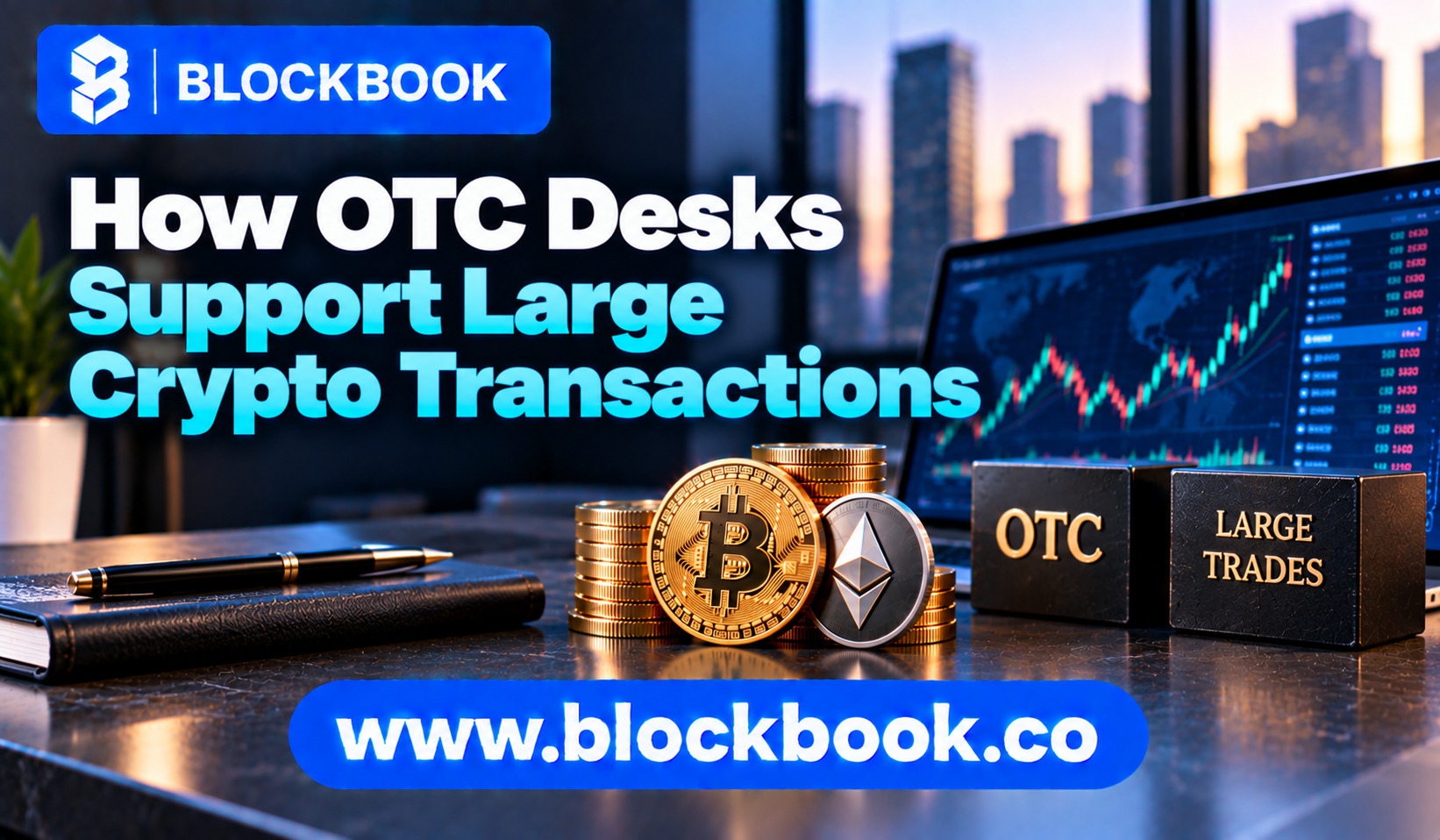
The cryptocurrency market has grown into a large and diverse financial ecosystem. While many people buy and sell digital assets through public exchanges, large investors often need a different approach. An institution purchasing or selling a significant amount of Bitcoin, Ethereum, or another digital asset may face challenges that are less common for smaller traders.
Placing a very large order on a public exchange can affect the market price, expose the size of the transaction, or require the investor to split the order across several venues. Over-the-counter, or OTC, trading desks provide an alternative by helping clients arrange large transactions directly through negotiated trades.
OTC desks have become an important part of the institutional crypto market. They connect large buyers and sellers, source liquidity, arrange pricing, coordinate settlement, and provide professional support throughout the transaction.
What Is an OTC Crypto Desk?
An OTC crypto desk is a specialized trading service that facilitates digital asset transactions outside the traditional public exchange order book.
Instead of placing an order directly into a visible marketplace, a client contacts an OTC desk and provides details about the desired transaction. This can include the asset, quantity, preferred currency, and settlement requirements.
The desk then looks for suitable liquidity and provides a quote. If the client accepts the terms, the transaction is executed and the assets are settled according to the agreed process.
OTC desks can serve institutional investors, hedge funds, family offices, corporations, miners, professional traders, and high-net-worth individuals.
Why Large Crypto Transactions Are Different
A small cryptocurrency purchase may have little effect on the market. A large transaction can be very different.
Public exchanges operate using order books containing buy and sell orders at different prices. If an investor wants to purchase more cryptocurrency than is available at the current price, the order may continue filling at progressively higher prices.
This is commonly referred to as market impact.
For an institution handling a large transaction, even a small difference in the average execution price can represent a substantial amount of money.
OTC desks can help address this challenge by arranging a negotiated transaction rather than requiring the investor to place the entire order into a public order book.
How OTC Desks Handle Large Transactions
The process usually begins with a client request. The investor tells the OTC desk what asset they want to buy or sell and how much they need.
The desk assesses market conditions and available liquidity. It may use its own inventory or obtain liquidity from exchanges, market makers, other counterparties, or multiple sources.
The desk then provides a price or trading terms.
Once the client accepts the quote, both parties confirm the transaction details. Payment and cryptocurrency are then transferred through the agreed settlement process.
This approach allows the transaction to be handled as a coordinated financial operation rather than a series of individual public market orders.
Access to Deeper Liquidity
Liquidity is one of the most important benefits of OTC trading.
A large investor may find that one exchange does not have enough available liquidity to complete the desired transaction efficiently. An OTC desk can potentially access several liquidity sources and combine them into one client-facing transaction.
This can reduce the amount of work required from the investor’s trading team.
For example, a fund looking to purchase a large amount of Bitcoin may receive a single quote from an OTC desk rather than manually searching multiple exchanges and negotiating with several counterparties.
The actual liquidity available depends on market conditions, the asset being traded, transaction size, and the OTC provider.
Negotiated Pricing
OTC transactions generally involve negotiated pricing rather than relying solely on a public exchange’s displayed price.
The quoted price can depend on several factors, including the current market price, transaction size, liquidity, volatility, settlement requirements, and the provider’s costs.
The investor can evaluate the quote before agreeing to the transaction.
For large trades, the final price can be more important than a standard exchange trading fee. A slightly different execution price on a large order can have a much greater financial effect than a small advertised fee.
Reducing Market Impact
One of the main reasons institutions use OTC desks is to reduce the visibility and potential market impact of large trades.
If a large buy order is placed directly on a public exchange, it can consume available sell orders and potentially push the market price higher while the transaction is being completed.
An OTC transaction can instead be arranged privately between the client and the desk.
This does not guarantee that the transaction will have no effect on the wider market. However, the execution method can be more controlled than placing a large order directly into a public order book.
Privacy and Confidentiality
Large investors may not want their trading intentions to become widely visible.
An OTC desk can provide a more private transaction process because the client’s full order does not necessarily need to appear on a public exchange order book.
Privacy can be particularly important for institutions managing investment strategies, corporate treasury transactions, or large portfolio changes.
However, private trading does not mean anonymous trading. Professional OTC providers may still need to collect client information and follow applicable identity, compliance, and transaction-monitoring requirements.
Settlement of Large Crypto Trades
Settlement is a critical part of any large transaction.
After the trade is agreed, the buyer needs to provide payment and the seller needs to deliver the digital assets. OTC desks coordinate this process and establish the required settlement instructions.
Settlement may involve bank transfers, stablecoins, cryptocurrency transfers, or other agreed methods.
For institutional clients, settlement needs to be predictable and properly documented. Errors in wallet addresses, payment instructions, or transaction approvals can create serious operational problems.
This is why professional OTC desks often have dedicated settlement teams and procedures.
OTC Desks and Institutional Custody
OTC trading frequently works alongside institutional custody.
After purchasing cryptocurrency, an institution may transfer the assets to a professional custodian rather than keeping them with the OTC desk.
Some companies offer both OTC trading and custody, while others focus on one service and integrate with external providers.
Institutional custody can include secure key management, cold storage, multiple approval systems, transaction limits, and monitoring.
The combination of professional execution and custody can create a more complete digital asset workflow.
OTC Trading vs Public Exchange Trading
OTC desks and public exchanges both provide access to digital asset markets, but their operating models are different.
| Feature | OTC Desk | Public Exchange |
| Order Method | Negotiated transaction | Order book |
| Typical Users | Institutions and large traders | Retail and professional traders |
| Large Trades | Specialized for block transactions | Depends on available liquidity |
| Pricing | Direct quote or negotiated price | Market-based order execution |
| Privacy | Private trade negotiation | Orders may be visible in order book |
| Support | Often dedicated trading assistance | Primarily platform-based |
| Settlement | Coordinated directly | Exchange-specific process |
Neither model is appropriate for every transaction. The choice depends on size, urgency, liquidity, strategy, and operational requirements.
Risk Management During Large Transactions
Large cryptocurrency transactions involve several types of risk. OTC desks need systems to manage market, settlement, counterparty, technology, and operational risks.
Market prices can change quickly between the initial quote and settlement. A desk therefore needs appropriate procedures for locking in prices and managing inventory.
Counterparty risk is another consideration. Both the client and the OTC provider need confidence that the other party will complete its obligations.
Professional desks may also use transaction limits, collateral arrangements, approved counterparties, and internal risk controls.
Compliance and Verification
Institutional OTC trading generally involves formal client verification and compliance procedures.
A professional desk may need to verify the identity of the client, understand the nature of the business relationship, monitor transactions, and follow applicable rules.
These processes are important because large cryptocurrency transactions can involve significant financial flows.
Compliance systems may also examine wallet addresses and transaction activity for potential risks.
For institutions, a well-organized compliance process can make it easier to maintain internal records and meet applicable requirements.
Technology Behind OTC Trading
Although OTC trading may involve direct communication with trading professionals, technology plays an important role.
Modern OTC platforms can connect to multiple liquidity sources, calculate quotes, manage orders, monitor transactions, and provide settlement information.
Institutional clients may also connect their own trading and financial systems through APIs.
This can automate parts of the transaction process and reduce manual work.
Technology is particularly valuable when an institution executes large numbers of transactions rather than occasional large purchases.
Common Uses of OTC Crypto Trading
OTC desks can support many types of transactions. Their services are not limited to buying Bitcoin.
Common uses include:
- Large purchases or sales of major cryptocurrencies
- Corporate digital asset treasury transactions
- Fund portfolio rebalancing
- Conversion between cryptocurrencies and fiat or stablecoins
Miners may also use OTC desks when selling significant amounts of cryptocurrency, while investment funds can use them when entering or exiting large positions.
Costs of Using an OTC Desk
OTC trading is not necessarily cheaper than exchange trading in every situation.
The total cost can include the spread between the desk’s buying and selling prices, transaction fees, settlement costs, financing charges, or other service expenses.
However, the relevant comparison for a large investor is often the total execution cost rather than a single trading fee.
A lower advertised fee does not necessarily mean a better result if the transaction receives poor execution or insufficient liquidity.
Choosing an OTC Crypto Desk
Institutions should carefully evaluate an OTC provider before completing a significant transaction.
Important considerations include:
- Available liquidity and supported assets
- Pricing and total transaction costs
- Settlement procedures and timelines
- Security, compliance, and counterparty controls
The provider’s reputation, geographic coverage, custody arrangements, reporting systems, and institutional support can also be relevant.
It is useful for organizations to understand how the desk sources liquidity and whether it acts as a principal, intermediary, or both.
The Future of OTC Crypto Trading
The OTC market is likely to remain an important part of institutional digital asset infrastructure.
As more professional organizations use cryptocurrencies, tokenized assets, and stablecoins, demand for large-scale transaction services could increase.
OTC desks may also expand beyond basic spot transactions into financing, derivatives, tokenized assets, treasury services, and cross-border settlement.
The connection between OTC desks, custodians, banks, exchanges, and blockchain infrastructure providers is likely to become increasingly important.
Conclusion
OTC desks provide an important solution for investors dealing with large cryptocurrency transactions. They can help clients access liquidity, negotiate pricing, coordinate settlement, and execute significant trades without relying entirely on public exchange order books.
Their role extends beyond simply buying and selling digital assets. Modern OTC providers can connect trading with custody, compliance, settlement, and institutional financial infrastructure.
For professional investors, understanding liquidity, pricing, settlement, counterparty risk, security, and total transaction costs is essential before selecting an OTC provider.
As digital assets continue to develop as an institutional market, OTC desks are likely to remain an important part of the infrastructure supporting large transactions.
FAQs
1. What is an OTC crypto transaction?
An OTC crypto transaction is a digital asset trade arranged privately between parties or through an OTC trading desk rather than being executed entirely through a public exchange order book.
2. Why do institutions use OTC desks?
Institutions may use OTC desks when they need to execute large transactions and want access to professional liquidity, negotiated pricing, coordinated settlement, and a more private execution process.
3. Does OTC trading eliminate market impact?
No. OTC trading can help reduce the direct market impact associated with placing a large order on a public exchange, but large transactions can still affect market conditions.
4. Are OTC crypto trades regulated?
The regulatory treatment of OTC crypto trading varies by jurisdiction and the services provided. Professional providers may be subject to identity verification, compliance, transaction monitoring, and other applicable requirements.
5. What should investors check before using an OTC desk?
Investors should evaluate liquidity, pricing, total costs, supported assets, settlement procedures, security controls, counterparty risk, compliance processes, custody options, and institutional support.
About the Author