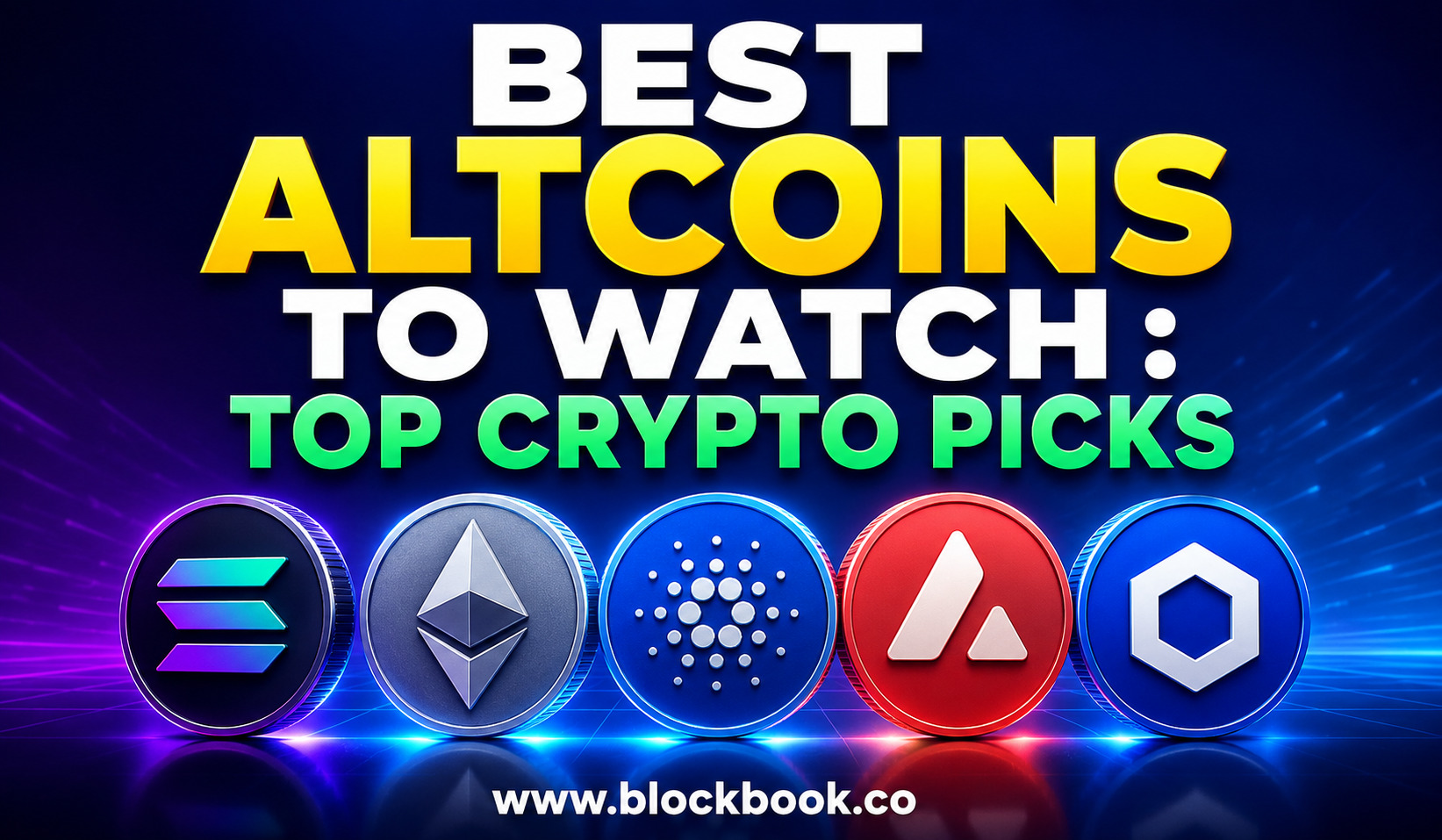
The altcoin market is entering an interesting phase in 2026. Bitcoin remains the benchmark for the cryptocurrency market, but investors are increasingly looking beyond BTC for projects with strong technology, growing ecosystems and real-world use cases.
The latest market environment is also becoming more selective. Instead of every cryptocurrency rising together, investors are paying closer attention to networks that can demonstrate adoption, liquidity and a clear reason for their tokens to exist. Recent industry coverage has highlighted Ethereum, Solana, XRP, Chainlink, Hyperliquid, Sui and other established projects as notable altcoins to research in 2026.
That does not mean these cryptocurrencies are guaranteed to outperform. Altcoins remain highly volatile, and even fundamentally strong projects can experience major corrections. The goal of this guide is to identify altcoins worth watching in 2026, explain their potential catalysts and discuss the risks investors should consider.
What Makes an Altcoin Worth Watching in 2026?
The strongest altcoin candidates are not necessarily the coins with the lowest prices or the biggest social-media hype. In the current market, factors such as network activity, developer adoption, institutional interest, token economics and regulatory positioning can matter more.
Another important consideration is liquidity. Large-cap altcoins are generally easier to trade than smaller tokens, while established ecosystems may have more applications and users supporting demand.
For 2026, investors may want to focus on projects connected to several major crypto trends, including decentralized finance, tokenized real-world assets, payments, blockchain infrastructure and high-performance applications.
1. Ethereum (ETH)
Ethereum remains one of the most important altcoins to watch in 2026 because it continues to serve as a major infrastructure layer for decentralized applications, DeFi, stablecoins and tokenized assets.
Its position is different from that of many newer Layer-1 networks. Ethereum has an extensive developer ecosystem and a large network of applications built around it. Recent analysis from Forbes continues to describe Ethereum as the cornerstone smart-contract platform, while other 2026 market research also places ETH among the leading long-term crypto assets.
One of Ethereum’s biggest potential catalysts is the continued growth of tokenization. Financial assets such as bonds, funds and other real-world assets are increasingly being explored on blockchain networks.
The main risk is competition. Solana and other high-performance networks are attempting to attract developers and users with faster execution and different fee structures. Ethereum therefore needs to continue improving scalability and usability to maintain its dominant position.
2. Solana (SOL)
Solana is another major altcoin to watch in 2026, particularly for investors interested in high-speed blockchain applications.
The network has developed a strong presence in decentralized exchanges, consumer applications, stablecoins and meme-coin activity. Forbes recently highlighted Solana’s position across memes, real-world assets, stablecoins and consumer applications.
Solana’s development roadmap is also attracting attention. The proposed Alpenglow upgrade is designed to significantly reduce transaction finality times, potentially strengthening the network’s performance advantage.
The opportunity is substantial if Solana can continue attracting users and developers. However, its strong connection to speculative trading can also increase volatility. Investors should distinguish between genuine ecosystem growth and temporary trading activity.
3. XRP (XRP)
XRP remains one of the most closely watched payment-focused cryptocurrencies.
The XRP Ledger is designed around fast transactions and settlement, giving XRP a different investment narrative from smart-contract platforms such as Ethereum and Solana. The project has also benefited from growing interest in institutional settlement, tokenized assets and regulated crypto investment products.
Recent market reporting has identified XRP among the altcoins attracting significant ETF-related capital, with XRP products reportedly recording around $1.5 billion in cumulative inflows.
If institutional adoption of blockchain-based payments and settlement expands, XRP could benefit from increased attention.
However, XRP remains exposed to regulatory, competitive and adoption risks. Investors should evaluate actual network usage rather than assuming that partnerships or ETF activity will automatically translate into long-term token appreciation.
4. Chainlink (LINK)
Chainlink is one of the more interesting infrastructure plays in the altcoin market.
Rather than competing directly with Ethereum or Solana as a general-purpose blockchain, Chainlink provides infrastructure that helps blockchain applications access external information and interact across different networks.
This becomes particularly important as tokenized real-world assets develop. Financial institutions need reliable data and connectivity between traditional systems and blockchain networks. Chainlink’s work with major financial institutions and infrastructure providers has therefore become an important part of its investment narrative.
Chainlink is also increasingly associated with cross-chain infrastructure and institutional blockchain applications.
The major question for investors is whether increased adoption of Chainlink’s technology translates into sustained demand for LINK itself. A strong product does not automatically guarantee strong token performance, making token economics an important part of the analysis.
5. Hyperliquid (HYPE)
Hyperliquid is a newer and more speculative name on this list, but it has attracted considerable attention because of its decentralized trading ecosystem.
The platform has become notable for perpetual futures trading and has developed a business model that has generated significant protocol revenue. Forbes recently highlighted Hyperliquid’s revenue generation and token buyback activity as unusual strengths within the 2026 altcoin market.
That makes HYPE interesting because its story is connected not only to speculation but also to actual trading activity on the platform.
Still, HYPE carries considerably more risk than established assets such as Ethereum. Its future depends on continued user activity, competitive positioning, token economics and the broader decentralized-exchange market.
For investors looking beyond the largest altcoins, HYPE is worth researching—but it should be viewed as a higher-risk opportunity.
6. Sui (SUI)
Sui is another Layer-1 blockchain attracting attention in 2026.
Its focus on scalability, developer-friendly infrastructure and fast applications makes it part of the competition for the next generation of blockchain users. Sui has also appeared on several current 2026 altcoin watchlists alongside Solana and Chainlink.
The potential upside comes from ecosystem expansion. If developers continue building applications on Sui and user activity grows, demand for the network could increase.
However, smaller Layer-1 networks face intense competition. Sui also has to contend with token-supply and dilution considerations, which can affect investors even when the underlying technology performs well.
7. BNB (BNB)
BNB remains an important cryptocurrency because of its connection to the broader Binance ecosystem and BNB Chain.
The token has utility across an extensive blockchain ecosystem, including transaction fees and decentralized applications. BNB also benefits from the large user base surrounding Binance-related infrastructure.
Its main advantage is ecosystem scale. However, its close association with one major crypto company also creates concentration and regulatory risks.
BNB may therefore appeal to investors who want exposure to a mature crypto ecosystem rather than a brand-new blockchain project.
Comparing the Top Altcoins to Watch
| Altcoin | Main Theme | Potential Catalyst | Key Risk |
| Ethereum (ETH) | Smart contracts & DeFi | Tokenization and ecosystem growth | Competition |
| Solana (SOL) | High-performance apps | Network upgrades and adoption | High volatility |
| XRP | Payments & settlement | Institutional adoption | Regulatory/competitive risk |
| Chainlink (LINK) | Blockchain infrastructure | Tokenized assets and interoperability | Token-value capture |
| Hyperliquid (HYPE) | Decentralized trading | Trading volume and buybacks | Higher volatility |
| Sui (SUI) | Layer-1 applications | Ecosystem expansion | Competition and dilution |
| BNB | Exchange ecosystem | Network activity | Regulatory concentration |
Which Altcoins Could Benefit Most From a Bull Market?
If the crypto market enters a sustained bull phase, different altcoins could benefit at different stages.
Ethereum and other large-cap assets would likely attract investors looking for established ecosystems first. As confidence increases, capital could rotate into higher-growth networks such as Solana and Sui.
Infrastructure projects such as Chainlink could benefit if blockchain adoption expands beyond speculation and into financial applications. Meanwhile, trading-focused platforms such as Hyperliquid could perform strongly if crypto volumes increase.
This creates an important distinction: the best-performing altcoin is not necessarily the best long-term project.
A smaller token may rise faster during a speculative phase, while a larger network may offer greater liquidity and a more established ecosystem.
Four Things to Check Before Buying an Altcoin
Investors researching altcoins should look beyond price charts. A token trading at $1 is not automatically cheaper than one trading at $100 because market capitalization and circulating supply determine valuation.
Before investing, consider:
- Real-world utility: Does the network solve a meaningful problem?
- Adoption: Are users and developers actually using it?
- Tokenomics: How much supply exists, and how much may enter circulation?
- Competition: Does the project have a sustainable advantage?
These factors can help separate established blockchain networks from short-lived market narratives.
Are Altcoins Riskier Than Bitcoin?
Generally, yes.
Bitcoin has the largest cryptocurrency market capitalization and the longest track record, while altcoins vary widely in size, liquidity and development maturity.
During strong market conditions, altcoins can sometimes outperform Bitcoin dramatically. But during downturns, they can also fall much faster.
That is why diversification within crypto does not eliminate risk. Holding several altcoins can reduce exposure to one individual project, but the entire portfolio may still decline if the broader cryptocurrency market enters a bear phase.
Frequently Asked Questions
Is Ethereum still worth watching in 2026?
Yes. Ethereum remains one of the largest smart-contract ecosystems and continues to play an important role in DeFi, stablecoins and tokenized assets. Its biggest challenge is maintaining its position while competing networks grow.
Could Solana outperform Ethereum?
It is possible, particularly if Solana continues gaining users and application activity. However, performance depends on market conditions, valuation and adoption, so investors should not assume that one network will automatically outperform another.
Is XRP a good altcoin for long-term investors?
XRP has a distinctive payments and institutional-settlement narrative and is attracting attention from crypto investment products. However, regulatory developments, competition and actual network adoption remain important factors.
What is the riskiest altcoin on this list?
Hyperliquid and Sui would generally carry more risk than Ethereum because they have shorter track records and different market structures. Higher potential growth also comes with greater uncertainty.
Should I invest in altcoins in 2026?
That depends on your financial situation, risk tolerance and investment strategy. Cryptocurrency can experience large and rapid price swings. Researching a project’s technology, adoption, tokenomics and competition is essential before making an investment decision.
Final Thoughts
The best altcoins to watch in 2026 are not simply the tokens generating the most online hype. Ethereum, Solana, XRP and Chainlink stand out because they represent major themes such as smart contracts, high-speed applications, payments and blockchain infrastructure. Hyperliquid, Sui and BNB provide additional exposure to decentralized trading, emerging Layer-1 ecosystems and established crypto infrastructure.
Current market research shows that investors are becoming increasingly selective as the altcoin market matures.
The biggest opportunity may come from identifying projects that continue building and attracting users even when speculation cools down. At the same time, no altcoin is guaranteed to succeed, and even strong projects can experience severe drawdowns.
For 2026, the smartest approach is therefore to treat these cryptocurrencies as a research watchlist rather than a guaranteed list of winners. Focus on utility, adoption, token economics and long-term ecosystem growth—and remember that higher potential returns generally come with higher risk.
About the Author