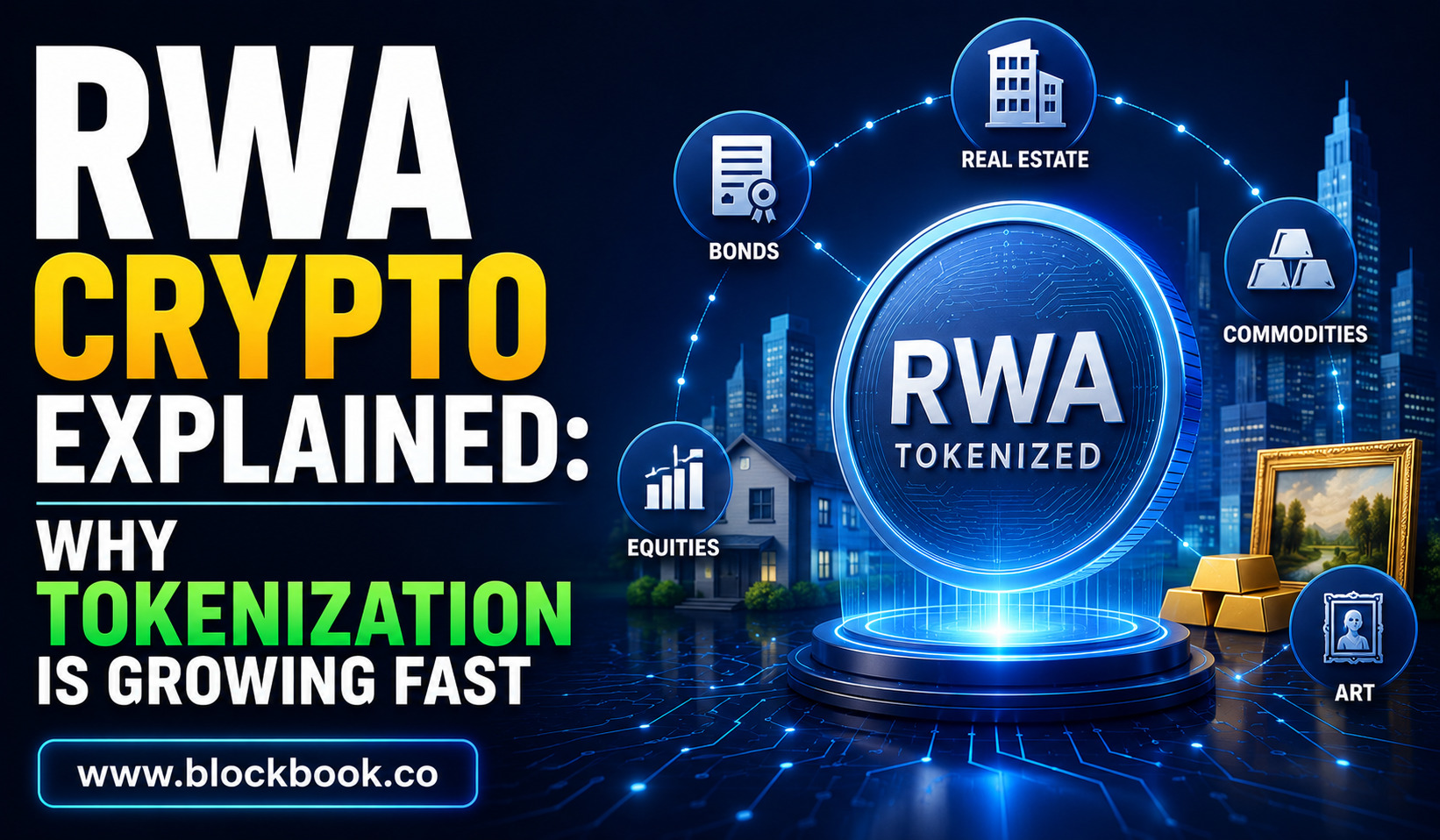
Real-world assets, commonly called RWAs, have become one of the most important narratives in the cryptocurrency market. Instead of creating digital assets that exist only on a blockchain, RWA projects bring traditional assets such as U.S. Treasury securities, gold, private credit, stocks and funds onto blockchain networks.
The idea sounds simple, but its potential impact is much bigger. Tokenization could change how financial assets are issued, traded, settled and managed. In 2026, that possibility is moving beyond experiments as banks, asset managers, fintech companies and crypto-native platforms increasingly explore blockchain-based financial infrastructure.
The growth is already visible in market data. CoinGecko reported that tokenized real-world assets excluding stablecoins increased from $5.42 billion at the beginning of 2025 to about $19.32 billion by the end of Q1 2026, representing growth of more than 250%.
So, what exactly is RWA crypto, and why is tokenization growing so quickly?
What Are Real-World Assets in Crypto?
The underlying asset can be almost anything with economic value. A token could represent a share in a fund, ownership rights connected to a property, exposure to government bonds or a claim on physical commodities.
Tokenization does not necessarily mean that the physical asset itself is moved onto a blockchain. Instead, blockchain technology is used to create a digital representation of an asset or an ownership interest connected to it.
For example, a tokenized Treasury product can give investors blockchain-based exposure to U.S. government debt. A tokenized gold product can represent a claim linked to physical gold held by a custodian.
This creates a bridge between traditional finance and digital markets.
How Does RWA Tokenization Work?
The process generally begins with an asset owner, issuer or financial institution identifying an asset that can be represented digitally.
The issuer then creates tokens according to a legal and technical structure. Depending on the product, the tokens may represent ownership, a beneficial interest, a claim on an underlying asset or exposure to its economic performance.
Custody is another critical part of the process. If a token represents Treasury securities or gold, someone must hold and manage the underlying assets.
The blockchain then provides a digital layer for issuing, transferring and recording the tokens.
A simplified tokenization process looks like this:
- A traditional asset is selected and placed within an appropriate legal structure.
- An issuer creates digital tokens representing the asset or related rights.
- The underlying asset is held by a custodian or managed according to the product’s legal framework.
- Investors acquire and transfer the tokens through supported blockchain infrastructure.
The important point is that blockchain technology is only one part of RWA tokenization. Legal ownership, custody, compliance and investor rights are equally important.
Why Is RWA Tokenization Growing So Fast?
Several developments are pushing the sector forward at the same time.
1. Institutional Investors Are Becoming More Comfortable With Blockchain
Financial institutions are increasingly treating blockchain as infrastructure rather than simply as a speculative technology.
A 2026 Coinbase and EY-Parthenon survey of 351 institutional investors found that 64% of asset managers were interested in tokenizing their assets, up from 40% in the previous year’s survey. More than 60% of respondents expected tokenization to significantly affect market structure.
This is significant because institutional adoption can bring large pools of capital into tokenized markets.
Instead of asking whether blockchain has a use case, financial institutions are increasingly asking how blockchain can improve existing financial products.
2. Tokenization Can Make Markets Operate Around the Clock
Traditional financial markets often operate according to specific trading hours and settlement schedules.
Blockchain networks can operate continuously.
Tokenized assets can potentially be transferred outside traditional market hours, creating the possibility of 24/7 markets. Coinbase research identifies near-instant settlement, capital efficiency and composability as some of the major attractions of tokenization.
This does not mean every tokenized asset can immediately trade 24 hours a day. Regulatory restrictions and the structure of the underlying asset still matter.
However, the technology creates the possibility of a more continuous financial system.
Tokenized Treasuries Are Leading the Market
Government securities have emerged as one of the strongest RWA categories.
Tokenized U.S. Treasuries allow investors to access government debt through blockchain-based products. They are particularly attractive because Treasuries are highly liquid, widely understood and already an important component of global financial markets.
CoinGecko reported that tokenized Treasuries remained the largest RWA category in Q1 2026, accounting for more than half of tokenized RWA market capitalization.
Their growth also demonstrates an important characteristic of successful tokenization: the best early candidates may be assets that already have strong demand in traditional finance.
Tokenized Gold and Commodities Are Expanding
Commodities are another major part of the RWA market.
Tokenized gold has become particularly successful because gold already has a global investor base and can be represented through custodial structures.
According to CoinGecko, tokenized commodities increased from approximately $1.43 billion to $5.55 billion between the beginning of 2025 and the end of Q1 2026. Gold-backed tokens accounted for most of that expansion.
This demonstrates how tokenization can bring familiar assets into blockchain-based markets.
Investors who are already comfortable with gold exposure may find tokenized versions attractive because they can potentially be transferred and integrated with digital financial applications.
Tokenized Stocks Are Becoming a New Frontier
Stocks are one of the newer and more closely watched RWA categories.
Tokenized equities can potentially give investors blockchain-based exposure to publicly traded companies. The appeal includes potentially longer trading hours, faster settlement and integration with decentralized financial applications.
CoinGecko reported that tokenized stocks grew from only a few million dollars in mid-2025 to nearly $487 million by the end of Q1 2026.
The broader market has also continued expanding. CoinDesk reported that tokenized stocks reached $2.41 billion in market capitalization in May 2026, while tokenized assets overall reached a record $28.9 billion.
However, investors should understand that tokenized equities do not necessarily provide the same legal ownership rights as holding shares through a traditional brokerage account. The structure depends on the issuer, jurisdiction and product.
Why Financial Institutions Like Tokenization
Tokenization offers financial institutions several potential advantages.
The first is efficiency. Blockchain-based settlement could reduce the number of intermediaries involved in transferring assets.
The second is programmability. Smart contracts can automate certain actions, such as settlement conditions, compliance checks or distributions.
The third is composability. Tokenized assets can potentially interact with other blockchain applications, allowing financial products to be combined in ways that are more difficult within traditional systems.
For asset managers, there is also a distribution opportunity. Tokenized funds could potentially reach investors through digital platforms and operate with more automated back-office processes.
PwC expects tokenized fund assets under management to grow at a 41% compound annual growth rate through 2030, illustrating the scale of expectations surrounding the sector.
RWA Crypto and DeFi Could Become More Connected
One of the biggest long-term opportunities is connecting tokenized traditional assets with decentralized finance.
Imagine a tokenized Treasury fund being used as collateral for a blockchain-based loan. Or imagine tokenized financial assets being used within automated settlement systems.
That is where RWA tokenization becomes more than simply putting traditional assets on a blockchain.
However, this integration remains limited. A March 2026 analysis from CoinDesk noted that much of the RWA market remains separated from permissionless DeFi because of compliance and structural restrictions.
Bringing regulated assets into open blockchain environments requires careful consideration of identity, investor eligibility, custody and legal rights.
The Main Benefits of RWA Tokenization
The appeal of tokenization comes from several potential improvements to traditional markets:
- Faster settlement: Blockchain can reduce settlement delays.
- Greater accessibility: Digital platforms can potentially broaden distribution.
- Fractional ownership: Certain assets can be divided into smaller digital units.
- Programmability: Smart contracts can automate financial processes.
These advantages do not automatically make every tokenized asset better than its traditional equivalent. The quality of the underlying asset, legal structure and issuer remains crucial.
What Are the Risks of RWA Crypto?
RWA tokenization also introduces new risks.
One major issue is the connection between the blockchain token and the real-world asset. If an issuer claims that tokens are backed by Treasury securities or gold, investors need confidence that those assets actually exist and that the legal structure gives token holders the rights they expect.
Regulatory uncertainty is another challenge. Tokenized securities can fall under financial-market rules, while different countries may apply different requirements.
Technology creates additional risks. Smart-contract vulnerabilities, wallet security problems and blockchain outages can affect tokenized assets even when the underlying asset is perfectly sound.
Investors should therefore consider:
- Who issues the token?
- What exactly does each token represent?
- Where is the underlying asset held?
- What rights does the investor legally have?
- How can the token be redeemed?
These questions are often more important than the token’s market price.
RWA Tokenization vs Traditional Assets
| Feature | Traditional Asset | Tokenized RWA |
| Ownership record | Traditional databases | Blockchain-based record |
| Trading hours | Often limited | Potentially 24/7 |
| Settlement | Can take time | Potentially near-instant |
| Fractionalization | Depends on asset | Easier to structure digitally |
| Programmability | Limited | Smart contracts can automate functions |
| Regulation | Established | Still evolving in many markets |
The table shows why tokenization is attracting attention, but it also highlights an important limitation: the technology does not eliminate regulation.
What Could Happen to RWA Crypto in the Rest of 2026?
The sector could become increasingly diverse.
Treasuries may continue to dominate because of their liquidity and institutional demand, while tokenized stocks, funds, commodities and private credit expand their market share.
Another important development could be greater integration with payment systems and stablecoins. Institutions already report using stablecoins for cash management, money movement and near-real-time settlement, according to Coinbase’s 2026 institutional survey.
If tokenized assets and stablecoins become interoperable, blockchain could begin functioning as a more complete financial settlement layer.
Frequently Asked Questions
What does RWA mean in crypto?
RWA stands for Real-World Assets. In crypto, it generally refers to traditional assets represented through blockchain-based tokens or digital structures.
Why is RWA tokenization growing?
Growth is being driven by institutional adoption, regulatory progress, faster settlement, potential 24/7 markets and the ability to make traditional assets more programmable and digitally accessible.
What are examples of tokenized real-world assets?
Common examples include U.S. Treasuries, gold, investment funds, private credit, stocks and ETFs. Tokenized Treasuries and commodities are currently among the largest RWA categories.
Is RWA crypto the same as buying a cryptocurrency?
Not necessarily. An RWA token may represent an interest in a traditional asset rather than functioning like a conventional cryptocurrency. Its value and investor rights depend on the underlying asset and legal structure.
Is RWA tokenization safe?
Tokenization does not eliminate investment risk. Investors still face market, issuer, custody, regulatory, smart-contract and liquidity risks.
Could RWA become the next major crypto sector?
RWA is already one of the fastest-growing areas of blockchain finance. Whether it becomes a dominant sector will depend on institutional adoption, regulation, liquidity and the ability to connect tokenized assets with broader digital financial infrastructure.
Final Thoughts
RWA crypto is changing the way investors think about blockchain. Instead of using blockchain only for native digital currencies, tokenization allows traditional financial assets to participate in digital markets.
The growth is already substantial. Tokenized RWAs excluding stablecoins reached around $19.3 billion by the end of Q1 2026 according to CoinGecko, while later market data showed the broader tokenized-asset market reaching new highs.
The most important development may be the increasing participation of traditional financial institutions. Banks, asset managers and market infrastructure providers are moving from experimentation toward practical applications.
The future of RWA tokenization will ultimately depend on whether blockchain can deliver meaningful improvements in settlement, liquidity, accessibility and operational efficiency.
If those benefits continue to materialize, tokenization could become one of the most important bridges between traditional finance and the blockchain economy—not just another crypto market narrative.
About the Author