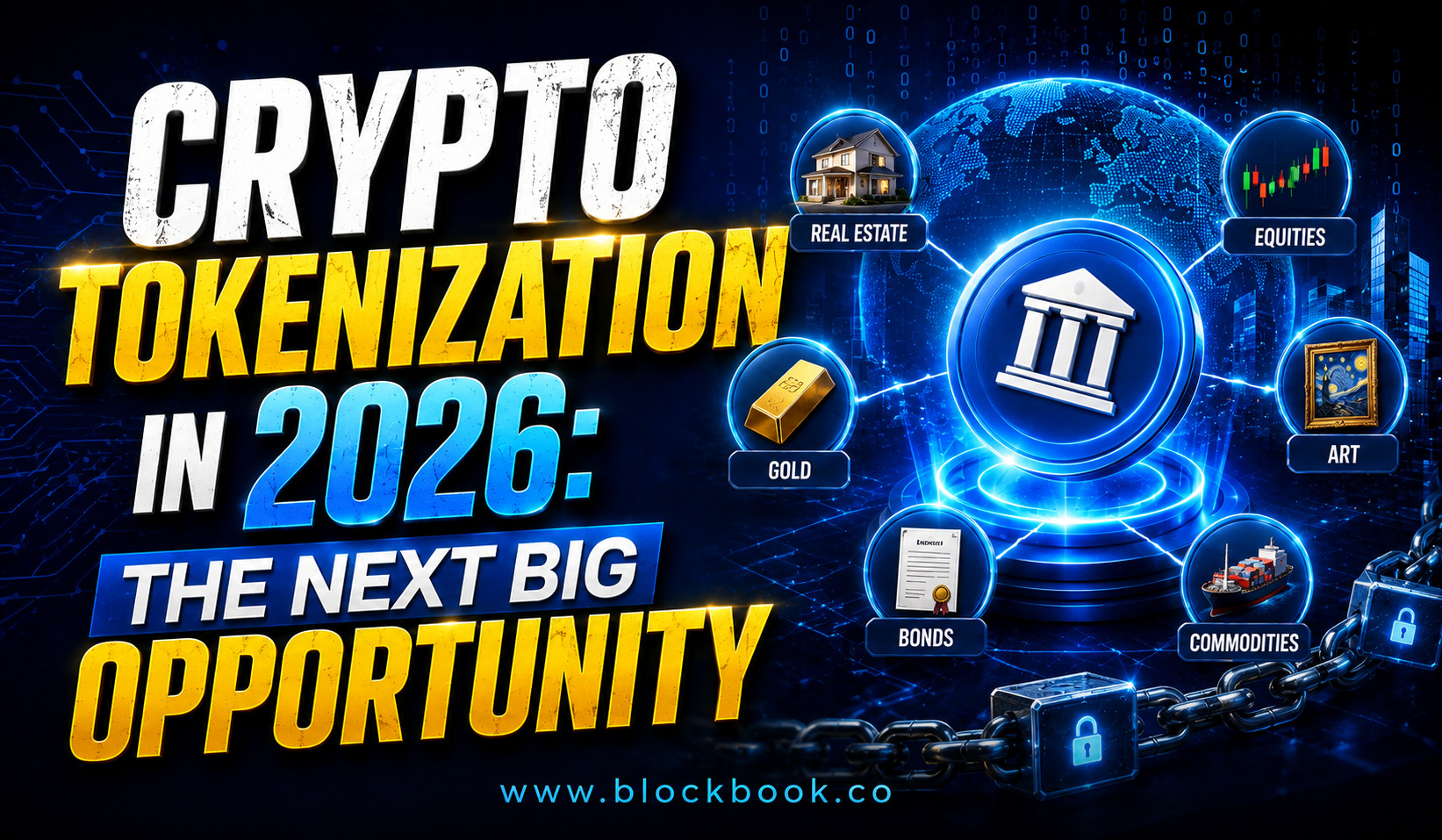
Crypto tokenization is quickly becoming one of the most important trends in the digital-asset industry. Instead of limiting blockchain technology to cryptocurrencies, tokenization allows traditional assets such as government bonds, stocks, funds, commodities and private credit to be represented digitally on blockchain networks.
What was once largely viewed as an experimental idea is now attracting banks, asset managers, exchanges and fintech companies. The shift is especially visible in 2026, as institutional investors increasingly explore blockchain-based issuance, settlement and investment products.
The market is growing rapidly. CoinGecko reported that tokenized real-world assets excluding stablecoins reached approximately $19.3 billion by the end of Q1 2026, up more than 250% from the beginning of 2025. Tokenized Treasuries remained the largest category, while tokenized commodities and equities also expanded.
This raises an important question: Could crypto tokenization become the next major opportunity in financial markets?
What Is Crypto Tokenization?
Crypto tokenization is the process of creating a blockchain-based digital representation of an asset or financial interest.
The underlying asset might be a U.S. Treasury security, a share in an investment fund, a quantity of gold, a private-credit instrument or another asset with economic value. A token is then issued according to a legal and technical structure that determines what rights the token holder receives.
The blockchain acts as a digital infrastructure layer. It can record ownership, facilitate transfers and allow smart contracts to automate certain financial processes.
This is different from simply creating a cryptocurrency. A tokenized asset is generally connected to something outside the blockchain, while a native cryptocurrency exists within its own digital ecosystem.
Why Is Tokenization Growing So Quickly in 2026?
The current growth of tokenization is being driven by several trends happening at the same time.
Regulators are developing clearer frameworks in major markets. Stablecoins are creating digital payment infrastructure, while public blockchains are becoming more capable of supporting sophisticated financial applications.
Institutional interest is particularly important. A 2026 Coinbase and EY-Parthenon survey of 351 institutional investors found that 63% were very interested in tokenized assets, while 64% of asset managers were very interested in tokenizing their own assets, up from 40% in the previous year’s survey.
That suggests tokenization is moving from the research stage toward practical implementation.
Tokenized Treasuries Are Leading the Market
U.S. Treasury securities have emerged as one of the strongest use cases for tokenization.
Treasuries are attractive because they are highly liquid, widely recognized and already held by institutions around the world. Putting exposure to these assets on blockchain networks can potentially make them easier to transfer, integrate with digital financial applications and use as collateral.
According to CoinDesk Data, tokenized Treasuries reached approximately $16.1 billion in May 2026, representing more than half of the tokenized-asset market at that time.
The popularity of tokenized Treasuries also shows why tokenization does not necessarily need to create a completely new asset class. It can improve the way an existing financial asset is issued, distributed and settled.
Tokenized Stocks Could Change Equity Trading
Equities are another area receiving significant attention.
Tokenized stocks can provide blockchain-based exposure to shares or economic interests connected to publicly traded companies. The potential benefits include extended trading hours, faster settlement and integration with digital financial applications.
The sector is still relatively young, but its growth has been notable. CoinDesk reported that tokenized stocks reached approximately $2.41 billion in market capitalization in May 2026, increasing more than 20% during that month.
However, investors need to understand the legal structure behind these products. A token that tracks the price of a stock is not necessarily equivalent to owning the underlying shares directly.
That distinction will become increasingly important as regulators determine how tokenized securities should operate.
Tokenized Funds Could Be a Major Institutional Opportunity
Investment funds may eventually become one of the largest areas of tokenization.
A tokenized fund can potentially automate parts of the subscription, transfer and settlement process while giving investors a blockchain-based representation of their interest.
Asset managers are particularly interested in this model because blockchain technology could improve distribution and operational efficiency.
PwC expects tokenized fund assets under management to grow at approximately 41% annually to reach $715 billion globally by 2030.
That forecast illustrates why large financial institutions are taking the sector seriously.
If tokenized funds become widely accepted, investors could eventually purchase traditional investment products through blockchain-based platforms without needing to understand the underlying blockchain infrastructure.
The Biggest Benefits of Crypto Tokenization
Tokenization is attracting attention because it can potentially improve several parts of traditional financial markets.
One of the most important is settlement. Traditional financial transactions can involve multiple intermediaries and settlement periods. Blockchain networks can potentially enable faster or even near-instant settlement.
Another advantage is programmability. Smart contracts can automate certain rules around ownership transfers, payments, compliance and distributions.
Tokenization can also make certain assets easier to divide into smaller units. Fractionalization may expand access to assets that have historically required substantial minimum investments.
Some of the major potential advantages include:
- Faster settlement and transfer
- 24/7 market availability
- Fractional ownership
- Automated compliance and financial processes
- Greater interoperability with digital financial applications
These benefits are potential advantages rather than guarantees. The actual experience depends on the blockchain, legal structure, issuer and market infrastructure supporting the token.
Tokenization and Stablecoins Could Work Together
One of the most interesting developments is the growing relationship between tokenized assets and stablecoins.
Stablecoins can provide the digital money used to settle tokenized transactions.
For example, an investor could purchase a tokenized Treasury product using a dollar-backed stablecoin. The Treasury token represents the investment, while the stablecoin represents the payment.
This creates the foundation for a blockchain-based financial market in which both assets and money are digital.
Institutional investors are already exploring this combination. The 2026 Coinbase and EY-Parthenon survey found that institutions are using or considering stablecoins for cash management, money movement and near-real-time settlement, while also increasing interest in tokenized assets.
The combination could become more powerful as regulation and infrastructure improve.
Why Institutions Are Taking Tokenization Seriously
The institutional case for tokenization is increasingly based on efficiency rather than cryptocurrency speculation.
Banks and asset managers already operate enormous financial systems. If blockchain can reduce settlement friction, simplify reconciliation or make financial products easier to distribute, institutions have a practical reason to adopt it.
This is why companies such as asset managers, exchanges and financial infrastructure providers are exploring tokenized securities and funds.
Coinbase’s 2026 research describes tokenization as a structural market theme and highlights potential benefits including atomic settlement, composability and continuous access.
The result could be a gradual transition rather than a sudden revolution. Traditional financial institutions may adopt blockchain behind the scenes before consumers notice major changes.
What Could Tokenization Mean for Investors?
For investors, tokenization could expand the range of assets available through digital platforms.
Instead of holding only cryptocurrencies, investors could potentially access tokenized Treasury funds, commodities, equities, private credit and other financial products.
It could also allow traditional assets to interact with decentralized applications.
For example, a tokenized Treasury could potentially serve as collateral in a blockchain-based lending system. A tokenized fund could potentially integrate with a digital settlement platform.
This creates a more interconnected financial environment.
However, investors should not assume that every tokenized product is automatically superior to its traditional equivalent.
Crypto Tokenization vs Traditional Markets
| Feature | Traditional Financial Markets | Tokenized Markets |
| Settlement | Often multi-step | Potentially near-instant |
| Trading hours | Usually scheduled | Potentially 24/7 |
| Ownership records | Centralized systems | Blockchain-based records |
| Automation | Limited in some processes | Smart-contract enabled |
| Fractionalization | Asset dependent | Easier to structure digitally |
| Global accessibility | Depends on intermediaries | Potentially broader |
The biggest opportunity is not necessarily eliminating traditional finance. It is combining traditional financial assets with more efficient digital infrastructure.
What Are the Risks of Tokenization?
Rapid growth does not mean tokenization is risk-free.
The first challenge is regulation. Tokenized securities may be subject to securities laws, investor restrictions and reporting requirements. Different jurisdictions may also classify the same product differently.
The second challenge is custody. Investors need confidence that the underlying asset exists and that the token gives them the rights they expect.
Technology introduces another layer of risk. Smart-contract bugs, cybersecurity attacks and blockchain failures can affect tokenized products.
There are also liquidity concerns. A token can technically trade 24/7, but that does not mean there will always be enough buyers and sellers.
Institutional investors recognize these obstacles. EY reports that regulatory uncertainty, integration challenges and insufficient secondary-market liquidity remain major barriers to tokenized-asset adoption.
What Could Drive the Next Wave of Growth?
The next phase of tokenization is likely to depend on infrastructure.
Several developments could accelerate adoption:
- Clearer regulations that establish predictable rules for issuers and investors.
- Better interoperability between blockchains and traditional financial systems.
- Deeper liquidity so tokenized assets can trade efficiently.
- Institutional-grade custody and compliance that make products easier for large investors to use.
The industry is already moving in this direction, but adoption will depend on whether these systems work reliably at scale.
Could Crypto Tokenization Become a Trillion-Dollar Market?
Long-term forecasts vary considerably, but expectations are clearly substantial.
The FII Institute’s 2026 Digital Assets & Tokenized Finance Impact Report describes a potential $16 trillion to $30 trillion market opportunity for digital assets and tokenized finance, while PwC forecasts significant growth in tokenized investment funds.
These figures should be treated as forecasts rather than guaranteed outcomes.
Still, the direction of institutional interest is difficult to ignore. Tokenized assets have already reached tens of billions of dollars, and the market is expanding across multiple asset categories.
The more important question may therefore be how quickly tokenization develops, rather than whether it develops at all.
Frequently Asked Questions
What is crypto tokenization?
Crypto tokenization is the process of representing an asset or financial interest through a blockchain-based token. The underlying asset can include bonds, stocks, funds, commodities or private-credit instruments.
Why is tokenization growing in 2026?
Growth is being supported by institutional adoption, improved blockchain infrastructure, regulatory progress, stablecoin development and demand for faster settlement and more efficient financial markets.
What are the biggest tokenized assets?
Tokenized U.S. Treasuries currently represent the largest major category. Tokenized commodities, stocks and investment funds are also expanding rapidly.
Is tokenization the same as cryptocurrency?
No. Cryptocurrency can exist natively on a blockchain, while a tokenized asset generally represents an asset or financial interest connected to the traditional economy.
Is crypto tokenization safe?
Tokenization carries risks involving regulation, custody, liquidity, smart contracts, cybersecurity and the underlying asset. Investors should investigate the issuer and legal structure before purchasing a tokenized product.
Will tokenization replace traditional finance?
A complete replacement is unlikely in the near term. A more realistic outcome is that blockchain becomes part of traditional financial infrastructure, supporting issuance, settlement, custody and distribution.
Final Thoughts
Crypto tokenization in 2026 is moving from an experimental concept toward a genuine financial-market opportunity.
The growth of tokenized Treasuries, commodities, stocks and funds demonstrates that blockchain technology can be applied to assets far beyond cryptocurrencies. At the same time, institutional investors are showing increasing interest in using blockchain for issuance, settlement and asset management.
The most important development may be the convergence of tokenized assets, stablecoins and institutional blockchain infrastructure. Together, they could create financial markets that operate continuously, settle faster and allow assets and money to interact natively on digital networks.
There are still significant challenges. Regulation, liquidity, custody, interoperability and investor protection must develop alongside the technology.
But the direction is increasingly clear. As traditional financial institutions move from experimentation toward implementation, tokenization could become one of the defining opportunities of the 2026 crypto market—and potentially one of the foundations of the next generation of global finance.
About the Author