Layer-1 blockchains remain the foundation of the crypto industry. They are the base networks where transactions are processed, assets are issued, smart contracts operate and decentralized applications are built.
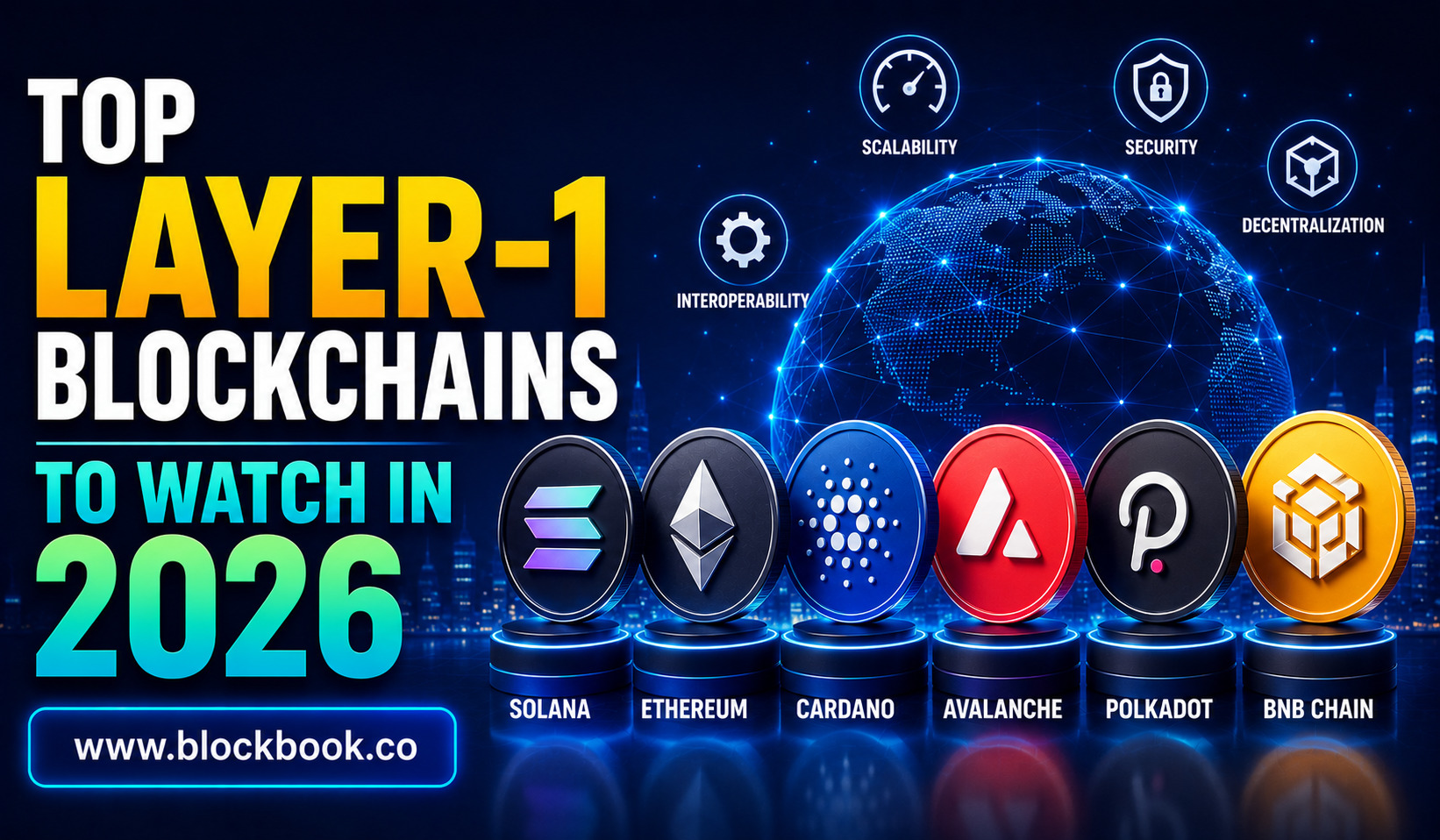
In 2026, the Layer-1 market is becoming more competitive than ever. Ethereum continues to dominate as a major settlement and liquidity hub, while Solana has established itself as a high-performance network for trading and consumer applications. At the same time, BNB Chain, Avalanche, Sui, Aptos and NEAR are competing for developers, users and capital.
The Layer-1 race is also changing. Raw transaction speed is no longer enough to guarantee success. Investors and developers are increasingly looking at network reliability, liquidity, developer activity, real-world usage, scalability and the ability to support applications over multiple market cycles.
So, which Layer-1 blockchains deserve the most attention in 2026?
What Is a Layer-1 Blockchain?
A Layer-1 blockchain is a base blockchain that processes and settles transactions on its own network. Ethereum, Solana, Avalanche, BNB Chain, Sui and Aptos are examples of Layer-1 networks.
Layer-1 blockchains provide the infrastructure needed for decentralized applications. They can support activities ranging from decentralized finance and gaming to payments, tokenized assets and digital collectibles.
The major challenge for these networks is balancing three important characteristics: security, decentralization and scalability.
Different blockchains make different trade-offs.
Ethereum has focused heavily on security and decentralization while using Layer-2 networks to expand capacity. Other Layer-1s attempt to process more activity directly on the base chain.
This difference is becoming increasingly important in 2026.
Ethereum: The Core Layer-1 to Watch
Ethereum remains one of the most important Layer-1 blockchains in the crypto market.
Its biggest advantage is not simply transaction speed. It is the size and depth of its ecosystem.
Ethereum supports a large range of decentralized applications, stablecoins, tokenized assets, lending protocols and other blockchain-based financial products. Its developer community and liquidity provide a significant network effect that competing chains must work hard to overcome.
Ethereum’s strategy also differs from many other Layer-1 networks. Instead of attempting to put every transaction directly on the mainnet, Ethereum increasingly functions as a settlement and security layer for Layer-2 networks.
That creates a unique position.
Ethereum may process less everyday activity directly than some faster chains, but it can still benefit from a broader ecosystem built around its infrastructure.
Why Ethereum Matters in 2026
Ethereum’s biggest themes include:
- DeFi and stablecoin liquidity
- Tokenization and real-world assets
- Layer-2 expansion
- Institutional blockchain adoption
The main question is whether Ethereum can maintain its dominant ecosystem while making the overall user experience faster, cheaper and simpler.
Solana: The High-Performance Challenger
Solana is arguably Ethereum’s most prominent Layer-1 competitor in terms of high-volume on-chain activity.
The network was designed around fast transaction processing and low fees, making it attractive for applications where users interact frequently with blockchain infrastructure.
Solana has developed strong activity across decentralized exchanges, consumer applications, digital assets and other areas.
Its biggest advantage is the ability to provide a fast experience directly on the Layer-1 network.
That can be particularly useful for trading and applications that require frequent transactions.
Solana must continue demonstrating network reliability, developer growth and sustainable user demand.
If it can do that, its position as one of the leading Layer-1 ecosystems could become even stronger.
BNB Chain: The Mass-Market Contender
BNB Chain has a different competitive advantage.
Its close connection to the broader Binance ecosystem gives it access to a large global user base and significant liquidity.
The network has become an important environment for decentralized finance, trading and consumer-oriented applications.
Its compatibility with Ethereum’s development environment also makes it relatively accessible to developers familiar with the Ethereum ecosystem.
BNB Chain’s 2026 opportunity is largely connected to scale.
If it continues attracting users who prioritize low transaction costs and easy access to applications, it can remain one of the industry’s major Layer-1 networks.
Its biggest challenge is balancing mass adoption with concerns around decentralization and regulatory exposure.
Avalanche: A Layer-1 for Custom Networks
Avalanche takes a different approach to blockchain scalability.
Rather than relying only on one shared environment, its architecture allows developers and organizations to create customized blockchain environments for specific applications.
This makes Avalanche particularly interesting for gaming, enterprise applications and tokenized assets.
The concept is important because not every application needs exactly the same blockchain environment.
A financial institution may want predictable infrastructure. A gaming project may require high throughput. Another application may need customized rules and validators.
Avalanche’s flexibility gives it an interesting position in the Layer-1 market.
What to Watch With Avalanche
The key question is whether its customizable architecture can translate into sustained adoption.
Technical flexibility is valuable, but successful blockchains ultimately need developers, users, liquidity and applications.
If Avalanche can continue turning blockchain deployments into active ecosystems, its role in the Layer-1 market could expand.
Sui: A Rising Layer-1 to Watch
Sui is one of the newer Layer-1 networks attracting attention in 2026.
Its architecture is designed around parallel transaction processing and low-latency applications. The network also uses the Move programming language, giving it a different development environment from Ethereum and many EVM-compatible chains.
Sui’s potential is particularly interesting for consumer applications, gaming and financial products that require fast interactions.
The challenge is ecosystem maturity.
Newer Layer-1 networks need to prove that their activity is sustainable rather than driven primarily by incentives or short-term speculation.
If Sui continues attracting developers and users while expanding liquidity, it could become one of the strongest newer competitors in the Layer-1 sector.
Aptos: Another Move-Based Competitor
Aptos is another Layer-1 blockchain built around the Move programming language.
Its development strategy emphasizes scalability, parallel execution and efficient transaction processing.
Like Sui, Aptos is attempting to build an ecosystem capable of supporting consumer applications and decentralized financial services.
The network’s long-term success will depend heavily on developer adoption.
A technically advanced blockchain does not automatically become a major ecosystem. Developers need tools, liquidity, users and sustainable economic incentives.
Aptos therefore remains a blockchain worth watching as the competition among newer Layer-1 networks intensifies.
NEAR Protocol: Betting on Better User Experience
NEAR has positioned itself around scalability and improving the experience of interacting with multiple blockchain networks.
One of the most interesting ideas associated with NEAR is chain abstraction.
The basic concept is that users should not need to understand the technical differences between blockchains every time they make a transaction.
Instead of manually choosing networks, managing multiple wallets and worrying about bridges, applications could potentially handle much of the complexity in the background.
If this vision becomes practical at scale, NEAR could compete in an area that many blockchain projects struggle with: making Web3 feel simpler.
Layer-1 Blockchain Comparison
| Blockchain | Main Strength | Key Area to Watch | Main Challenge |
| Ethereum | Ecosystem and security | DeFi, RWA and L2s | User experience and scaling |
| Solana | Speed and low-cost activity | Trading and consumer apps | Reliability and decentralization trade-offs |
| BNB Chain | Large user base | Mass-market applications | Centralization concerns |
| Avalanche | Customizable networks | Institutional and app-specific chains | Sustained adoption |
| Sui | Parallel execution | Gaming and consumer apps | Ecosystem maturity |
| Aptos | Move and scalability | DeFi and applications | Developer traction |
| NEAR | Chain abstraction | Multichain user experience | Turning technology into adoption |
What Makes a Layer-1 Blockchain Successful?
The Layer-1 race is not simply a competition for the highest transaction-per-second figure.
A successful blockchain needs an ecosystem around it.
The most important factors to watch include:
- Developer activity: Developers create the applications that attract users.
- Liquidity: Deep liquidity makes trading and financial applications more useful.
- Real users: Sustainable adoption matters more than temporary transaction spikes.
- Network reliability: Applications need infrastructure that can operate consistently.
These factors can reinforce one another.
More developers create more applications. Better applications attract users. More users create liquidity and economic activity. That activity can then encourage additional developers to build on the network.
The Role of Stablecoins in the Layer-1 Race
Stablecoins are becoming increasingly important for Layer-1 ecosystems.
They provide digital representations of relatively stable currencies and are widely used for trading, payments, transfers and decentralized finance.
A blockchain with strong stablecoin liquidity can become more attractive to both users and developers.
This is one reason Ethereum, Solana, BNB Chain and other major networks are competing to capture stablecoin activity.
The rise of stablecoins could also change how Layer-1 networks are evaluated.
Instead of asking only how many transactions a blockchain processes, investors may increasingly ask how much useful economic activity takes place on the network.
Layer-1s and Real-World Assets
Tokenization is another major opportunity.
Real-world assets such as government securities, funds and other financial instruments can potentially be represented using blockchain tokens.
Layer-1 networks provide the infrastructure for these assets to be issued, transferred and integrated with blockchain applications.
Ethereum currently has a major advantage because of its institutional ecosystem and liquidity.
However, other networks are also competing for tokenized asset activity.
If RWA adoption accelerates, Layer-1 blockchains could become increasingly important infrastructure for traditional financial markets.
Could There Be One Layer-1 Winner?
The crypto market does not necessarily need one winning blockchain.
Different networks can serve different purposes.
Ethereum could remain the major settlement and liquidity layer. Solana could continue focusing on high-performance consumer applications and trading. Avalanche could specialize in customized blockchain environments, while Sui and Aptos compete for the next generation of applications.
This means the future may be multi-chain rather than winner-takes-all.
The strongest networks may be those that develop a clear identity instead of attempting to copy every competitor.
What Could Change the Layer-1 Market in 2026?
Several developments could significantly influence the competition:
- Growth in stablecoin payments
- Expansion of tokenized real-world assets
- Increased institutional blockchain adoption
- Better cross-chain interoperability
Interoperability may become especially important.
Users do not necessarily want to choose a blockchain every time they interact with an application. The best networks may eventually be those that make blockchain selection largely invisible.
Risks to Consider
Layer-1 blockchains remain high-risk areas of the crypto market.
Competition is intense, and technological advantages can disappear quickly.
A network may have impressive performance but struggle to attract developers. Another may have a strong community but insufficient liquidity. A third could experience regulatory or security problems.
Token economics are another consideration.
A blockchain’s native token may have a strong ecosystem behind it, but investors still need to understand supply, emissions, staking dynamics and potential dilution.
The strongest technology does not automatically mean the strongest investment.
Frequently Asked Questions
What is the best Layer-1 blockchain in 2026?
There is no single best Layer-1 for every purpose. Ethereum has major advantages in ecosystem depth and settlement, while Solana stands out for performance. Other networks such as Avalanche, Sui, Aptos and NEAR offer different approaches.
Is Ethereum still the leading Layer-1?
Ethereum remains one of the most important Layer-1 ecosystems, particularly for DeFi, stablecoins, tokenization and Layer-2 settlement.
Is Solana a competitor to Ethereum?
Yes. Solana competes with Ethereum for developers, users, liquidity and applications, although the two networks use different scaling strategies.
Are Sui and Aptos worth watching?
Both are newer Layer-1 networks with a focus on scalable execution and the Move programming language. Their long-term potential will depend on developer adoption and sustainable ecosystem growth.
Why are Layer-1 blockchains important?
Layer-1 networks provide the base infrastructure on which blockchain applications operate. They process transactions, maintain network security and support digital assets and smart contracts.
Will Layer-1 blockchains still matter if Layer-2 networks grow?
Yes. Layer-2 networks still depend on underlying Layer-1 infrastructure for important functions such as settlement and security. The relationship between L1s and L2s may become increasingly interconnected.
Final Thoughts
The Layer-1 blockchain race in 2026 is becoming less about finding an “Ethereum killer” and more about identifying networks with sustainable competitive advantages.
Ethereum continues to benefit from ecosystem depth, liquidity and its role as a major settlement layer. Solana has built a strong position around speed and high-frequency activity. BNB Chain benefits from a large user ecosystem, while Avalanche offers customizable infrastructure.
At the same time, Sui and Aptos are challenging established networks with newer architectures, and NEAR is pursuing a different opportunity through chain abstraction and improved user experience.
The most important lesson is that technology alone does not determine which blockchain wins.
Developers, users, liquidity, reliability, applications and real economic activity all matter.
As blockchain adoption expands into stablecoins, tokenized assets, payments and institutional finance, the strongest Layer-1 networks may become the infrastructure that quietly powers the next stage of the digital economy.
In 2026, the Layer-1 race is not simply about speed. It is about becoming useful enough that users, developers and capital have a reason to stay.
About the Author