
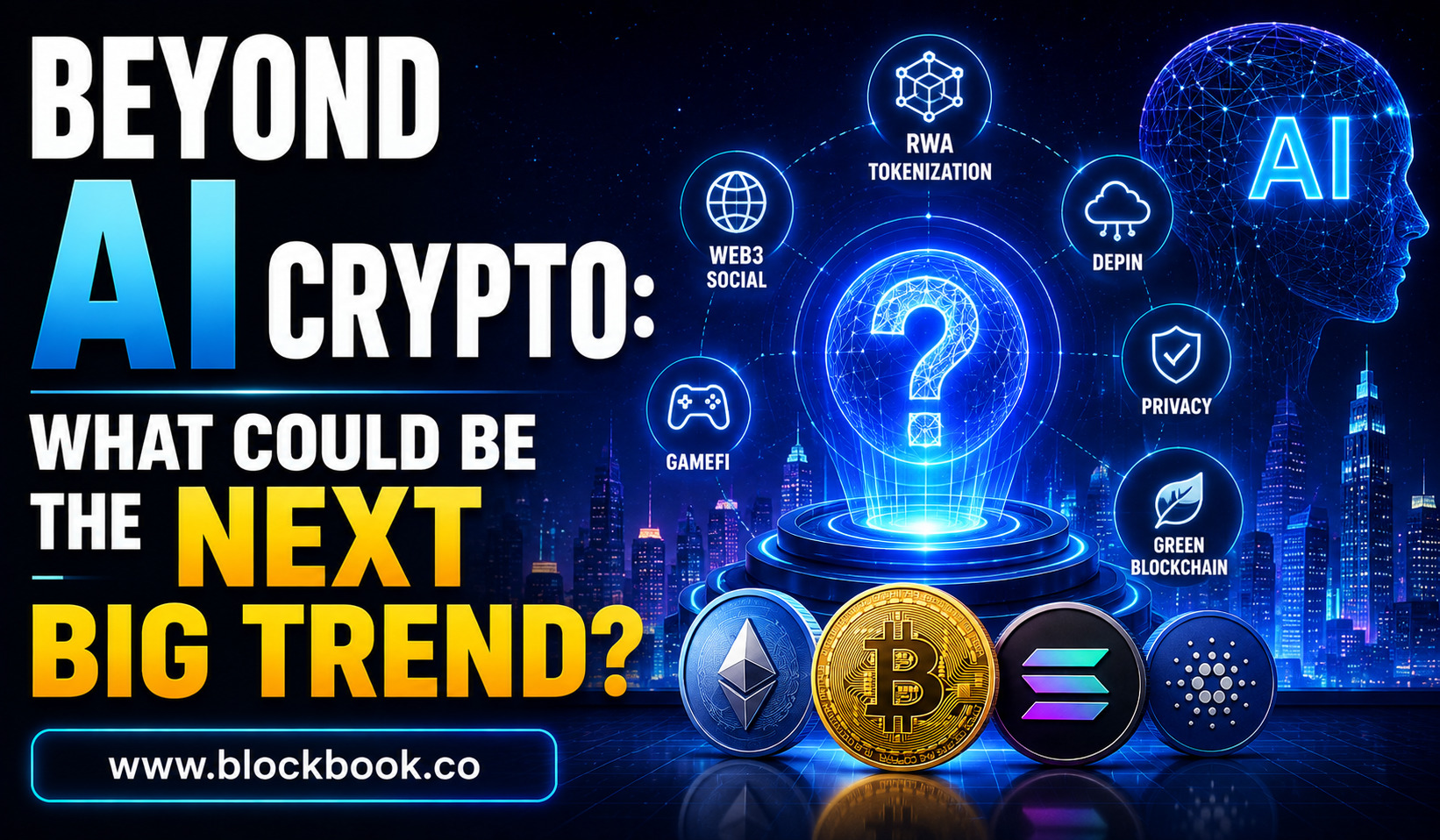
One year, decentralized finance dominates attention. Another year, NFTs, Layer 2 networks, meme coins or artificial intelligence become the center of the market.
In 2025 and into 2026, AI crypto became one of the most talked-about themes in the industry. Projects connected to AI agents, decentralized computing, machine intelligence and GPU infrastructure attracted significant interest.
But crypto narratives rarely stay in the spotlight forever.
As the AI crypto story becomes more mature, investors and builders are already looking beyond it. The next major opportunity may not come from one single category. Instead, several sectors are developing around practical blockchain applications, including stablecoins, real-world assets, decentralized physical infrastructure, prediction markets, privacy technology and on-chain financial products.
The bigger shift is that crypto appears to be moving from “What could blockchain do?” toward “What are people actually using blockchain for?”
So, what could be the next big crypto trend after AI?
Why Crypto Narratives Keep Changing
Crypto markets are unusually sensitive to narratives because technological developments, liquidity and speculation all interact.
A new narrative can attract developers, venture capital, traders and users at the same time. As capital enters a particular sector, token prices can rise, creating even more attention. Eventually, valuations may become difficult to justify, momentum slows and investors begin searching for the next opportunity.
That does not necessarily mean the previous technology has failed.
Instead, the market often moves from one stage to another.
AI crypto is a good example. Artificial intelligence is still an important technology, and AI-related blockchain projects continue to develop. However, the market is increasingly separating projects with genuine infrastructure from tokens that simply benefited from the AI label.
This creates room for other sectors to take the spotlight.
Could Stablecoins Become the Next Big Crypto Trend?
One of the strongest candidates is stablecoins.
Unlike many cryptocurrencies, stablecoins are designed to maintain relatively stable values, usually by tracking currencies such as the U.S. dollar. Their importance is expanding beyond crypto trading into payments, remittances, settlements and financial applications.
The reason stablecoins are particularly interesting is that they solve a problem people already understand: moving money.
A dollar-denominated digital asset can potentially move across borders at any time without relying entirely on traditional banking infrastructure. Businesses can use stablecoins for settlement, while individuals can use them for transfers and digital payments.
The market is also seeing greater interest in stablecoins as financial institutions explore blockchain-based payment and settlement systems.
This makes stablecoins different from purely speculative crypto narratives. They have a potential use case even when cryptocurrency prices are not rising.
Why Stablecoins Could Matter
Several factors could support continued stablecoin growth:
- Cross-border payments and remittances
- Faster settlement between businesses
- Digital payroll and financial services
- DeFi collateral and liquidity
- Payments made by autonomous software and AI agents
The interesting part is that stablecoins could also become infrastructure for other crypto trends.
For example, AI agents may need stablecoins to pay for computing resources or digital services. Tokenized assets may use stablecoins for settlement. DeFi applications can use them as collateral.
That makes stablecoins more than just another crypto category. They could become a financial layer connecting several emerging technologies.
Real-World Asset Tokenization Could Be a Major Winner
Another strong candidate for the next major crypto narrative is real-world asset tokenization, often called RWA tokenization.
The concept is relatively simple: traditional assets can be represented digitally on a blockchain.
These assets can include government bonds, real estate, commodities, private credit, investment funds and potentially equities.
Tokenization could make certain financial assets easier to transfer, divide, settle and use as collateral.
The appeal is particularly strong for institutional investors.
Traditional financial markets often operate through multiple intermediaries, business hours and separate settlement systems. Blockchain-based assets can potentially operate continuously and interact with other on-chain applications.
This creates the possibility of financial markets becoming more programmable.
Why RWA Tokenization Is Different From Earlier Crypto Narratives
RWA tokenization has a major advantage: it connects blockchain technology with assets that already have established economic value.
Instead of asking users to create demand for an entirely new digital product, tokenization can bring existing financial assets onto blockchain networks.
That could make adoption easier.
Imagine a tokenized treasury fund that can be transferred between investors and used as collateral in an on-chain lending application. The asset would still represent an underlying financial product, but blockchain technology could make its movement and integration more efficient.
This could eventually connect traditional finance and decentralized finance more closely.
Assets That Could Become Increasingly Tokenized
Some of the most interesting categories include:
- Government securities and treasury products
- Private credit and corporate debt
- Real estate
- Commodities and precious metals
The major challenge is regulation, custody and ensuring that the token actually represents enforceable rights to the underlying asset.
If those problems are solved, RWA tokenization could become one of the most important blockchain applications of the next few years.
DePIN Could Bring Crypto Into the Physical World
Another trend worth watching is Decentralized Physical Infrastructure Networks, commonly known as DePIN.
DePIN projects use blockchain-based incentives to coordinate physical resources.
Instead of a single company owning an entire network, participants can contribute hardware or infrastructure and receive rewards for providing useful services.
This can include wireless networks, computing power, storage, mapping data and energy-related infrastructure.
The concept is particularly interesting because it gives cryptocurrency a role outside purely digital finance.
A DePIN network can potentially create an economic marketplace around physical resources.
For example, someone with unused computing capacity could contribute it to a decentralized network and receive compensation. A business needing that capacity could pay for access.
The blockchain becomes the coordination and payment layer.
Why DePIN Could Gain More Attention
DePIN sits at the intersection of cryptocurrency, infrastructure and the real economy.
That gives it a different investment narrative from meme coins or purely speculative tokens.
The strongest DePIN projects will need to prove that their networks provide services people actually want.
That means metrics such as usage, revenue, hardware participation and customer demand could become more important than social-media attention.
This could make DePIN one of the sectors where crypto investors increasingly focus on fundamentals.
Prediction Markets Could Become a Major Consumer Application
Prediction markets are another potential breakout trend.
These platforms allow users to trade contracts based on the outcomes of future events.
Participants might speculate on elections, economic data, sports results, technology developments or other measurable outcomes.
Blockchain can make prediction markets globally accessible and transparent, while smart contracts can automate settlement.
The interesting part is that prediction markets are not simply financial products. They can also become information platforms.
Prices in prediction markets can represent collective expectations about future events.
As more people participate, these markets could become a source of real-time information for media companies, investors, researchers and everyday users.
Why Prediction Markets Are Interesting
The growth of prediction markets could be supported by several factors:
- Greater mainstream awareness
- More available markets
- Improved user interfaces
- Integration with media and financial applications
- Greater liquidity and easier access
However, regulation will remain an important consideration.
Prediction markets operate close to the boundaries between financial products, information markets and regulated event contracts. Their long-term development will depend heavily on how regulators and platforms approach the category.
Privacy and Zero-Knowledge Technology Could Be the Quiet Breakout
Not every major crypto trend will be flashy.
Privacy technology could become one of the most important infrastructure developments in the industry without attracting the same attention as AI or meme coins.
Zero-knowledge technology allows a user or application to prove something without revealing all of the underlying information.
This has applications in privacy, identity, authentication and financial compliance.
For institutions, privacy can be especially important.
A bank may want to use blockchain settlement while keeping sensitive transaction information private. A business may want to prove that it meets certain requirements without exposing its entire customer database.
Zero-knowledge technology could help bridge that gap.
Why Privacy Could Become More Important
As blockchain adoption increases, the limitations of completely transparent transactions become more obvious.
Public blockchains offer transparency, but businesses and individuals do not always want every financial activity to be permanently visible.
The future could therefore involve systems that combine blockchain verification with selective privacy.
If that happens, privacy technology may become foundational infrastructure rather than a niche crypto sector.
On-Chain Trading Could Continue Taking Market Share
Another possible trend is the continued growth of decentralized exchanges and on-chain financial markets.
For years, centralized exchanges dominated cryptocurrency trading because they were easier to use and generally offered better liquidity.
That is changing.
Decentralized exchanges have become more sophisticated, with better execution, deeper liquidity and more advanced trading products.
Perpetual futures are also becoming increasingly important in decentralized finance.
The next stage could involve on-chain derivatives becoming integrated with lending, collateral and other financial applications.
This would create a more interconnected financial system where users can trade, borrow, lend and hedge without moving assets between multiple platforms.
The Rise of Crypto Super Apps
Another possible narrative is the development of crypto super apps.
Instead of requiring users to interact with separate applications for trading, payments, lending, investing and transfers, a super app could combine multiple services into one interface.
This could be important because complexity remains one of the biggest barriers to crypto adoption.
Most mainstream users do not want to understand bridges, gas fees, wallets and multiple networks.
They simply want to send money, make purchases or invest.
If developers can hide the technical complexity while retaining blockchain’s benefits, crypto applications could become significantly easier to use.
The winner may therefore not be the blockchain with the most impressive technology, but the application that makes the technology almost invisible.
What Could Be the Next Big Crypto Trend?
There probably will not be one single winner.
Instead, the next crypto cycle could be defined by the convergence of several narratives.
| Trend | Main Opportunity | Major Challenge |
| Stablecoins | Payments and settlement | Regulation and competition |
| RWA Tokenization | Bringing financial assets on-chain | Legal rights and compliance |
| DePIN | Decentralized physical infrastructure | Real-world demand |
| Prediction Markets | Information and event trading | Regulation |
| Privacy & ZK | Private and verifiable transactions | Complexity and adoption |
| On-Chain Finance | Trading, lending and derivatives | Security and user experience |
| Crypto Super Apps | Easier mainstream adoption | Competition and integration |
This convergence could be more powerful than a single narrative.
For example, a tokenized treasury could be used as collateral in DeFi, settled with stablecoins and protected through privacy technology. An AI agent could interact with that system automatically.
That is a much bigger concept than simply buying an “AI token.”
What Will Determine the Next Winning Narrative?
Crypto narratives can rise quickly, but sustainable trends need more than attention.
The next major sector is likely to be the one that combines technology, liquidity, users and real economic demand.
Investors should therefore look beyond token price charts.
Important signals include:
- Real users: Is anyone actually using the product?
- Revenue: Does the network generate sustainable economic activity?
- Developer activity: Are builders continuing to improve the technology?
- Token utility: Does the cryptocurrency have a meaningful role?
- Institutional interest: Are established companies or financial institutions participating?
A narrative supported by these factors has a better chance of surviving after speculative excitement fades.
Is AI Crypto Finished?
Not necessarily.
AI crypto may continue to be important even if another sector becomes the next major market narrative.
AI could become a layer that connects with DePIN, stablecoins, prediction markets and decentralized finance.
For example, AI agents may use stablecoins for payments, DePIN networks for computing resources and decentralized exchanges for financial transactions.
In this scenario, AI would not disappear. It would become part of a broader crypto infrastructure stack.
That may actually be a more sustainable outcome than another short-lived speculative cycle.
What Should Crypto Investors Watch in the Rest of 2026?
The most important development may be the transition from speculative narratives toward practical applications.
Investors should pay attention to sectors where adoption is measurable rather than relying exclusively on social-media momentum.
In particular, stablecoin usage, tokenized asset value, DePIN network activity, prediction-market liquidity and on-chain financial volume could provide useful indicators of where capital and users are moving.
The key is to remember that a growing industry does not guarantee that every related token will perform well.
A technology can become successful while individual projects fail.
Frequently Asked Questions
What could be the next big crypto trend after AI?
Potential candidates include stablecoins, real-world asset tokenization, DePIN, prediction markets, privacy technology and on-chain financial applications. There may not be one single winner.
Are stablecoins the next major crypto narrative?
Stablecoins are one of the strongest candidates because they have practical applications in payments, settlement, remittances, trading and decentralized finance.
What is RWA tokenization?
RWA tokenization involves representing traditional assets such as bonds, real estate, commodities or investment funds as blockchain-based tokens.
Is DePIN still worth watching?
Yes. DePIN connects blockchain incentives with physical infrastructure such as computing, wireless networks, storage and other resources. Its long-term success will depend on genuine demand for the services provided.
Could prediction markets become mainstream?
They could. Prediction markets offer a way to trade expectations about future events and could become useful information platforms. However, regulatory treatment remains an important factor.
Why is privacy important for crypto?
Greater blockchain adoption could increase demand for privacy because businesses and individuals may want the benefits of blockchain without exposing sensitive financial information publicly.
Will AI crypto disappear if another narrative becomes popular?
Probably not. AI and crypto are increasingly becoming connected with other sectors, particularly decentralized computing, stablecoins and autonomous agents. AI may evolve from a standalone narrative into a broader infrastructure layer.
Final Thoughts
The next major crypto trend may not look like the previous ones.
Instead of another wave built primarily around speculation, the market could increasingly reward technologies that connect blockchain with the real economy.
Stablecoins could become payment infrastructure. Real-world assets could move onto blockchains. DePIN could coordinate physical resources. Prediction markets could become information platforms. Zero-knowledge technology could make blockchain more private. On-chain finance could become more sophisticated, while crypto super apps could make the entire ecosystem easier to use.
The most interesting possibility is that these trends will not develop independently.
They could eventually connect into one larger digital economy.
Stablecoins could provide payments. Tokenized assets could provide financial products. DePIN could provide physical resources. AI agents could automate transactions. Privacy technology could protect sensitive information. DeFi could provide the financial infrastructure connecting everything together.
That is why the next big crypto trend may not be a single token category at all.
The real opportunity could be the transition from crypto as a speculative asset class to crypto as infrastructure for a more programmable global economy.
About the Author