
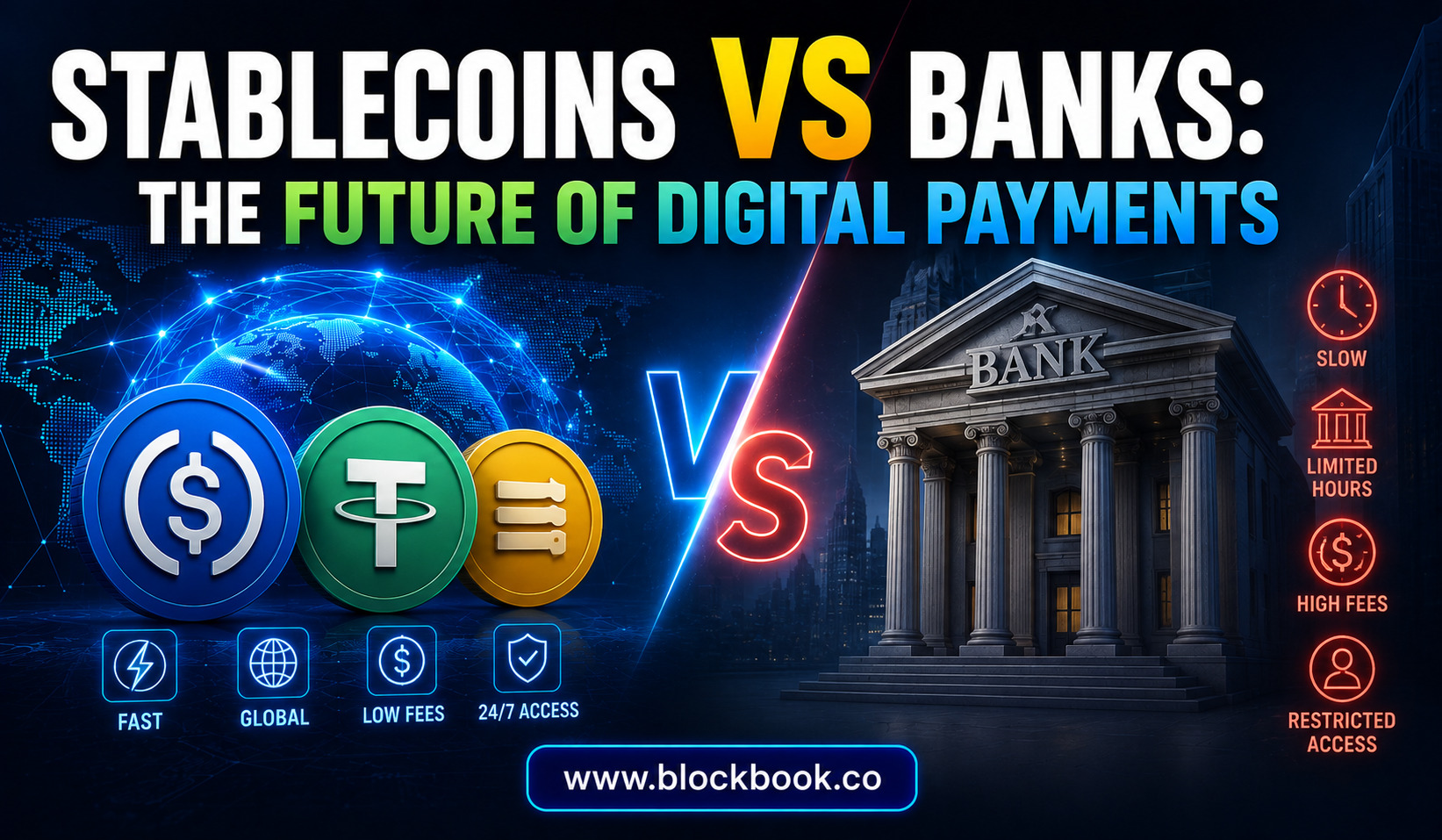
Digital payments are changing rapidly. For decades, banks and traditional payment networks have been the foundation of global money transfers. People use bank accounts, cards, payment apps and wire transfers every day without thinking about the complex infrastructure operating behind them.
Now, stablecoins are challenging parts of that system.
Stablecoins are blockchain-based digital assets designed to maintain a relatively stable value, usually by tracking currencies such as the U.S. dollar. Unlike volatile cryptocurrencies such as Bitcoin, stablecoins are designed primarily for payments, transfers, trading and financial settlement.
This creates an important question: Will stablecoins eventually replace banks in digital payments, or will banks use stablecoins to improve the financial system?
The most likely future may not be a simple battle between the two. Instead, stablecoins and banks could become increasingly connected, with each playing a different role.
What Are Stablecoins?
Stablecoins are digital tokens that attempt to maintain a stable value against another asset, most commonly a fiat currency.
A dollar-backed stablecoin, for example, aims to maintain a value close to one U.S. dollar.
The idea is straightforward. Users get the programmability and transferability of blockchain technology without taking the same level of price risk associated with cryptocurrencies that can move dramatically within hours.
Stablecoins can operate 24/7 and can be transferred between compatible blockchain addresses without relying entirely on traditional banking rails.
This makes them particularly interesting for digital commerce and international payments.
Why Stablecoins Are Different
Stablecoins combine characteristics of traditional money and blockchain technology.
Some of their potential advantages include:
- 24/7 transfer capability
- Global accessibility
- Programmable transactions
- Potentially faster settlement
- Lower barriers for certain cross-border transfers
However, stablecoins also introduce new challenges involving regulation, reserves, custody, cybersecurity and issuer risk.
How Traditional Banks Handle Digital Payments
Banks have developed sophisticated payment infrastructure over many decades.
When a customer sends money to another person, several systems may be involved behind the scenes. Payment processors, correspondent banks, clearing systems and settlement networks can all play a role depending on the transaction.
Domestic transfers can be relatively fast, especially in countries with modern instant-payment infrastructure.
Cross-border payments are more complicated.
International transfers can involve multiple institutions, currency conversions, compliance checks and settlement processes.
The banking system therefore provides something stablecoins do not automatically provide: a broad regulatory framework and established relationships with governments, businesses and consumers.
Banks also provide services beyond payments.
Customers can hold deposits, obtain loans, receive salaries, access credit and manage investments through the same institution.
That makes banks much more than payment networks.
Stablecoins vs Banks: The Key Difference
The biggest difference is that stablecoins are primarily digital payment assets, while banks are full financial institutions.
A stablecoin can move value from one blockchain address to another.
A bank can hold deposits, lend money, issue credit, process payments, provide custody, manage investments and perform many other functions.
This means comparing stablecoins directly with banks is not entirely fair.
A better comparison is stablecoins versus traditional payment infrastructure.
Speed: Stablecoins Have an Advantage
Blockchain networks operate continuously.
A stablecoin transfer can potentially be initiated at any hour, including weekends and holidays.
Traditional banking systems have increasingly improved their speed, but international transfers can still involve delays depending on the payment route and participating institutions.
Stablecoins can reduce some of those intermediate steps.
For businesses operating globally, this could be valuable.
A company receiving payment from another country may not want to wait several business days for funds to settle. A blockchain-based payment could potentially move value much faster.
However, speed depends on the blockchain, stablecoin, exchange, wallet and conversion process.
Stablecoins are not automatically instant in every situation.
Cost: Can Stablecoins Beat Banks?
Cost is another major area of competition.
Traditional cross-border payments can involve multiple fees, including transfer charges, currency conversion costs and intermediary fees.
Stablecoin transfers can potentially reduce some of these expenses because blockchain networks can move digital assets directly between addresses.
But the final cost depends on the network and transaction conditions.
Users may still face blockchain fees, exchange fees, conversion spreads or withdrawal charges.
For small transactions, these costs can matter.
For large international payments, however, the potential efficiency of stablecoins could become more significant.
Cross-Border Payments Could Be the Biggest Opportunity
The strongest use case for stablecoins may be international money movement.
Sending money across borders can be complicated because countries use different currencies, banking systems and regulatory frameworks.
Stablecoins can create a common digital settlement asset.
For example, a business in one country could receive a dollar-denominated stablecoin from a customer in another country and convert it into local currency when needed.
This does not eliminate regulation or banking relationships, but it can simplify the movement of digital value.
That is why stablecoins are increasingly being discussed as potential infrastructure for global payments.
Stablecoins and Banks Could Work Together
The future may not be stablecoins versus banks.
It could be stablecoins with banks.
Banks could issue their own digital tokens or use third-party stablecoins for settlement.
They could provide custody, compliance, conversion and account services around blockchain-based payments.
In this model, the blockchain handles part of the transfer while banks continue providing financial services around it.
This could create a hybrid system where consumers may not even realize a blockchain is being used.
Imagine paying for something through a familiar banking application while the underlying settlement occurs through a stablecoin network.
For the customer, the experience could look almost identical to today’s digital payments.
The infrastructure underneath would simply be different.
Why Banks Still Have Major Advantages
Stablecoins may be fast and programmable, but banks have several advantages that are difficult to replicate.
Banks operate within established regulatory frameworks and have long-standing relationships with customers and businesses.
They also provide important financial services that stablecoins cannot replace on their own.
These include:
- Lending and credit
- Deposit accounts
- Business financing
- Wealth management
A stablecoin wallet does not automatically provide these services.
This means stablecoins are more likely to change the way money moves than completely replace the banking system.
Programmable Money Could Change Payments
One of the most interesting features of stablecoins is programmability.
Traditional money can be transferred electronically, but blockchain-based assets can be designed to interact directly with software and smart contracts.
This could allow payments to become more automated.
A business could potentially create payment conditions where funds are released automatically after certain requirements are met.
A global company could automate recurring settlements between suppliers.
Digital platforms could distribute payments programmatically.
These possibilities could make stablecoins particularly useful in financial systems that rely heavily on automation.
Stablecoins and Online Commerce
E-commerce could also benefit from blockchain-based payments.
Traditional card payments involve payment processors, banks and other intermediaries.
Stablecoins could provide another option for online businesses, especially those operating internationally.
Customers could potentially pay with digital dollars while merchants receive the equivalent value through a stablecoin or convert it into local currency.
The biggest challenge is user adoption.
Most consumers do not want to understand wallets, blockchain addresses or private keys simply to purchase a product.
For stablecoins to become mainstream, payment experiences will need to become much simpler.
What About Regulation?
Regulation could determine how quickly stablecoins become part of mainstream finance.
Governments need to answer questions about reserves, consumer protection, issuer requirements, taxation, money laundering controls and redemption.
A stablecoin designed to maintain a one-dollar value needs users to trust that it can actually maintain that value.
That trust depends partly on the quality of its reserves and the reliability of its issuer.
Regulation could therefore be both a challenge and an opportunity.
Strict rules may increase compliance costs, but clear rules could also increase confidence among businesses and financial institutions.
Stablecoins vs Banks: Comparison
| Feature | Stablecoins | Banks |
| Operating hours | 24/7 blockchain-based | Depends on payment system |
| Cross-border transfers | Potentially faster | Can involve multiple intermediaries |
| Programmability | High | More limited |
| Regulation | Developing framework | Highly established |
| Lending | Not inherent | Core banking function |
| Deposits | Token-based | Traditional deposits |
| Global accessibility | Potentially broad | Depends on banking access |
| Consumer protection | Varies by issuer and jurisdiction | Established frameworks |
| Infrastructure | Blockchain networks | Traditional financial networks |
| Main strength | Digital value transfer | Full financial services |
Could Stablecoins Replace Bank Accounts?
For most consumers, completely replacing bank accounts is unlikely in the near future.
People use banks for much more than transferring money.
They need mortgages, personal loans, credit cards, savings products, investment services and financial advice.
Stablecoins could instead become another form of digital money that sits alongside traditional bank deposits.
A consumer might eventually have both.
They could keep salary and savings in a bank account while using stablecoins for international purchases, digital commerce or blockchain-based applications.
That would make stablecoins complementary rather than directly competitive with banks.
The Role of Central Banks
Central banks are also paying attention to the evolution of digital money.
Central bank digital currencies, faster payment systems and updated financial regulations could influence how stablecoins develop.
Central banks may want to maintain control over monetary systems while allowing private companies to innovate.
This could lead to a financial environment containing several forms of digital money:
- Traditional bank deposits
- Stablecoins issued by private companies
- Potential central bank digital currencies
The competition between these models could shape the next generation of payments.
Challenges Stablecoins Must Overcome
Despite their potential, stablecoins face significant challenges.
The first is trust.
Users need confidence that the token can maintain its intended value and that redemption mechanisms will work when needed.
The second is regulation.
Different countries may establish different requirements, making global stablecoin operations more complicated.
The third is user experience.
Blockchain technology remains unfamiliar to many consumers.
Finally, stablecoins depend on blockchain infrastructure. Network congestion, technical failures or security problems could affect payment reliability.
For mainstream adoption, these issues will need to become less visible to ordinary users.
Frequently Asked Questions
Are stablecoins better than banks for payments?
Stablecoins can be faster and more programmable, especially for certain digital and cross-border transactions. Banks remain stronger for regulated financial services, deposits, lending and consumer protection.
Will stablecoins replace banks?
A complete replacement is unlikely. Stablecoins are more likely to become another payment and settlement layer that banks and businesses use alongside traditional financial infrastructure.
Are stablecoin payments faster?
They can be. Blockchain networks operate continuously, allowing transactions to be processed outside traditional banking hours. Actual speed depends on the network and payment infrastructure involved.
Can stablecoins be used internationally?
Yes. Stablecoins can potentially transfer value across borders without requiring the same traditional payment route used by conventional bank transfers. However, currency conversion and regulatory requirements can still apply.
Are stablecoins safe?
Their risks vary by issuer, reserve structure, blockchain and regulatory environment. Stablecoins are designed for price stability, but that does not mean they are completely risk-free.
Why are banks interested in stablecoins?
Banks may see stablecoins as an opportunity to improve settlement, international payments, digital asset services and financial infrastructure while creating new products for customers.
The Future of Digital Payments
The debate over stablecoins vs banks is likely to become less about replacement and more about integration.
Banks have the relationships, regulatory structures and financial services that consumers and businesses rely on. Stablecoins offer programmable digital value that can move across blockchain networks continuously.
The combination could be powerful.
A future payment may begin with a customer using a banking application, move through a stablecoin network and settle with a merchant in another country. The customer may never need to know that blockchain technology was involved.
This is perhaps the most realistic vision for mainstream adoption.
Stablecoins do not need to destroy banks to transform payments.
They simply need to make certain parts of the financial system faster, cheaper and more programmable.
Final Thoughts
Stablecoins and banks are likely to compete in some areas while working together in others.
Stablecoins have clear potential in cross-border payments, digital commerce, automated settlement and blockchain-based financial applications. Banks remain essential because they provide credit, deposits, wealth management, compliance and a wide range of financial services.
The most important development could therefore be the creation of a hybrid financial system.
Traditional banking may continue to serve as the foundation for everyday finance, while stablecoins become a new digital layer for moving money around the world.
If regulation becomes clearer and stablecoin technology becomes easier to use, digital payments could become faster, more global and more programmable than they are today.
The future may not be stablecoins versus banks. It may be banks powered by stablecoins.
About the Author