
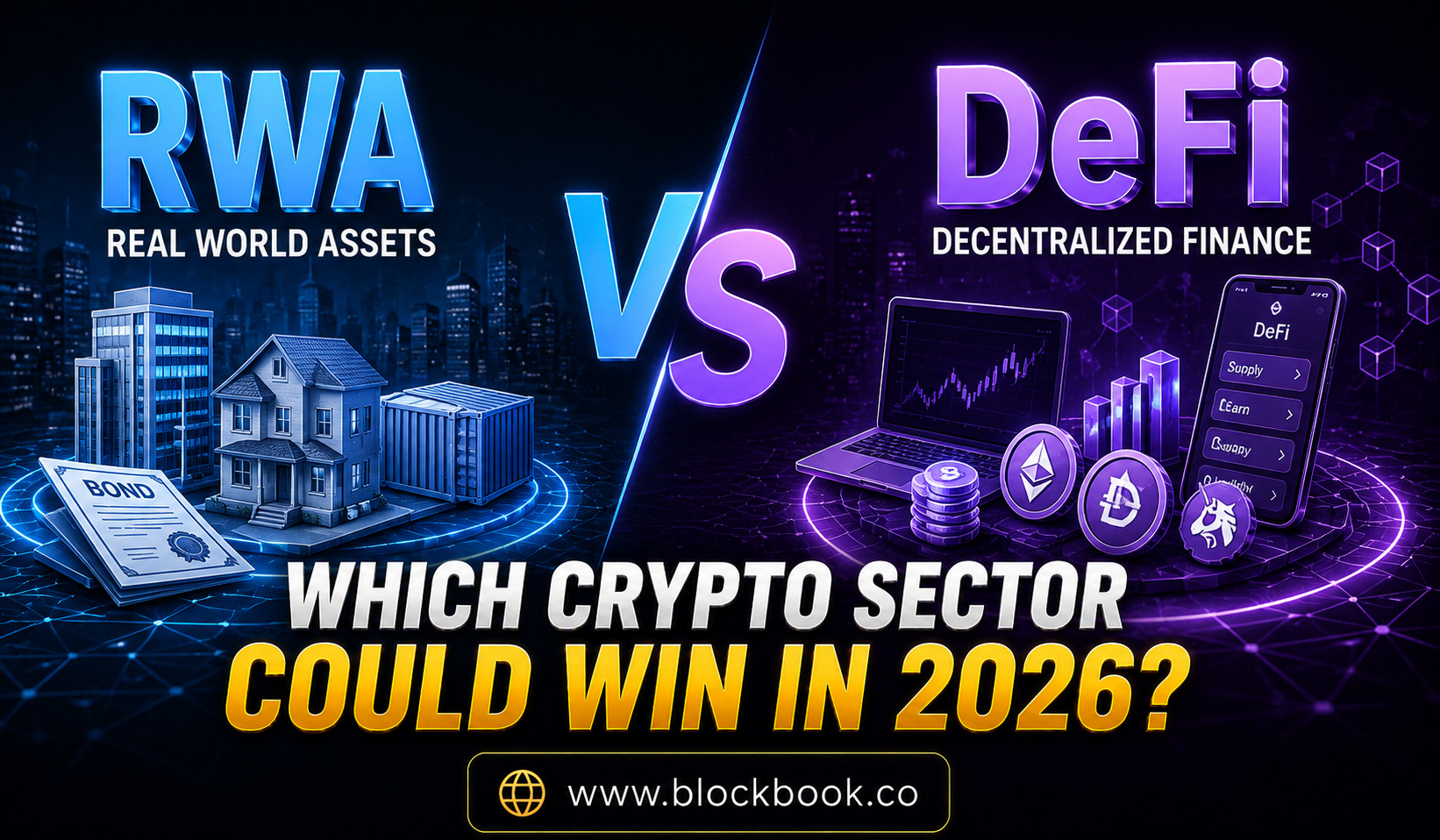
The cryptocurrency industry is entering a more mature phase in 2026. Instead of focusing only on speculative tokens and short-term price movements, investors and developers are increasingly interested in blockchain applications that could support real financial activity.
Two sectors are at the center of this shift: Real-World Assets (RWA) and Decentralized Finance (DeFi).
DeFi aims to recreate or improve financial services using smart contracts and blockchain networks. RWA focuses on bringing traditional assets such as bonds, funds, credit products and other financial instruments onto blockchains.
Both sectors have significant potential.
But which one could become the bigger crypto opportunity in 2026?
The answer may depend on what the market values most. DeFi has the advantage of being crypto-native and already has a large ecosystem. RWA has the potential to connect blockchain technology with the enormous traditional financial system.
What Are RWAs?
Real-World Assets are traditional financial or physical assets represented in digital form on a blockchain.
The concept can apply to many types of assets, including:
- Government securities
- Real estate
- Corporate credit
- Investment funds
Tokenization can potentially make these assets easier to transfer, track and integrate with blockchain-based applications.
For example, a traditional financial instrument could be represented by a blockchain token. That token could then potentially be transferred between approved participants or used within a broader digital financial ecosystem.
The important idea is that RWA projects do not necessarily create entirely new assets.
Instead, they bring existing economic value onto blockchain infrastructure.
What Is DeFi?
Decentralized Finance uses blockchain networks and smart contracts to provide financial services without relying entirely on traditional intermediaries.
Users can potentially trade assets, lend money, borrow funds and provide liquidity through decentralized applications.
DeFi became one of crypto’s biggest growth sectors during previous market cycles.
Its appeal comes from accessibility and programmability.
A user with an internet connection and compatible wallet can potentially interact with decentralized financial applications without opening a traditional bank account or obtaining permission from a financial institution.
However, DeFi also has significant risks, including smart-contract vulnerabilities, market volatility, liquidity problems and regulatory uncertainty.
RWA vs DeFi: The Biggest Difference
The simplest way to understand the difference is this:
DeFi is primarily focused on the financial infrastructure.
RWA is primarily focused on the assets themselves.
This distinction could become less important over time because the two sectors can work together.
A tokenized government security, for example, could potentially become collateral in a decentralized lending protocol.
That means RWA and DeFi are not necessarily competitors.
They could eventually become complementary parts of the same blockchain economy.
Why RWA Is Growing in 2026
The strongest argument for RWAs is their connection to traditional finance.
The global financial system already contains enormous amounts of capital.
If even a small portion of that value moves onto blockchain networks, the potential market is much larger than the existing crypto-native economy.
Tokenization could improve settlement, automate administrative processes and allow assets to interact with programmable financial applications.
This creates a compelling reason for banks, asset managers and financial technology companies to explore blockchain technology.
Unlike some crypto narratives that depend heavily on speculation, RWA adoption can be driven by efficiency.
That makes the sector particularly interesting in a market that is becoming more focused on practical applications.
Why DeFi Still Has a Strong Advantage
DeFi has something RWA projects cannot easily reproduce: a mature crypto-native ecosystem.
Decentralized exchanges, lending protocols, stablecoin markets and liquidity platforms already serve millions of users across multiple blockchain networks.
Developers also have years of experience building open financial applications.
This gives DeFi a significant first-mover advantage.
The sector has also learned from its earlier problems.
The next generation of DeFi applications is increasingly focused on better security, improved user experience, deeper liquidity and more sustainable economic models.
If these improvements continue, DeFi could remain one of the core financial layers of the crypto industry.
Stablecoins Connect RWA and DeFi
Stablecoins could become the bridge between these two sectors.
Stablecoins provide blockchain-based representations of relatively stable currencies and are already heavily used in crypto trading and decentralized finance.
RWAs can expand the types of assets available on-chain, while DeFi provides applications that allow those assets to be traded, borrowed against or used as collateral.
This creates a potentially powerful cycle.
More tokenized assets can increase the amount of capital available to DeFi. More DeFi infrastructure can make tokenized assets more useful.
The result could be a financial ecosystem where traditional and decentralized assets interact on the same blockchain infrastructure.
RWA vs DeFi: Key Comparison
| Factor | RWA | DeFi |
| Main focus | Tokenized traditional assets | Decentralized financial services |
| Primary users | Institutions and investors | Crypto users and investors |
| Main advantage | Access to traditional financial value | Open and programmable finance |
| Regulation | Highly important | Developing and complex |
| Adoption stage | Rapidly developing | More mature |
| Main risks | Regulation, custody and asset verification | Smart contracts, liquidity and market risk |
| Growth potential | Very large | Very large |
| Connection to TradFi | High | Increasing |
The table shows why both sectors have strong arguments.
RWA has access to a potentially enormous pool of traditional capital. DeFi already has the infrastructure and users required to create a functioning on-chain financial market.
Could RWA Become the Bigger Narrative?
RWA could become one of the strongest crypto narratives if institutional adoption accelerates.
Banks and asset managers do not necessarily need to embrace decentralized tokens to benefit from blockchain technology.
They may simply use tokenization to improve existing financial products.
For example, a fund could issue blockchain-based shares. A financial institution could tokenize government securities. A lending platform could represent credit agreements digitally.
These applications could operate within regulated frameworks while still benefiting from blockchain infrastructure.
This makes RWA attractive to institutions that may be uncomfortable with highly speculative crypto assets.
The Institutional Advantage
Institutional participation could give RWA a major boost.
Traditional financial firms manage enormous amounts of capital, and they are increasingly exploring digital settlement and tokenized financial products.
If tokenization becomes more efficient and regulatory frameworks become clearer, RWA adoption could accelerate.
The potential market is therefore much larger than crypto alone.
DeFi may have billions of dollars moving through its protocols, but traditional financial markets represent vastly larger pools of assets.
Even limited tokenization could have a meaningful impact on blockchain adoption.
Could DeFi Still Win?
Absolutely.
DeFi has the advantage of being more open and flexible.
RWA products often require legal structures, custodians, identity verification and compliance procedures.
DeFi can operate through permissionless smart contracts.
For users who value open access, composability and self-custody, DeFi remains highly attractive.
DeFi also creates financial products that may not have direct equivalents in traditional finance.
Decentralized exchanges, automated market makers and permissionless lending protocols are examples of applications built specifically around blockchain technology.
RWA can bring traditional finance onto blockchain, but DeFi can create entirely new forms of financial interaction.
The Biggest Opportunity May Be RWA + DeFi
The most interesting outcome may not be RWA defeating DeFi.
It could be RWA powering the next generation of DeFi.
Imagine a decentralized lending market where users can provide tokenized government securities as collateral.
Or consider a financial platform where tokenized funds can be traded around the clock.
These examples show how the two sectors can reinforce each other.
RWA supplies new forms of value.
DeFi supplies the financial infrastructure.
Together, they could create a much larger blockchain economy.
What Could Drive Growth in 2026?
Several developments could determine which sector gains the most momentum:
- Greater regulatory clarity
- More institutional blockchain adoption
- Expansion of stablecoins
- Improved blockchain scalability
If these trends continue, both RWA and DeFi could benefit.
However, RWA may have more direct exposure to institutional capital, while DeFi may benefit more from retail and crypto-native users.
Risks That Could Slow RWA
RWA is promising, but tokenization is not as simple as creating a blockchain token.
The underlying asset still needs legal recognition.
Someone must verify ownership, manage custody and ensure that the token actually represents the promised asset.
This introduces centralized points of control.
A tokenized property may exist on a decentralized blockchain, but the legal rights associated with that property still depend on contracts and institutions.
RWA therefore cannot completely eliminate intermediaries.
Its value comes from making those relationships more efficient and transparent.
Risks That Could Slow DeFi
DeFi has its own problems.
Smart-contract vulnerabilities remain a major concern.
A protocol can have strong technology and still suffer from an exploit.
Liquidity can also disappear quickly during market stress.
Regulatory uncertainty could create additional challenges for decentralized applications, especially those that provide services traditionally offered by regulated financial institutions.
DeFi’s long-term success will depend on improving security without sacrificing the openness that makes it attractive.
Which Sector Could Win in 2026?
If the definition of “winning” means institutional adoption and connection with traditional finance, RWA may have the advantage.
If winning means crypto-native activity, innovation and decentralized financial services, DeFi remains extremely strong.
The difference is becoming less important because the sectors are increasingly overlapping.
A tokenized asset can become part of a DeFi protocol. A DeFi platform can provide markets for tokenized assets.
This convergence could ultimately be more important than the competition itself.
Frequently Asked Questions
What is the difference between RWA and DeFi?
RWA focuses on bringing traditional assets onto blockchain networks, while DeFi focuses on creating financial services through decentralized applications and smart contracts.
Is RWA bigger than DeFi?
RWA has access to the much larger traditional financial market, but DeFi currently has a more established crypto-native ecosystem. Both have significant growth potential.
Can RWA and DeFi work together?
Yes. Tokenized real-world assets can potentially be used within DeFi applications for trading, lending, collateral and other financial activities.
Why are institutions interested in RWA?
Institutions may see tokenization as a way to improve settlement, transparency, automation and access to digital financial infrastructure without relying entirely on speculative cryptocurrencies.
Is DeFi still relevant in 2026?
Yes. DeFi remains an important part of the crypto ecosystem, particularly in decentralized trading, lending, liquidity and stablecoin applications.
Which sector is better for investors?
Neither sector is automatically better. RWA may benefit from institutional adoption, while DeFi offers exposure to decentralized financial innovation. Investors should evaluate individual projects, risks and use cases rather than relying only on sector narratives.
Final Verdict: RWA vs DeFi
The debate over RWA vs DeFi may eventually prove to be less about choosing a winner and more about understanding how the two sectors fit together.
RWA has the potential to bring enormous amounts of traditional financial value onto blockchain networks. DeFi already provides an ecosystem capable of trading, lending and interacting with digital assets.
That creates a powerful combination.
RWA could bring traditional capital to blockchain, while DeFi could provide the infrastructure that makes those tokenized assets useful.
In 2026, RWA may have the stronger institutional narrative, while DeFi remains the stronger crypto-native ecosystem.
The biggest opportunity could emerge where the two meet.
If tokenization accelerates and DeFi becomes more secure and mature, blockchain-based finance could move beyond speculative markets and become a genuine part of the global financial system.
RWA may bring the assets. DeFi may provide the financial engine. And together, they could shape the next major chapter of crypto.
About the Author