
Introduction
Choosing how to trade can matter as much as choosing what to trade. Spot trading and margin trading are two of the most common ways people buy and sell assets, and they work very differently under the hood. One uses only the money you already have, while the other lets you borrow funds to trade bigger positions. This guide breaks down both methods in plain language, so you can see which one actually fits your goals and comfort with risk.
What Is Spot Trading
Spot trading means buying or selling an asset for immediate delivery at the current market price. You pay full price with money you already own, and the asset becomes yours right away.
There is no borrowing involved here. If you buy one unit of an asset, you own exactly one unit, nothing more.
This simplicity is a big reason spot trading is often the starting point for new traders. What you see is what you get, and your losses are limited to the amount you put in.
What Is Margin Trading
Margin trading lets you borrow money from a broker or exchange to open a larger position than your own cash would normally allow. You put up a portion of the total value yourself, known as collateral, and borrow the rest.
This borrowed money increases your buying power, but it also increases both potential gains and potential losses. A small price move can have a much bigger effect on your account than it would in spot trading.
Because you are trading with borrowed funds, the platform will usually require you to maintain a minimum account balance. If your losses push your balance below that level, you may face a margin call or automatic liquidation of your position.
How the Two Actually Differ
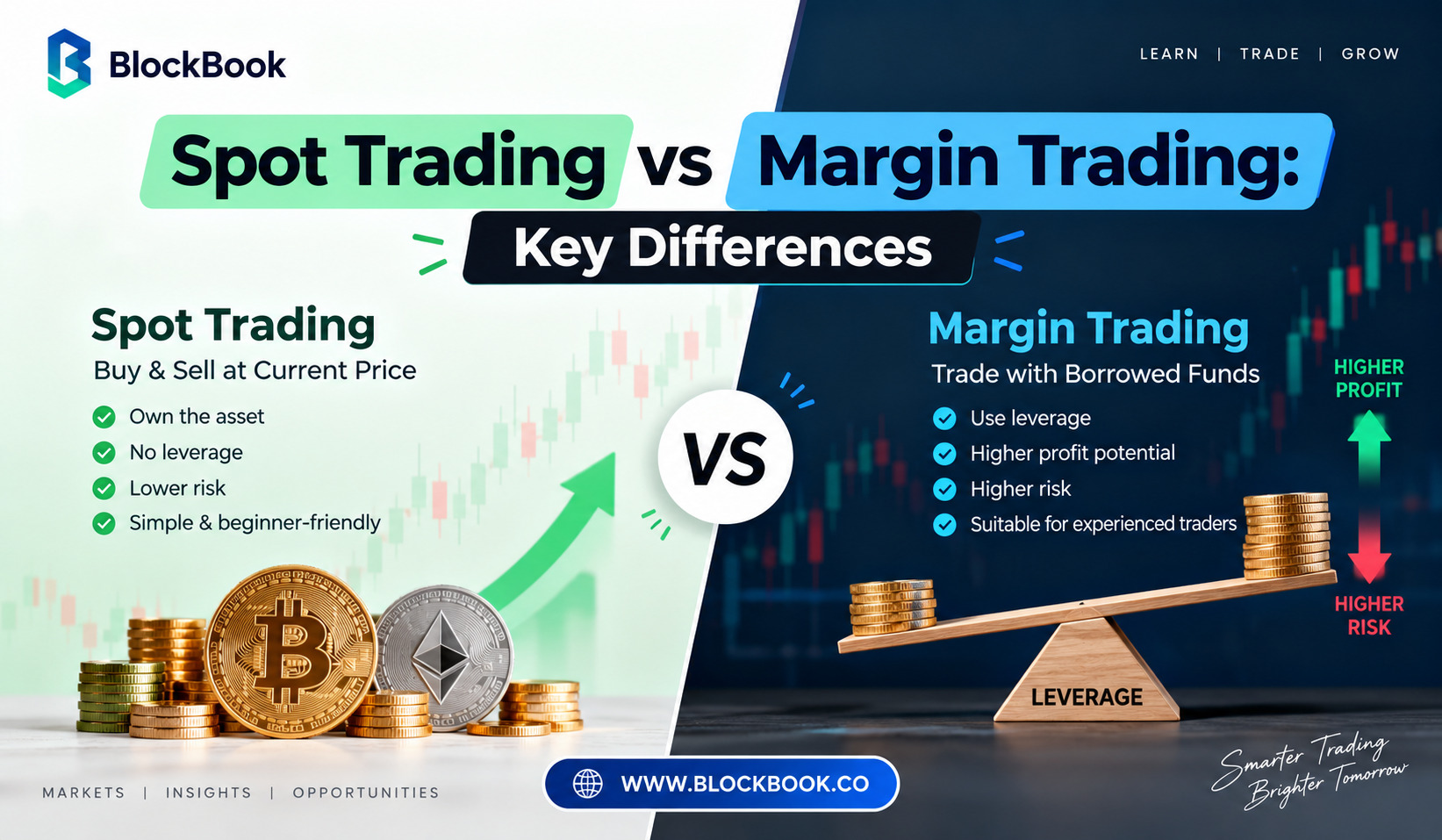
The core difference comes down to ownership and borrowed funds. In spot trading, you own the asset outright. In margin trading, part of your position is financed by debt.
Here is a simple side-by-side comparison:
- Ownership: Spot gives full ownership; margin involves borrowed funds
- Capital needed: Spot requires the full amount upfront; margin requires only a portion
- Position size: Spot limits you to what you can afford; margin allows larger positions
- Liquidation risk: Spot has none; margin can trigger forced position closure
- Complexity: Spot is simpler to understand; margin requires tracking additional account metrics
Leverage Explained
Margin trading often involves leverage, a ratio showing how much borrowed money is being used compared to your own funds. Higher leverage means bigger potential swings in both directions.
Risk Levels Compared
Risk is where these two approaches separate the most. Spot trading carries straightforward risk. If the price drops, your holdings lose value, but you never owe money beyond what you invested.
Margin trading carries a sharper edge. Because losses are calculated against a leveraged position, a drop that would be minor in spot trading can wipe out a margin account much faster.
There is also the added risk of liquidation. An exchange can automatically close your margin position if your losses reach a certain point, sometimes locking in a loss you might have otherwise recovered from.
Costs and Fees to Expect
Spot trading generally involves a straightforward trading fee charged per transaction. Fee structures vary by platform, but the cost is usually simple to calculate.
Margin trading adds another layer of cost. On top of standard trading fees, you typically pay interest on the amount you borrow, charged for as long as the position stays open.
These borrowing costs can add up over time, especially if a position is held for days or weeks rather than closed quickly. This is one reason margin trading tends to suit shorter holding periods.
Which Style Fits Which Trader
Neither approach is universally better. The right choice depends on experience, risk tolerance, and how much time you can dedicate to watching the market.
Good Fit for Spot Trading
Beginners, long-term investors, and anyone who prefers not to actively monitor positions throughout the day tend to do well with spot trading.
Good Fit for Margin Trading
Experienced traders who understand leverage, can monitor positions closely, and have a clear risk management plan may find margin trading useful for short-term strategies.
Common Mistakes to Avoid With Each
Spot Trading Mistakes
Putting all your funds into a single asset is a frequent error. Spreading funds across a few assets can reduce the impact of any one position underperforming.
Margin Trading Mistakes
Using high leverage without a clear exit plan is one of the fastest ways to lose an account. New margin traders also often underestimate how quickly interest costs and liquidation risk can stack up against them.
Ignoring margin call warnings until it is too late is another common misstep. Reacting early, rather than waiting, can prevent a small problem from becoming a forced liquidation.
Key Takeaways
- Ownership differs: Spot trading means full ownership, margin trading involves borrowed funds.
- Risk is amplified with margin: Leverage increases both potential gains and potential losses.
- Margin adds costs: Interest on borrowed funds is charged in addition to normal trading fees.
- Liquidation is unique to margin: Spot positions cannot be forcibly closed by a broker.
- Beginners often start with spot: Its simplicity makes it easier to learn the basics safely.
FAQs
Can I lose more than I invest in spot trading?
spot trading losses are limited to the amount of money you originally invested.
Can I lose more than I invest in margin trading?
Yes, margin trading can result in losses that exceed your initial investment, depending on the platform and leverage used.
Is margin trading only for experienced traders?
Margin trading is generally recommended for traders who already understand leverage and risk management.
Do I pay interest in spot trading?
No, spot trading does not involve borrowed funds, so there is no interest charge.
What triggers a margin call?
A margin call happens when your account balance falls below the minimum level required to keep a leveraged position open.
Conclusion
Spot trading and margin trading serve different purposes, and understanding their differences helps you trade with more confidence. Spot trading offers simplicity and limited risk, while margin trading offers larger position sizes at the cost of added risk and borrowing fees. Choosing between spot trading and margin trading ultimately comes down to your experience level, risk tolerance, and how closely you plan to manage your positions.
About the Author