Buying or selling crypto sounds simple until the exchange asks you to pick an order type. Most beginners freeze at that screen. Understanding crypto market orders vs limit orders is one of the first real skills every trader needs, because the choice affects your price, your timing, and sometimes how much you pay in fees. This article walks through both order types in plain language, so you can pick the right one without guessing.
What Is a Market Order?
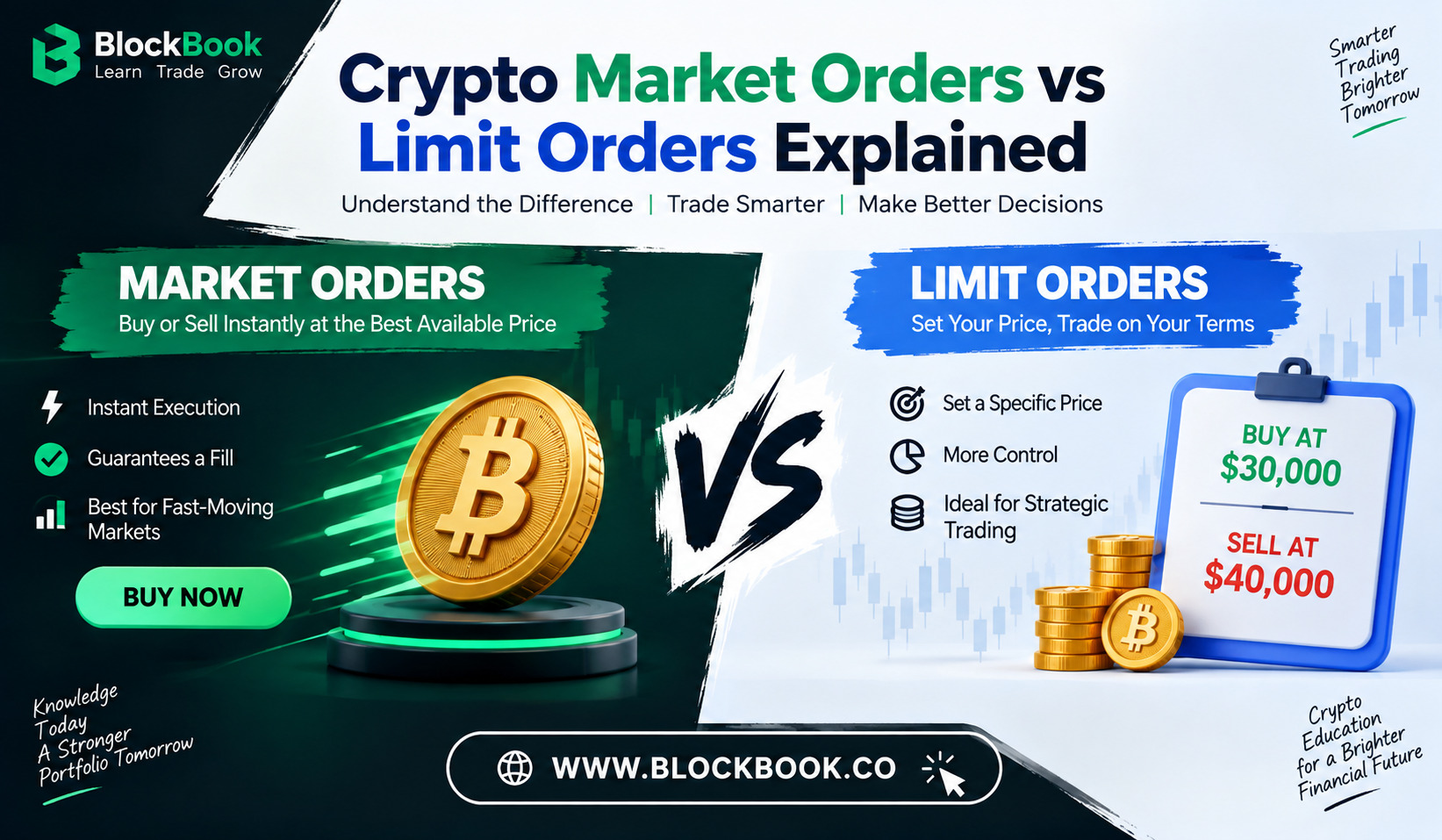
A market order tells the exchange to buy or sell right now, at whatever price is currently available. You are not naming a price. You are asking for speed.
Here is what happens behind the scenes:
- The exchange matches your order against the best available price on the order book.
- If you are buying, you get matched against the lowest sell offers.
- If you are selling, you get matched against the highest buy offers.
- The trade fills almost instantly, assuming there is enough liquidity.
The tradeoff is control. You get speed, but you give up the ability to set an exact price.
Example
Say Bitcoin is trading around 60,000 dollars, but the order book only has small amounts available at that price. A large market buy order might fill part of itself at 60,000, then the next chunk at 60,050, and so on, until the whole order is filled. Your average price ends up higher than the price you first saw on the screen.
What Is a Limit Order?
A limit order lets you set the exact price you are willing to buy or sell at. The order sits on the exchange’s order book until the market reaches your price, or until you cancel it.
- A buy limit order only fills at your price or lower.
- A sell limit order only fills at your price or higher.
- If the market never reaches your price, the order simply does not execute.
This gives you price control, but you lose the guarantee of an instant fill.
Example
If Bitcoin is trading at 60,000 dollars and you place a buy limit order at 58,000, nothing happens until the price actually drops to 58,000. It might take minutes. It might take days. It might never happen at all.
Crypto Market Orders vs Limit Orders: The Core Differences
Put side by side, the difference comes down to two questions: do you want speed, or do you want price control?
| Feature | Market Order | Limit Order |
| Execution speed | Immediate | Only when price is reached |
| Price control | None | Full control |
| Risk of slippage | Higher | None |
| Risk of no fill | None | Possible |
| Best for | Fast-moving situations | Patient, planned trades |
A market order is like walking into a shop and paying whatever price is on the tag right now. A limit order is like telling the shop, “call me when this item drops to the price I want.”
When to Use a Market Order
Market orders make sense in a handful of situations.
- You need to exit a position fast. If the market is crashing and you want out immediately, a market order gets you out without waiting.
- You are trading a highly liquid coin. Bitcoin and Ethereum usually have deep order books, so slippage is often small.
- Price precision matters less than timing. Sometimes being in or out of a trade matters more than saving a few dollars per coin.
A word of caution: market orders can behave unpredictably during high volatility, when prices swing fast and order books thin out. That is exactly when slippage tends to be at its worst.
When to Use a Limit Order
Limit orders fit a different kind of trader, one who is planning ahead rather than reacting.
- You want to buy a dip. Set a limit order below the current price and let it wait for the market to come to you.
- You are not in a rush. If missing a trade is fine, a limit order avoids overpaying.
- You trade less liquid coins. Smaller-cap tokens often have thin order books, where a market order can cause serious price slippage.
Some traders combine both: a limit order for planned entries, and a market order reserved for emergencies. That mix works well once you get comfortable with both tools.
Slippage, Fees, and Order Books: What Changes Between the Two
Slippage is the gap between the price you expected and the price you actually got. Market orders are more exposed to slippage because they chase whatever price is available, layer by layer, until the order is filled.
Limit orders avoid slippage entirely. You either get your exact price, or you get nothing.
Fees can differ too. Many exchanges charge lower “maker” fees for limit orders, since they add liquidity to the order book by sitting there waiting. Market orders are usually charged a higher “taker” fee, since they remove liquidity by matching instantly against existing orders. It is worth checking your specific exchange’s fee schedule, since these structures vary from platform to platform.
Common Mistakes Beginners Make
A few patterns show up again and again with new traders.
- Using a market order during low liquidity. This is where slippage hits hardest, especially with smaller altcoins.
- Setting a limit price too far from the current market. The order can sit unfilled for a long time, or forever.
- Forgetting that limit orders are not guaranteed. A big price gap can jump straight past your limit price without ever triggering a fill.
- Ignoring fee differences. Repeatedly using market orders when a limit order would work fine adds up in taker fees over time.
Avoiding these mistakes usually comes down to matching the order type to the situation, not defaulting to one out of habit.
Key Takeaways
- Market orders fill instantly at the best available price, but carry a risk of slippage.
- Limit orders let you set your price, but the trade might never execute.
- Best use case for market orders: fast exits or highly liquid coins.
- Best use case for limit orders: planned entries, dip buying, or thinly traded tokens.
- Fees: limit orders often qualify for lower maker fees, while market orders usually pay taker fees.
- Biggest beginner mistake: using a market order on a low-liquidity coin and getting a worse average price than expected.
Frequently Asked Questions
Is a market order or limit order better for beginners?
Limit orders are usually safer for beginners because they remove the risk of unexpected slippage.
Can a limit order fail to execute?
Yes, if the market price never reaches your set limit price, the order stays open or expires unfilled.
Do market orders always execute instantly?
In most cases yes, as long as there is enough liquidity on the order book to match your order size.
Which order type has lower fees?
Limit orders often qualify for lower maker fees, while market orders typically pay higher taker fees.
Can I use both order types in the same trading strategy?
Yes, many traders use limit orders for planned entries and market orders for urgent exits.
Conclusion
Choosing between crypto market orders vs limit orders really comes down to what you value more in a given moment: speed or price control. Market orders get you in or out immediately, but you accept whatever price the market gives you. Limit orders let you name your price, but there is no promise the market will ever meet it. Most experienced traders end up using both, switching between them depending on how urgent the trade is and how liquid the coin happens to be.
About the Author