
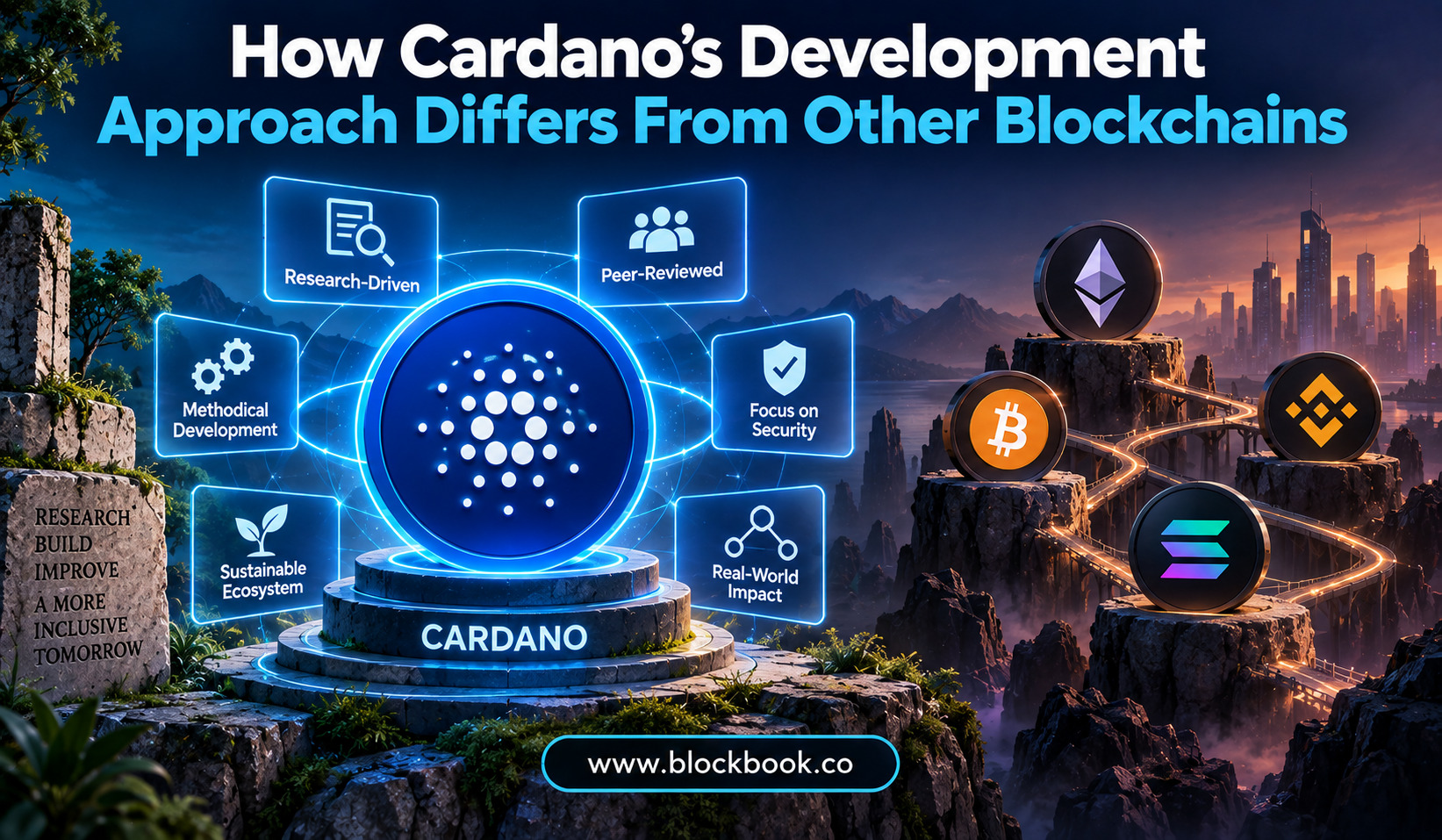
The blockchain industry has grown into a highly competitive technology market, with networks taking very different approaches to security, scalability, smart contracts and governance. Some projects prioritize rapid development and frequent upgrades, while others place greater emphasis on formal verification, academic research and carefully structured protocol changes.
Cardano has developed a distinct identity within this environment. Its development process has traditionally emphasized peer-reviewed research, formal specifications and staged network upgrades before implementing major features. Rather than treating blockchain development primarily as an iterative software process, Cardano combines academic research with engineering and testing to establish a technical foundation for its protocol.
This approach has influenced almost every part of the network, from its Ouroboros proof-of-stake consensus mechanism to its extended UTXO accounting model, smart-contract platform and governance system. Cardano’s development has also evolved through distinct eras, each introducing specific capabilities and infrastructure improvements.
A Research-First Philosophy
One of the most frequently cited differences between Cardano and other blockchain projects is its research-first development philosophy. Cardano’s core protocols are supported by academic papers and technical specifications, with research made publicly available through the project’s documentation.
The approach is particularly visible in the development of Ouroboros, Cardano’s proof-of-stake consensus protocol. Cardano’s documentation notes that the Ouroboros family was developed through peer-reviewed research and that its security properties have been studied formally.
The idea is not simply to write software and test whether it works. Instead, important protocol concepts can be mathematically specified and analyzed before implementation. Cardano’s developer documentation describes its architecture as formally specified, with the ledger and other core components defined independently of their implementation.
This can make the development process more deliberate than approaches where new features are introduced primarily through rapid software iteration.
Formal Methods and Verification
Formal methods are another major component of Cardano’s development strategy. In conventional software development, testing is generally used to identify bugs by running software against expected scenarios. Formal methods can go further by mathematically describing how a system should behave and then checking whether an implementation conforms to those specifications.
Cardano uses this approach particularly for its ledger and core protocol components. According to its developer documentation, ledger rules are specified mathematically, while security properties of consensus protocols are supported by formal reasoning.
This does not mean every line of Cardano-related software is mathematically proven to be bug-free. Rather, formal methods are used as part of the engineering process to provide stronger guarantees about important system properties.
The philosophy reflects Cardano’s emphasis on high-assurance infrastructure, particularly because blockchain networks can manage financial assets and operate continuously once deployed.
Key elements of Cardano’s development philosophy include:
- Peer-reviewed research before implementing major protocol concepts.
- Formal specifications for important parts of the network.
- Evidence-based engineering supported by testing and analysis.
- Staged development eras that introduce functionality over time.
Cardano’s Layered Architecture
Cardano also uses a clearly separated architecture. Its developer documentation describes four major layers: the ledger, consensus, networking and scripting. Each has its own responsibilities and technical boundaries.
The ledger determines the rules for transactions and state changes. The consensus layer determines how nodes agree on the blockchain’s history. Networking handles communication between nodes, while scripting provides on-chain computation.
This separation allows developers and researchers to reason about different components independently.
A modular architecture can also make protocol development more structured. Changes to one component can be considered in relation to its defined interface and responsibilities rather than treating the entire blockchain as one large system.
Other blockchain projects also use modular architectures, so this feature is not unique to Cardano. What distinguishes Cardano is how this architecture is combined with formal specifications and its research-driven development process.
Ouroboros and Cardano’s Proof-of-Stake Model
Cardano uses Ouroboros as its proof-of-stake consensus protocol. Instead of relying on energy-intensive mining, the network uses stake pools and delegated stake to participate in block production.
Cardano documentation describes Ouroboros as a proof-of-stake protocol developed through peer-reviewed research. Stake pool operators run infrastructure that produces blocks, while ada holders can delegate stake to pools.
This model was designed around decentralization and participation. It also became a major research area within Cardano’s broader development program.
The Ouroboros family has evolved over time, with research covering areas such as adaptive security, dynamic availability and other properties of proof-of-stake networks. Cardano publishes the relevant research papers and specifications as part of its development record.
The emphasis on formally studied consensus mechanisms is one of the clearest examples of how Cardano’s development philosophy differs from simply selecting an existing consensus mechanism and focusing primarily on implementation.
The Extended UTXO Model
Cardano’s transaction model is another important difference.
Many smart-contract blockchains use an account-based model in which accounts maintain balances and smart contracts can update shared state. Cardano instead uses an extended unspent transaction output model, commonly called eUTXO.
The eUTXO model builds on the UTXO approach used by Bitcoin but adds programmable logic and additional data to transaction outputs. Cardano documentation explains that transaction validity can be evaluated based on the transaction and its inputs, rather than requiring the entire blockchain’s current state for every validation decision.
This design influences how developers build decentralized applications. Smart-contract developers need to think about UTXOs, transaction inputs and outputs, datums and validators rather than using exactly the same development patterns found on account-based networks.
The model can provide predictable transaction behavior in certain situations, but it also requires developers to understand a different application architecture.
| Area | Cardano’s Approach | Common Alternative Approach |
| Development | Research and formal methods | Often iterative engineering and testing |
| Consensus | Ouroboros proof of stake | Varies by blockchain |
| Transaction model | Extended UTXO | Account-based or other models |
| Smart contracts | Plutus and related tooling | Varies by network |
| Upgrades | Structured eras and hard-fork mechanisms | Varies by network |
| Governance | On-chain governance framework | Ranges from off-chain to on-chain systems |
This is a broad comparison. Individual blockchain networks can use approaches that overlap with Cardano in one or more areas.
Smart Contracts and Plutus
Cardano’s smart-contract system also reflects its functional-programming orientation.
Plutus is Cardano’s native smart-contract platform and is based on Haskell and functional programming concepts. Plutus smart contracts consist of on-chain and off-chain components, with on-chain code compiled into Plutus Core.
The choice of Haskell and functional programming is connected to Cardano’s broader emphasis on correctness and formal reasoning.
The Alonzo upgrade, implemented in September 2021, introduced smart-contract capabilities to Cardano and enabled developers to build decentralized applications using the Plutus platform and eUTXO accounting model.
This marked an important stage in Cardano’s development because the network moved from primarily supporting transfers and native assets toward programmable decentralized applications.
For developers, however, the architecture can require a different learning path compared with ecosystems built around account-based smart contracts and more widely used programming environments.
A Staged Approach to Network Development
Cardano’s roadmap has historically been organized into development eras. These stages have focused on different aspects of the network, including its foundation, decentralization, smart contracts and multi-asset functionality, scalability and governance.
The research published by Cardano is organized around these development periods, including Byron, Shelley, Goguen, Basho and Voltaire.
This staged approach creates a structured development narrative. Rather than attempting to implement every major capability simultaneously, the network has introduced functionality through protocol upgrades and hard-fork events.
Cardano’s Hard Fork Combinator is designed to allow protocol transitions between eras without requiring a separate blockchain or disruptive network split for every upgrade.
The result is a development model where major changes can be introduced incrementally while preserving continuity of the network.
Governance Becomes Part of the Development Model
Another significant change in Cardano’s development is the increasing role of on-chain governance.
The Conway era introduced a governance framework based on CIP-1694. Cardano’s current governance structure includes ada holders, delegated representatives known as DReps, stake pool operators and a constitutional committee.
This means governance is becoming part of the protocol itself rather than remaining entirely within a small group of developers or organizations.
Governance actions can include decisions concerning protocol parameters, treasury withdrawals, constitutional matters and hard-fork initiation. The exact voting requirements depend on the type of action.
This represents an important evolution in Cardano’s development approach. The network is increasingly designed not only to be developed by a technical team but also to provide formal mechanisms through which participants can influence future changes.
How This Approach Affects Development Speed
A research-heavy and formal development process can involve more stages than a rapid software-development model. Research papers, specifications, reviews, implementation, testing and deployment all require time.
That can make Cardano’s development process appear slower when compared with blockchain projects that prioritize rapid feature releases.
However, speed is only one measure of software development. For blockchain infrastructure, developers also have to consider security, backward compatibility, economic consequences and the potential impact of protocol changes on a decentralized network.
Cardano’s approach therefore places greater emphasis on establishing technical foundations before introducing major functionality.
This does not guarantee that every upgrade will be problem-free. No software development methodology can eliminate all risks. Instead, the approach attempts to reduce certain categories of risk through structured research and verification.
Scalability and the Basho Era
Cardano’s development philosophy does not focus only on formal correctness. Scalability and interoperability have also been important parts of the roadmap.
The Basho era focused on improving network scalability and interoperability. Cardano’s research program includes work on Hydra, sidechains, Mithril and other technologies intended to expand the network’s capabilities.
Hydra, for example, is a family of layer-2 protocols designed around state channels. Mithril focuses on stake-based threshold signatures and efficient certification of chain state.
These projects demonstrate that Cardano’s research model extends beyond the base blockchain. The ecosystem continues to investigate additional ways to increase performance and improve how the network interacts with other systems.
What Developers Should Know
Cardano’s development philosophy influences developers directly. Building applications on the network means understanding its eUTXO transaction model, smart-contract architecture and development tooling.
For developers coming from account-based ecosystems, the programming model can initially feel different. Instead of thinking primarily about changing balances stored in accounts, developers need to reason about transaction inputs, outputs and validation conditions.
The approach can also encourage developers to think carefully about transaction behavior before deploying an application.
Some important considerations include:
- Understanding how eUTXO affects application architecture.
- Learning the relevant smart-contract and developer tooling.
- Designing transactions around Cardano’s ledger model.
- Testing application logic before deploying it to mainnet.
These requirements represent a learning curve, but they also reflect the design decisions that make Cardano distinct from many other blockchain platforms.
Where Cardano’s Development Model Is Heading
Cardano’s development has now entered a governance-focused stage in which the community has a greater formal role in deciding the network’s future.
The current governance framework is designed to make protocol development increasingly self-sustaining. Cardano’s documentation says governance actions can be submitted by ada holders and must receive the required approvals from the relevant governance bodies.
This creates an interesting transition. The early development of the network was strongly associated with research institutions and engineering organizations, while the newer model places more responsibility on decentralized governance participants.
The long-term effect of this transition will depend on how effectively the community uses these mechanisms and how governance evolves alongside technical development.
Why Cardano’s Approach Matters
Cardano’s development model represents one of several possible approaches to building blockchain infrastructure. Its defining characteristics are the combination of academic research, formal methods, functional programming, proof-of-stake consensus, a distinctive transaction model and increasingly decentralized governance.
Other blockchain networks may prioritize different goals, such as faster feature deployment, specialized execution environments or different approaches to scalability.
Cardano’s approach instead emphasizes building a formally specified foundation and introducing major capabilities through structured development phases.
That makes Cardano particularly interesting from an engineering perspective. Its development history provides an example of how blockchain technology can combine academic research with production infrastructure while gradually transferring more decision-making to network participants.
Conclusion
Cardano’s development approach differs from many blockchain projects because it places research and formal engineering methods at the center of protocol development. Its use of peer-reviewed research, formal specifications and the Haskell programming ecosystem has shaped the architecture from consensus through to smart contracts.
The eUTXO model gives Cardano a different foundation for decentralized applications, while Ouroboros provides its proof-of-stake consensus mechanism. Its staged development eras have gradually introduced decentralization, smart contracts, scalability improvements and governance.
The network is now also moving toward a more community-driven development model through on-chain governance. This adds another dimension to Cardano’s evolution, as future protocol changes increasingly involve formal participation from ada holders, DReps, stake pool operators and the constitutional committee.
FAQs
What makes Cardano’s development approach different?
Cardano emphasizes peer-reviewed research, formal specifications and evidence-based engineering. Its major protocol components are supported by publicly available research and technical specifications.
Is Cardano based on proof of stake?
Yes. Cardano uses the Ouroboros family of proof-of-stake consensus protocols. Stake pool operators participate in block production, while ada holders can delegate their stake.
What is the eUTXO model?
eUTXO stands for extended unspent transaction output. It extends the UTXO model with programmable validation logic and additional data, forming the basis for Cardano’s transaction and smart-contract architecture.
Why does Cardano use Haskell?
Haskell is a functional programming language that supports a programming style suited to strong type systems, formal reasoning and testing. Cardano uses Haskell for important parts of its node and smart-contract ecosystem.
When did Cardano introduce smart contracts?
Cardano introduced smart-contract functionality with the Alonzo upgrade in September 2021. The upgrade added Plutus-based smart contracts and expanded the network’s capabilities for decentralized applications.
About the Author