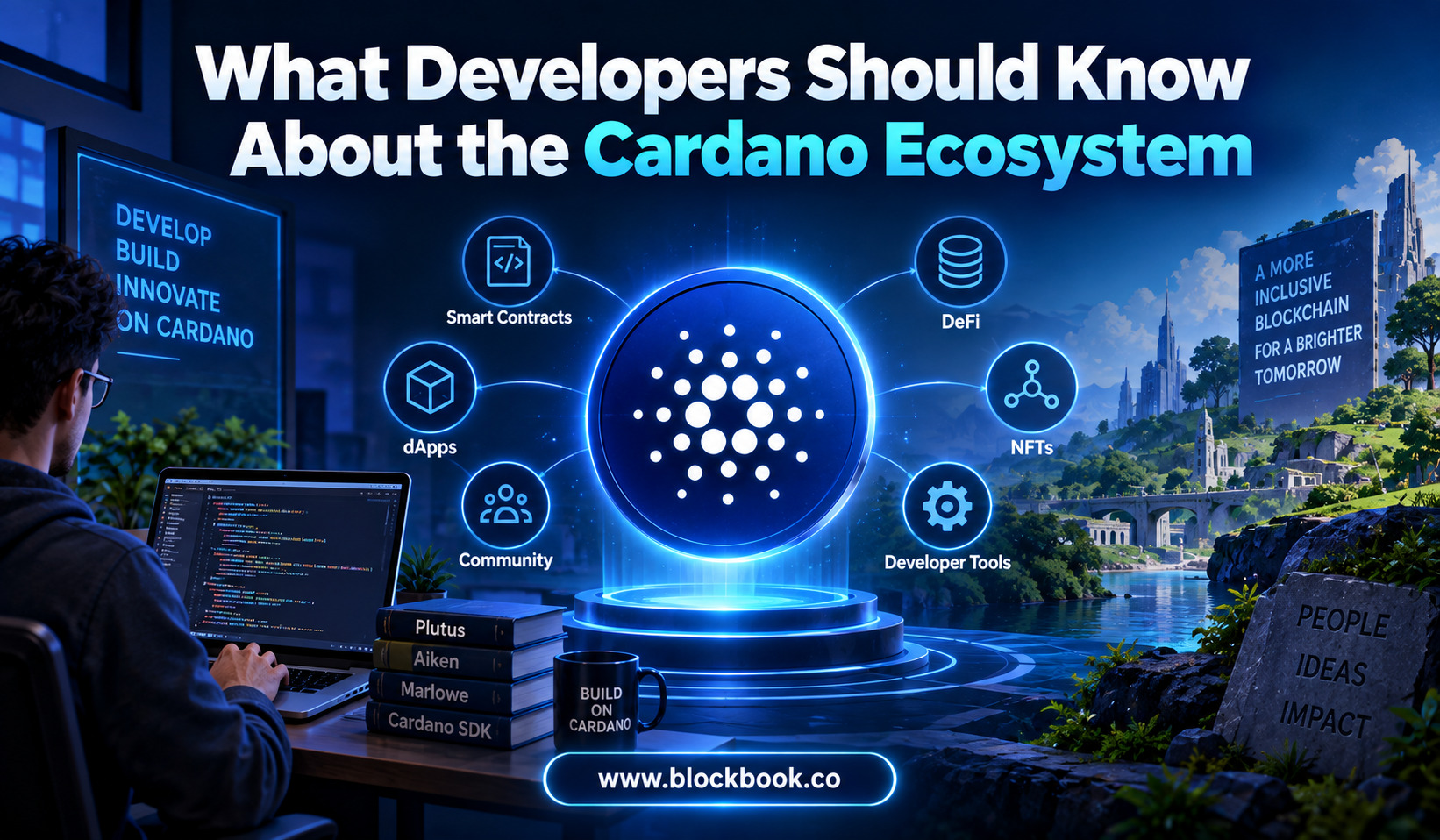
The blockchain development industry has expanded rapidly, creating a wide range of networks for developers to choose from. While some ecosystems focus on transaction speed, others emphasize smart contracts, decentralized applications, interoperability, scalability or governance. Cardano has developed a different identity by combining a research-driven development process with a proof-of-stake network, a distinctive transaction model and an increasingly decentralized governance structure.
For developers considering Cardano, understanding the ecosystem requires more than learning how to deploy a smart contract. Developers need to understand how the Cardano ledger works, how its extended unspent transaction output model affects application design, which programming tools are available, how assets are represented and how the network is evolving.
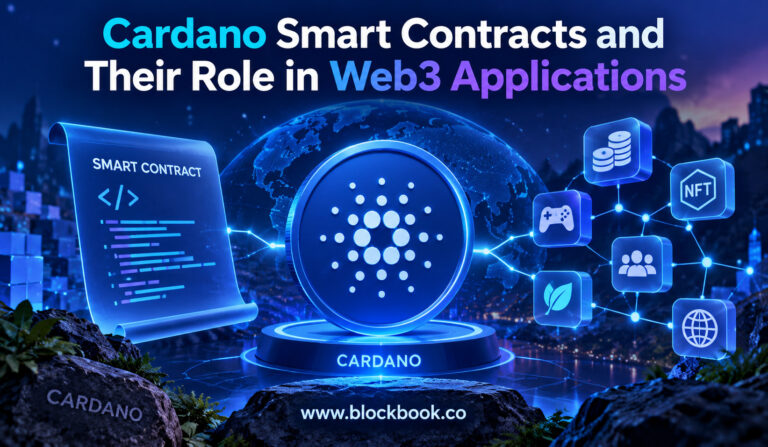
Cardano’s ecosystem has also expanded significantly since smart-contract functionality was introduced. The Alonzo upgrade in September 2021 enabled programmable smart contracts, opening the network to decentralized applications and broader Web3 development.
Today, developers can work across several layers of the Cardano technology stack, from application development and smart contracts to infrastructure, wallets, native assets and scaling technologies.
Understanding the Cardano Development Philosophy
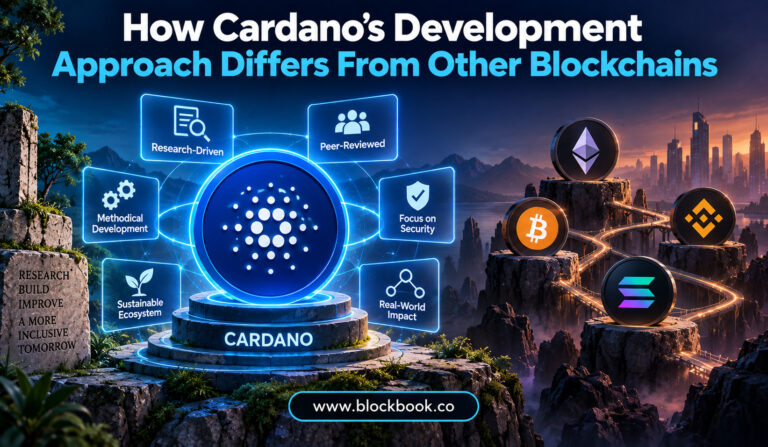
One of the first things developers should know about Cardano is that its development process has historically placed strong emphasis on academic research and formal methods.
Cardano’s research program includes work on consensus, ledger design, scalability, cryptography and other areas of blockchain technology. Its Ouroboros proof-of-stake protocol, for example, has been developed through a series of academic papers and formal analysis.
This philosophy affects how new technologies are introduced into the ecosystem. Major changes have generally been associated with defined development stages, technical research and network upgrades.
For developers, this means the ecosystem may feel more methodical than platforms where features can be introduced through rapid and frequent releases. It also means that understanding the reasoning behind Cardano’s architecture can be valuable when designing applications.
The eUTXO Model
The extended unspent transaction output, or eUTXO, model is one of the most important technical concepts for Cardano developers.
Unlike account-based systems, where users and contracts have account states that can be modified by transactions, Cardano builds on the UTXO approach. Its extended model adds programmable validation logic and additional data to transaction outputs.
Cardano’s developer documentation explains that eUTXO allows transactions to interact with specific UTXOs and provides deterministic validation based on transaction information and associated data.
This difference has a direct impact on application architecture.
A developer coming from an Ethereum-style account model may initially need to rethink how application state is represented. Instead of simply updating a shared contract state, developers often design applications around UTXOs and transactions that consume and create new outputs.
Once developers understand this model, it becomes one of the defining characteristics of Cardano development.
Developers should become familiar with:
- UTXOs and transaction inputs and outputs.
- Datums and redeemers.
- Validator scripts and transaction validation.
- Transaction construction and fee calculation.
These concepts form the foundation for working with Cardano smart contracts.
Smart Contracts and Plutus
Cardano’s smart-contract environment is closely associated with Plutus.
Plutus is a platform for creating smart contracts on Cardano and is built around functional-programming concepts. Haskell has played an important role in the Cardano development ecosystem, particularly for core components and smart-contract development.
The smart-contract architecture is closely connected to the eUTXO model. A validator can examine transaction information and associated data to determine whether a UTXO can be spent.
This creates a different development workflow from account-based smart-contract platforms.
Developers need to understand not only how to write contract logic but also how transactions interact with validators. Off-chain code is also important because applications need to construct transactions that satisfy the conditions established by on-chain scripts.
The learning curve can therefore be significant for developers who are completely new to UTXO-based programming. However, the model provides a structured way to reason about transaction validation.
Cardano Native Assets
Another feature developers should understand is Cardano’s native asset system.
Cardano allows native assets to be represented directly by the ledger rather than requiring every token to be implemented through a separate smart contract. This can simplify certain token-related operations.
Native assets can be used for a range of applications, including digital collectibles, utility tokens, community assets and other blockchain-based representations.
Smart contracts can then provide additional rules around how these assets are distributed or used.
The separation between basic asset functionality and application-specific contract logic is an important design characteristic for developers working on token-based projects.
Building Decentralized Applications
Cardano developers can build decentralized applications across several categories.
DeFi has become one of the major areas of blockchain application development. Cardano-based protocols can use smart contracts to support decentralized exchanges, lending systems, liquidity applications and other financial services.
NFT and digital-asset applications represent another area. Developers can combine Cardano’s native asset capabilities with marketplace logic and other application features.
Gaming is also an emerging area where blockchain assets can represent ownership, rewards or other digital items.
Common Cardano application categories include:
- Decentralized finance and financial protocols.
- NFT and digital-asset marketplaces.
- Gaming and blockchain-based digital economies.
- Governance and community applications.
The exact architecture depends on the application’s requirements, and developers should evaluate transaction design, performance and security before selecting an implementation approach.
Developer Tools and Infrastructure
A blockchain ecosystem depends heavily on the tools surrounding its core protocol.
Cardano’s developer environment includes tools for smart-contract development, transaction construction, node operation, testing and application integration.
The Cardano node is responsible for participating in the blockchain network, while other tools allow developers to interact with the ledger and build applications.
Wallet infrastructure is also an important part of the ecosystem. Decentralized applications need reliable methods for connecting users to blockchain transactions and allowing them to approve operations.
For developers, learning the core concepts is only one part of the process. Understanding how wallets, APIs, transaction builders and blockchain data services work together is equally important when creating a complete Web3 product.
Cardano and Proof of Stake
Cardano uses the Ouroboros family of proof-of-stake protocols.
Instead of relying on energy-intensive mining, the network uses stake pools and delegated stake to participate in block production. Ada holders can delegate their stake to stake pools, while stake pool operators maintain the infrastructure required to participate in consensus.
This system is important for developers because applications operate within a proof-of-stake network where staking and delegation form part of the broader ecosystem.
Stake pools also provide infrastructure and community participation beyond simply producing blocks.
Understanding how Cardano’s consensus mechanism works can help developers better understand transaction finality, network behavior and the broader economic environment in which their applications operate.
Scalability and Hydra
As blockchain applications become more complex, scalability becomes an increasingly important development concern.
Cardano’s research and development program includes several technologies designed to improve network performance and usability. Hydra is one of the best-known examples.
Hydra is a family of layer-2 protocols based on state-channel technology. It is designed to enable transactions and application interactions to take place through additional execution environments while ultimately connecting with the Cardano ledger.
For developers, layer-2 technologies can create opportunities to design applications that require higher transaction throughput or more frequent interactions.
However, developers need to understand the specific capabilities and limitations of the technology before designing an application around it.
Interoperability and Sidechains
The Cardano ecosystem is not limited to applications operating directly on the main chain.
Interoperability has been another area of research and development. Cardano’s research program includes work involving sidechains and other methods for connecting blockchain environments.
Interoperability can allow applications to access functionality or assets across different blockchain systems.
For developers, this introduces additional architectural possibilities but also additional security considerations. Cross-chain applications need to account for message handling, asset representation, transaction finality and the security assumptions of connected systems.
As Web3 increasingly becomes multichain, interoperability knowledge is likely to become useful for developers working across several blockchain ecosystems.
Governance Is Becoming Increasingly Important
Cardano’s development has entered a new phase with the introduction of on-chain governance.
The Conway era introduced a governance framework involving ada holders, delegated representatives, stake pool operators and a constitutional committee.
This matters to developers because protocol governance can influence the environment in which applications operate.
Governance actions can involve protocol parameters, treasury withdrawals, constitutional matters and changes associated with future network upgrades.
The move toward on-chain governance also means that the Cardano community has a more formal role in determining the network’s future direction.
For developers building long-term applications, understanding governance can therefore be just as important as understanding smart contracts.
Cardano Development Compared With Other Ecosystems
Developers often compare Cardano with Ethereum and other Layer-1 networks. While all these platforms support blockchain applications, their underlying designs differ.
Ethereum uses an account-based architecture and has a large developer ecosystem centered around the Ethereum Virtual Machine and Solidity. Cardano uses eUTXO and its own smart-contract architecture.
These differences influence everything from contract design to transaction construction.
| Development Area | Cardano | Other Layer-1 Networks |
| Ledger model | Extended UTXO | Account-based or other models |
| Consensus | Ouroboros proof of stake | Varies |
| Smart contracts | Plutus and related tools | Varies |
| Native assets | Supported at ledger level | Implementation varies |
| Governance | Increasingly on-chain | Varies significantly |
| Scaling strategy | Includes layer-2 and other research | Depends on network |
There is no universal development model that works for every application. Developers should evaluate the technical requirements of their project before choosing an ecosystem.
Security Should Be a Core Development Priority
Cardano’s research-oriented approach does not remove the need for application-level security.
Smart contracts can still contain logic errors, poorly designed authorization systems or economic vulnerabilities. Developers should therefore test applications extensively before deployment.
Security becomes even more important when applications interact with financial assets or other smart contracts.
A strong development process can include automated testing, code review, transaction simulation and independent security audits.
Developers should also understand the security assumptions of external services such as price feeds, APIs, bridges and wallets.
What Developers Should Learn First
For someone entering the Cardano ecosystem, trying to learn every component simultaneously can be overwhelming.
A structured learning process is generally more practical. Developers can begin by understanding how Cardano transactions and UTXOs work before moving into smart contracts and application architecture.
A useful progression is:
- Learn Cardano’s ledger and eUTXO model.
- Understand native assets and transaction construction.
- Explore Plutus and smart-contract development.
- Build and test a small decentralized application.
After learning these fundamentals, developers can explore advanced topics such as Hydra, interoperability, governance and infrastructure development.
Conclusion
The Cardano ecosystem offers developers a distinctive environment for building Web3 applications. Its research-driven development philosophy, Ouroboros proof-of-stake consensus, eUTXO ledger model and Plutus smart-contract platform create a technical foundation that differs from many other blockchain networks.
For new developers, understanding the eUTXO model should be a priority because it influences how transactions, application state and smart contracts are designed. Native assets, wallet infrastructure and developer tools are also important components of the wider ecosystem.
Cardano’s development is also expanding beyond basic smart-contract functionality. Hydra and other scalability initiatives are aimed at supporting larger workloads, while interoperability research can provide opportunities for communication across blockchain environments. At the same time, on-chain governance is giving network participants a greater role in future protocol decisions.
The Cardano ecosystem is therefore more than a blockchain for deploying smart contracts. It is a collection of technologies and development practices that require developers to understand both the underlying architecture and the broader Web3 environment.
FAQs
What is the Cardano ecosystem?
The Cardano ecosystem includes the Cardano blockchain, smart contracts, native assets, wallets, developer tools, decentralized applications, stake pools, scaling technologies and governance infrastructure.
What programming language does Cardano use?
Haskell is important within Cardano’s core development and smart-contract ecosystem, while developers can use different languages and frameworks depending on the tools and application environment they choose.
What is eUTXO?
eUTXO stands for extended unspent transaction output. It extends the traditional UTXO model with data and programmable validation logic and is central to Cardano’s transaction architecture.
What is Plutus?
Plutus is Cardano’s smart-contract platform. It enables developers to create on-chain logic that validates transactions according to predefined conditions.
About the Author