The Web3 development landscape is changing as blockchain projects move from experimental applications toward products designed for larger audiences. Developers are looking for networks that can provide scalability, manageable transaction costs, simple user experiences and tools that reduce the complexity of building decentralized applications. NEAR Protocol is taking a distinct approach by combining a sharded blockchain architecture with developer-friendly tools and a growing focus on cross-chain applications and artificial intelligence.
NEAR was created with scalability and usability as major objectives. Its current development strategy extends that original approach by treating blockchain infrastructure as more than a place to deploy smart contracts. The ecosystem is increasingly focused on connecting applications across different networks and making blockchain interactions easier for both users and autonomous software.
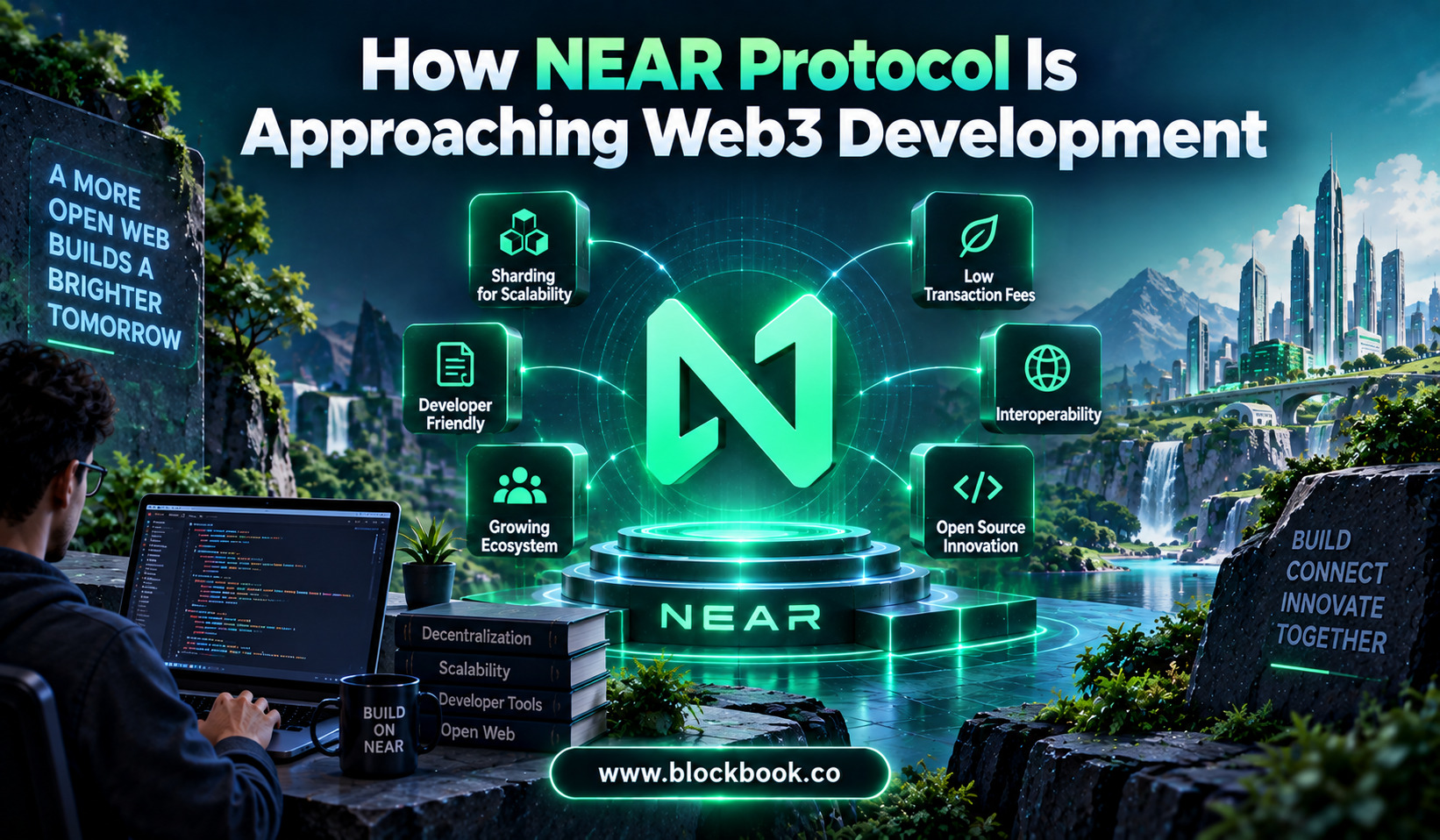
According to NEAR’s current developer materials, the network supports smart-contract development using Rust and JavaScript and emphasizes scalable applications, low transaction costs, human-readable accounts and gasless user experiences.
A Development Philosophy Built Around Scalability
One of the defining features of NEAR’s technical approach is sharding. Instead of requiring every part of the network to process all blockchain activity, sharding divides computational and storage workloads across multiple shards.
NEAR’s Nightshade design was created to support horizontal scaling. The basic idea is that the network can increase its capacity by distributing work rather than depending entirely on the processing capability of a single chain. NEAR’s technical documentation describes Nightshade as its sharding design, with later development adding stateless validation and other improvements.
This architecture is important for developers because application growth can create increasing demands on blockchain infrastructure. A network designed to distribute workloads can provide a foundation for applications expected to serve larger numbers of users.
NEAR currently describes its production network as fully sharded and reports 600-millisecond block times, approximately 1.2-second finality and a scalability target of up to 1 million transactions per second. These are network-level capabilities and should not be interpreted as guaranteed performance for every individual application or workload.
Making Web3 Development More Accessible
NEAR’s approach also places considerable emphasis on reducing the technical barriers associated with blockchain development.
Developers can build NEAR smart contracts using Rust and JavaScript, with contracts compiled to WebAssembly. This provides developers with familiar programming environments rather than requiring them to learn an entirely specialized programming language before beginning blockchain development.
The developer experience also includes human-readable account names and mechanisms that can allow applications to cover transaction fees for users. These features address a common Web3 problem: users often need to understand wallets, gas fees and blockchain-specific account structures before they can use an application.
For developers targeting mainstream audiences, reducing these barriers can be as important as improving raw blockchain performance.
Key areas of NEAR’s developer approach include:
- Scalable sharded infrastructure
- Rust and JavaScript development options
- Human-readable accounts and simplified onboarding
- Tools for applications that interact across multiple chains
This approach reflects a broader shift in Web3 development toward making blockchain technology less visible to ordinary users.
Chain Abstraction Is Becoming a Major Focus
Another major part of NEAR’s current development strategy is chain abstraction.
The traditional Web3 experience often requires users to know which blockchain they are using, hold the appropriate token for transaction fees and switch between wallets or networks. Developers also have to build integrations for different blockchain environments.
NEAR is attempting to reduce this complexity by allowing applications to interact with assets and transactions across multiple networks.
Its Chain Signatures technology allows NEAR smart contracts to participate in transaction signing on other blockchains through a multi-party computation system. NEAR says this infrastructure can support cross-chain applications without requiring users to manually manage every underlying blockchain interaction.
This changes the role of NEAR from simply being the destination blockchain for an application. Developers can instead use NEAR-based infrastructure as a coordination layer for applications that interact with multiple networks.
NEAR Intents Changes How Transactions Can Be Designed
NEAR’s Intents framework takes the chain-abstraction concept further.
Instead of requiring a user to specify every technical step, an application can focus on the desired outcome. For example, a user might want to exchange one asset for another without needing to understand which blockchain, bridge or routing mechanism performs the operation.
NEAR describes Intents as an outcome-oriented framework in which solvers compete to execute transactions across chains. The system is intended to simplify cross-chain swaps, payments and other blockchain operations.
This model could be particularly relevant as applications become more complex. Developers can concentrate on the user experience and desired result while infrastructure handles more of the underlying blockchain coordination.
NEAR’s current Intents materials describe support for multiple blockchain ecosystems and assets, demonstrating how the project is positioning this technology as a cross-chain execution layer rather than a feature limited to NEAR-native applications.
A Growing Focus on AI Applications
NEAR’s development direction has increasingly expanded into artificial intelligence.
The project now describes its broader strategy around an “agent economy,” where AI agents can interact with digital assets, applications and blockchain infrastructure. Its 2026 roadmap identifies two major areas: cross-chain financial infrastructure through NEAR Intents and autonomous AI agents through NEAR AI.
The connection between blockchain and AI is based on several practical requirements. Autonomous software may eventually need to make payments, manage assets, interact with decentralized services and coordinate transactions. Blockchain infrastructure can provide programmable ownership and settlement mechanisms for these activities.
NEAR is therefore developing infrastructure intended to allow AI agents to interact with blockchain systems while maintaining controls around credentials and execution.
Confidential Computing Adds Another Layer
Privacy is becoming an increasingly important issue for AI and Web3 applications.
AI systems may need access to sensitive information, while financial applications can involve strategies or transaction details that users may not want publicly exposed. Public blockchains traditionally make transaction data broadly visible, creating challenges for applications requiring confidentiality.
NEAR’s newer infrastructure includes a private shard introduced with its Nightshade 3.0 development. NEAR says this environment is designed for confidential execution while remaining connected to the public network.
The project’s broader AI infrastructure also uses Trusted Execution Environments, or TEEs, for confidential computation. The goal is to allow sensitive workloads to be processed in protected environments while maintaining verifiable execution properties.
This could become relevant for applications involving AI agents, financial strategies and enterprise data.
Cross-Chain Development Becomes More Practical
The Web3 industry has become increasingly fragmented across different blockchains. Each network can have its own programming environment, assets, wallet standards and transaction mechanisms.
For developers, this fragmentation can increase development and maintenance costs.
NEAR’s chain-abstraction strategy attempts to address this problem by providing infrastructure through which applications can interact with multiple blockchain ecosystems.
| NEAR Technology | Development Purpose |
| Nightshade sharding | Distributed blockchain processing and scalability |
| Rust and JavaScript support | More accessible smart-contract development |
| Chain Signatures | Cross-chain transaction signing |
| NEAR Intents | Outcome-based cross-chain execution |
| Private Shard | Confidential blockchain execution |
| NEAR AI infrastructure | Development of AI-related applications and agents |
This model could allow developers to build applications that are less dependent on a single blockchain’s ecosystem.
Better User Experience Is Part of the Development Strategy
Web3 adoption has often been slowed by complicated user interfaces.
A new user may need to create a wallet, protect a seed phrase, obtain tokens for gas and understand which network an application uses. Every additional step can create friction.
NEAR’s account model and gas-payment features attempt to reduce some of these barriers. The developer documentation highlights human-readable accounts and the ability for contracts to pay transaction fees on behalf of users.
These features matter because developers increasingly want blockchain applications to feel similar to conventional internet services.
The blockchain can remain in the background while the application presents users with a familiar interface. This approach could be particularly important for consumer applications and AI-powered services.
What Developers Need to Consider
Despite its developer-focused architecture, building on NEAR still requires an understanding of blockchain-specific concepts.
Developers need to consider smart-contract security, account permissions, transaction behavior and state management. Cross-chain applications introduce additional complexity because they depend on infrastructure operating across multiple networks.
AI applications add another layer of responsibility. Developers must think about authorization, privacy, agent behavior and the conditions under which autonomous software can execute transactions.
Developers exploring NEAR should pay particular attention to:
- Smart-contract security and testing
- Account and state architecture
- Cross-chain transaction dependencies
- AI-agent permissions and privacy
These considerations become increasingly important as applications move from experimental prototypes toward production environments.
NEAR’s Evolution From a Scalable Blockchain
NEAR’s current direction builds on its original focus rather than abandoning it.
The protocol was founded around scalability and usability, with sharding positioned as a way to support larger numbers of users and applications. Over time, the ecosystem added infrastructure for interoperability and gasless transactions, and later expanded toward Chain Signatures, Intents and AI-focused development.
This evolution shows how the role of a blockchain can change as Web3 itself develops.
Rather than competing only to become the place where developers deploy applications, NEAR is increasingly positioning itself as infrastructure that connects users, applications, assets, chains and autonomous agents.
The Road Ahead for NEAR Development
The future direction of NEAR development is closely connected to chain abstraction and AI.
Its 2026 roadmap describes a strategy combining cross-chain financial infrastructure with autonomous AI agents. NEAR is also continuing work on dynamic resharding, protocol performance and privacy-oriented infrastructure.
If these technologies mature, developers could build applications where users do not need to know which blockchain processes an operation. AI agents could potentially execute transactions across multiple networks while blockchain infrastructure handles settlement and authorization.
However, adoption will depend on more than technical capabilities. Developers need reliable infrastructure, security, useful tools and sustainable application models. Users also need to trust the products they interact with.
Conclusion
NEAR Protocol is approaching Web3 development through a combination of scalability, developer accessibility, cross-chain infrastructure and AI-focused technology. Its sharded architecture provides the foundation for handling larger workloads, while tools such as Rust and JavaScript support, human-readable accounts and gasless transaction capabilities are designed to simplify application development and user onboarding.
The project’s newer focus on Chain Abstraction, Chain Signatures and NEAR Intents represents a broader change in how blockchain applications can be designed. Instead of forcing users and developers to manage every individual blockchain, NEAR is working toward an environment where the underlying network becomes less visible.
At the same time, the integration of AI introduces another potential development direction. Autonomous agents may require infrastructure capable of managing assets, executing transactions and interacting across multiple chains.
Frequently Asked Questions
1. What is the NEAR Protocol mainly designed for?
NEAR is a Layer-1 blockchain designed around scalability, usability and decentralized application development. Its architecture uses sharding to distribute network workloads.
2. What programming languages can developers use on NEAR?
NEAR supports smart-contract development using Rust and JavaScript, with contracts running through its WebAssembly-based execution environment.
3. What is NEAR Chain Abstraction?
Chain Abstraction is NEAR’s approach to reducing the complexity of interacting with multiple blockchain networks. Technologies such as Chain Signatures and NEAR Intents are used to enable cross-chain operations.
4. What are NEAR Intents?
NEAR Intents allow users or applications to specify desired outcomes while underlying infrastructure and solvers handle the execution across supported blockchain networks.
5. Why is NEAR focusing on AI?
NEAR is developing infrastructure for AI agents that can interact with digital assets and blockchain applications. Its current roadmap connects AI agents with cross-chain financial infrastructure and autonomous transactions.
About the Author