Privacy has become one of the most important requirements as businesses explore blockchain technology. Public blockchains can provide transparency and shared verification, but that model is not always suitable for companies handling confidential commercial information. Businesses may need to exchange prices, contracts, customer details, transaction records, or supply-chain information with selected partners without exposing those details to everyone on a network.
Hyperledger Fabric approaches this challenge through a permissioned blockchain architecture designed for enterprise environments. Rather than treating every transaction as information that should be visible to all network participants, Fabric provides mechanisms that allow organizations to control who can access particular data. This makes private transactions an important part of its enterprise blockchain model.
For companies evaluating distributed ledger technology, understanding how Fabric handles privacy can help explain why permissioned blockchain networks are being considered for business-to-business applications.
What Makes a Blockchain Transaction Private?
On a conventional public blockchain, transaction information is often distributed widely across the network. This transparency can be useful when participants need to independently verify activity, but it can create difficulties for businesses.
Imagine two suppliers negotiating different prices with the same manufacturer. If all commercial transactions were publicly visible, one supplier could potentially gain access to information that was never intended for it. Similar concerns can arise with financial agreements, customer information, intellectual property, and strategic business data.
A private transaction environment attempts to solve this problem by limiting sensitive information to authorized participants. The objective is not necessarily to hide the existence of every transaction. Instead, it is to ensure that the actual business data is disclosed only to parties that have a legitimate reason to access it.
Hyperledger Fabric incorporates this principle into its network design.
Hyperledger Fabric Uses a Permissioned Model
Hyperledger Fabric is a permissioned distributed ledger framework. Participants in a Fabric network generally have recognized identities rather than joining anonymously.
Organizations can establish membership rules and define the permissions associated with different participants. This creates a foundation for privacy because the network knows which organizations are participating and can apply access policies accordingly.
For example, a Fabric network connecting a manufacturer and several suppliers could establish different permissions for each company. A supplier might access transactions related to its own orders, while the manufacturer could have broader visibility across the network.
This identity-based approach is different from the typical model of a public blockchain, where anyone who follows the network’s protocol can potentially submit transactions or inspect publicly available ledger information.
Channels for Selective Data Sharing
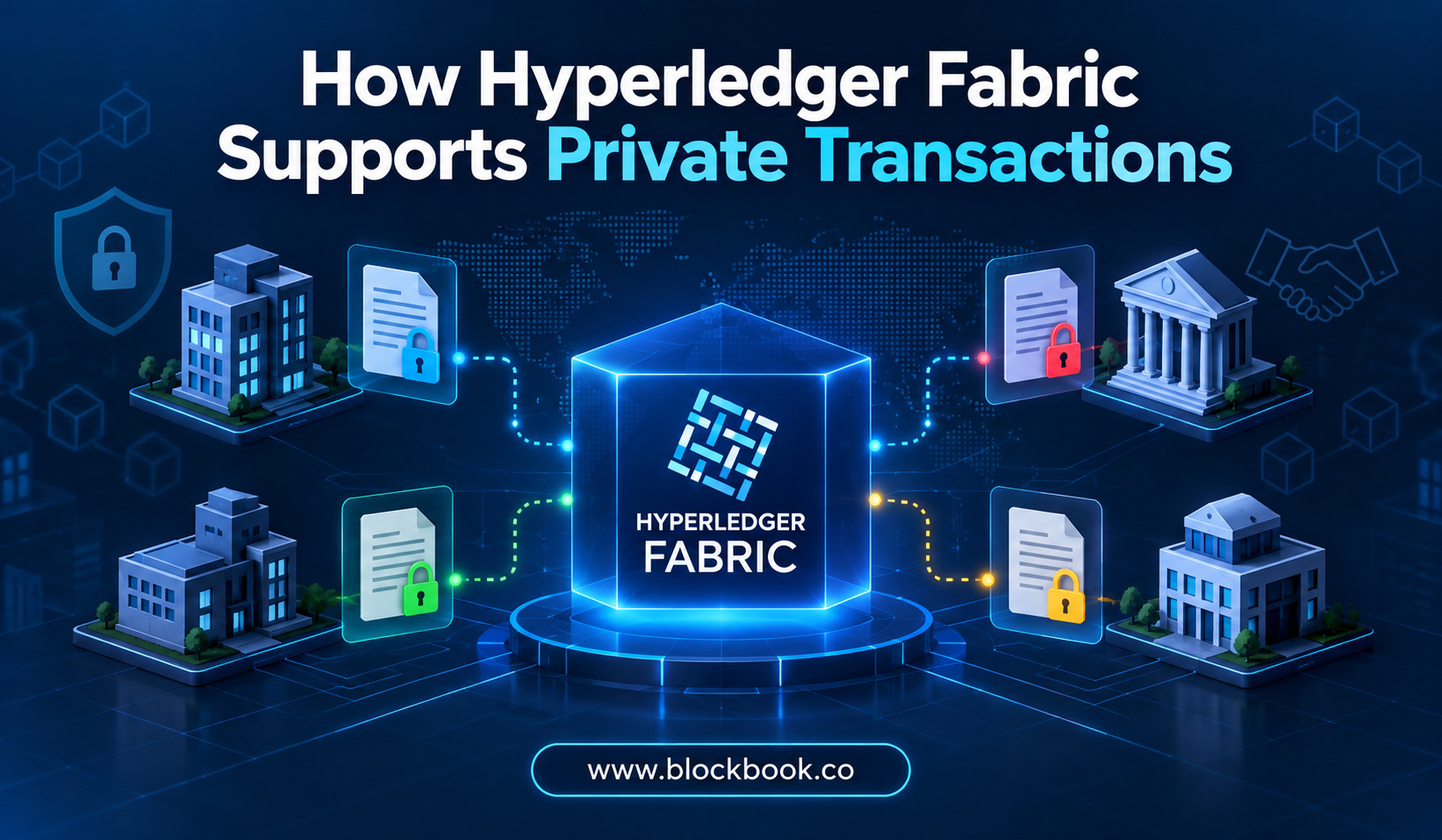
Channels are one of the key mechanisms associated with privacy in Hyperledger Fabric. A channel can be viewed as a private communication and ledger environment for a defined group of network participants.
Suppose a business network contains a manufacturer, Supplier A, Supplier B, and a logistics company. The manufacturer may need to share a confidential purchasing agreement with Supplier A but have no reason to disclose that information to Supplier B.
A separate channel can provide an environment where the relevant participants maintain and process transactions that other organizations on the wider network do not have access to.
This can be particularly useful for consortium blockchain environments where many companies participate in the same overall network but do not have identical business relationships.
Channels can help organizations establish boundaries around information without requiring them to create a completely separate blockchain network for every relationship.
Private Data Collections
Hyperledger Fabric also provides private data collections for situations where organizations need even more selective data sharing.
With a private data collection, the actual private information can be shared only with authorized organizations. Other participants may receive a representation or hash associated with the data rather than the underlying private value.
This architecture allows the network to preserve evidence that particular information was part of a transaction while preventing unauthorized participants from viewing the sensitive content.
For example, a manufacturer and supplier could record a confidential pricing agreement. Authorized organizations could retain the actual price information, while other network participants could have access only to the information necessary to verify that a corresponding transaction occurred.
This separation between private information and shared verification is one of the important concepts behind enterprise blockchain privacy.
How Private Transactions Work
A simplified Fabric transaction flow can help explain the process. An application submits a transaction proposal to the appropriate peers. Those peers simulate the transaction and produce an endorsement according to the network’s rules.
The transaction is then passed through the ordering process, after which peers validate the transaction before updating the ledger. When private data is involved, only authorized organizations receive the underlying information according to the relevant private-data configuration.
The precise workflow depends on the Fabric version and network architecture, but the broader principle remains the same: transaction processing and data distribution can be controlled separately.
This gives enterprises greater flexibility than simply making every transaction visible to every participant.
Role of Identity and Certificates
Privacy in an enterprise blockchain depends heavily on identity management. Fabric networks use identity mechanisms that allow participants to be associated with recognized organizations and roles.
Certificate-based identity can help the network determine whether a participant is authorized to perform a particular operation. Organizations can also establish policies that determine which participants can endorse transactions or access specific resources.
This creates an accountability layer alongside privacy. A transaction does not have to be publicly visible to everyone to be attributable within the business network.
For regulated industries, this combination of controlled identity and restricted information can be particularly relevant.
Hyperledger Fabric Privacy Compared With Public Blockchains
The differences between Fabric and a typical public blockchain become clearer when privacy is considered.
| Feature | Hyperledger Fabric | Typical Public Blockchain |
| Network access | Permissioned | Generally open |
| Participant identity | Managed identities | Often pseudonymous addresses |
| Data visibility | Can be restricted | Frequently broadly visible |
| Private channels | Supported | Not typically part of the base architecture |
| Private data | Supported through private-data mechanisms | Usually requires additional privacy solutions |
| Governance | Organizations or consortium | Network/protocol dependent |
| Enterprise confidentiality | Built into network design | Often requires additional architecture |
Public blockchains can also support privacy technologies, including zero-knowledge systems, encryption techniques, and specialized privacy layers. Therefore, the distinction is not that public blockchains cannot provide privacy. Rather, Fabric makes controlled access and organizational privacy fundamental parts of its permissioned architecture.
Supply Chain Privacy
Supply-chain networks provide a practical example of why private transactions matter.
A manufacturer may work with dozens of suppliers, logistics companies, warehouses, and retailers. Although these organizations need to share information, they do not necessarily need access to every commercial agreement.
Private transactions can help maintain confidentiality around supplier pricing, purchase agreements, inventory information, or other commercially sensitive records.
At the same time, the shared network can preserve information needed for traceability. For example, authorized participants can verify that a shipment was processed or that a particular event was recorded without receiving confidential details unrelated to their role.
This combination of collaboration and selective disclosure is one of the strongest enterprise use cases for Fabric’s privacy capabilities.
Financial Services Applications
Financial organizations regularly exchange sensitive information. Transaction values, settlement details, customer-related records, and contractual terms may need to be shared between selected institutions while remaining inaccessible to unrelated participants.
A permissioned blockchain can create a controlled environment for these interactions. Fabric’s identity and privacy mechanisms can allow financial institutions to establish defined access rules.
Potential applications can include trade finance, settlement workflows, interbank processes, asset records, and document verification. The technology does not automatically make a financial process compliant or secure, but it can provide infrastructure for implementing controlled transaction workflows.
Organizations still need encryption, access management, cybersecurity controls, regulatory procedures, and appropriate data governance.
Healthcare and Sensitive Information
Healthcare is another sector where selective data access is important. Hospitals, laboratories, insurers, pharmaceutical companies, and other organizations may need to coordinate certain processes without sharing every piece of information.
Fabric could be used for applications involving consent records, pharmaceutical supply chains, administrative workflows, or controlled data-access records.
Importantly, sensitive medical information does not necessarily need to be stored directly on the blockchain. A system can keep confidential information in appropriate databases or secure storage while using the blockchain to record permissions, references, hashes, or transaction events.
This architecture can help reduce unnecessary exposure while preserving a verifiable record of relevant activities.
Benefits of Private Transactions in Fabric
The privacy architecture of Hyperledger Fabric can provide several practical advantages for enterprise networks:
- Selective disclosure: Sensitive information can be shared only with relevant participants.
- Business confidentiality: Companies can collaborate without automatically exposing commercial terms.
- Identity-based access: Organizations can establish recognized participants and permissions.
- Auditability: Authorized parties can maintain verifiable transaction histories.
- Flexible network design: Different groups can operate with different data-sharing requirements.
These advantages can be valuable, but they depend on careful configuration. A poorly designed access policy can undermine the intended privacy of the network.
Challenges of Implementing Private Transactions
Private blockchain transactions do not eliminate the need for strong security practices. Enterprises must determine which information should be private, who should receive it, how long it should be retained, and what happens when an organization leaves the network.
Network governance can also become complicated. Multiple organizations need to agree on membership, access policies, smart-contract rules, infrastructure responsibilities, and software updates.
Another challenge is integration. Private transaction systems often need to communicate with existing ERP platforms, databases, identity providers, and enterprise applications. Building these connections can require significant development and testing.
Organizations should therefore treat privacy as part of a broader architecture rather than assuming that blockchain alone will protect sensitive information.
The Growing Importance of Enterprise Blockchain Privacy
As businesses experiment with distributed ledger technology, privacy is likely to remain a major consideration. Companies want the benefits of shared records without sacrificing confidentiality.
Hyperledger Fabric’s approach reflects this requirement by combining permissioned membership with mechanisms for controlled data distribution. This allows organizations to build networks where transparency can be selective rather than universal.
Future enterprise applications may combine Fabric with cloud platforms, digital identity systems, IoT devices, artificial intelligence, and traditional enterprise software. These integrations could create more sophisticated workflows in which blockchain records are shared only when they provide a clear business benefit.
Conclusion
Hyperledger Fabric supports private transactions by combining permissioned participation, identity management, channels, private data collections, and configurable access policies. These features allow businesses to collaborate through a shared blockchain environment while limiting sensitive information to authorized participants.
This approach is particularly relevant for industries where several organizations need to coordinate but cannot publicly disclose every transaction. Supply chains, financial services, healthcare, manufacturing, and trade are examples of environments where selective information sharing can be important.
However, Fabric’s privacy capabilities do not replace cybersecurity, encryption, governance, or regulatory compliance. Organizations still need to design carefully who can access information and how data moves between blockchain and existing systems.
As enterprise blockchain adoption develops, the ability to combine shared verification with controlled disclosure could remain an important factor in determining where permissioned networks deliver practical value.
FAQs
What is a private transaction in Hyperledger Fabric?
A private transaction is a transaction or associated data that is made available only to authorized participants rather than being distributed to every organization on the network.
How does Hyperledger Fabric protect private data?
Fabric can use permissioned identities, channels, private data collections, access policies, and other network controls to restrict sensitive information.
What are Fabric channels?
Channels are private communication and ledger environments that allow a defined group of organizations to conduct transactions separately from other network participants.
What are private data collections?
Private data collections allow selected organizations to share confidential data while other participants can receive a related representation or hash without seeing the underlying information.
Is Hyperledger Fabric completely private?
Not necessarily. Privacy depends on how the network is configured. A Fabric network can provide controlled data access, but organizations must establish appropriate policies and security controls.
About the Author