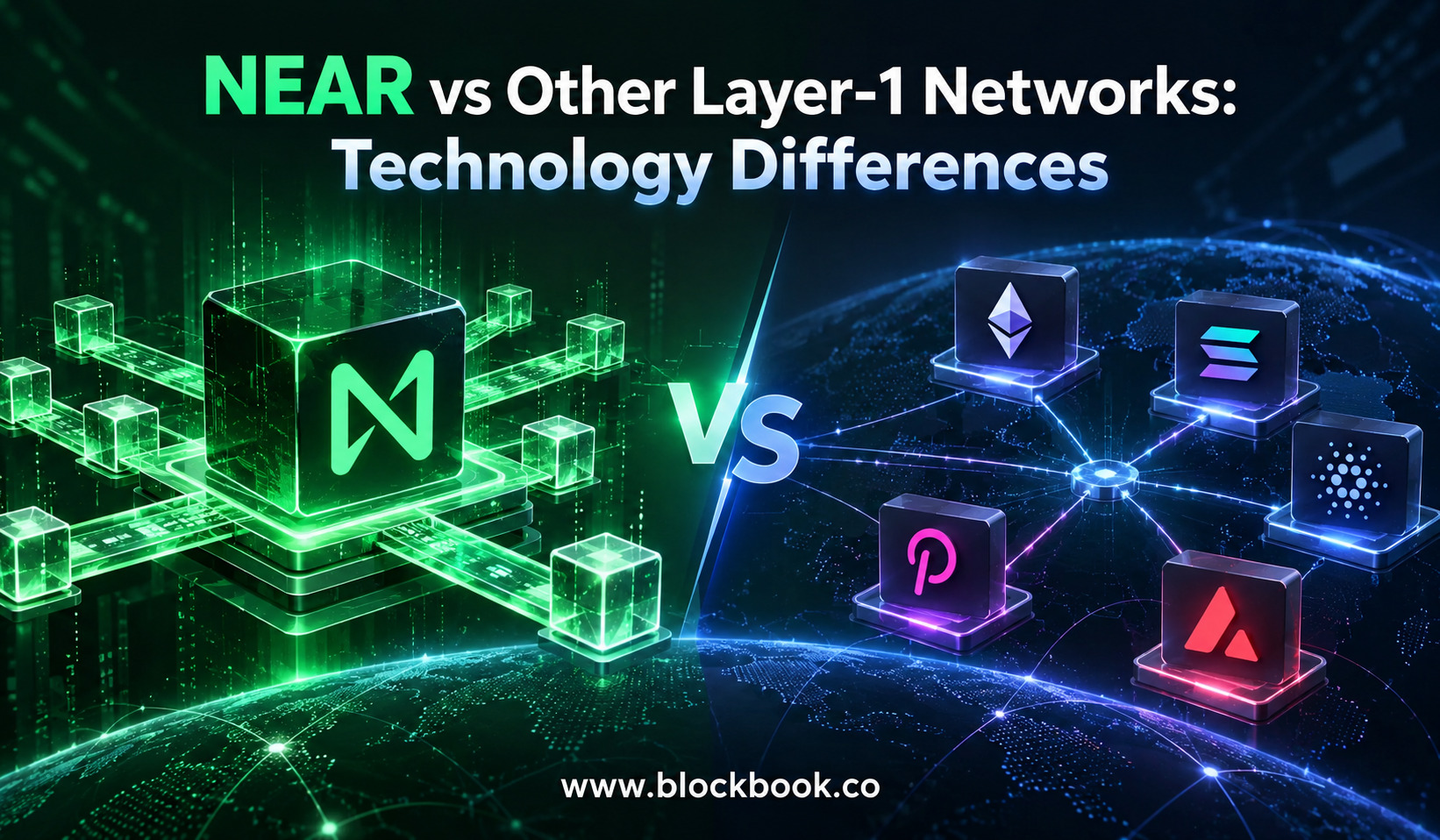
The Layer-1 blockchain sector has become increasingly diverse, with networks taking different approaches to scalability, transaction processing, smart contracts, interoperability and user experience. NEAR Protocol is one of the platforms pursuing a distinct technical model, particularly through sharding, developer-friendly programming options and a growing focus on chain abstraction.
Comparing NEAR with other Layer-1 networks is therefore less about identifying a single technology that works for every application and more about understanding how their architectures differ. Ethereum, Solana, Avalanche, Sui and other networks use different mechanisms to process transactions and organize blockchain state.
NEAR’s architecture is built around Nightshade sharding, while its broader ecosystem is developing technologies such as Chain Signatures and NEAR Intents. These systems are intended to address not only blockchain scalability but also the growing complexity of a multichain Web3 environment.
For developers and businesses evaluating blockchain infrastructure, these differences can influence application architecture, programming requirements, transaction design and user experience.
What Makes a Layer-1 Network Different?
A Layer-1 network is a base blockchain that provides its own consensus, transaction processing and security infrastructure. Developers can build applications directly on top of it, while other technologies may operate as additional layers.
Different Layer-1 networks make different architectural choices. Some prioritize decentralization and security, while others focus heavily on transaction throughput, parallel execution or application-specific infrastructure.
NEAR’s approach combines scalability with usability. The network uses sharding to distribute workloads, while its account model and developer tools are designed to reduce some of the complexity associated with blockchain applications.
This makes the comparison with other Layer-1 networks especially relevant as developers consider which architecture fits a particular application.
NEAR’s Sharding-Based Architecture
One of the clearest technology differences between NEAR and several other Layer-1 networks is its use of sharding.
NEAR’s Nightshade architecture divides network activity into shards. Rather than requiring every validator to process all application activity, workloads can be distributed across different parts of the network.
The purpose of this design is to provide horizontal scalability. As demand grows, additional processing capacity can be introduced through the network’s sharding architecture.
NEAR’s official technical materials describe the network as fully sharded and highlight continued development around dynamic resharding and network scalability.
This approach differs from networks that primarily pursue scalability through parallel transaction execution within a shared state environment.
NEAR vs Ethereum
Ethereum is one of the most widely used Layer-1 blockchain networks and has a large developer ecosystem. Its development strategy has increasingly relied on Layer-2 networks to expand transaction capacity while Ethereum remains the primary settlement and security layer.
NEAR takes a different approach by incorporating sharding directly into its Layer-1 architecture.
Ethereum’s ecosystem contains a large number of rollups and Layer-2 solutions. These technologies process transactions outside Ethereum’s main execution environment before publishing relevant information back to Ethereum.
NEAR instead attempts to provide scalability through its own sharded base-layer infrastructure.
The difference can be summarized as an architectural distinction: Ethereum’s scaling strategy includes a broad Layer-2 ecosystem, while NEAR’s core protocol directly incorporates sharding.
Neither model automatically determines which network is appropriate for every application. Developers need to consider security assumptions, tooling, ecosystem requirements and application architecture.
NEAR vs Solana
Solana and NEAR both emphasize high-performance blockchain applications, but their approaches to scalability are different.
Solana uses a high-performance architecture built around parallel transaction processing. Its Sealevel runtime can execute transactions concurrently when their account dependencies do not conflict.
NEAR’s primary scalability mechanism is sharding. The network distributes application workloads across multiple shards.
This creates different development considerations.
A Solana developer needs to understand account dependencies and how transactions can be structured for parallel execution. A NEAR developer needs to understand how accounts and application activity interact with the network’s sharded environment.
Both approaches aim to support applications requiring substantial transaction activity, but they achieve that goal through different architectural paths.
NEAR vs Avalanche
Avalanche takes another approach to blockchain architecture.
The Avalanche ecosystem supports multiple specialized networks, including its primary network components and application-specific Avalanche L1s. This allows projects to create blockchain environments tailored to particular use cases.
NEAR instead provides a shared Layer-1 environment built around sharding and a common protocol architecture.
This creates a different trade-off for developers. Avalanche’s model can provide application-specific customization, while NEAR’s approach focuses on scalability within its own sharded blockchain and increasingly on cross-chain application infrastructure.
The right architecture depends on whether a project benefits more from application-specific blockchain infrastructure or a scalable shared environment.
NEAR vs Sui
Sui is another Layer-1 network that takes a distinctive approach to transaction processing.
Sui uses an object-centric data model. Instead of organizing application state primarily around a traditional account-based structure, assets and other state are represented as programmable objects.
The network also uses parallel execution for transactions that do not conflict with the same objects.
NEAR’s model is different. Its architecture combines accounts, contracts and sharding, while Sui emphasizes object-based state and parallel transaction processing.
For developers, these differences can significantly affect how application state is designed.
A developer choosing between the ecosystems needs to consider the programming model as well as raw network performance.
Programming Language Differences
Programming languages are another important distinction between Layer-1 ecosystems.
NEAR supports smart-contract development using Rust and JavaScript, with WebAssembly used as the execution environment.
Ethereum development is commonly associated with Solidity and the Ethereum Virtual Machine. Solana development is strongly associated with Rust, while Sui uses the Move programming language.
These differences can influence developer onboarding and application architecture.
Teams with existing Rust experience may find several high-performance blockchain ecosystems accessible, but the underlying programming model can still vary significantly.
Common development environments include:
- NEAR: Rust and JavaScript with WebAssembly
- Ethereum: Solidity and the EVM ecosystem
- Solana: Rust and its specialized runtime
- Sui: Move and an object-oriented blockchain model
Language support is only one factor. Developers also need to evaluate frameworks, documentation, testing tools and available libraries.
Transaction Processing Models
Transaction processing is one of the most important technical differences among Layer-1 networks.
NEAR’s sharded architecture distributes workloads. Solana emphasizes parallel execution within its runtime. Sui also uses parallel execution for suitable transactions, while Ethereum’s base-layer execution follows a different architecture and increasingly works alongside Layer-2 systems.
These differences affect how developers design applications.
If multiple operations depend on the same state, they may create execution constraints regardless of the underlying blockchain. Efficient application architecture therefore remains important even on high-performance networks.
| Network | Key Scaling/Execution Approach | Smart-Contract Environment |
| NEAR | Sharding and distributed processing | Rust/JavaScript + WebAssembly |
| Ethereum | Base-layer execution plus Layer-2 scaling | EVM/Solidity ecosystem |
| Solana | Parallel transaction execution | Solana runtime/Rust ecosystem |
| Avalanche | Multiple specialized blockchain environments | EVM and other supported tooling |
| Sui | Object-centric model and parallel execution | Move |
The table highlights broad architectural differences rather than ranking network performance.
NEAR’s Focus on Chain Abstraction
One of the areas where NEAR has increasingly differentiated itself is chain abstraction.
As blockchain adoption expands, users can hold assets across many networks. Developers then face the challenge of creating applications that interact with multiple ecosystems.
NEAR’s Chain Signatures technology allows NEAR-based applications to sign transactions on supported external blockchains using a multi-party computation system.
This allows developers to consider applications that are not limited to NEAR-native assets.
For example, a financial application could potentially interact with assets on multiple networks without requiring users to manually navigate each blockchain.
This approach reflects NEAR’s broader attempt to treat different blockchains as connected components of a larger application environment.
NEAR Intents and Multichain Applications
NEAR Intents adds another layer to the ecosystem’s cross-chain strategy.
Instead of requiring users to define every technical step, Intents allow users or applications to specify an intended outcome. Solvers can then compete to execute the requested operation across supported networks.
This model could simplify applications such as cross-chain trading, payments and asset transfers.
The technology is particularly relevant because blockchain fragmentation can create significant user-experience problems. Users may need different wallets, tokens and transaction procedures for different networks.
NEAR’s intent-based architecture attempts to make those distinctions less visible.
Account Design and User Experience
NEAR also differs from several Layer-1 networks through its approach to accounts.
The network supports human-readable account names, which can be easier for users to understand than long blockchain addresses.
This design reflects NEAR’s focus on making Web3 applications more approachable.
NEAR also provides mechanisms that can support applications where users do not directly handle every transaction-fee requirement. Its developer resources describe gasless transaction experiences as part of the platform’s capabilities.
These features may be particularly useful for consumer applications where developers want blockchain infrastructure to operate in the background.
Scalability Is Not Just About Transactions
Comparisons between Layer-1 networks often focus heavily on transactions per second, but scalability involves several additional factors.
A blockchain needs to support growing numbers of users while maintaining reliable execution, data availability, security and reasonable costs.
For developers, application-level scalability can be just as important as network-level throughput.
A blockchain may provide substantial theoretical capacity, but an application can still become inefficient if it requires unnecessary transactions or poorly structured state.
Developers comparing Layer-1 networks should examine:
- Execution and state architecture
- Programming languages and developer tooling
- Transaction costs and confirmation behavior
- Cross-chain and interoperability requirements
These factors can have a direct impact on development decisions.
The Importance of Developer Ecosystems
Technology is only one part of a blockchain platform’s appeal.
Developers also depend on documentation, libraries, frameworks, wallets, infrastructure providers and community resources.
NEAR’s ecosystem includes developer tools, wallets, applications and infrastructure providers. Its ecosystem strategy is increasingly connected to chain abstraction and AI infrastructure.
Ethereum has one of the largest and most established smart-contract developer ecosystems, while Solana and other newer networks have developed their own specialized communities and tooling.
For a new project, the availability of third-party infrastructure can significantly affect development time.
Security Models and Application Risks
Layer-1 networks also differ in their security assumptions.
Developers need to understand the consensus mechanism, validator architecture and execution environment of the network they choose.
Application developers must also consider risks introduced by their own smart contracts.
Cross-chain applications can create additional security considerations because they interact with external networks and infrastructure. NEAR’s Chain Signatures and Intents therefore require developers to understand not only NEAR’s architecture but also the systems used for cross-chain execution.
Security should remain a core consideration regardless of which Layer-1 network a project uses.
Where NEAR’s Technology Direction Is Heading
NEAR’s technology roadmap increasingly connects scalability with interoperability and artificial intelligence.
The project’s current roadmap highlights NEAR Intents for cross-chain financial infrastructure and NEAR AI for autonomous agents.
This represents a broader interpretation of blockchain scalability.
Instead of only asking how many transactions a network can process, the ecosystem is also considering how easily applications can operate across different networks and how autonomous software can interact with blockchain infrastructure.
This could make NEAR relevant to a different generation of Web3 applications where the blockchain layer becomes less visible to users.
Conclusion
NEAR Protocol occupies a distinctive position among Layer-1 networks because of its combination of sharding, developer accessibility and cross-chain infrastructure.
Its technology differs from Ethereum’s increasingly Layer-2-oriented scaling model, Solana’s parallel execution architecture, Avalanche’s specialized blockchain approach and Sui’s object-centric execution model.
These differences matter because blockchain architecture directly influences how developers design applications. State management, transaction execution, programming languages and interoperability can all affect development decisions.
NEAR’s focus is also expanding beyond the traditional Layer-1 model. Chain Signatures and NEAR Intents are designed to connect applications with multiple blockchain networks, while its growing AI strategy explores interactions between autonomous agents and blockchain infrastructure.
As Web3 becomes increasingly multichain, the technical question for developers is no longer simply which blockchain can process the most transactions. It is also how easily an application can scale, interact with different ecosystems, provide a simple user experience and remain secure.
Frequently Asked Questions
1. What makes NEAR different from other Layer-1 networks?
NEAR combines a sharded blockchain architecture with developer-focused programming options, human-readable accounts and technologies designed for cross-chain application development.
2. How does NEAR compare with Ethereum?
NEAR uses sharding directly within its Layer-1 architecture, while Ethereum’s scaling strategy increasingly relies on Layer-2 networks alongside the Ethereum base layer.
3. How does NEAR differ from Solana?
NEAR primarily uses sharding to distribute workloads, while Solana emphasizes parallel transaction execution through its runtime.
4. What programming languages does NEAR support?
NEAR supports smart-contract development using Rust and JavaScript, with WebAssembly used for execution.
5. What is Chain Abstraction?
Chain Abstraction is NEAR’s strategy for simplifying interactions across multiple blockchain networks. Chain Signatures are one of the technologies supporting this approach.
About the Author