Blockchain technology is increasingly being explored by enterprises that need secure data sharing, transparent transactions, and stronger coordination between multiple organizations. While public blockchains are widely associated with cryptocurrencies and open networks, businesses often require a different approach. They may need controlled access, privacy between participants, predictable transaction processing, and governance mechanisms that fit existing corporate structures. This is where Hyperledger Fabric has become an important enterprise blockchain framework.
Hyperledger Fabric is an open-source, permissioned distributed ledger platform designed for business applications. Unlike public blockchain networks where participation can be open to anyone, Fabric allows organizations to control who can join a network and what information different participants can access. Its architecture is designed around business relationships, making it suitable for industries such as supply chain management, financial services, healthcare, insurance, manufacturing, and logistics.
Understanding Hyperledger Fabric
Hyperledger Fabric was developed as part of the Hyperledger project hosted by the Linux Foundation. It provides organizations with a framework for creating private or consortium blockchain networks without requiring every participant to operate in the same way as users of a public cryptocurrency network.
The central idea behind Fabric is that several known organizations can collaborate through a shared ledger while maintaining appropriate levels of privacy and control. For example, manufacturers, suppliers, logistics companies, distributors, and retailers could participate in a supply-chain network. Instead of maintaining separate databases and repeatedly reconciling information, participants can share verified transaction records through a common infrastructure.
Fabric also separates several blockchain functions that are commonly combined in other networks. This modular architecture allows businesses to configure components according to their operational requirements. The approach can make enterprise blockchain deployments more adaptable to existing IT environments.
Why Enterprises Use Hyperledger Fabric
For businesses, blockchain adoption is generally less about cryptocurrency and more about improving coordination between organizations. A company may already have databases, enterprise resource planning systems, cloud infrastructure, and customer-management platforms. The challenge is connecting different organizations while maintaining trust and data integrity.
Hyperledger Fabric addresses this challenge through a permissioned model. Participants receive identities through a membership and identity-management system, allowing network administrators to establish who can access particular resources. This is particularly relevant when companies are exchanging commercially sensitive information.
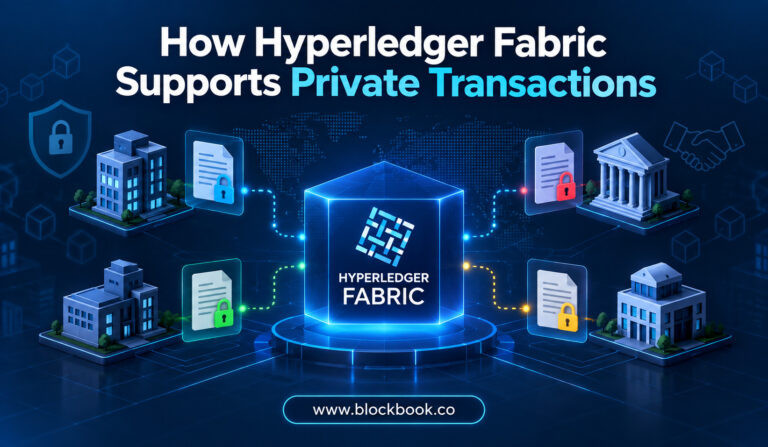
Another important characteristic is the use of channels. Channels can allow selected participants to maintain separate transaction environments within the broader network. This means that organizations do not necessarily have to expose every transaction to every participant.
For enterprises, common reasons for considering Fabric include:
- Controlled participation and identity management
- Privacy between selected business partners
- Shared records across organizational boundaries
- Flexible smart-contract or chaincode development
These characteristics make Fabric particularly relevant where several organizations need to collaborate but cannot rely entirely on a single company’s database.
How Hyperledger Fabric Works in an Enterprise Environment
A Fabric network generally consists of organizations, peers, ordering services, a certificate authority or identity infrastructure, and smart contracts. Each component performs a specific role in processing and validating transactions.
When a business application submits a transaction, the request can first be evaluated by the appropriate peers according to the network’s endorsement policies. The transaction proposal is then processed before an ordering service establishes the sequence of transactions. After ordering, participating peers validate the transactions and update their copies of the ledger.
This architecture differs from the traditional approach in which every participant might independently maintain records and later reconcile differences. With Fabric, organizations can maintain synchronized ledger information while applying rules that determine which participants can perform or approve particular activities.
The ledger itself generally consists of two important concepts: the blockchain containing the transaction history and the current-state database representing the latest state of the assets or records. This combination allows applications to retrieve current information while preserving a history of transactions.
Smart Contracts and Chaincode
Smart contracts are another important part of enterprise blockchain applications. In Hyperledger Fabric, business logic is commonly implemented through what the platform calls chaincode.
Chaincode can define how assets are created, transferred, updated, or otherwise managed. Consider a logistics company tracking a shipment. A chaincode application could establish rules for recording shipment creation, transfer between parties, delivery confirmation, or changes in ownership.
The advantage is that business rules can become part of the shared network rather than remaining solely inside one organization’s private application. When participants follow the same agreed rules, the risk of inconsistent processing can be reduced.
However, smart contracts do not automatically solve every business problem. Organizations still need clearly defined processes, accurate input data, appropriate governance, and integration with external systems. Blockchain can preserve and distribute information, but it cannot guarantee that information entered into the network is truthful.
Enterprise Supply Chain Applications
Supply chain management is one of the clearest areas where Hyperledger Fabric can be applied. Modern supply chains often involve numerous organizations spread across different locations. Information about manufacturing, transportation, storage, inspection, and delivery may be stored in separate systems.
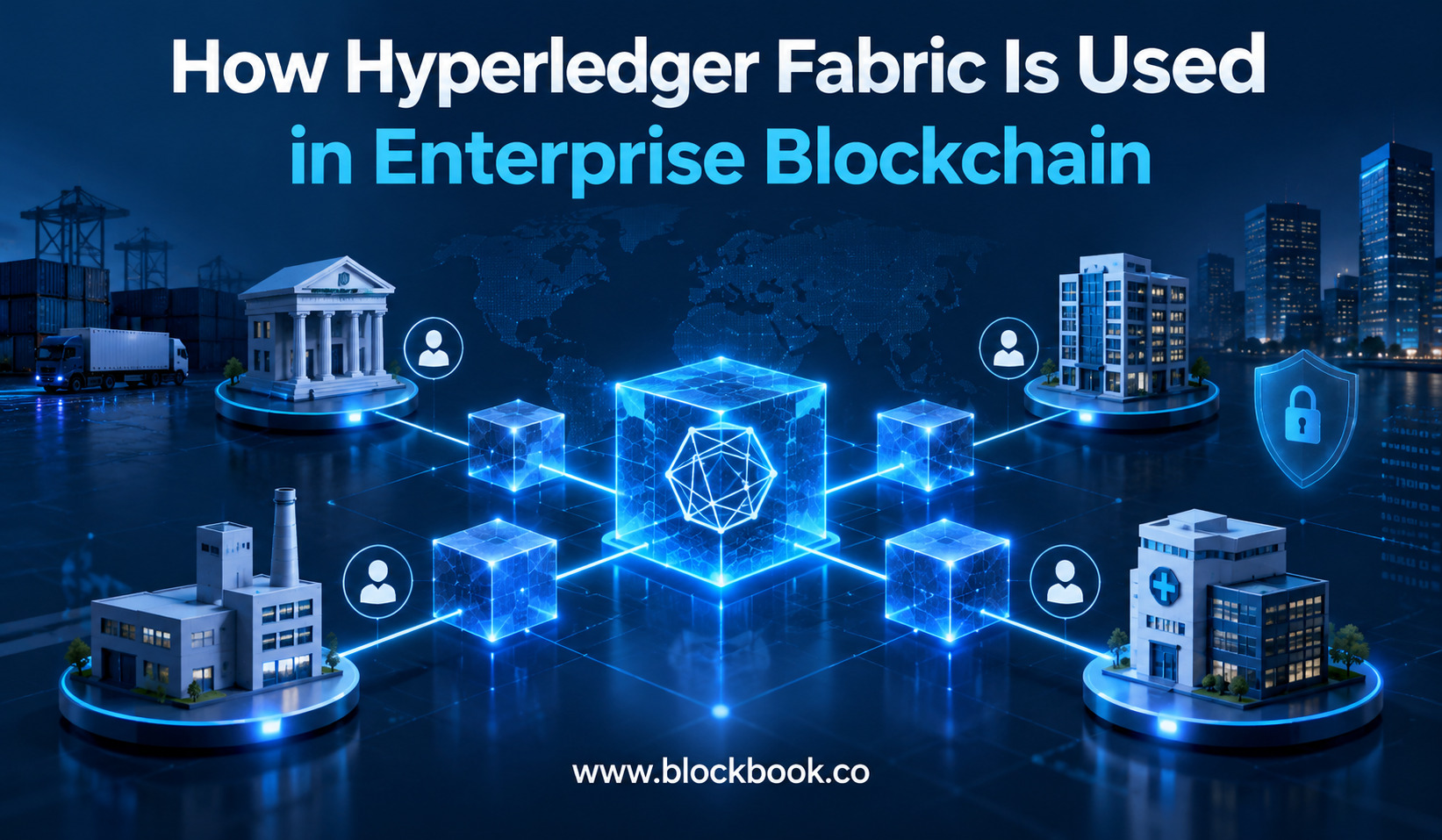
A Fabric network can provide a shared environment in which authorized participants record important events. A manufacturer could record production information, a logistics provider could add shipment updates, and a retailer could confirm receipt. Depending on the network design, selected information can be shared with relevant participants without making all records publicly available.
This can improve traceability and make it easier to investigate discrepancies. For products requiring detailed provenance, the shared ledger can provide a chronological record of events from one stage of the supply chain to another.
The practical value depends heavily on adoption. If only one organization uses the system while its partners continue relying on disconnected processes, the benefits of a shared ledger may be limited.
Financial Services and Trade
Financial institutions can also explore Fabric for applications involving multiple organizations. Banks and other institutions frequently exchange transaction information, documentation, and verification data. Traditional processes may require repeated reconciliation between systems.
A permissioned blockchain can provide a common transaction environment for authorized participants. Fabric’s identity and access controls can be useful where participants need to know exactly which organizations are interacting with the network.
Trade documentation is another potential application. Importers, exporters, banks, insurers, logistics providers, and customs-related organizations may need access to different parts of the same commercial process. A blockchain-based system can provide a shared record while maintaining permission boundaries.
The objective is not necessarily to replace every existing banking system. Instead, Fabric can operate as a coordination layer connecting organizations and reducing unnecessary duplication in selected workflows.
Healthcare Data Management
Healthcare organizations handle highly sensitive information, making privacy and access control critical. Hyperledger Fabric can be considered for use cases where hospitals, laboratories, insurers, pharmaceutical companies, and other authorized organizations need to coordinate information.
For example, a healthcare network could use a permissioned ledger to record selected events related to data access, consent management, medical supply tracking, or administrative processes. Sensitive documents themselves do not necessarily need to be placed directly on the blockchain. Instead, blockchain records can contain references, hashes, permissions, or transaction metadata while the underlying data remains in appropriate storage systems.
This distinction is important because blockchain’s immutability can create challenges when information needs to be corrected, removed, or handled according to privacy regulations. Enterprise deployments therefore need careful architecture rather than simply placing sensitive records directly on a ledger.
Hyperledger Fabric vs Public Blockchain Networks
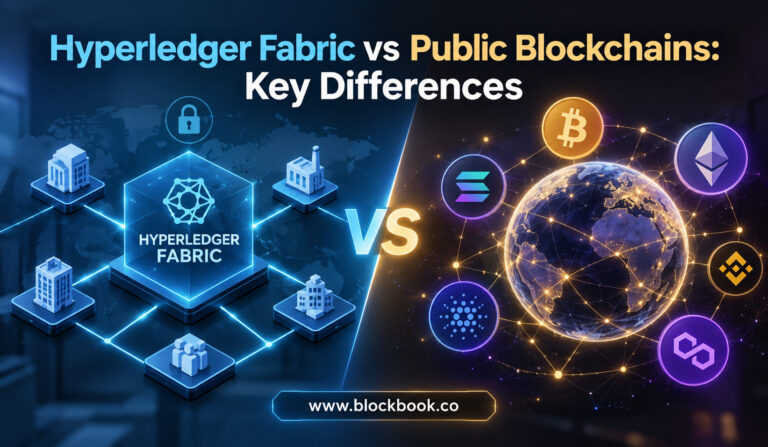
Hyperledger Fabric is fundamentally different from many public blockchain platforms. Public networks generally emphasize open participation and decentralized operation across potentially unknown participants. Fabric is designed around known organizations operating within a permissioned environment.
| Feature | Hyperledger Fabric | Typical Public Blockchain |
| Network access | Permissioned | Generally open |
| Participants | Known organizations | Potentially unknown users |
| Privacy | Supports private data and channels | Usually broader transaction visibility |
| Governance | Consortium or organizational governance | Network-level decentralized governance |
| Main focus | Enterprise applications | Open decentralized applications and digital assets |
| Transaction model | Configurable enterprise workflow | Depends on individual blockchain |
| Identity | Managed identities | Often wallet-based pseudonymous identity |
The comparison does not mean one model universally replaces the other. They are designed for different environments. Enterprises choosing a blockchain architecture need to consider their participants, regulatory requirements, privacy expectations, transaction patterns, and governance structure.
Integration With Existing Enterprise Systems
One of the major considerations for enterprise blockchain is integration. Companies rarely want to abandon their existing technology stacks simply to introduce a distributed ledger. Fabric can therefore be connected with applications, databases, APIs, cloud platforms, and enterprise software.
For instance, an organization’s existing ERP system could remain responsible for internal business processes while a Fabric network handles shared transactions involving external partners. APIs or middleware can connect the systems so that selected events are recorded on the blockchain.
This hybrid approach can be more practical than attempting to put an entire enterprise operation on-chain. Blockchain is most useful when multiple parties need a shared source of trusted records and existing databases alone do not adequately address the coordination problem.
Challenges Enterprises Need to Consider
Despite its enterprise-oriented architecture, Hyperledger Fabric is not a plug-and-play solution. A successful implementation requires agreement among participating organizations. Businesses must decide who operates network components, who can access information, how identities are managed, and how disputes are handled.
Performance and infrastructure planning also matter. Transaction volume, endorsement requirements, database configuration, network topology, and application design can all influence system performance.
There are also organizational challenges. A blockchain network can only create value when participants agree to use common processes. Different companies may have conflicting incentives or technical standards, making consortium governance one of the most important parts of a deployment.
Enterprises should therefore evaluate blockchain against conventional technologies before beginning development. If a centralized database can solve the problem efficiently and the participating organizations already trust a single operator, blockchain may not provide a meaningful advantage.
Conclusion
Hyperledger Fabric provides enterprises with a blockchain framework built around controlled participation, privacy, identity management, configurable business rules, and collaboration between organizations. Its applications can extend across supply chains, finance, healthcare, manufacturing, logistics, insurance, and other industries where multiple parties need to share trusted information.
The technology does not eliminate the need for databases, APIs, governance, or strong business processes. Instead, it offers another architecture for situations in which organizations need a shared and verifiable record without exposing their information through a public blockchain.
As enterprise technology continues to evolve, Hyperledger Fabric remains relevant because it approaches blockchain from a business-network perspective. Its value ultimately depends on choosing the right use case, designing appropriate governance, and integrating the ledger with the systems companies already rely on.
FAQs
What is Hyperledger Fabric?
Hyperledger Fabric is an open-source, permissioned blockchain framework designed primarily for enterprise and business applications.
Is Hyperledger Fabric a public blockchain?
No. Fabric is designed for permissioned networks where participating organizations and their identities can be managed.
What industries use Hyperledger Fabric?
Potential applications include supply chain management, financial services, healthcare, manufacturing, insurance, logistics, and trade.
What is chaincode in Hyperledger Fabric?
Chaincode is the term used in Fabric for programs that implement business logic and rules for interacting with ledger assets.
Does Hyperledger Fabric use cryptocurrency?
Fabric is not designed primarily around cryptocurrency. Its main purpose is enabling organizations to build permissioned blockchain applications and shared business networks.
About the Author