Smart contracts have become one of the most important building blocks of blockchain applications. From decentralized finance platforms and token systems to NFT marketplaces and decentralized autonomous organizations, smart contracts allow applications to execute predefined rules without depending entirely on a traditional centralized server. Solidity is one of the most widely used programming languages for creating these contracts, particularly within the Ethereum and broader EVM-compatible ecosystem.
However, writing a Solidity contract is only one part of blockchain development. Developers also need to test the code carefully and deploy it correctly to a blockchain network. Unlike many conventional applications, smart contracts can interact with digital assets and may remain active after deployment. A coding mistake can therefore create financial, operational, or security risks.
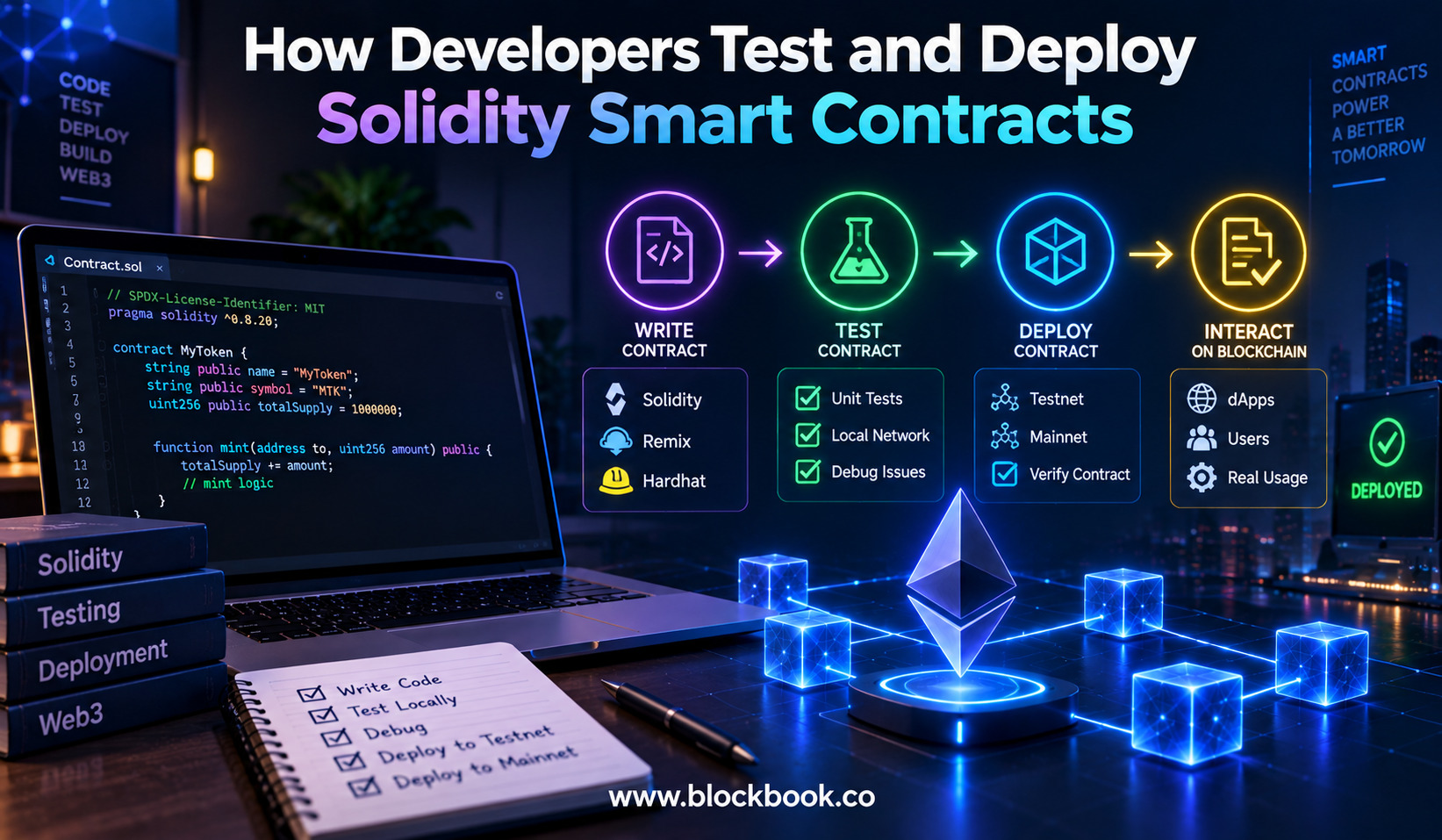
For this reason, modern Solidity development generally involves a structured process that moves from writing and compiling code to local testing, security checks, testnet deployment, and eventually production deployment.
Why Testing Matters in Solidity Development
Testing is essential for almost every software project, but smart contracts require particular attention because blockchain transactions are generally persistent. Once a transaction has been confirmed, reversing its effects may not be straightforward.
A smart contract can contain multiple functions that change blockchain state. These functions may interact with other contracts, transfer tokens, verify permissions, or perform calculations. Developers need to confirm that the contract behaves correctly not only under normal conditions but also when users provide unexpected inputs.
Testing also helps developers identify inefficient operations. Since blockchain transactions can consume gas, unnecessary computation or storage operations may increase transaction costs. A contract that works correctly but consumes excessive gas may still create problems for users.
The First Stage: Writing and Compiling the Contract
The development process normally begins with Solidity source code. Developers define the contract’s variables, functions, events, access controls, and other components according to the application’s requirements.
After writing the code, the Solidity compiler converts it into a format that the blockchain’s execution environment can understand. Compilation can reveal syntax errors, incompatible language features, incorrect data types, and other problems before the contract reaches a blockchain network.
Compiler settings are also important. Developers need to select an appropriate Solidity compiler version and pay attention to compiler warnings. Ignoring warnings can make it easier for potential problems to remain hidden during development.
At this stage, developers commonly use a local development framework that supports compiling, testing, debugging, and deployment. These environments make it possible to repeatedly modify and test contracts without immediately interacting with a public blockchain.
Testing Smart Contracts Locally
Local testing is one of the most important stages in the Solidity development lifecycle. A local blockchain environment allows developers to simulate transactions and contract interactions without spending real cryptocurrency.
Developers create test cases that represent different situations. For example, a token contract may need tests for successful transfers, insufficient balances, unauthorized operations, and invalid addresses. A financial contract may require tests involving deposits, withdrawals, interest calculations, and unexpected transaction sequences.
Automated tests are particularly valuable because they can be executed repeatedly whenever the contract code changes. Instead of manually checking every function after each modification, developers can build a test suite that verifies expected behavior automatically.
Some common testing areas include:
- Normal contract operations
- Invalid inputs and failed transactions
- Permission and access-control rules
- Balance and state changes
- Interactions between multiple contracts
Testing should cover both successful and unsuccessful scenarios. A function working correctly under ideal conditions does not necessarily mean the contract is secure.
Unit Testing and Integration Testing
Unit testing focuses on individual components of a smart contract. Developers can test whether a particular function produces the expected result when given specific inputs. This approach is useful for identifying problems in individual pieces of contract logic.
Integration testing goes further by examining how different contracts or application components work together. A decentralized application may include several smart contracts, a frontend, wallet interactions, and external services. A problem may not appear when each component is tested independently but can become visible when they interact.
For example, a decentralized exchange could involve token contracts, liquidity pools, trading logic, and user transactions. Developers need to verify that these components communicate correctly and that state changes occur as expected.
Testing Edge Cases and Failure Conditions
One of the major differences between basic testing and serious smart-contract testing is the attention given to unusual situations.
Developers should consider what happens when a user supplies zero values, extremely large numbers, invalid addresses, or unexpected transaction sequences. They should also examine how the contract behaves when a transaction fails halfway through an intended workflow.
Blockchain applications can have complex state transitions. A contract might work correctly during a simple transaction but produce unexpected behavior when several users interact with it rapidly or when another contract calls it.
Testing edge cases helps developers discover these weaknesses before deployment.
Security Testing for Solidity Contracts
Security testing is a major part of the smart-contract development process. Blockchain contracts may manage assets or enforce financial rules, making vulnerabilities especially significant.
Developers can use automated analysis tools to identify suspicious code patterns and potential vulnerabilities. Manual code review is also important because automated tools cannot understand every business rule or application-specific risk.
Common security areas include reentrancy, access-control problems, unsafe external calls, incorrect authorization, arithmetic mistakes, and poorly designed upgrade mechanisms.
Security testing should not be treated as a final step performed immediately before deployment. It is more effective when security considerations are incorporated throughout the development process.
Using Test Networks Before Mainnet Deployment
After local testing, developers can deploy the contract to a public blockchain test network. Testnets provide an environment that behaves more like a real blockchain while allowing developers to experiment without risking the same assets used on a production network.
A testnet deployment allows developers to check how the contract behaves with wallets, blockchain explorers, frontend applications, and actual network transactions. It can also reveal issues related to transaction confirmation, gas usage, deployment configuration, and contract interaction.
Before moving to production, developers may repeat testing on the testnet using realistic user scenarios. This provides another opportunity to identify problems that were not visible in a local environment.
Deployment Configuration
Deploying a Solidity smart contract requires more than sending compiled code to a blockchain. Developers must configure the target network, deployment account, RPC connection, compiler settings, and other project parameters.
The deployment process typically creates a transaction that publishes the contract bytecode to the selected blockchain. Once that transaction is confirmed, the contract receives a blockchain address that applications can use for future interactions.
Developers should carefully verify the target network before executing a production deployment. Deploying to the wrong network or using an incorrect configuration can cause operational problems.
Mainnet Deployment and Verification
Once the contract has passed development, testing, and security checks, developers can deploy it to a production blockchain network. This is generally considered the most sensitive stage because the deployed contract may begin handling real user transactions or digital assets.
After deployment, developers commonly verify the contract source code through a blockchain explorer when appropriate. Verification allows users and developers to compare the published contract’s source code with its deployed bytecode and can improve transparency.
The deployment transaction, contract address, compiler version, and configuration details should be documented carefully. Maintaining accurate records makes future maintenance and monitoring easier.
Testing and Deployment Workflow
| Stage | Main Purpose | Typical Outcome |
| Code development | Create contract logic | Solidity source code |
| Compilation | Convert and validate code | Compiled contract artifacts |
| Unit testing | Check individual functions | Function-level confidence |
| Integration testing | Test component interactions | Application-level validation |
| Security review | Identify vulnerabilities | Risk findings and fixes |
| Testnet deployment | Simulate production use | Real network testing |
| Mainnet deployment | Release contract | Live contract address |
| Verification and monitoring | Improve transparency and observe behavior | Verified and monitored deployment |
Gas Optimization Before Deployment
Gas efficiency is another consideration before a contract reaches production. Every state-changing transaction can require network resources, and inefficient contract design may increase costs for users.
Developers can review storage usage, repeated computations, data structures, and function design to identify unnecessary operations. However, gas optimization should not come at the expense of security or readability.
A technically optimized contract that is difficult to understand or introduces additional security risks may create larger problems later. The goal is to balance efficiency with maintainability and safety.
Monitoring After Deployment
Deployment does not mark the end of smart-contract development. Once a contract becomes active, developers may need to monitor transactions, events, contract activity, and application behavior.
Monitoring can help identify unusual activity or unexpected interactions. Developers can also use logs and blockchain data to understand how users interact with the contract.
For upgradeable systems, additional administrative controls and upgrade procedures may be required. These mechanisms should be tested as carefully as the underlying contract logic.
Common Mistakes Developers Try to Avoid
Developers working with Solidity need to consider several issues throughout the deployment lifecycle. Rushing directly from coding to mainnet is one of the most significant risks. A contract that compiles successfully is not necessarily secure or production-ready.
Other common mistakes include:
- Testing only successful transactions while ignoring failure cases.
- Deploying without thoroughly reviewing access-control logic.
- Ignoring compiler warnings or gas-consumption problems.
- Treating testnet results as a complete substitute for security auditing.
- Failing to document deployment addresses, versions, and configuration details.
A disciplined development process helps reduce these risks.
The Growing Importance of Solidity Development Practices
As blockchain applications become more sophisticated, Solidity development is increasingly moving beyond simply writing functional smart contracts. Developers are paying greater attention to automated testing, security analysis, gas efficiency, deployment automation, and post-deployment monitoring.
Development frameworks and testing tools are also making it easier to build repeatable workflows. Instead of treating deployment as a single event, development teams can approach smart contracts as software systems that require testing, review, documentation, and ongoing operational attention.
This approach is particularly important for applications that manage financial transactions or interact with multiple decentralized protocols.
Conclusion
Testing and deploying Solidity smart contracts requires a structured process. Developers generally begin by writing and compiling the contract, followed by local unit tests, integration testing, security analysis, and testnet deployment. Only after these stages have been completed should a production deployment be considered.
The most important principle is that a contract should not be considered ready simply because it compiles or passes a few basic tests. Blockchain applications operate in an environment where transactions, state changes, and deployed code can have lasting consequences.
By combining automated testing, edge-case analysis, security reviews, testnet experiments, careful deployment configuration, and post-deployment monitoring, developers can create a more reliable workflow for Solidity-based applications. As smart contracts continue to support a wider range of blockchain use cases, disciplined testing and deployment practices will remain an essential part of Web3 development.
FAQs
What is the first step in deploying a Solidity smart contract?
The process normally starts with writing and compiling the Solidity contract. Developers then test the code locally before moving toward testnet and production deployment.
Why are Solidity smart contracts tested before deployment?
Testing helps identify programming errors, unexpected behavior, security weaknesses, and inefficient operations before the contract interacts with a production blockchain.
Can Solidity contracts be tested without real cryptocurrency?
Yes. Developers can use local blockchain environments and public test networks to test contract behavior without relying on the same real assets used on a production network.
What is the purpose of a blockchain testnet?
A testnet provides a blockchain environment where developers can test contracts and applications under conditions that are closer to a public network without using production assets.
Is a smart contract audit the same as testing?
No. Testing checks whether the contract behaves as expected under defined scenarios, while a security audit provides a deeper review aimed at identifying vulnerabilities and design risks. They serve different purposes and can complement each other.
About the Author