
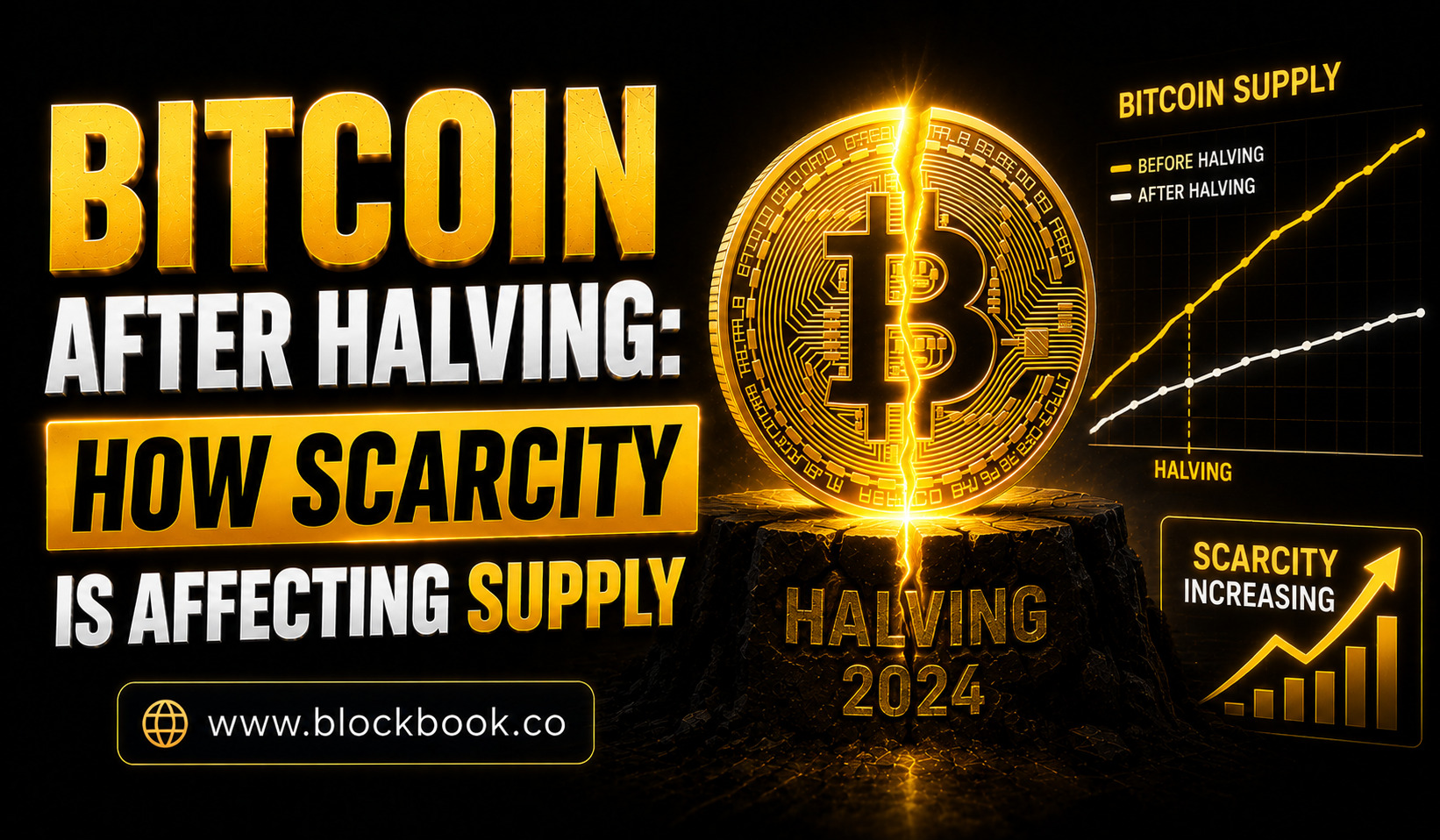
Bitcoin has always been built around scarcity. Unlike traditional currencies, which can be created according to monetary policy, Bitcoin has a fixed maximum supply of 21 million coins. The halving mechanism reinforces this scarcity by reducing the number of new BTC entering circulation approximately every four years.
The latest Bitcoin halving took place in April 2024, reducing the mining reward from 6.25 BTC to 3.125 BTC per block. Its effects continue to influence Bitcoin’s supply economics, mining industry and long-term investment narrative.
As Bitcoin moves further beyond the latest halving, an important question remains: How is reduced new supply affecting the market, and could increasing scarcity contribute to higher BTC prices over time?
The answer depends on demand. Scarcity alone does not guarantee price appreciation, but when limited supply meets sustained or growing demand, the potential for significant price movements increases.
What Happens During a Bitcoin Halving?
A Bitcoin halving reduces the amount of newly created Bitcoin awarded to miners for validating blocks.
Before the 2024 halving, miners received 6.25 BTC as the block subsidy. After the event, that reward dropped to 3.125 BTC. The change means the Bitcoin network creates significantly fewer new coins every day than it did during the previous cycle.
The halving does not reduce the Bitcoin already held by investors. Instead, it affects the future rate of supply creation.
This distinction is important.
Bitcoin continues to produce new coins, but at a slower pace. As a result, the percentage increase in the total circulating supply becomes smaller over time.
The next scheduled halving is expected in 2028, when the block subsidy will fall again to 1.5625 BTC.
Why Bitcoin Scarcity Matters
Scarcity is one of the central ideas behind Bitcoin’s value proposition.
This creates a fundamentally different supply structure from fiat currencies, where central banks can increase the monetary supply.
Bitcoin’s scarcity becomes even more significant because not all 21 million coins are actively available for trading. Some BTC is held by long-term investors, lost permanently or stored in wallets that rarely move.
This means the amount of Bitcoin readily available in the market can be considerably smaller than the theoretical maximum supply.
When demand increases while available supply remains limited, buyers may have to compete more aggressively for the coins that are actually being offered for sale.
The Four Main Effects of the Halving
The halving influences Bitcoin’s market structure in several ways:
- New Bitcoin enters circulation at a slower rate.
- Mining revenue from block subsidies is reduced.
- The inflation rate of Bitcoin’s supply declines.
- Long-term scarcity becomes more pronounced.
These effects do not automatically produce a price increase. Instead, they change the supply side of the market.
Bitcoin’s New Supply Is Becoming Smaller
One of the most important consequences of repeated halvings is that Bitcoin’s annual supply growth continues to decline.
When Bitcoin was first launched, miners received 50 BTC for every block. That reward was later reduced to 25 BTC, then 12.5 BTC, followed by 6.25 BTC and finally 3.125 BTC.
Every halving reduces the flow of new coins entering the market.
This creates an increasingly scarce monetary asset.
The following simplified comparison shows how the block subsidy has changed:
| Bitcoin Era | Block Subsidy |
| 2009 launch | 50 BTC |
| 2012 halving | 25 BTC |
| 2016 halving | 12.5 BTC |
| 2020 halving | 6.25 BTC |
| 2024 halving | 3.125 BTC |
| Expected 2028 halving | 1.5625 BTC |
The decline is significant because miners are one of the main sources of newly issued Bitcoin entering the market.
Why Miners Matter to Bitcoin Supply
Bitcoin miners receive newly created BTC as part of their compensation for securing the network.
Historically, miners have often sold some of their rewards to pay for electricity, equipment, employees and other operating expenses.
When the block reward is reduced, miners receive fewer newly created coins.
This can reduce the amount of fresh Bitcoin available for sale, although the actual impact depends on miner behavior.
A miner experiencing financial pressure may sell a larger percentage of its holdings after the halving. Meanwhile, an efficient miner with strong margins may choose to hold more BTC.
Therefore, the halving does not guarantee that miner selling will decrease immediately.
Over a longer period, however, fewer new coins are being created.
Scarcity Only Matters When Demand Exists
Bitcoin’s limited supply is often described as inherently bullish, but scarcity by itself does not determine price.
A scarce asset can decline in value if demand falls significantly.
The important relationship is between available supply and demand.
If fewer new BTC are entering the market while demand remains stable, the supply-demand balance becomes tighter. If demand increases at the same time, the effect can become much stronger.
This is why institutional adoption has become an important part of the post-halving Bitcoin story.
Investment products, corporations, professional investors and individuals can all create demand for BTC. If these groups collectively want to acquire more Bitcoin than existing holders are willing to sell, scarcity can become increasingly visible in the price.
Bitcoin ETFs Could Make Scarcity More Important
The growth of spot Bitcoin ETFs has changed how traditional investors access BTC.
This can make Bitcoin easier to include in conventional portfolios.
If ETF demand remains strong, the products can become an important source of Bitcoin buying pressure.
This creates an interesting situation after the halving.
On one side, the network is producing fewer new coins. On the other side, new channels are making it easier for investors to gain exposure.
The combination of reduced issuance and increased access could potentially create a tighter market.
However, ETF inflows can also reverse. Institutional demand should therefore be viewed as a variable rather than a permanent source of buying.
Long-Term Holders Increase Effective Scarcity
Another factor affecting Bitcoin supply is the behavior of long-term holders.
Some Bitcoin investors accumulate BTC with the intention of holding it for years rather than trading frequently. When these coins remain inactive, they are effectively removed from the pool of Bitcoin that is readily available for purchase.
This does not mean the coins are permanently unavailable. Their owners can sell at any time.
However, long periods of inactivity can reduce the amount of BTC circulating through exchanges and other liquid markets.
Bitcoin’s supply can therefore be viewed in two ways: the total number of coins that exist and the much smaller amount that is actively available for trading.
The second figure may be more important when analyzing short-term price movements.
What Does Scarcity Mean for Bitcoin Investors?
The post-halving environment can create opportunities, but investors should avoid assuming that every halving will produce the same result.
Bitcoin’s historical cycles have included strong rallies following previous halvings, but many other factors influenced those markets.
Interest rates, liquidity, regulation, institutional demand, economic conditions and investor sentiment can all affect BTC prices.
A halving changes Bitcoin’s supply schedule, but it does not control the entire market.
For investors, the most important signals include:
- The rate of new BTC issuance.
- Miner selling activity.
- Long-term holder behavior.
- Institutional and retail demand.
Watching these factors together provides a better understanding of whether scarcity is actually affecting the market.
How Scarcity Could Influence Bitcoin’s Future
As Bitcoin approaches its maximum supply, scarcity is expected to become increasingly pronounced.
The number of new coins created with each block will continue declining through future halvings. Eventually, the block subsidy will become extremely small compared with today’s reward.
Bitcoin is expected to reach its maximum supply around the year 2140. Until then, new BTC will continue entering circulation, but at progressively lower rates.
This creates a monetary system where supply growth is predictable years in advance.
For investors, that predictability is one of Bitcoin’s most distinctive characteristics.
Governments can change monetary policies. Companies can issue more shares. Commodity production can increase when prices rise. Bitcoin’s issuance schedule, by contrast, is embedded in its protocol.
What Could Reduce the Impact of Scarcity?
Scarcity does not eliminate Bitcoin’s risks.
A major decline in investor demand could overwhelm the effect of reduced issuance. Economic uncertainty could cause investors to move toward cash or other assets. Higher interest rates could make riskier investments less attractive.
Bitcoin holders can also sell existing coins.
The halving only reduces new supply. It does not prevent the millions of BTC already in circulation from entering the market.
This is why Bitcoin’s price ultimately depends on both sides of the market.
If existing holders aggressively sell, the market can experience significant supply even though mining issuance has declined.
Frequently Asked Questions
1. What happened to Bitcoin supply after the 2024 halving?
The 2024 halving reduced the mining reward from 6.25 BTC to 3.125 BTC per block. This lowered the rate at which new Bitcoin enters circulation.
2. Does the Bitcoin halving automatically increase the BTC price?
No. The halving reduces new supply, but Bitcoin’s price also depends on demand, liquidity, interest rates, investor sentiment and broader market conditions.
3. Why is Bitcoin becoming more scarce?
Bitcoin has a maximum supply of 21 million coins, while repeated halvings continually reduce the number of new BTC created. Long-term holders and lost coins can further reduce the amount readily available in the market.
4. When is the next Bitcoin halving?
The next Bitcoin halving is expected in 2028. The block subsidy is scheduled to fall from 3.125 BTC to 1.5625 BTC per block.
5. Can Bitcoin scarcity push BTC higher?
Scarcity can support higher prices when demand remains strong or increases. However, scarcity alone cannot guarantee price appreciation because investors can sell existing Bitcoin and overall market demand can change.
Final Thoughts
Bitcoin after the halving is becoming increasingly scarce from a new-supply perspective.
The 2024 halving cut the block reward to 3.125 BTC, meaning fewer new coins are entering circulation every day. Future halvings will continue reducing issuance until Bitcoin eventually reaches its maximum supply.
The most important factor is what happens to demand alongside this declining supply.
If institutional investors, companies and individuals continue increasing their exposure to Bitcoin while long-term holders keep significant amounts of BTC out of active circulation, the available supply could become increasingly constrained.
That does not guarantee another Bitcoin rally, but it creates an important structural feature that differentiates BTC from traditional currencies.
The post-halving Bitcoin market is therefore less about a sudden shortage and more about a gradual reduction in the rate of new supply.
As each halving passes, fewer coins are created, and the importance of existing Bitcoin holders becomes greater.
Ultimately, Bitcoin’s long-term value will depend on the interaction between its predictable scarcity and global demand. If demand continues growing while new supply keeps falling, scarcity could become one of the strongest forces shaping Bitcoin’s market in the years ahead.
About the Author