
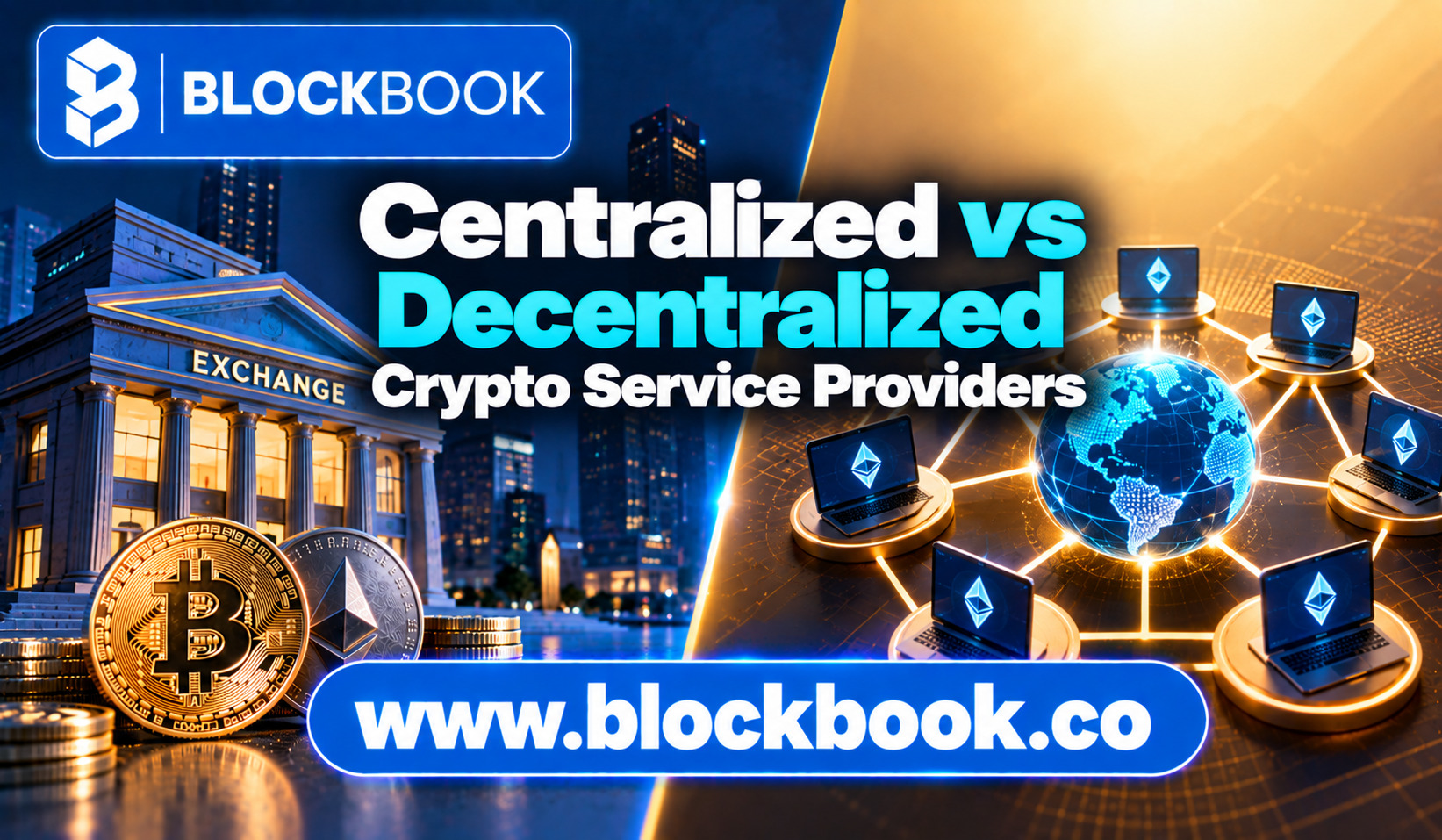
The cryptocurrency industry offers users more choices than ever before. People can buy digital assets through traditional crypto exchanges, trade directly through blockchain-based applications, store assets with custodians, use decentralized finance platforms, and access many other services. Among these options, centralized and decentralized crypto service providers represent two different approaches to handling digital assets.
Centralized providers operate more like traditional financial technology companies. A company controls the platform, manages infrastructure, and usually takes responsibility for customer accounts and services. Decentralized providers rely more heavily on blockchain networks and smart contracts, allowing users to interact with services without depending on one company to control every part of the system.
Both models have their own advantages, limitations, and use cases. Understanding the difference can help users decide which type of service fits their needs.
What Are Centralized Crypto Service Providers?
Centralized crypto service providers are businesses that manage and operate a digital asset platform. Users typically create an account with the company, complete any required verification, deposit funds, and then use the provider’s services.
Centralized exchanges are the most familiar example. They provide an organized marketplace where users can buy and sell cryptocurrencies. The company generally manages the trading infrastructure, customer accounts, security systems, and other operational functions.
Other centralized services can include crypto custody providers, brokers, payment companies, and institutional digital asset platforms.
How Centralized Services Work
When a user deposits cryptocurrency on a centralized platform, the assets are generally held through wallets controlled or managed by the company. The user’s account balance is recorded within the platform’s internal system.
This setup can make transactions between users fast because every transaction does not necessarily need to be recorded individually on a blockchain.
The company is responsible for maintaining the platform and handling many operational tasks.
What Are Decentralized Crypto Service Providers?
Decentralized crypto services use blockchain networks and smart contracts to provide financial or digital asset functions without relying on one central company to control every transaction.
Decentralized exchanges, lending applications, liquidity platforms, and other decentralized finance services are common examples.
Instead of creating an account with a traditional company, users may connect a compatible crypto wallet directly to the application. Transactions are then processed through blockchain networks and smart contracts.
This gives users a different type of control over their assets and transactions.
How Decentralized Services Work
Smart contracts are programs stored on a blockchain that can automatically carry out predefined actions. For example, a decentralized exchange can use smart contracts to allow users to swap one digital asset for another.
The application interface may be operated by a development team or organization, but the underlying transaction process can take place through blockchain-based systems.
This reduces the need for a traditional intermediary in many transactions.
Centralized vs Decentralized: Key Differences
The biggest difference between the two models is where control and responsibility sit.
| Feature | Centralized Provider | Decentralized Provider |
| Account management | Company-managed account | Usually wallet-based |
| Asset control | Often held by provider | Usually controlled by user wallet |
| Transactions | Platform systems and blockchain | Primarily blockchain and smart contracts |
| Customer support | Company support team | Often community or limited support |
| Identity checks | Common on regulated services | May vary by application |
| User experience | Usually simpler | Can require more technical knowledge |
| Governance | Company or management team | May involve community-based systems |
| Main risks | Company and account risks | Smart contract and blockchain risks |
Neither model removes risk completely. They simply distribute responsibility in different ways.
Convenience and User Experience
Centralized platforms are generally designed to make cryptocurrency easier to use. A new user can create an account, deposit money, and purchase digital assets through a familiar interface.
Password recovery and account support are also commonly available.
Decentralized platforms can require more involvement from users. Instead of relying on a company to manage an account, users may need to understand wallets, private keys, blockchain networks, transaction fees, and wallet approvals.
Why Beginners Often Choose Centralized Platforms
For people who are new to cryptocurrency, centralized services can provide a more familiar experience. The platform handles many technical processes behind the scenes.
However, convenience also means users depend more heavily on the service provider.
Decentralized services give users more direct interaction with blockchain systems but require greater responsibility.
Asset Ownership and Control
One of the most important differences concerns control of digital assets.
With a centralized provider, cryptocurrency deposited into the platform may be held by the company on behalf of the customer. The user generally accesses the assets through an account rather than directly controlling the private keys.
With a decentralized service, users generally connect their own wallet and approve transactions themselves.
This creates a different responsibility structure.
If users control their own wallet, they also need to protect their recovery phrase and private keys. Losing access to those credentials can create serious problems.
Security Considerations
Security is important in both models, but the risks are different.
Centralized platforms can face risks involving account attacks, internal security failures, operational problems, and unauthorized access. A major security incident can affect many customers at once.
Decentralized platforms can face smart contract vulnerabilities, malicious applications, wallet attacks, and errors in blockchain transactions.
A decentralized system is not automatically safer simply because it does not depend on one central company. Likewise, a centralized platform is not automatically unsafe because a company controls the service.
Users need to understand the specific risks of the platform they choose.
Regulation and Compliance
Centralized crypto businesses often operate within financial and regulatory frameworks applicable to their locations and services. This can involve customer identification, transaction monitoring, reporting requirements, and other compliance measures.
Decentralized services can operate differently because the underlying technology may not have a traditional company performing every intermediary function.
Regulatory treatment can therefore vary significantly depending on the application, organization, jurisdiction, and type of service.
Users should understand which rules apply to the service available in their location.
Privacy and Personal Information
Privacy can also differ between the two models.
Centralized providers commonly require users to provide personal information when opening accounts, particularly where identity verification requirements apply.
Decentralized applications may allow users to interact through blockchain wallets without creating a conventional customer account. However, blockchain transactions are generally recorded publicly, and wallet activity can sometimes be analyzed or connected with other information.
Therefore, decentralized does not necessarily mean completely private.
Trading and Liquidity
Centralized exchanges traditionally use order books where buyers and sellers place orders. The platform matches these orders and manages the trading environment.
Many decentralized exchanges use automated systems based on liquidity pools. Users trade against assets deposited into these pools rather than directly matching with another individual trader.
Both approaches can provide liquidity, but their mechanisms are different.
Why Liquidity Matters
Liquidity affects how easily an asset can be traded and how much the price may change during a transaction.
Large centralized exchanges often attract significant trading activity. Decentralized markets can also have substantial liquidity, especially for popular trading pairs.
For smaller assets, liquidity can vary considerably between platforms.
Transaction Speed and Costs
Centralized platforms can process internal transactions quickly because many activities take place within the company’s own database.
When users withdraw assets to a blockchain wallet, however, blockchain processing times and network fees may apply.
Decentralized services depend more directly on the underlying blockchain. A transaction may require network confirmation and a blockchain fee.
During periods of heavy network activity, these costs can increase.
Customer Support
Centralized platforms usually have dedicated customer support teams. Users can contact the company about account access, deposits, withdrawals, or other problems.
Decentralized services generally cannot provide the same type of traditional customer support because there may not be a central company controlling the entire system.
This difference can be important for beginners who prefer having someone to contact when they encounter a problem.
Governance and Decision-Making
Centralized providers normally have management teams that make decisions about platform policies, supported assets, fees, and product development.
Some decentralized projects use governance systems that allow token holders or community participants to influence certain decisions.
However, decentralized governance can vary significantly between projects. Some systems provide broad participation, while others give greater influence to specific groups.
Users should examine how governance actually works rather than assuming every decentralized project operates in the same way.
Advantages of Centralized Providers
Centralized providers can offer a familiar and convenient experience. They often provide customer support, fiat payment options, account recovery, and a wide selection of trading services.
They can also invest heavily in technology, security, compliance, and user interfaces.
For customers who value simplicity and professional support, these features can be useful.
Advantages of Decentralized Providers
Decentralized services can provide direct access to blockchain-based markets without requiring users to rely on a traditional intermediary for every transaction.
They can also support open financial applications where users interact directly through wallets and smart contracts.
Common attractions include:
- Direct wallet interaction
- Access to blockchain-native applications
- Greater control over transaction approvals
- Open access to certain markets
- Reduced dependence on a traditional intermediary
However, these advantages come with greater user responsibility and technical risks.
Which Model Is More Suitable?
There is no single model that works for everyone.
A beginner who wants simple cryptocurrency purchases, traditional payment methods, and customer support may prefer a centralized platform.
An experienced crypto user who understands wallets, blockchain transactions, and smart contracts may prefer decentralized services for certain activities.
Some users choose both. They may use a centralized exchange to convert traditional currency into cryptocurrency and a decentralized application for specific blockchain-based transactions.
The Future of Centralized and Decentralized Services
The two models may continue to develop alongside each other. Centralized companies are adding more blockchain-based services, while decentralized applications are becoming easier to use.
The industry may also see hybrid models that combine centralized customer services with blockchain-based settlement and asset management.
As technology improves, the difference between the two models may become less obvious in some areas. Users may eventually interact with services that combine convenience, transparency, and greater control.
Conclusion
Centralized and decentralized crypto service providers offer different ways to access digital assets and blockchain-based services.
Centralized platforms emphasize convenience, managed accounts, customer support, and professional infrastructure. Decentralized services focus more on direct blockchain interaction, wallet-based access, and reduced dependence on traditional intermediaries.
The important difference is not simply which model is centralized or decentralized. Users should understand who controls the assets, how transactions are processed, what fees apply, what security risks exist, and what support is available.
Choosing between the two depends on experience, goals, technical comfort, and the specific service being used.
FAQs
1. What is the main difference between centralized and decentralized crypto services?
Centralized services are operated and controlled by a company, while decentralized services rely more heavily on blockchain networks and smart contracts. This creates different approaches to account management, asset control, and transactions.
2. Are decentralized crypto services safer than centralized exchanges?
Neither model is automatically safer. Centralized platforms can face company, account, and custody risks, while decentralized applications can face smart contract, wallet, and blockchain risks.
3. Which model is easier for beginners?
Centralized platforms are generally easier for beginners because they often provide familiar account systems, simple interfaces, payment options, and customer support.
4. Do decentralized exchanges require an account?
Many decentralized exchanges allow users to connect a compatible cryptocurrency wallet instead of creating a traditional account. The exact process depends on the application.
5. Can someone use both centralized and decentralized crypto services?
Yes. Some users use centralized platforms for activities such as purchasing cryptocurrency with traditional currency and decentralized applications for specific blockchain-based transactions.
About the Author