
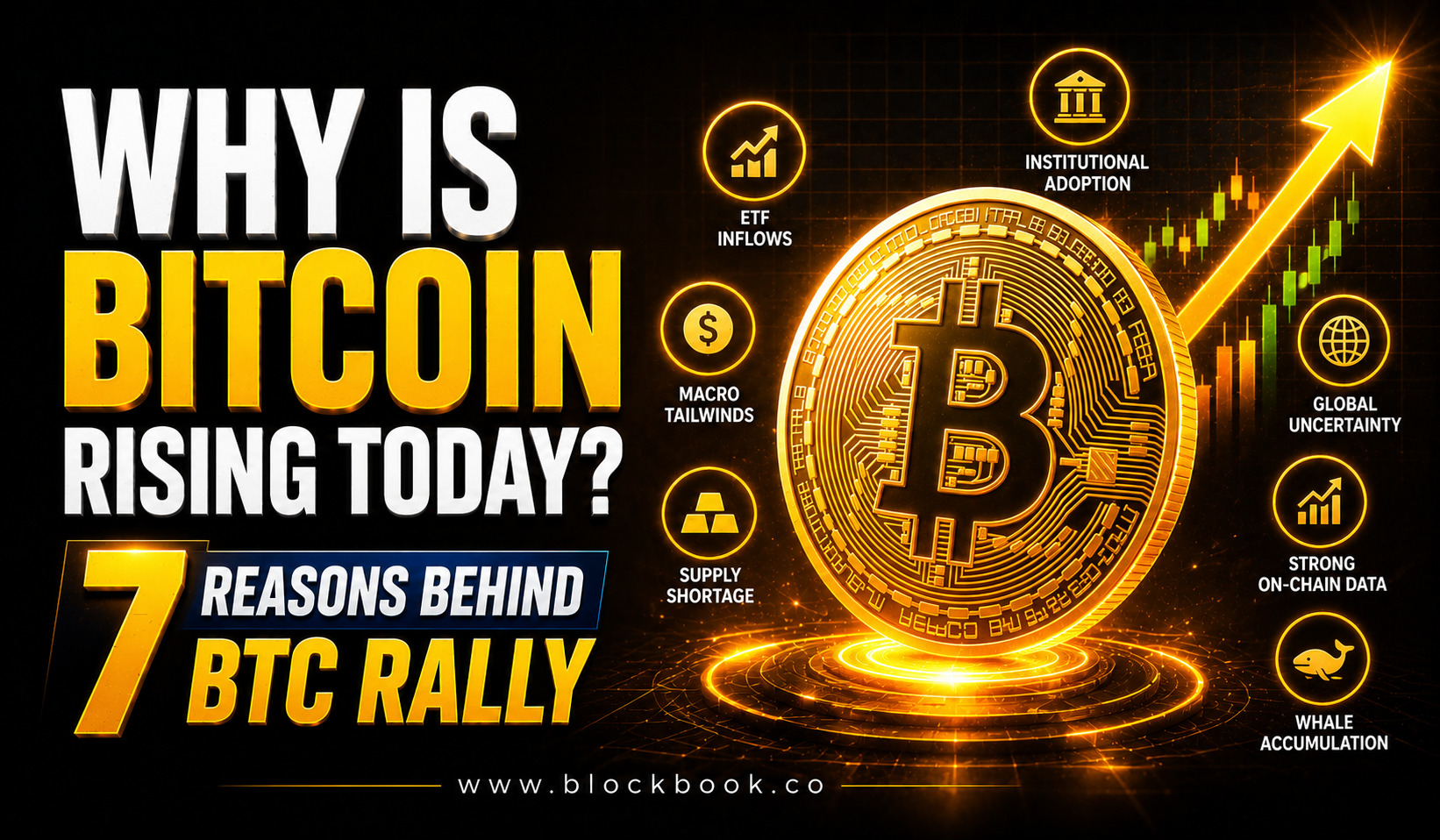
Bitcoin is back in the spotlight after a powerful rally pushed BTC toward the $80,000 level. The move has attracted renewed attention from traders, long-term investors and institutions that had remained cautious during Bitcoin’s earlier weakness in 2026.
The latest rally is particularly notable because it has not been driven by a single crypto-specific announcement. Instead, several forces are working together: stronger Bitcoin ETF demand, changing expectations around liquidity, a weaker U.S. dollar, improving regulatory sentiment and a wave of short covering. Bitcoin has gained more than 20% over the past week, making the recent move one of its strongest rallies of 2026.
So, why is Bitcoin rising today? Here are seven of the biggest factors behind the current BTC rally and what they could mean for the market going forward.
1. Bitcoin ETF Inflows Are Returning
One of the clearest reasons behind Bitcoin’s latest strength is renewed demand through U.S. spot Bitcoin ETFs.
When investors purchase shares of spot Bitcoin ETFs, the funds generally need to obtain exposure to actual Bitcoin. Strong inflows can therefore create additional demand for BTC and improve market sentiment.
Recent trading has shown a significant increase in ETF activity. The latest rally coincided with several strong inflow sessions, with approximately $1.9 billion entering U.S. spot Bitcoin ETFs over a five-day period. This has helped demonstrate that the rally is not solely dependent on speculative derivatives trading.
The importance of ETF demand goes beyond one day’s price movement. Consistent inflows can provide a more durable source of buying pressure because institutional and professional investors can use regulated investment products to gain Bitcoin exposure without directly managing cryptocurrency wallets.
If ETF inflows continue, they could become one of the strongest foundations for Bitcoin’s attempt to move above $80,000.
2. U.S. Treasury Bond Buybacks Improved Liquidity Expectations
Another major catalyst has come from the U.S. Treasury market.
The Treasury’s decision to expand buybacks of longer-dated government bonds has influenced expectations around liquidity and bond-market conditions. Falling or stabilizing long-term yields can make the environment more favorable for risk assets.
Bitcoin is particularly sensitive to changes in liquidity because investors often treat it as a high-beta asset. When financial conditions become more supportive, capital can move toward assets with greater potential returns.
The Treasury development therefore created a broader market effect rather than simply affecting cryptocurrencies. Gold, equities and Bitcoin all benefited from the shift in sentiment.
For Bitcoin traders, the important point is that the rally has gained support from the wider financial environment rather than relying exclusively on crypto-related news.
3. The U.S. Dollar Is Losing Some Strength
The dollar is another important piece of the current Bitcoin story.
Bitcoin is priced in U.S. dollars, so changes in the dollar’s value can influence the attractiveness of alternative and scarce assets. A weaker dollar can make assets such as Bitcoin and gold more appealing to investors who are concerned about currency purchasing power.
The recent decline in the dollar has occurred alongside increased interest in so-called hard assets. Bitcoin’s fixed maximum supply gives it a distinctive position within this discussion.
This does not mean that every dollar decline automatically produces a Bitcoin rally. Markets are more complicated than that. However, when a weaker dollar appears at the same time as improving liquidity expectations and stronger investment flows, the combination can create a favorable environment for BTC.
4. Short Sellers Are Being Forced to Exit
Bitcoin’s rally is also being amplified by short covering.
A short position benefits when an asset falls. When Bitcoin unexpectedly moves higher, traders holding bearish positions may be forced to buy BTC to close those positions. Their buying adds further demand to the market and can accelerate the upward move.
This creates a feedback loop:
- Bitcoin rises unexpectedly.
- Short sellers begin closing losing positions.
- Their buying pushes BTC higher.
- Other traders interpret the breakout as confirmation.
- Additional buyers enter the market.
Short squeezes can produce very fast price increases, which is one reason Bitcoin has moved so sharply over a short period.
However, short covering is usually not enough to sustain a long-term bull market by itself. Once the forced buying disappears, the market needs genuine spot demand to keep prices elevated. This is why the recent ETF inflows are particularly important.
5. Crypto Regulation Is Becoming More Supportive
Regulatory expectations are another reason investor confidence has improved.
Greater clarity around digital assets can reduce uncertainty for financial institutions, investment firms and businesses considering cryptocurrency exposure. Investors generally prefer environments where the rules are easier to understand and the risk of sudden regulatory changes is lower.
Recent developments in Washington have increased optimism around potential cryptocurrency legislation and clearer rules for the digital-asset industry.
For Bitcoin, regulatory clarity could have a long-term effect. Banks, asset managers and other financial companies may be more comfortable developing products and services connected to digital assets when regulatory uncertainty declines.
That does not mean regulation automatically makes Bitcoin more valuable. But a clearer framework can remove one of the barriers that has historically limited institutional participation.
6. Bitcoin Has Broken Out of a Long Consolidation Phase
Technical momentum is also playing an important role in today’s rally.
Bitcoin spent a significant period struggling to establish a sustained upward trend. The move through several previous resistance areas changed the market’s technical structure and encouraged traders to reassess their positions.
A breakout becomes particularly powerful when traders who were waiting on the sidelines begin entering the market at the same time.
Bitcoin’s move toward $80,000 has therefore created a psychological shift. Instead of asking whether BTC can recover from its previous decline, traders are increasingly asking whether it can break above $80,000 and continue toward higher levels.
The $80,000 area is important because round numbers often attract significant buying and selling activity. A convincing move above that level could strengthen momentum, while repeated rejection could result in consolidation or a correction.
7. Investors Are Returning to Bitcoin as a Scarce Asset
The final reason behind the rally is broader investor demand for scarce assets.
Concerns about government debt, inflation and currency purchasing power have encouraged some investors to look beyond traditional assets. Gold has also benefited from this environment, while Bitcoin is increasingly being viewed by some investors as a digital alternative to scarce assets.
Bitcoin’s supply is limited by its underlying protocol. Unlike fiat currencies, its maximum supply cannot simply be increased by a central bank.
This scarcity narrative becomes more influential when investors are worried about long-term currency depreciation or fiscal pressures.
It is important to remember that Bitcoin remains considerably more volatile than gold and can experience large corrections. Nevertheless, its role in the broader “hard asset” investment conversation has become increasingly visible.
What Does the Bitcoin Rally Mean for BTC’s Next Move?
The biggest question now is whether Bitcoin can maintain its momentum.
A rapid rally can create significant opportunities, but it can also produce excessive optimism. After a strong move, traders often take profits, and leveraged positions can make the market more volatile.
For the rally to develop into a sustained trend, several signals will be important:
- Continued ETF inflows
- Bitcoin holding above recently recovered support levels
- Stable or improving liquidity conditions
- Continued institutional participation
If these conditions remain favorable, Bitcoin could attempt to establish a new trading range above its previous levels. A sustained breakout above $80,000 would likely attract even more attention because it could shift market expectations toward $90,000 and eventually $100,000.
However, failure to maintain momentum could send BTC back into consolidation.
Bitcoin Rally Risks Investors Should Watch
Despite the bullish momentum, Bitcoin’s rally is not risk-free.
The first risk is that ETF inflows could slow. If institutional buying fades after the initial surge, Bitcoin may struggle to maintain the same pace of appreciation.
The second risk is macroeconomic uncertainty. Bond yields, inflation data, central-bank policy and the dollar can all change investor sentiment quickly.
The third risk is profit-taking. Traders who bought Bitcoin near recent lows may choose to sell after a large gain, creating temporary downward pressure.
The main warning signs to monitor are:
- A sharp reversal below important support.
- Weakening spot and ETF demand.
- Rising yields and renewed dollar strength.
- Excessive leverage and speculative positioning.
A healthy bull market does not necessarily move upward every day. Pullbacks are normal, particularly after a rapid rally.
Is Bitcoin’s Rally Sustainable?
The current Bitcoin rally has stronger foundations than a simple speculative spike because several different factors are moving in the same direction.
ETF inflows indicate renewed investment demand, while improved liquidity expectations are helping risk assets. A weaker dollar is supporting the appeal of scarce assets, and regulatory optimism is improving confidence in the cryptocurrency sector.
At the same time, short covering and technical breakouts have accelerated the move.
The key distinction is between a rally and a trend. A rally can last for several days because of momentum and forced buying. A trend can last for months when sustained capital continues entering the market.
Bitcoin now needs to prove that buyers are willing to remain active after the initial excitement fades.
What Could Happen to Bitcoin Next?
Bitcoin’s next major challenge is maintaining its position near the upper end of its recent range.
If BTC can consolidate around these higher levels rather than immediately giving back its gains, the market could develop a stronger foundation for another upward move. A successful break above $80,000 could put higher psychological levels back into focus.
On the other hand, rejection near resistance could lead to a period of profit-taking. That would not necessarily mean the broader recovery has ended. Bitcoin frequently experiences substantial pullbacks even during strong long-term trends.
For investors, the most important factor may therefore be the quality of demand rather than the size of today’s price increase.
Frequently Asked Questions
1. Why is Bitcoin rising today?
Bitcoin is rising because several factors are supporting demand simultaneously. Strong Bitcoin ETF inflows, improved liquidity expectations, a weaker dollar, regulatory optimism, short covering and technical momentum have all contributed to the recent rally.
2. Is the Bitcoin rally driven only by ETF inflows?
No. ETF demand is an important factor, but it is only part of the story. Macro conditions, Treasury bond-market developments, short covering, regulatory expectations and improving investor sentiment are also contributing to Bitcoin’s strength.
3. Can Bitcoin reach $100,000 after this rally?
Bitcoin reaching $100,000 is possible if the current momentum develops into a sustained trend. Continued institutional demand, strong ETF inflows and supportive liquidity conditions would improve the chances, although no price target is guaranteed.
4. Will Bitcoin fall after such a big rally?
A pullback is possible and would not necessarily be unusual. After a rapid increase, traders may take profits and leveraged positions can increase volatility. The more important question is whether Bitcoin can maintain higher support levels during any correction.
5. Is Bitcoin still worth buying during a rally?
Buying after a sharp rally carries additional timing risk because prices can correct quickly. Investors should consider their risk tolerance, investment horizon and position size rather than assuming that recent momentum will continue indefinitely.
Final Thoughts
Bitcoin’s latest rally is the result of several forces coming together at the same time. Stronger ETF demand has provided direct buying pressure, while improving liquidity expectations and a weaker dollar have created a more favorable macro environment. Regulatory optimism has improved confidence, while short covering and technical momentum have accelerated the move.
The rally is therefore more than a single-news event. It reflects a broader improvement in Bitcoin’s market environment.
Still, investors should remain cautious. Bitcoin can move rapidly in both directions, and a strong rally does not guarantee another immediate leg higher. The next stage of the market will depend on whether genuine demand remains strong after short sellers have exited and early investors begin taking profits.
It is whether the forces driving today’s rally can remain strong enough to turn a short-term surge into a sustained Bitcoin uptrend.
About the Author