
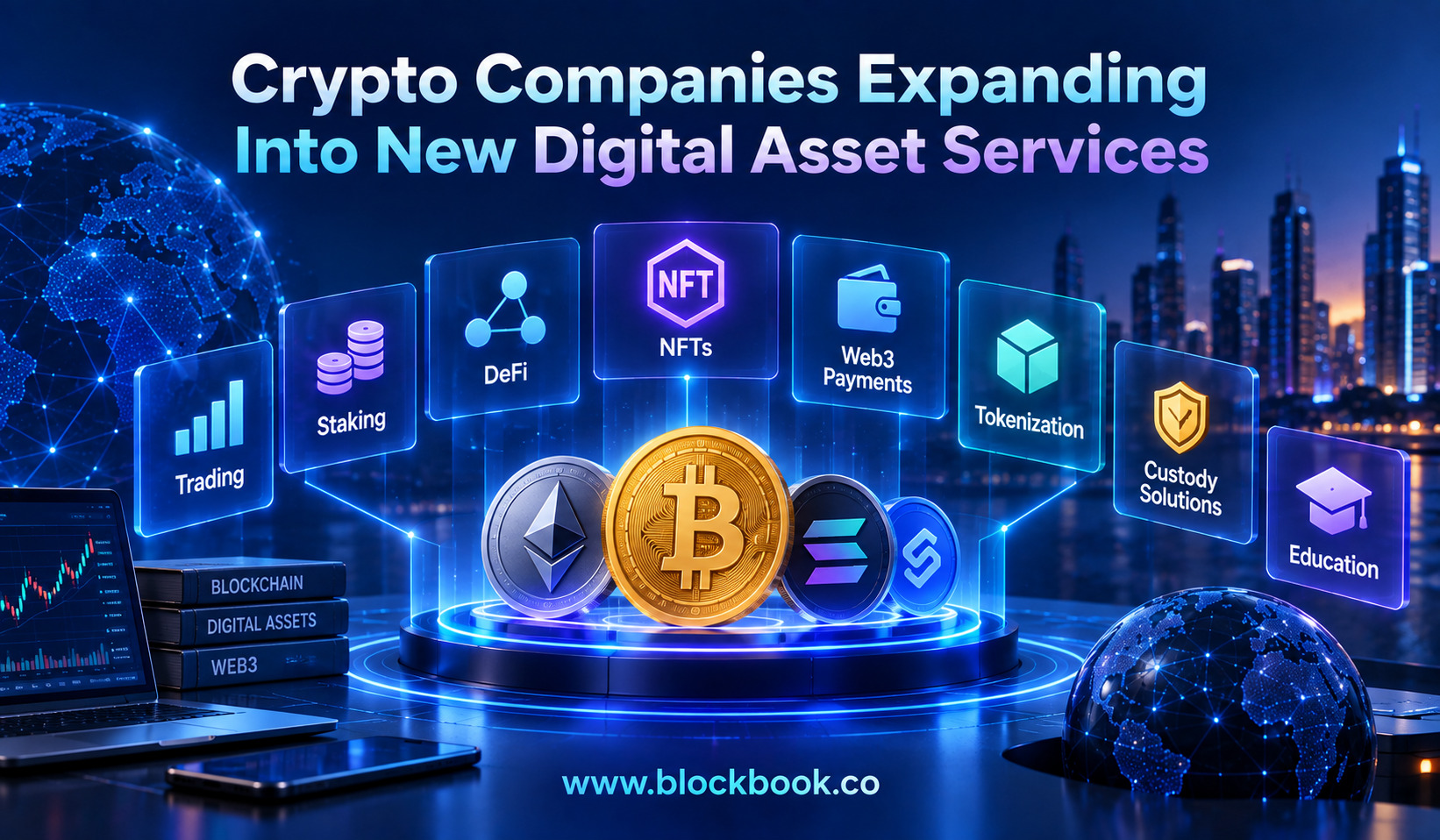
The cryptocurrency industry is moving beyond its original focus on buying, selling and transferring digital currencies. Crypto companies are increasingly expanding into new digital asset services, creating broader ecosystems that combine trading, custody, payments, staking, institutional finance, Web3 applications and blockchain infrastructure.
This transformation is being driven by changes in the way individuals, businesses and financial institutions use blockchain technology. As the market develops, customers are looking for more than a simple exchange account. They may want to store assets, make payments, participate in blockchain networks, access professional trading tools or explore tokenized financial products.
At the same time, crypto companies are facing a rapidly changing regulatory environment. New rules are influencing how businesses provide digital-asset services, what products can be offered and which customers can access them. As a result, expansion is increasingly taking place alongside greater attention to compliance, security and operational controls.
The combination of technological development, customer demand and regulatory change is creating a new phase for the digital asset industry in 2026.
From Exchanges to Digital Asset Ecosystems
Crypto exchanges were originally designed mainly to provide markets for cryptocurrency trading. Customers could deposit funds, place orders and withdraw their digital assets.
That model has gradually expanded. Major crypto companies are now developing ecosystems that can include several financial and blockchain services under one brand.
The shift is significant because it changes the relationship between a platform and its users. Instead of serving customers only when they make a trade, companies can provide services throughout the digital asset lifecycle.
A user might purchase cryptocurrency, transfer it to a wallet, stake an eligible asset and use stablecoins for payments without leaving the broader ecosystem.
For companies, this approach can diversify revenue. Trading fees may remain important, but custody, payments, subscriptions, institutional services and other products provide additional opportunities.
Advanced Trading Services Continue to Grow
Trading remains the foundation of many crypto businesses, but the technology surrounding trading is becoming more sophisticated.
Retail customers may receive simplified interfaces, while professional traders can access advanced order types, market data, charting tools and APIs.
Derivatives are another major area of expansion. Futures, perpetual contracts and options allow eligible customers to use more complex trading strategies.
These products can involve leverage and liquidation risks, making them different from ordinary spot transactions. Regulations may also limit access depending on the user’s country.
The growth of derivatives shows how crypto companies are attempting to serve a wider range of market participants, from casual users to professional investors.
Custody Is Becoming a Major Business
As more institutions enter the digital asset market, custody has become increasingly important.
Digital assets depend on cryptographic keys for control and transfer. Managing those keys securely requires technical systems and operational procedures.
Crypto companies are developing professional custody services that can include offline storage, multi-signature controls, transaction approval systems and access management.
Institutional clients may also require reporting, governance and asset-segregation arrangements.
The growth of professional custody could make digital assets easier for financial institutions to integrate into their existing operations. Instead of developing custody systems themselves, institutions can work with specialised providers.
This is helping transform custody from a supporting exchange feature into a major digital asset service.
Crypto Companies Are Expanding Into Payments
Payments are another important area of expansion.
Crypto companies are building services that allow individuals and businesses to transfer digital assets and, in some cases, use them for merchant payments.
Stablecoins are particularly relevant because they are designed to maintain a relatively stable value against a reference asset. This makes them potentially useful for payments and settlement compared with highly volatile cryptocurrencies.
Businesses operating internationally may also explore stablecoins for cross-border transfers and settlement.
However, payment adoption depends on regulatory requirements, transaction costs, liquidity and merchant acceptance. Crypto payment systems therefore need to offer practical advantages rather than simply relying on blockchain technology as a selling point.
Staking Services Are Becoming More Common
Staking is another service being added by crypto companies.
Proof-of-stake networks allow participants to contribute eligible assets to support blockchain operations. Depending on the network, participants can receive rewards for their involvement.
Platforms can simplify this process by allowing customers to stake through an exchange or wallet interface.
For users, this can reduce the technical complexity involved in participating directly in blockchain networks.
However, staking terms vary. Rewards, fees, lock-up periods, supported networks and withdrawal conditions depend on the provider and blockchain.
Regulatory treatment can also differ between jurisdictions, making it important for users to understand the specific service available in their market.
Web3 Wallets Connect Centralized and Decentralized Services
Crypto companies are also expanding into Web3 wallets.
Traditional exchange accounts provide access to assets through a centralised platform. Web3 wallets can allow users to interact directly with blockchain networks and decentralized applications.
By offering wallet services, crypto companies can connect centralized trading with decentralized finance, NFT marketplaces, blockchain games and other applications.
This creates a broader ecosystem in which users can move between exchange-based services and on-chain applications.
However, Web3 introduces additional risks. Users may interact with smart contracts, decentralized applications and external websites that have different security characteristics from centralized platforms.
Companies expanding into Web3 therefore need to combine convenience with security education.
Institutional Services Are Reshaping the Market
Institutional participation is becoming an increasingly important part of the digital asset industry.
Professional investors generally require infrastructure that differs from the needs of retail customers. They may need deep liquidity, custody, reporting, compliance tools and dedicated support.
Crypto companies are responding with institutional trading desks, professional custody products and APIs designed for financial institutions.
Some platforms are also combining trading, custody and settlement services into integrated institutional offerings.
The growth of institutional services can have wider implications for the industry. Financial institutions often have strict requirements around security and governance, encouraging crypto companies to improve their operational systems.
Tokenization Opens a New Market
Tokenization is another area attracting attention from crypto companies and traditional financial institutions.
Tokenization involves representing an asset or financial interest through a blockchain-based token. Depending on the legal structure, this can apply to securities, funds, real-world assets and other financial instruments.
Crypto companies could potentially support tokenized assets through issuance platforms, trading venues, custody systems and settlement infrastructure.
Regulatory developments are influencing this market. In September 2026, the U.S. Securities and Exchange Commission announced a five-year conditional exemption related to certain tokenized stock trading activities. The framework included conditions concerning qualifying tokenized stocks and investor rights.
Such developments could encourage companies to experiment with blockchain-based versions of traditional financial products while also increasing compliance requirements.
Blockchain Infrastructure Becomes a Service
Not every crypto company is focused on consumers. Some are building infrastructure that other businesses can use.
Blockchain infrastructure providers can offer node services, APIs, wallet technology, custody tools, transaction monitoring and other technical components.
This model allows banks, fintech companies and businesses to integrate digital assets without developing their own blockchain infrastructure from the ground up.
Infrastructure services could become particularly important as traditional companies explore stablecoins, tokenized assets and blockchain-based settlement.
The growth of this sector demonstrates that the digital asset industry is developing multiple layers, from consumer applications to specialised enterprise technology.
AI and Automation in Digital Asset Services
Artificial intelligence and automation are also becoming part of the digital asset ecosystem.
Crypto companies can use automated systems for transaction monitoring, fraud detection, customer support and compliance analysis.
AI can potentially help analyse large amounts of blockchain data and identify patterns that require further investigation.
However, automated systems can make mistakes. Human oversight remains important, especially when decisions involve account restrictions, fraud investigations or regulatory compliance.
As transaction volumes increase, AI and automation may become increasingly valuable for helping digital asset companies manage operational complexity.
Main Areas of Expansion
| Service Area | What It Provides | Main Audience |
| Trading | Spot markets and advanced trading tools | Retail and professional traders |
| Derivatives | Futures, options and perpetuals | Experienced and institutional users |
| Custody | Digital-asset security and management | Businesses and institutions |
| Payments | Crypto transfers and settlement | Consumers and businesses |
| Staking | Participation in proof-of-stake networks | Asset holders |
| Web3 Wallets | Access to decentralized applications | Web3 users |
| Tokenization | Blockchain-based asset infrastructure | Financial institutions and businesses |
| Blockchain Infrastructure | Technical services and APIs | Companies and fintech firms |
The exact services offered and their availability depend on each provider and jurisdiction.
Regulation Is Influencing Expansion
The expansion of crypto services is happening alongside increased regulatory scrutiny.
Companies may need to comply with customer-identification requirements, anti-money-laundering rules, licensing conditions, custody requirements and consumer-protection standards.
The Financial Action Task Force continues to encourage countries to establish appropriate systems for licensing, registering and supervising relevant virtual asset service providers.
These rules can influence product development. A company may be able to offer a particular service in one country but have to restrict it in another.
This means global crypto companies increasingly need flexible compliance systems capable of adapting to different legal environments.
Security Must Keep Pace With Innovation
Adding more services creates additional security challenges.
A company providing trading, custody, payments and Web3 services is managing several interconnected systems. A security weakness could potentially affect multiple parts of the customer experience.
Companies are therefore investing in measures such as multi-factor authentication, cold storage, encryption, transaction monitoring and withdrawal controls.
Users also need to maintain strong security practices. Phishing attacks, compromised credentials and fraudulent applications can create risks even when the underlying platform has extensive security controls.
As crypto businesses become broader financial ecosystems, security and operational resilience will remain central to their growth.
What Is Driving Crypto Companies to Expand?
The current expansion can be linked to several major developments.
- Changing customer expectations: Users want more digital-asset services within integrated platforms.
- Institutional adoption: Financial institutions need professional trading, custody and compliance infrastructure.
- Blockchain innovation: Stablecoins, tokenization and Web3 applications are creating new markets.
- Competitive pressure: Companies are diversifying their services to reach more customers and revenue sources.
These forces are reinforcing one another and accelerating the development of the digital asset sector.
Challenges Ahead
Expansion creates opportunities, but it also increases complexity.
Companies must manage cybersecurity, compliance, operational reliability and customer education while developing new products.
Regulatory fragmentation is particularly challenging for international businesses. Different countries can apply different requirements to the same service.
Another issue is product complexity. As platforms add derivatives, staking, tokenization and Web3 services, users need clearer information about how each product works and what risks it carries.
The ability to communicate these differences effectively could become an important part of responsible digital asset service development.
Conclusion
Crypto companies are moving beyond basic cryptocurrency trading and building broader digital asset ecosystems. Trading, custody, payments, staking, institutional services, Web3 wallets, tokenization and blockchain infrastructure are becoming important areas of expansion.
This transformation reflects the increasing maturity of the digital asset industry. Customers are looking for more services, institutions are demanding stronger infrastructure and blockchain technology is creating new applications.
However, expansion also brings greater responsibility. Security, regulatory compliance, transparency and user education must develop alongside new products.
In 2026, the growth of crypto companies is increasingly about building financial and technological infrastructure rather than simply creating new places to trade cryptocurrency. How successfully companies manage this transition could shape the next stage of the digital asset industry.
FAQs
What are digital asset services?
Digital asset services are products that allow users and businesses to trade, store, transfer, manage or interact with cryptocurrencies and other blockchain-based assets.
Why are crypto companies expanding their services?
Companies are responding to customer demand, institutional adoption, blockchain innovation and competition within the digital asset market.
What new services are crypto companies offering?
Depending on the company, services can include custody, staking, payments, derivatives, Web3 wallets, institutional trading and tokenization infrastructure.
Why is crypto custody important?
Custody provides systems for safeguarding digital assets and managing the cryptographic keys or access mechanisms used to control those assets.
How are stablecoins being used?
Stablecoins are being explored for payments, transfers and settlement because they are designed to maintain a relatively stable value against a reference asset.
About the Author