Web3 development is continuing to expand as developers explore blockchain networks for decentralized applications, digital assets, financial services, gaming platforms, and other online services. At the center of many Web3 applications are smart contracts, which allow software programs to execute predefined rules on a blockchain without requiring every operation to be controlled by a conventional centralized server.
TRON has developed its own ecosystem for smart-contract-based applications. Its infrastructure includes the TRON Virtual Machine (TVM), Solidity support, developer tools, token standards, and blockchain resources designed to support decentralized applications. The network is particularly active in areas such as digital asset transfers, decentralized finance, stablecoins, and other Web3 services.
Understanding how TRON smart contracts work can help developers and businesses evaluate the network as part of their Web3 development strategies.
What Are TRON Smart Contracts?
A smart contract is a program deployed on a blockchain that executes according to predefined instructions. Instead of depending entirely on a central application server, specific functions can be processed through blockchain-based code.
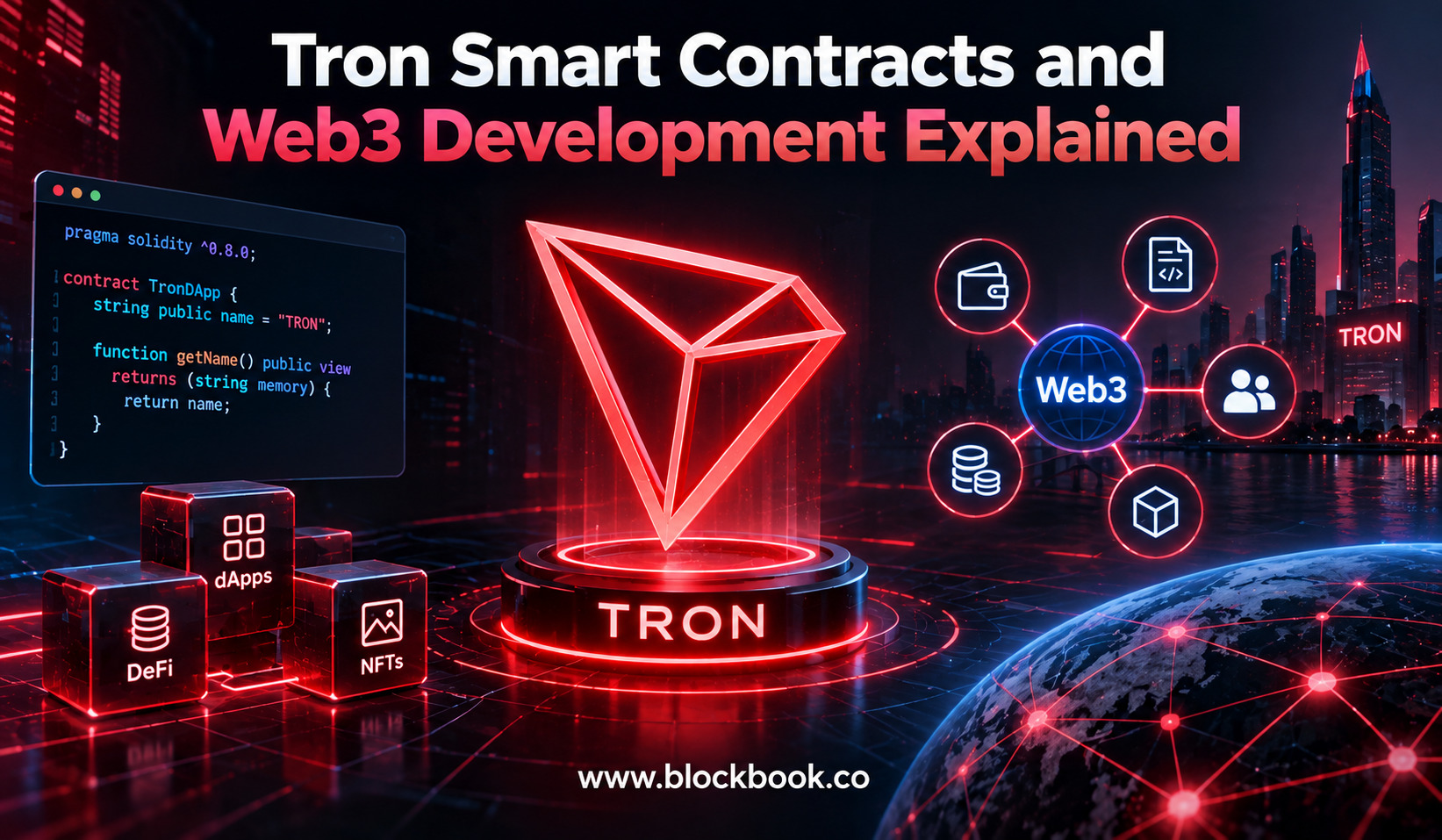
TRON smart contracts operate through the TRON Virtual Machine, or TVM. Developers commonly use Solidity to write smart-contract code, which is then compiled into bytecode that can be deployed to the TRON network.
The concept is relatively straightforward. A developer creates a contract containing specific rules, deploys it to the blockchain, and allows users or other applications to interact with its functions. When a transaction changes blockchain state, network resources are required to process it.
This architecture allows developers to create applications where important operations are recorded and executed through blockchain infrastructure rather than relying solely on a centralized database.
Understanding the TRON Virtual Machine
The TRON Virtual Machine is the execution environment used to run smart contracts on the TRON network. It is designed to provide a blockchain-based environment in which contract instructions can be processed consistently across participating nodes.
One feature that can be useful for developers is TVM’s compatibility with most Ethereum Virtual Machine opcodes. Because Solidity is supported, developers familiar with Ethereum-style smart-contract development may find it easier to adapt existing knowledge to TRON. However, compatibility does not mean that every application can simply be moved without modification. Developers still need to account for TRON’s specific transaction, resource, token, and network mechanisms.
The TVM provides the foundation for applications ranging from financial protocols to token-based services and decentralized applications.
How TRON Smart Contracts Work
The smart-contract development process generally begins with writing application logic in Solidity. Developers then compile and test the contract before deploying it to a TRON network.
Once deployed, a contract has an address that applications can use to interact with it. Users can connect through compatible wallets or applications and authorize transactions that call contract functions.
Some contract interactions only read information from the blockchain. Others change the blockchain’s state and therefore require a transaction. For example, transferring tokens, supplying assets to a DeFi protocol, or executing a token swap can require state-changing transactions.
The blockchain records successful state changes, creating a verifiable history of activity. The exact behavior depends on the contract’s programming and the rules established by its developers.
TRON’s Bandwidth and Energy Model
One of the important concepts for TRON developers is the network’s resource model. Instead of thinking only in terms of a traditional gas model, TRON uses resources including Bandwidth and Energy.
Bandwidth is associated with transaction data, while Energy is used for computational operations performed by smart contracts. Users can obtain network resources through mechanisms such as staking TRX or may need to pay TRX when sufficient resources are unavailable, depending on the transaction.
This model has implications for Web3 application design. Developers need to consider how frequently their applications submit transactions and how computationally expensive their smart contracts are.
Efficient contract design can help reduce unnecessary resource consumption. This becomes particularly important for applications that expect frequent user interactions.
TRON and Web3 Development
Web3 applications generally combine blockchain infrastructure with conventional software components. The blockchain may handle ownership, transactions, smart-contract logic, or verification, while other parts of the application can operate through websites, APIs, databases, cloud infrastructure, or decentralized storage.
TRON provides developer tools that can connect these components. TronWeb, for example, provides JavaScript-based functionality for interacting with the TRON blockchain. Developers can use blockchain APIs and related infrastructure to retrieve information, construct transactions, interact with contracts, and build application interfaces.
This makes Web3 development on TRON more than simply writing smart contracts. Developers also need to build user interfaces, wallet connections, transaction flows, security systems, and supporting infrastructure.
Token Standards and Web3 Applications
Tokens are a major component of many Web3 applications. TRON supports standards such as TRC-20 for fungible tokens and TRC-721 for non-fungible tokens.
TRC-20 tokens can be used to represent digital assets that are interchangeable with one another. They can be integrated into decentralized exchanges, payment applications, financial protocols, and other blockchain services.
TRC-721 focuses on unique digital assets. This standard can support applications where individual tokens represent distinct items or digital ownership records.
Token standards provide developers with common rules for creating and interacting with blockchain assets. This can improve interoperability between tokens and applications within the ecosystem.
TRON and Decentralized Finance
Decentralized finance, commonly known as DeFi, is one of the major areas where smart contracts are used on TRON.
DeFi applications use programmable contracts to provide functions such as token swaps, lending, liquidity provision, and other financial operations. Users can interact with these systems through blockchain wallets rather than relying exclusively on traditional financial intermediaries.
TRON’s ecosystem includes applications such as decentralized exchanges and lending platforms. Smart contracts can automate specific functions, including the management of liquidity pools, asset deposits, borrowing conditions, and other operations.
However, DeFi applications also introduce risks. Smart-contract vulnerabilities, market volatility, liquidity problems, oracle failures, and user mistakes can all affect decentralized financial systems.
TRON and Stablecoin-Based Applications
Stablecoins are another important part of TRON’s Web3 ecosystem. Stablecoins are digital assets designed to maintain a relatively stable value against a reference asset, commonly a fiat currency.
TRON has become a significant network for stablecoin transfers, particularly through TRC-20 tokens. Developers can incorporate supported stablecoins into applications for payments, trading, lending, transfers, and other financial functions.
For Web3 developers, stablecoins can provide a digital settlement mechanism within blockchain applications. A decentralized marketplace, for example, could potentially allow users to make payments using supported tokens.
The availability of widely used digital assets can also encourage developers to create applications that interact with existing liquidity and blockchain infrastructure.
Developer Tools in the TRON Ecosystem
Building a complete Web3 application requires more than a blockchain network. Developers need tools for coding, testing, deploying, monitoring, and interacting with smart contracts.
TRON provides several tools and resources designed to support this workflow. Developers can use TronWeb for JavaScript-based blockchain interaction, while development and deployment environments can assist with smart-contract testing and management.
A typical TRON Web3 project may involve:
- Solidity for smart-contract development
- TVM for contract execution
- TronWeb or related libraries for blockchain interaction
- Wallet infrastructure for user transaction approval
Developers may also use APIs, indexing systems, databases, cloud infrastructure, and front-end frameworks depending on the application’s requirements.
TRON vs Ethereum for Smart-Contract Development
TRON and Ethereum both support programmable blockchain applications, but their ecosystems and network architectures differ.
| Feature | TRON | Ethereum |
| Smart-contract language | Solidity | Solidity and other supported languages |
| Execution environment | TRON Virtual Machine | Ethereum Virtual Machine |
| Token standards | TRC-20, TRC-721 and others | ERC-20, ERC-721 and others |
| Resource model | Bandwidth and Energy | Gas |
| Main applications | DeFi, payments, tokens and Web3 services | DeFi, NFTs, infrastructure and broad DApp ecosystem |
| Developer tools | TronWeb and TRON development tools | Ethereum development frameworks and tooling |
| Network model | Public blockchain | Public blockchain |
This comparison does not mean one platform is universally suitable for every project. Developers need to evaluate factors such as application requirements, existing ecosystem integrations, developer experience, transaction economics, security, and user base.
Security Challenges in TRON Smart Contracts
Smart-contract security is one of the most important considerations in Web3 development. Once a contract is deployed, vulnerabilities can potentially create serious consequences, especially when the contract controls digital assets.
Developers should carefully test contract logic before deployment. Code reviews and independent security audits can also be useful for applications involving significant value.
Common areas requiring attention include:
- Access-control errors
- Incorrect contract logic
- Reentrancy vulnerabilities
- Poor input validation
- Unsafe external contract interactions
Security is not only a coding issue. Wallet management, private keys, front-end interfaces, APIs, and infrastructure can also introduce vulnerabilities.
Building a TRON Web3 Application
A TRON Web3 project generally begins with identifying the application’s purpose and deciding which functions should operate on-chain. Developers then design smart contracts around those requirements.
After coding and testing, contracts can be deployed to the appropriate TRON environment. The front end can then connect to the blockchain through libraries and wallet infrastructure.
Testing is especially important before a project moves into production. Developers can use test environments to identify contract errors, transaction problems, and user-experience issues without exposing real assets.
Once deployed, developers must also monitor the application and respond to security issues, infrastructure changes, and evolving user requirements.
Challenges for TRON Web3 Developers
TRON provides infrastructure for Web3 development, but building decentralized applications still presents several challenges.
Blockchain applications can be more difficult for mainstream users because wallet connections, transaction confirmations, private keys, and network resources introduce new concepts. Developers therefore need to make the user experience as clear as possible.
Smart-contract limitations also require careful architectural decisions. Blockchain contracts cannot directly access arbitrary information from external systems, so applications may need oracle infrastructure when they depend on off-chain data.
Scalability and transaction costs must also be considered when designing applications for large user populations. Efficient code and appropriate infrastructure can help manage these requirements.
Conclusion
TRON smart contracts provide developers with a programmable environment for creating Web3 applications, digital assets, financial services, and decentralized platforms. Through the TRON Virtual Machine, Solidity support, token standards, developer libraries, and network resources, the ecosystem provides many of the components required for blockchain application development.
The network’s Bandwidth and Energy model is an important consideration for developers, while TRC-20 and TRC-721 standards provide established frameworks for creating different types of digital assets.
At the same time, Web3 development involves challenges that go beyond blockchain code. Security, wallet management, user experience, external data, infrastructure, and regulatory considerations all need attention.
FAQs
What are TRON smart contracts?
TRON smart contracts are blockchain-based programs that execute predefined logic on the TRON network through the TRON Virtual Machine.
Which programming language is used for TRON smart contracts?
Solidity is commonly used for developing TRON smart contracts. Developers then compile the code into bytecode that can execute on the TRON Virtual Machine.
What is the TRON Virtual Machine?
The TRON Virtual Machine, or TVM, is the execution environment that processes smart-contract code on the TRON blockchain.
What is TronWeb?
TronWeb is a JavaScript library that helps developers interact with the TRON blockchain and smart contracts from Web3 applications.
What are TRC-20 tokens?
TRC-20 is a TRON token standard for fungible tokens. These tokens can be used across compatible TRON applications and smart contracts.
About the Author