
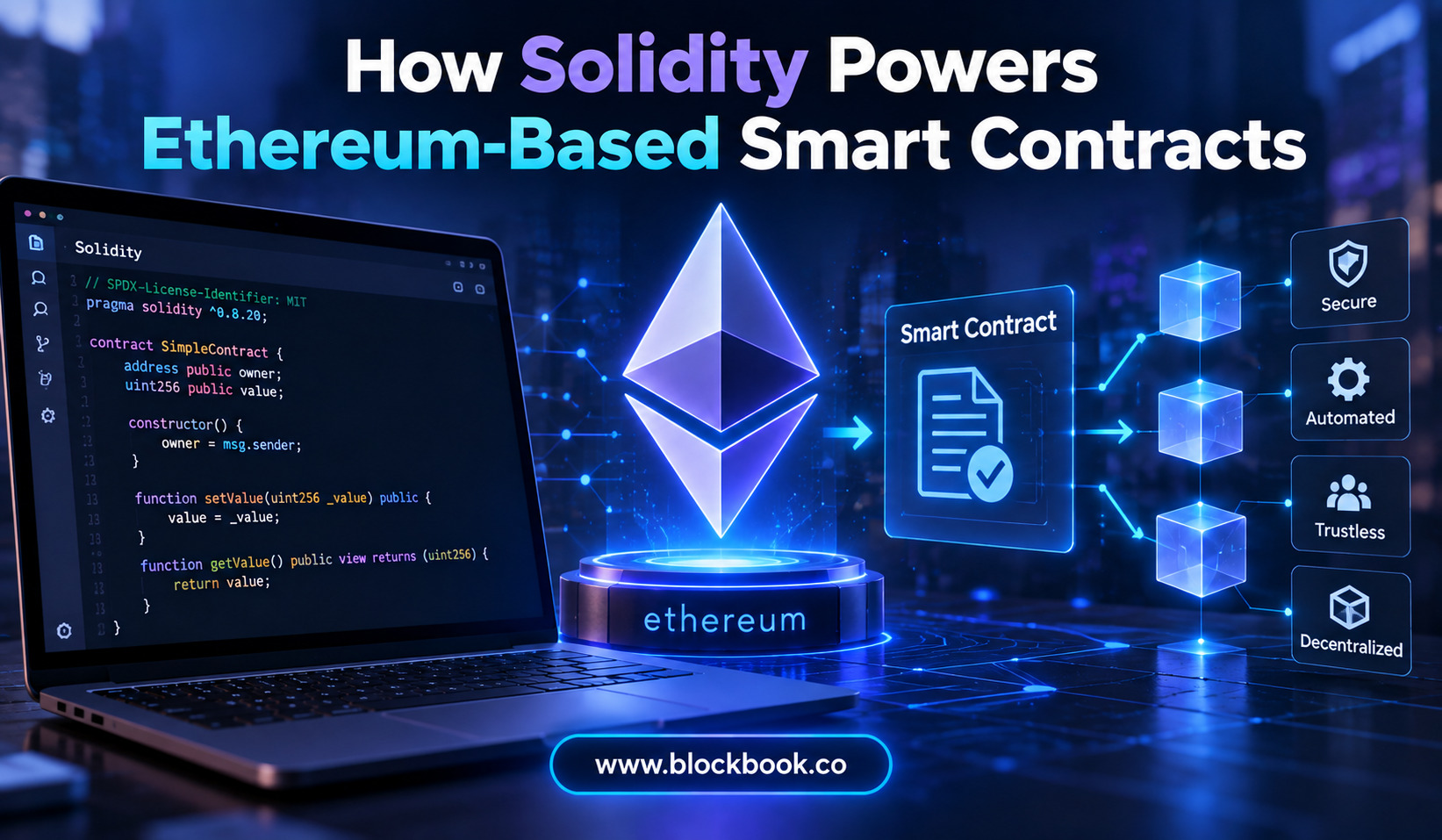
Ethereum-based applications have changed the way developers think about software by allowing programs to operate on a blockchain rather than depending entirely on traditional servers. At the center of many of these applications are smart contracts, which automatically execute programmed rules on the Ethereum network. Solidity plays a major role in creating these contracts and has become one of the most widely recognized programming languages in the Ethereum development ecosystem.
As decentralized finance, tokenization, blockchain gaming, decentralized applications, and other Web3 services continue to evolve, understanding the connection between Solidity, smart contracts, and the Ethereum Virtual Machine is becoming increasingly important for developers. Solidity provides the programming language, while Ethereum supplies the environment in which the resulting contract code can execute.
What Is Solidity?
Solidity is a high-level programming language designed for writing smart contracts that run on the Ethereum Virtual Machine, commonly known as the EVM. The language is statically typed and supports programming concepts such as variables, functions, structures, inheritance, and custom data types.
Its syntax has similarities to familiar programming languages, which can make it easier for developers with traditional software backgrounds to begin learning blockchain development. However, Solidity introduces concepts that are specific to blockchain applications. Developers need to understand transactions, gas, blockchain storage, addresses, contract calls, and the consequences of deploying code to a decentralized network.
Solidity is not the blockchain itself. Instead, it is the language developers use to describe the logic that a smart contract should execute.
Understanding Ethereum Smart Contracts
A smart contract is essentially a program deployed to the blockchain. It contains predefined instructions that can be triggered when users or other contracts interact with it.
For example, a decentralized application might use a smart contract to manage token transfers. Instead of relying on a central server to decide whether a transfer should happen, the contract follows its programmed rules. If the required conditions are satisfied, the transaction can update the blockchain’s state.
This model allows developers to create applications where important rules are executed by blockchain infrastructure rather than being controlled entirely by a conventional centralized backend.
Solidity makes it possible to define those rules in a programming language that developers can write, test, compile, and deploy.
How Solidity Connects With the Ethereum Virtual Machine
The Ethereum Virtual Machine is the execution environment responsible for processing smart contract code on Ethereum. Solidity source code itself is not directly executed by the EVM. Instead, it is compiled into EVM bytecode.
The development process can therefore be viewed as a chain:
Solidity source code → Solidity compiler → EVM bytecode → deployed smart contract → blockchain execution
When a developer compiles a Solidity contract, the compiler converts the human-readable source into a form that the EVM can execute. Once deployed, the resulting contract has an address on the blockchain and can be interacted with through transactions and calls.
This separation between programming language and execution environment is important. Developers write Solidity, while the EVM provides the standardized environment in which the compiled contract operates.
The Role of Functions in Smart Contracts
Functions are among the most important elements of Solidity because they determine how users and other contracts interact with a smart contract.
A token contract, for example, may contain functions for transferring tokens, checking balances, approving spending, or interacting with another application. A decentralized finance contract may have functions for deposits, withdrawals, borrowing, repayment, or other financial operations.
Solidity also provides different function visibility and mutability options. Developers can define whether functions are intended to be called externally or internally and whether they can modify blockchain state.
Some common Solidity function characteristics include:
- public functions can be accessed externally and internally.
- external functions are intended to be called from outside the contract.
- view functions can read state without modifying it.
- pure functions do not read or modify contract state.
- payable functions can receive Ether.
Understanding these distinctions is essential because a function’s behavior determines how the contract can be used and how it interacts with the blockchain.
Solidity and Blockchain State
One of the defining characteristics of smart contracts is their ability to maintain state. State variables can store information such as token balances, ownership details, voting results, or application settings.
Solidity provides several data types for representing this information. Developers can use integers, Boolean values, addresses, strings, arrays, mappings, structures, and other types depending on the application’s requirements.
Mappings are particularly useful in blockchain development. A contract can use a mapping to associate an address with a balance, ownership status, or another piece of information.
However, blockchain storage is not equivalent to an ordinary application database. Persistent storage can require significant gas, so developers must carefully decide what information should be stored directly on-chain.
Gas and Solidity Execution
Gas is another major concept connecting Solidity with Ethereum. Smart contract operations require computational resources, and transactions pay for those resources through gas.
Every Solidity operation does not necessarily cost the same amount. Reading information in certain ways, modifying storage, performing calculations, and interacting with other contracts can have different execution costs.
This creates an additional consideration for Solidity developers. A contract must not only perform its intended function; it should also use blockchain resources sensibly.
Developers often examine storage layouts, loops, external interactions, and unnecessary computations when looking for opportunities to improve efficiency. However, optimization should not compromise security or make the contract unnecessarily difficult to understand.
Solidity Enables Different Ethereum Applications
The flexibility of Solidity has helped support a broad range of Ethereum-based applications. Developers can use smart contracts for token systems, decentralized exchanges, lending protocols, governance applications, blockchain games, NFT platforms, payment systems, and many other use cases.
The underlying principle remains similar: Solidity defines the rules, while Ethereum provides the decentralized environment for executing those rules.
| Solidity component | Role in a smart contract |
| State variables | Store persistent contract information |
| Functions | Define actions users or contracts can perform |
| Modifiers | Help apply reusable conditions to functions |
| Events | Provide logs that external applications can monitor |
| Structs | Organize related pieces of data |
| Mappings | Associate one type of value with another |
| Errors | Describe failed execution conditions |
This flexibility allows developers to build applications with different business models while relying on the same fundamental execution infrastructure.
Solidity and Token Development
Token development is one of the most visible examples of Solidity’s role in the Ethereum ecosystem. Developers can create smart contracts that establish rules for balances, transfers, approvals, and other token-related operations.
Common token standards provide established interfaces that applications can recognize. For developers, following a standard can make a token easier to integrate with wallets, decentralized applications, exchanges, and other blockchain services.
However, implementing a token should not be viewed as simply copying a contract template. Developers need to understand what every function does, how permissions work, how balances change, and what assumptions the implementation makes.
The same principle applies to more advanced applications. Reusing established libraries can improve development efficiency, but developers still need to understand the code and its dependencies.
Events Connect Smart Contracts With Applications
Solidity events provide an important connection between blockchain contracts and off-chain applications.
Imagine a user transfers tokens through a decentralized application. The transaction changes the blockchain state, but the application’s interface also needs a way to recognize that the transfer occurred. A contract can emit an event containing relevant information, allowing external software to monitor blockchain logs.
Events are therefore particularly useful for decentralized application interfaces, analytics systems, indexing services, and blockchain monitoring tools.
This demonstrates that Solidity is not isolated from the rest of Web3 development. Smart contracts form one layer of an application that can also include frontend software, wallets, APIs, indexing systems, and blockchain infrastructure.
Security Is Central to Solidity Development
Because smart contracts can manage digital assets and execute automatically, security is a major part of Solidity development. A coding error can potentially affect users or contract funds after deployment.
Developers need to understand vulnerabilities such as reentrancy, incorrect access control, unsafe external calls, improper input validation, and faulty business logic. They also need to test contracts under unexpected conditions rather than checking only the normal user flow.
Security development commonly includes:
- Unit and integration testing.
- Code review and static analysis.
- Testing unusual inputs and transaction sequences.
- Reviewing permissions and external contract interactions.
- Security audits for appropriate production projects.
No single technique guarantees that a contract is completely secure. A layered development and review process is generally more appropriate for applications that handle meaningful value.
Solidity’s Importance for Web3 Developers
Learning Solidity provides developers with a direct way to understand how decentralized application logic is implemented on EVM networks. It also teaches a different style of programming in which transactions, execution costs, state changes, and public blockchain data must all be considered.
For beginners, learning the language should go together with learning Ethereum fundamentals. Knowing Solidity syntax without understanding wallets, transactions, gas, contract addresses, and blockchain state can make it difficult to build complete applications.
A practical learning path can start with simple storage contracts before moving toward token systems, contract interactions, decentralized applications, and security testing.
Conclusion
Solidity has become a key part of Ethereum-based smart contract development by giving programmers a structured way to create decentralized application logic. Developers write Solidity code, compile it into EVM-compatible bytecode, and deploy the resulting contracts to Ethereum or other compatible networks.
Its role extends across token systems, decentralized finance, governance, gaming, NFTs, and many other blockchain applications. At the same time, Solidity development requires developers to think differently about storage, gas, transactions, security, and permanent blockchain state.
For newcomers, mastering the basics of Solidity is only the beginning. A strong understanding of Ethereum’s execution model, careful testing, security practices, and continued learning can help developers move from simple smart contracts toward more sophisticated decentralized applications.
FAQs
What is Solidity used for?
Solidity is primarily used to create smart contracts for Ethereum and other blockchain networks that support the Ethereum Virtual Machine.
Does Ethereum directly run Solidity code?
No. Solidity source code is compiled into EVM bytecode, and the EVM executes that bytecode.
Why is Solidity important for Ethereum developers?
Solidity allows developers to define the logic and rules of smart contracts that can operate on Ethereum’s decentralized infrastructure.
Can Solidity create tokens?
Yes. Developers can create token smart contracts using Solidity and established token standards, depending on the desired functionality.
What is gas in Solidity?
Gas represents the computational resources required to execute operations on an EVM blockchain. Transactions pay fees based on the amount of gas used and the applicable gas price.
About the Author