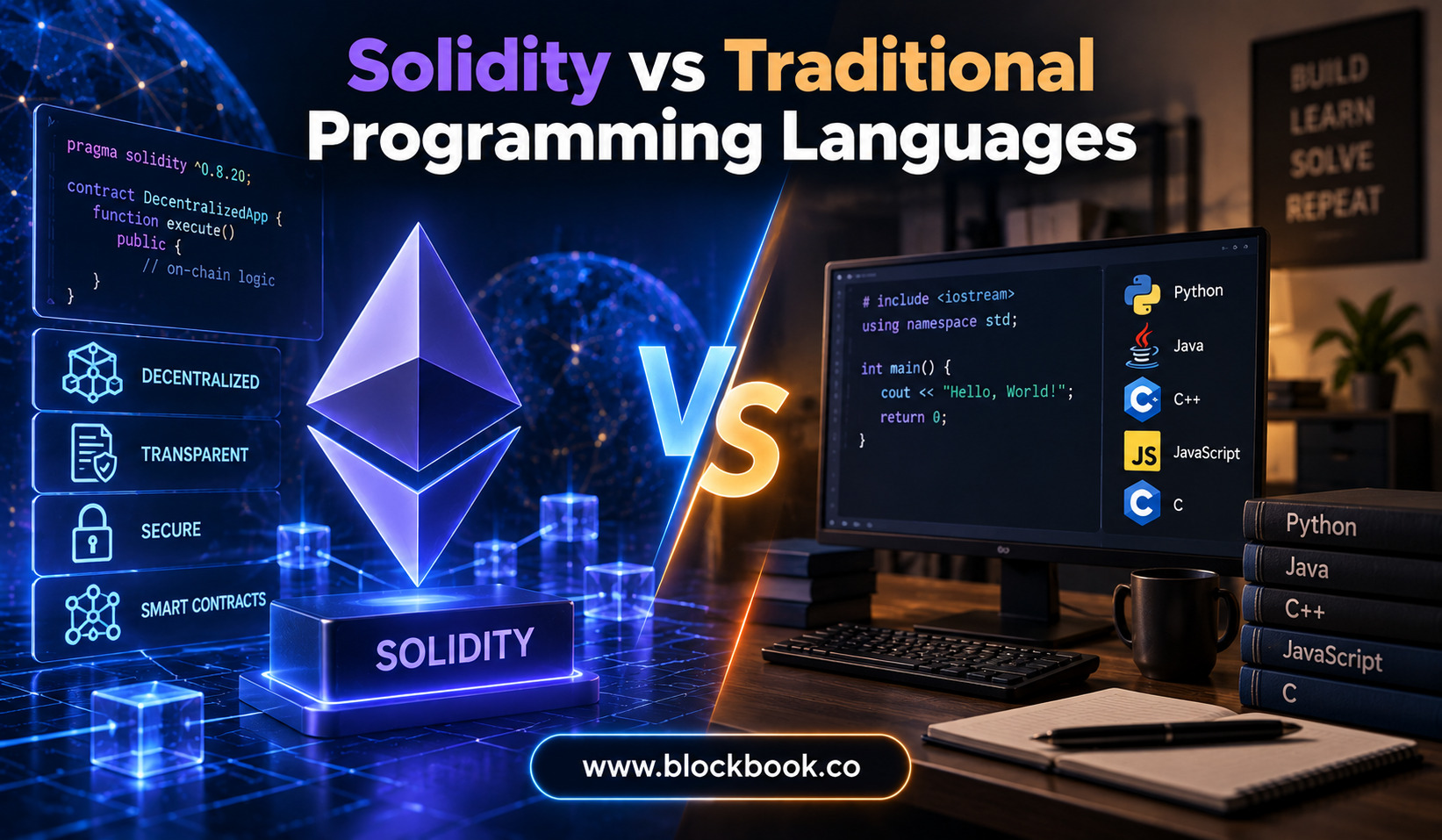
As blockchain technology continues to develop, programming languages are becoming an important part of the conversation around decentralized applications. Among them, Solidity has established itself as one of the primary languages for creating smart contracts on Ethereum-compatible blockchain networks. At the same time, traditional programming languages such as JavaScript, Python, Java, C++, and C# continue to power websites, mobile applications, enterprise software, games, and thousands of other digital services.
Although Solidity shares several programming concepts with conventional languages, its purpose and operating environment are considerably different. Developers moving from traditional software development into blockchain development therefore need to understand more than just Solidity syntax. They must also learn how blockchain execution, transaction costs, immutability, security, and decentralized networks influence the way applications are designed.
What Is Solidity?
Solidity is a high-level programming language primarily designed for writing smart contracts that run on the Ethereum Virtual Machine, commonly known as the EVM. A smart contract is a program deployed to a blockchain that can automatically execute predefined rules when the required conditions are met.
Unlike a conventional application that usually operates on a centralized server, a smart contract runs within a blockchain environment. Once deployed, its code and stored data can become difficult or impossible to modify depending on how the contract has been designed. This makes Solidity development particularly focused on security and predictable execution.
Solidity uses concepts familiar to developers, including variables, functions, conditional statements, loops, arrays, mappings, structures, and object-oriented programming principles. This familiarity can make the language approachable for programmers who already understand languages such as JavaScript, Java, or C++.
However, writing Solidity code is not simply the same as writing ordinary application code. Every operation may have consequences for blockchain resources and transaction costs, commonly measured through gas on Ethereum.
How Traditional Programming Languages Work
Traditional programming languages are used across a much wider range of software environments. Python, for example, is popular for automation, data analysis, artificial intelligence, and web development. JavaScript is widely used for websites and web applications, while Java and C# are commonly found in enterprise software and backend systems. C and C++ are heavily used where performance and lower-level system control are important.
Most traditional applications depend on computing infrastructure controlled by a company, organization, developer, or individual. A web application might communicate with a centralized database and server. Developers can normally update the application, modify its database, fix bugs, or deploy a new version when required.
Blockchain applications operate under different conditions. Instead of relying on a single trusted server, smart contracts interact with a distributed network of computers. This difference affects everything from application architecture to testing and security.
Solidity vs Traditional Languages: The Core Difference
The biggest difference between Solidity and traditional programming languages is the environment in which the code executes.
A conventional program may run on a personal computer, cloud server, mobile device, or centralized data center. Its execution environment is generally controlled by the developer or service provider. A Solidity smart contract, in contrast, is designed to execute across blockchain infrastructure according to the rules of the underlying network.
This decentralized environment introduces several unique requirements. Developers need to consider transaction fees, blockchain state, contract interactions, and the possibility that deployed code may remain active for a long period.
A small programming mistake in a normal application can often be corrected through an update. A vulnerable smart contract can create much more serious consequences because deployed blockchain code may control digital assets or interact with financial protocols.
Programming Model and Syntax
Solidity will feel familiar to developers who have worked with C-style programming languages. Its syntax uses concepts such as curly brackets, functions, variables, data types, and conditional logic.
For example, developers can define functions that change contract data or return information stored on the blockchain. Solidity also provides specialized features such as mappings, addresses, events, modifiers, and visibility controls that are particularly relevant to smart contracts.
Traditional languages generally provide much broader libraries and frameworks because they have been used across many decades of software development. Developers can choose from mature ecosystems for databases, networking, user interfaces, file management, operating systems, and cloud services.
Solidity’s ecosystem is more specialized. Its libraries and development tools are strongly connected to blockchain development, decentralized applications, wallets, token standards, and smart-contract infrastructure.
Execution and Performance
Performance is another major difference. Traditional software can often perform thousands or millions of operations without directly charging users for each individual computational step. The actual cost depends on hardware, infrastructure, hosting, and other factors.
Blockchain execution works differently. On Ethereum, computational work consumes gas, and users generally pay transaction fees when they submit transactions that require network processing. As a result, developers must think carefully about how much computation their contracts perform.
This creates a strong incentive for Solidity developers to write efficient code. A function that appears inexpensive from a traditional programming perspective may become costly when executed repeatedly on a blockchain.
At the same time, blockchain performance should not be judged only by raw computational speed. Decentralized networks prioritize distributed verification and security, which can introduce limitations that centralized systems do not face in the same way.
Data Storage and Immutability
Data management represents another important distinction.
Traditional applications frequently rely on databases such as PostgreSQL, MySQL, MongoDB, or other storage systems. Developers can typically create, modify, or delete records according to application requirements and database permissions.
Smart contracts maintain blockchain state, and changes to that state occur through transactions accepted by the network. Blockchain data is designed to provide a persistent and verifiable record.
This characteristic can be valuable for applications involving ownership, financial transactions, digital assets, and other records where transparent verification matters. However, it also means developers must carefully consider what information is stored on-chain.
For Solidity developers, changing the behavior of an already deployed contract can be substantially more complicated than updating a conventional server application. Upgradeable contract patterns exist, but they introduce their own technical and security considerations.
Security Becomes a Primary Concern
Security is important in every software project, but smart-contract development places exceptional emphasis on it because blockchain transactions can involve valuable digital assets.
Traditional applications can also suffer from vulnerabilities such as authentication failures, SQL injection, cross-site scripting, or unauthorized access. Smart contracts have their own categories of risks, including reentrancy vulnerabilities, access-control errors, arithmetic issues, faulty authorization logic, and unsafe external interactions.
Developers therefore need to approach Solidity programming with a security-first mindset. Testing, code reviews, automated analysis, and careful contract design are important parts of the development process.
Some key areas developers commonly examine include:
- Access control and permissions
- External contract interactions
- Input validation and state changes
- Gas consumption and inefficient operations
- Upgrade and administration mechanisms
The objective is not simply to make a contract work. Developers need to make sure its behavior remains predictable under unexpected conditions.
Development Tools and Ecosystem
Traditional programming has a huge variety of development environments, frameworks, package managers, testing systems, and deployment platforms. Developers can choose tools according to their preferred language and application type.
Solidity development also has a growing ecosystem. Developers commonly work with tools for compiling contracts, running local blockchain environments, testing smart contracts, deploying applications, and interacting with decentralized networks.
The development process may involve Solidity alongside JavaScript or TypeScript. A decentralized application, for example, may use Solidity for its blockchain logic while using JavaScript or TypeScript for the frontend and application interface.
This means learning Solidity does not necessarily replace traditional programming knowledge. Instead, blockchain developers often combine both approaches.
Solidity and Traditional Languages Compared
| Feature | Solidity | Traditional Programming Languages |
| Main purpose | Smart contracts and blockchain applications | General-purpose software development |
| Execution environment | Blockchain/EVM | Computers, servers, mobile devices, cloud systems and others |
| Data model | Blockchain state | Databases, files, memory and other storage |
| Cost of computation | Often linked to gas and transaction fees | Usually infrastructure or resource cost |
| Code changes | Deployment and upgrade patterns can be complex | Usually easier through software updates |
| Transparency | Blockchain activity can be publicly verifiable | Depends on application architecture |
| Security focus | Extremely important because contracts can control assets | Important across all application types |
| Common use cases | DeFi, tokens, NFTs, DAOs and dApps | Websites, enterprise systems, games, mobile apps and more |
Where Solidity Fits Into Modern Development
Solidity should not necessarily be viewed as a replacement for languages such as Python, JavaScript, Java, or C++. It serves a specialized purpose.
A blockchain project may require multiple programming languages. Solidity can handle smart-contract logic, while JavaScript or TypeScript can manage frontend interactions. Python may be used for analytics or automation, while other technologies can support backend services and infrastructure.
This combination has become an important part of modern Web3 development. Developers who already understand traditional programming can therefore use their existing knowledge as a foundation before learning blockchain-specific concepts.
The biggest adjustment is understanding how decentralized execution changes software design. Developers must think about trust, transaction confirmation, blockchain state, wallet interactions, gas costs, and contract security alongside conventional programming principles.
What Developers Should Learn Before Moving to Solidity
Developers interested in Solidity can benefit from learning programming fundamentals first rather than immediately focusing on complex blockchain applications. Understanding variables, functions, data structures, control flow, debugging, and software architecture makes the transition easier.
Blockchain-specific knowledge should then be added gradually. Important concepts include wallets, transactions, public and private keys, smart contracts, blockchain nodes, gas, decentralized applications, and token standards.
A practical learning path can include:
- Learn programming fundamentals and object-oriented concepts.
- Understand how Ethereum and EVM-based networks operate.
- Write and test simple Solidity contracts.
- Learn common smart-contract security vulnerabilities.
- Build small decentralized applications and interact with deployed contracts.
Hands-on development is particularly useful because blockchain programming involves concepts that may not appear in conventional application development.
Conclusion
Solidity and traditional programming languages share many fundamental programming concepts, but they operate under very different conditions. Traditional languages support a broad range of applications and generally run within infrastructure that developers can control and update. Solidity is designed for blockchain-based smart contracts, where decentralized execution, transaction costs, persistent state, and security play central roles.
For developers entering Web3, understanding these differences is more important than simply memorizing Solidity syntax. The most effective approach is to combine conventional programming fundamentals with blockchain-specific knowledge. As decentralized applications become more sophisticated, this combination can help developers build software that takes advantage of blockchain technology while following established software-development practices.
FAQs
Is Solidity similar to JavaScript?
Solidity has syntax that can look familiar to JavaScript developers, but the two languages serve different purposes. Solidity is designed primarily for smart contracts, while JavaScript is a general-purpose language widely used for web and application development.
Is Solidity harder than traditional programming languages?
The basic syntax can be approachable, especially for developers with programming experience. The more difficult part is understanding blockchain concepts, smart-contract security, gas costs, and decentralized execution.
Can a JavaScript developer learn Solidity?
Yes. JavaScript developers already understand many programming fundamentals that are useful when learning Solidity. However, they still need to learn blockchain-specific concepts and smart-contract security practices.
Why is Solidity security so important?
Smart contracts can interact with valuable digital assets and may continue operating after deployment. A programming vulnerability can therefore have consequences that are difficult to reverse, making testing and security review especially important.
Is Solidity used only for Ethereum?
Solidity was created for Ethereum and is strongly associated with the EVM ecosystem. It is also used on various EVM-compatible blockchain networks that support Solidity-based smart contracts.
About the Author