
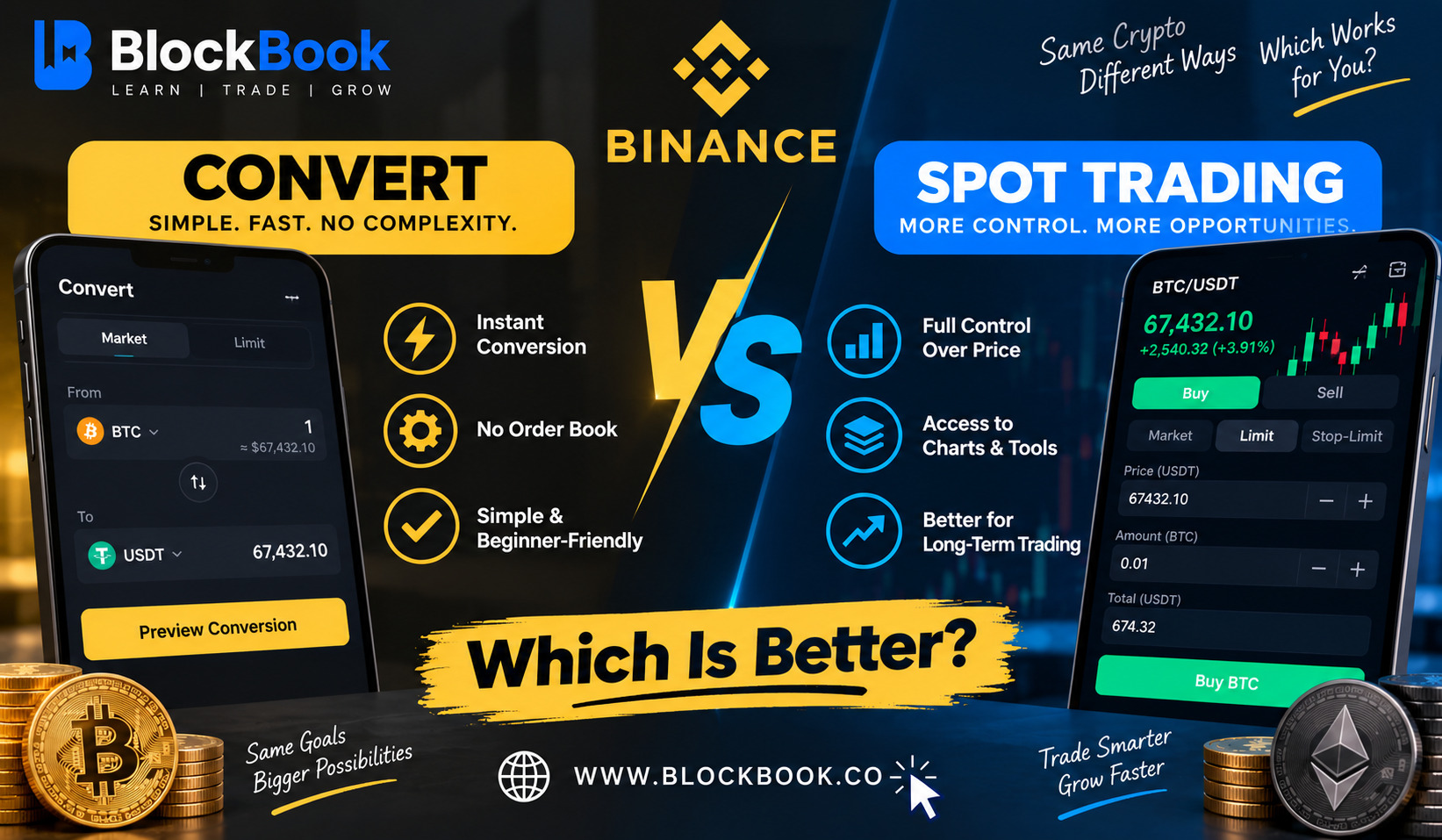
Binance offers more than one way to swap one crypto for another, and beginners often stumble onto both without understanding the difference. This comparison of Binance Convert vs spot trading breaks down how each one works, what each one costs, and which situations favor one over the other.
What Is Binance Convert?
Binance Convert is a simplified swap tool. You pick the coin you have, the coin you want, and Binance quotes you a single price for the full trade.
There is no order book, no order types, and no waiting for a price to be reached. You either accept the quoted rate or you do not.
This makes Convert especially approachable for beginners, since there is nothing to configure beyond the amount and the two currencies involved.
What Is Spot Trading?
Spot trading happens through the main trading interface, using an order book where buyers and sellers post their own prices.
- A market order fills instantly at the best currently available price.
- A limit order waits until the market reaches a price you set yourself.
Spot trading gives more control over price and order type, but it also asks the trader to understand a few more moving parts before placing a trade confidently.
Binance Convert vs Spot Trading: The Core Differences
| Feature | Convert | Spot Trading |
| Interface complexity | Very simple | More detailed |
| Price control | None, quote-based | Full control with limit orders |
| Order book visibility | Not shown | Fully visible |
| Speed | Instant quote and swap | Instant for market orders, variable for limit orders |
| Best for | Small trades, simplicity | Active trading, precise pricing |
The short version: Convert trades simplicity for a small cost in flexibility, while spot trading trades a bit of complexity for more control.
Pricing and Hidden Costs
This is where the two tools genuinely differ, and it catches some beginners off guard.
Convert quotes typically build the cost into the exchange rate itself, rather than showing a separate fee line. That built-in spread can end up wider than the combined cost of a spot trade, especially for larger amounts.
Spot trading fees are more transparent, shown as a separate percentage applied to the trade, and can often be reduced through maker orders, native token discounts, or volume-based tiers.
For small, occasional trades, the difference in cost is usually minor. For larger or more frequent trades, spot trading tends to work out cheaper over time.
When Convert Makes Sense
Convert fits certain situations particularly well.
- You are new to trading and want to avoid order books and order types entirely.
- You are making a small, one-off swap where a slightly wider spread barely matters.
- You want speed and simplicity over precise pricing.
- You are converting dust balances, small leftover amounts of a coin not worth actively trading.
For these cases, the convenience of Convert usually outweighs the small cost difference.
When Spot Trading Makes Sense
Spot trading fits a different kind of use case.
- You are trading larger amounts, where fee and spread differences start to matter more.
- You want to set a specific entry or exit price, which only a limit order allows.
- You trade frequently, where lower spot fees add up to meaningful savings over time.
- You want visibility into the order book, to see real buying and selling interest before trading.
Traders who move beyond occasional small swaps tend to graduate toward spot trading fairly quickly, once they get comfortable with the interface.
Key Takeaways
- Convert offers a simple, quote-based swap with no order book involved.
- Spot trading offers more control through market and limit orders, using a visible order book.
- Convert’s cost is usually built into the exchange rate as a spread, rather than shown separately.
- Spot trading fees are more transparent and can often be reduced through discounts and volume tiers.
- Small, occasional trades generally suit Convert, while larger or frequent trades generally suit spot trading.
Frequently Asked Questions
Is Binance Convert more expensive than spot trading?
It can be, since Convert typically builds its cost into the exchange rate rather than charging a separate visible fee.
Is Convert easier to use than spot trading?
Yes, Convert removes the order book and order types entirely, making it simpler for beginners.
Can I set a specific price using Convert?
No, Convert only offers a quoted rate at the time of the swap, with no option to set your own price.
Which option is better for large trades?
Spot trading is generally better for larger trades, since fees are more transparent and often lower than Convert’s built-in spread.
Can beginners eventually switch from Convert to spot trading?
Yes, many traders start with Convert and move to spot trading once they become comfortable with order types and the order book.
Conclusion
Choosing between Binance Convert and spot trading comes down to how much you value simplicity versus control. Convert offers a fast, no-fuss swap that suits small or occasional trades, while spot trading offers more precise pricing and generally lower costs for larger or more frequent activity. Many traders end up using both, depending on the size and purpose of the trade in front of them.
About the Author