
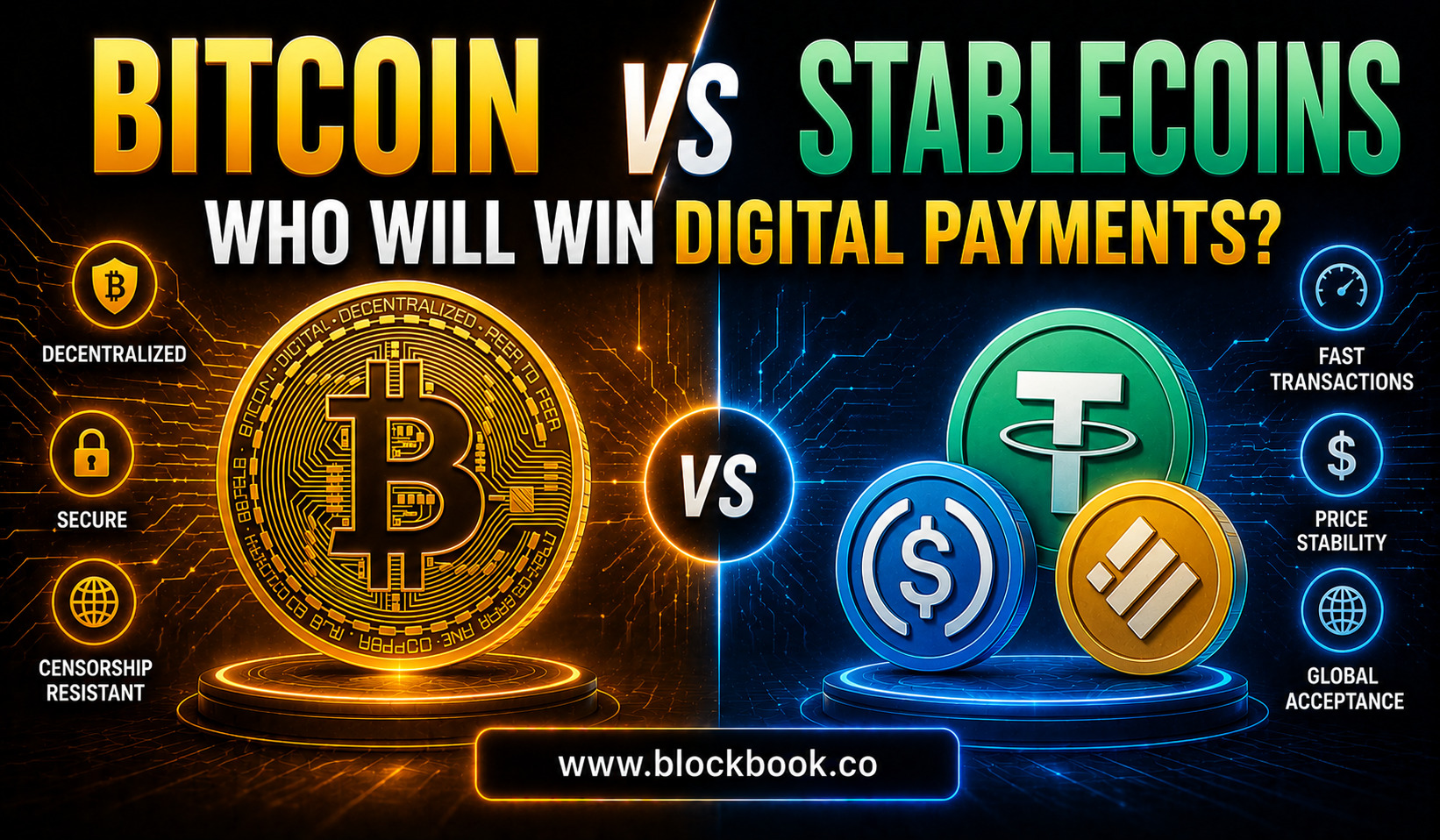
Digital payments are changing rapidly. Consumers and businesses can now move value through smartphones, online platforms and blockchain networks without relying entirely on traditional banking systems. Two of the most important cryptocurrency-based payment options are Bitcoin and stablecoins.
Bitcoin is the original decentralized cryptocurrency, built around a fixed maximum supply and a monetary network that operates without a central issuer. Stablecoins take a different approach. They are digital tokens designed to maintain a relatively stable value, usually by being linked to a fiat currency such as the US dollar.
This creates an important question for the future of digital payments: Bitcoin vs stablecoins — which one is more likely to become the preferred way to send money online?
Bitcoin could have an advantage as a decentralized monetary asset and cross-border settlement network, while stablecoins may be better suited to everyday transactions where price stability matters.
Bitcoin and Stablecoins Have Different Purposes
The biggest difference between Bitcoin and stablecoins is their monetary design.
Bitcoin’s value changes according to supply, demand and market conditions. There is no central organization setting a fixed exchange rate against the dollar.
Stablecoins are designed specifically to reduce this volatility. A dollar-linked stablecoin aims to maintain a value close to one US dollar, making it easier for users to think about payments in familiar terms.
This difference affects how people use the assets.
Someone holding Bitcoin may be comfortable with price fluctuations because they view BTC as a long-term investment or scarce digital asset. Someone paying an invoice may prefer a stablecoin because the amount owed today is more likely to remain the same tomorrow.
Bitcoin vs Stablecoins at a Glance
| Feature | Bitcoin | Stablecoins |
| Primary purpose | Digital monetary asset | Digital representation of stable value |
| Price volatility | High | Generally lower |
| Supply model | Fixed maximum supply | Depends on issuer and design |
| Central issuer | No | Usually yes |
| Cross-border payments | Yes | Yes |
| Everyday pricing | Less convenient | More convenient |
| Investment potential | High but volatile | Generally limited by design |
The distinction is important because the future of digital payments may involve different assets serving different purposes.
Why Bitcoin Could Win Long-Term
Bitcoin’s biggest advantage is that it does not depend on a central issuer to create or maintain its monetary policy.
Its maximum supply is limited to 21 million BTC, and new coins are introduced according to a predictable protocol.
This makes Bitcoin fundamentally different from stablecoins.
A stablecoin issuer generally needs reserves, financial infrastructure and mechanisms designed to maintain its peg. Bitcoin does not require an organization to promise that one BTC will equal one dollar.
For users who prioritize decentralization and monetary independence, this is a major advantage.
Bitcoin can also operate globally. A person with internet access can potentially send BTC across borders without opening a traditional bank account in the receiving country.
Bitcoin’s Strongest Payment Advantages
Bitcoin could remain attractive for:
- Cross-border transfers.
- Long-term digital savings.
- Payments where censorship resistance matters.
- Transfers that do not require a centralized issuer.
Bitcoin’s volatility remains its biggest obstacle to becoming an everyday currency.
Why Stablecoins Could Dominate Everyday Payments
Stablecoins have a powerful advantage: people already understand the value they represent.
If someone receives 100 units of a dollar-linked stablecoin, they generally expect it to remain close to $100.
That makes pricing much easier.
A business can charge customers a stable amount without worrying that the cryptocurrency it receives could lose a significant percentage of its value before the payment is converted or used.
This makes stablecoins especially attractive for commerce.
Businesses can potentially use them for payroll, invoices, international settlements and digital services.
For many consumers, stablecoins may therefore feel more like digital cash than Bitcoin.
Stablecoins and Cross-Border Payments
Cross-border transactions could become one of the biggest use cases for stablecoins.
Traditional international transfers can involve multiple financial institutions and currency conversions.
A stablecoin can represent dollar value on a blockchain, allowing users to transfer that value through digital wallets.
This could be particularly useful in countries where access to stable foreign currencies is limited or where international banking services are expensive.
However, stablecoins are still connected to the financial system through their reserves, issuers and redemption mechanisms.
That makes them different from Bitcoin’s decentralized monetary structure.
The Importance of Price Stability
Price stability matters enormously when something is used as money.
Imagine a merchant selling a product for $50. If the merchant accepts Bitcoin, the BTC amount must be calculated based on the current exchange rate, and the value of the received BTC can change afterward.
With a dollar-linked stablecoin, the merchant can generally keep the price denominated in dollars while receiving a digital token representing that value.
This removes one of the biggest obstacles to cryptocurrency payments.
Stablecoins do not need to become better investments than Bitcoin. Their purpose is different.
They are designed to make digital transactions easier by reducing volatility.
Bitcoin’s Lightning Network Changes the Equation
Bitcoin’s payment potential is not limited to its main blockchain.
The Lightning Network is designed to enable faster and potentially cheaper BTC transactions, particularly for smaller payments.
This could make Bitcoin more competitive with stablecoins for everyday purchases.
Lightning can allow users to send small amounts of BTC without recording every payment individually on the main Bitcoin blockchain.
That opens the possibility of Bitcoin being used for:
- Small retail purchases.
- Online services.
- Tips and creator payments.
- Machine-to-machine transactions.
If wallet technology and merchant adoption continue improving, Lightning could strengthen Bitcoin’s position as a payment network.
Stablecoins Have a Centralization Trade-Off
Stablecoins offer convenience, but that convenience comes with trade-offs.
Many stablecoins depend on centralized issuers or organizations that manage reserves and maintain the token’s value.
This can introduce risks that Bitcoin was specifically designed to avoid.
Users may need to trust that the issuer has sufficient reserves, follows appropriate procedures and continues operating effectively.
Some stablecoin systems can also have controls that allow transactions to be frozen or restricted.
For businesses and consumers, these features may provide useful compliance tools. For users seeking maximum monetary independence, they can be viewed as disadvantages.
Regulation Could Shape the Winner
Regulation will likely play a major role in determining how Bitcoin and stablecoins develop as payment technologies.
Stablecoins are closely connected to traditional currencies and financial institutions, so regulators may pay particular attention to reserves, issuers, consumer protection and compliance.
Bitcoin faces a different regulatory question because it does not have a central issuer responsible for managing the network.
Clear rules could encourage businesses to use both assets, but different regulations could favor one model over another in particular markets.
The regulatory environment may therefore become one of the most important factors influencing digital-payment adoption.
Bitcoin and Stablecoins Could Work Together
The idea that one must completely replace the other may be too simplistic.
A digital economy could use Bitcoin and stablecoins for different purposes.
For example, a company might hold Bitcoin as a long-term treasury asset while using stablecoins to pay international contractors.
A consumer might hold BTC as an investment while keeping stablecoins for everyday digital purchases.
A payment platform could potentially allow users to convert between BTC and stablecoins automatically.
This creates a broader financial ecosystem rather than a winner-takes-all competition.
Different Assets for Different Jobs
Bitcoin may be better suited to saving and decentralized settlement, while stablecoins may be better suited to pricing and everyday commerce.
That distinction could remain important even as both technologies become more widely adopted.
Could Stablecoins Reduce Bitcoin Demand?
Stablecoin growth could potentially reduce the need to use BTC for certain payment purposes.
If users can send digital dollars quickly and cheaply, they may have little reason to accept Bitcoin’s volatility for routine transactions.
However, stablecoins do not necessarily replace Bitcoin’s monetary characteristics.
A stablecoin represents a claim or digital version of relatively stable value. Bitcoin itself is a scarce digital asset with no central issuer.
This distinction means stablecoins may compete with Bitcoin as payment instruments without replacing Bitcoin as an independent monetary asset.
Could Bitcoin Become the Global Reserve Asset?
Bitcoin’s strongest long-term opportunity may not be buying coffee.
Its greater potential could involve becoming a globally recognized digital reserve asset.
If institutions, companies or individuals increasingly hold BTC as a hedge against monetary uncertainty or currency depreciation, Bitcoin could occupy a role that stablecoins are not designed to fill.
Stablecoins may remain connected to fiat currencies, while Bitcoin could offer exposure to an alternative monetary system.
This creates two very different visions of digital money.
Four Factors That Could Determine the Future
The competition between Bitcoin and stablecoins will depend on several factors:
- Transaction costs and speed.
- Merchant and consumer adoption.
- Regulatory treatment.
- Trust in issuers and blockchain infrastructure.
Technology will matter, but user experience may matter even more.
People generally choose payment systems that are simple, reliable and widely accepted.
The technology that makes payments easiest could ultimately gain the largest share of everyday usage.
Frequently Asked Questions
1. Are stablecoins better than Bitcoin for payments?
Stablecoins can be more convenient for everyday payments because their value is generally designed to remain stable. Bitcoin may be more attractive for decentralized payments, cross-border transfers and users who want to hold a scarce digital asset.
2. Can Bitcoin compete with stablecoins?
Yes. Bitcoin’s Lightning Network can make smaller BTC payments faster and more practical. Bitcoin also has advantages in decentralization, security and independence from a central issuer.
3. Why are stablecoins becoming popular?
Stablecoins combine blockchain-based transferability with relatively stable value. This can make them useful for international payments, trading, digital commerce and financial settlement.
4. Will stablecoins replace Bitcoin?
It is unlikely that stablecoins will completely replace Bitcoin because they serve different purposes. Stablecoins focus on stable digital value, while Bitcoin provides a decentralized monetary asset with a fixed maximum supply.
5. Which is better for the future of digital payments?
Stablecoins may have an advantage for everyday commerce because of their price stability. Bitcoin could remain important for decentralized settlement, savings and global monetary use. The future could involve both rather than a single winner.
Final Thoughts
The Bitcoin vs stablecoin debate is really a debate about what people want from digital money.
Bitcoin offers scarcity, decentralization and independence from a central issuer. Its volatility makes everyday pricing difficult, but technologies such as the Lightning Network could improve its usefulness for payments.
Stablecoins offer something different: predictable digital value. Their connection to fiat currencies makes them easier to price and potentially more convenient for merchants, businesses and consumers.
For everyday digital payments, stablecoins may currently have a natural advantage because people generally want the money they receive today to have a similar value tomorrow.
Bitcoin, however, has a broader monetary proposition.
It could serve as a long-term digital asset while also functioning as a payment and settlement network through technologies built around it.
The most likely future may therefore not be a world where Bitcoin defeats stablecoins or stablecoins eliminate Bitcoin.
Instead, stablecoins could become digital cash for everyday transactions, while Bitcoin becomes a scarce digital monetary asset and settlement network.
As blockchain infrastructure improves, users may move between both depending on what they need. The winner of digital payments may ultimately be less important than the emergence of a financial system in which Bitcoin and stablecoins each perform the jobs they are best designed to handle.
About the Author