
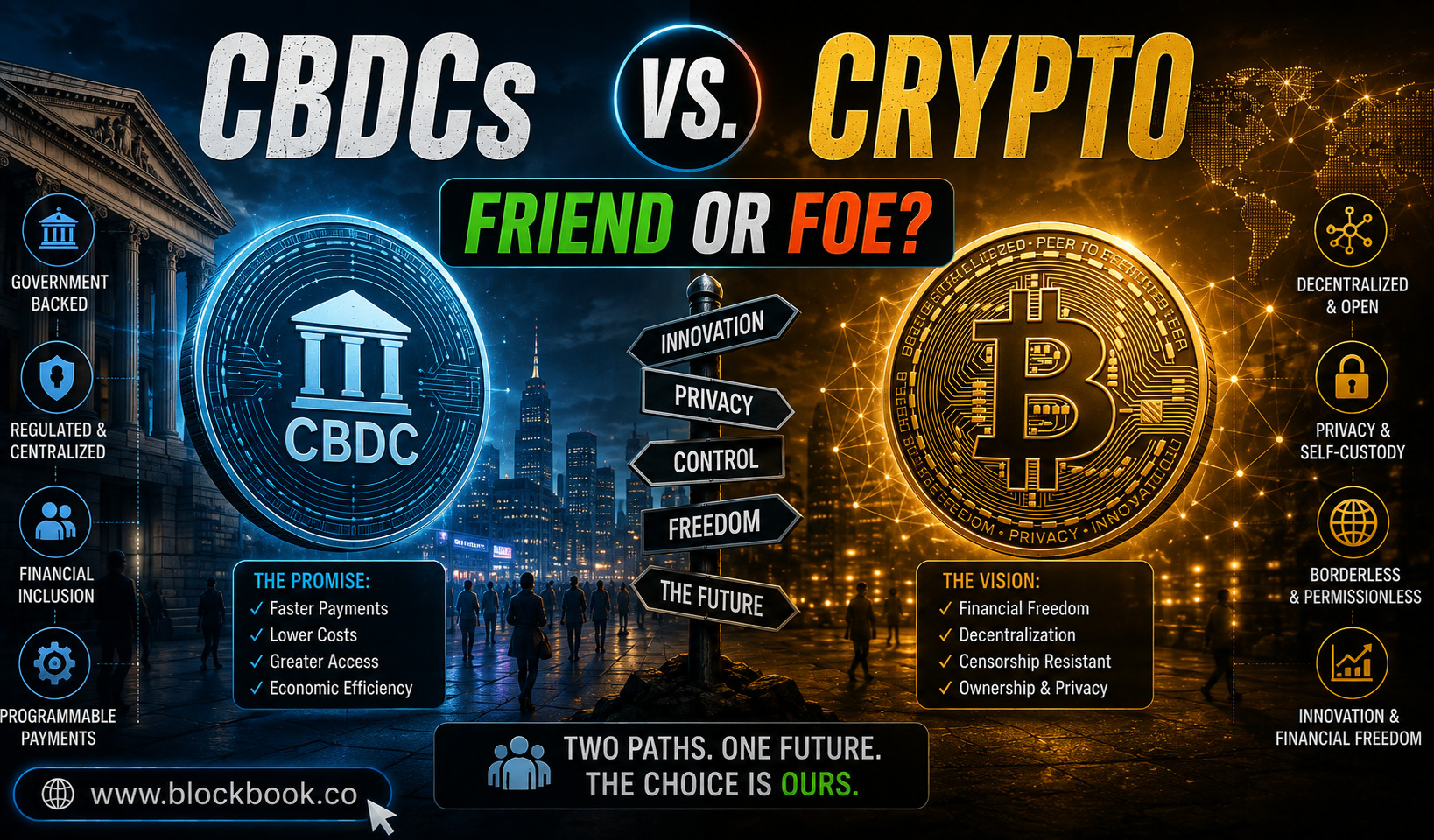
More than 130 countries, representing roughly 98% of global GDP, are now exploring some form of central bank digital currency, while the total cryptocurrency market has grown into the tens of billions of dollars alongside them. Two very different visions of digital money are expanding at the same time, and the relationship between CBDCs and crypto is a lot messier than a simple rivalry.
Depending on who you ask, central bank digital currencies represent either the natural evolution of money in a digital age, or a direct threat to the financial privacy and decentralization that drew people to crypto in the first place. Both views have real substance behind them, and understanding the actual mechanics helps cut through the noise on either side.
What a CBDC actually is
A central bank digital currency is a digital form of a country’s official currency, issued directly by that country’s central bank rather than by a commercial bank or private company. It sits on the central bank’s balance sheet the same way physical cash does, meaning it represents a direct claim on the government rather than a claim on a bank account that carries some counterparty risk.
This is fundamentally different from a decentralized cryptocurrency like Bitcoin, which isn’t issued by any single institution and doesn’t require trust in a central authority to function. It’s also different from a stablecoin, which is typically issued by a private company and backed by reserves rather than being base money the way a CBDC is.
Where things stand globally in 2026
The global picture is genuinely uneven, and the differences between regions tell an interesting story about priorities.
A handful of countries have already crossed the finish line with fully launched retail CBDCs, including the Bahamas, Jamaica, and Nigeria. Adoption in these smaller economies has been modest so far, with usage often concentrated in specific use cases like government cash transfers rather than everyday retail spending.
China’s digital yuan, known as e-CNY, remains the largest CBDC program in the world by a wide margin, having crossed several trillion yuan in cumulative transactions. In early 2026, China’s central bank reclassified e-CNY as a deposit liability, a technical shift that some analysts read as a signal the program’s function may be evolving beyond its original design as pure digital cash.
The eurozone has spent years in a preparation phase and appears to be moving toward a formal issuance decision for a digital euro. Meanwhile, cross-border wholesale CBDC projects, designed for settlement between countries rather than everyday retail use, have expanded significantly, with initiatives like mBridge processing tens of billions of dollars in transaction volume.
The United States stands apart from most of its peers on this issue. Legislation passed in 2025 explicitly banned the Federal Reserve from issuing a retail CBDC, a decision shaped heavily by concerns over financial privacy and government overreach into individual banking activity. Instead, US policy has moved toward regulating private stablecoins as the preferred vehicle for digital dollar innovation.
The case for CBDCs being crypto’s friend
There’s a reasonable argument that CBDCs and crypto can coexist, and even reinforce each other in certain ways.
When a central bank builds and promotes a digital currency, it normalizes the broader idea of digital-native money for the general public, which can make crypto concepts feel less foreign to newcomers. Some financial infrastructure providers are also exploring how tokenized assets and regulated stablecoins could interact with CBDC settlement rails, potentially creating bridges between traditional finance and blockchain-based systems rather than walls. Many CBDC pilot programs use blockchain or distributed ledger technology similar to what powers cryptocurrencies too, meaning the infrastructure investment and technical expertise built for one can sometimes benefit the other. And as governments build legal and technical frameworks for their own digital currencies, they often end up clarifying rules for private digital assets in the process, which can reduce uncertainty for crypto businesses operating in that jurisdiction.
The case for CBDCs being crypto’s foe
The counterargument is just as substantive, and it centers on what each system is actually designed to prioritize.
Decentralized cryptocurrencies were built, in large part, around the idea of reducing dependence on any single controlling authority, along with a degree of pseudonymity for users. CBDCs are built around the opposite priorities: centralized issuance, direct government visibility into transactions, and tighter integration with existing monetary policy tools.
That tension shows up in a few concrete ways. Because a CBDC is issued and tracked directly by a central bank, it creates the technical possibility for far greater visibility into individual spending patterns than cash or even traditional bank transfers typically allow, and privacy advocates argue this represents a meaningful shift in the balance of power between individuals and governments. Both CBDCs and crypto are also, at some level, competing to be the future rails for digital payments; a widely adopted CBDC could reduce demand for stablecoins and other crypto-based payment tools in that country, especially if the government actively discourages alternatives. Some economic research suggests widespread CBDC adoption could pull deposits away from commercial banks too, since holding money directly with a central bank might feel safer to some users than holding it with a private institution, ironically a disruption argument more often associated with crypto, now being raised about CBDCs instead. And underneath all of it is a philosophical disagreement as much as a technical one, between those who see centralized digital currency as a natural evolution of monetary policy and those who see decentralization as the entire point of digital money in the first place.
Where stablecoins fit into the picture
Stablecoins occupy an interesting middle ground in this debate. They’re privately issued, unlike CBDCs, but they’re typically pegged to a government currency and often backed by reserves held in traditional financial instruments. In the United States specifically, stablecoin regulation has effectively become the government’s preferred alternative to building its own retail CBDC.
This matters because it shows the CBDC-versus-crypto framing can be oversimplified. In practice, some governments appear to be choosing between direct CBDC issuance and indirect influence over the crypto ecosystem through stablecoin regulation, rather than treating crypto purely as a threat to be shut down.
What this means for someone holding crypto
None of this changes how Bitcoin or other decentralized cryptocurrencies actually function on a technical level. A CBDC doesn’t compete with Bitcoin’s core value proposition as a fixed-supply, decentralized asset in the same direct way it might compete with a stablecoin or a payments-focused altcoin.
What it does mean is that the regulatory and competitive landscape around crypto is shifting as governments build out their own digital money infrastructure. Staying aware of your own country’s CBDC status, and how it interacts with existing crypto regulation, is a reasonable part of understanding the broader environment your crypto holdings operate in.
FAQ
Is a CBDC the same thing as cryptocurrency?
No. A CBDC is issued directly by a central bank and represents a liability of that bank, similar to physical cash. Decentralized cryptocurrencies like Bitcoin are not issued by any central authority and do not rely on a single institution’s backing.
Does the United States have a CBDC?
No. Legislation passed in 2025 explicitly prohibits the Federal Reserve from issuing a retail CBDC. The US has instead focused on regulating privately issued stablecoins as its approach to digital dollar innovation.
Which country has the most widely used CBDC?
China’s e-CNY is the largest CBDC program in the world by transaction volume, having processed several trillion yuan in cumulative activity, though it still represents a modest share of the country’s overall payment system compared to established private platforms.
Could a CBDC replace Bitcoin?
Unlikely, since they serve different purposes. Bitcoin’s core appeal rests on its fixed supply and decentralized issuance, characteristics a CBDC doesn’t share by design. A CBDC is more likely to compete with stablecoins and other payment-focused digital assets than with Bitcoin directly.
About the Author