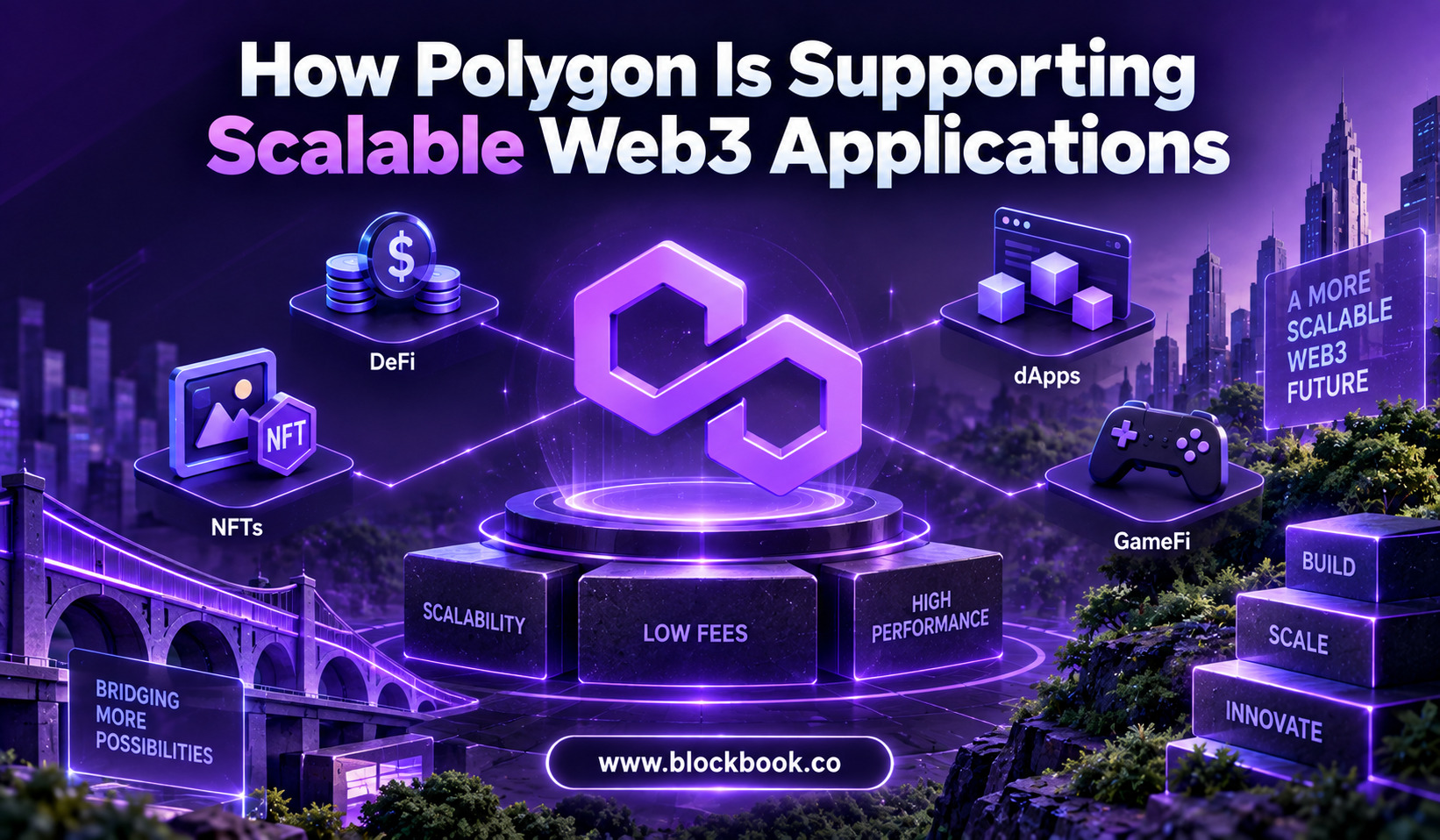
As Web3 applications move beyond experimentation, scalability has become one of the biggest challenges facing blockchain developers. Decentralized finance, gaming, payments, digital collectibles, tokenized assets and other blockchain-based services need networks that can process large numbers of transactions without making users deal with excessive costs or complicated experiences. Polygon has built its ecosystem around addressing several of these challenges through scaling infrastructure, Ethereum compatibility and cross-chain connectivity.
Polygon’s approach has evolved considerably over time. The ecosystem initially became widely known for Polygon PoS, a network designed to provide lower-cost blockchain transactions while maintaining close connections with Ethereum. Its broader strategy later expanded toward zero-knowledge technology and an interconnected ecosystem through the AggLayer. At the same time, the network’s native token changed from MATIC to POL, reflecting a broader vision for the Polygon ecosystem. Polygon confirmed that POL became the native gas token on Polygon PoS in September 2024.
Why Scalability Matters for Web3
Traditional blockchain networks can face limitations when transaction activity increases. When block space becomes scarce, users may experience higher fees and longer waits. For applications that depend on frequent interactions, such as blockchain games or payment platforms, these limitations can affect the overall user experience.
Scalability is therefore more than simply increasing transaction capacity. Developers also need predictable costs, familiar development tools, compatibility with established ecosystems and mechanisms for moving assets or information between different networks.
Polygon’s infrastructure has been designed around these requirements. Its technology allows developers to build applications that can interact with Ethereum-compatible smart contracts while using Polygon infrastructure for transactions and application activity.
This approach has helped make Polygon relevant to a wide range of Web3 use cases. Rather than requiring every application to operate directly on Ethereum mainnet, developers can use specialized infrastructure designed to handle application activity more efficiently.
Polygon PoS and Lower-Cost Blockchain Activity
Polygon PoS remains an important part of the ecosystem. It uses a separate architecture alongside Ethereum and is designed to support high-volume blockchain activity. Its architecture includes components such as Bor and Heimdall, which perform different functions within the network.
One useful feature is Polygon’s state-sync mechanism. It allows information originating on Ethereum to be propagated to Polygon PoS, enabling decentralized applications on Polygon to respond to relevant Ethereum events.
The network also provides Ethereum-compatible development infrastructure. This is important because developers can work with familiar smart-contract standards and tools instead of creating applications around an entirely different programming environment.
For users, the practical significance is that routine blockchain interactions can take place on infrastructure designed for lower-cost and higher-volume activity. This can be particularly useful for applications where users may need to perform many transactions rather than only occasional high-value transfers.
The Move Toward Zero-Knowledge Technology
Polygon’s scaling strategy has also placed significant attention on zero-knowledge technology. Zero-knowledge proofs can allow blockchain networks to demonstrate that a group of transactions has been processed correctly without requiring every participant to independently process all the underlying information in the same way.
This technology has become an important part of Polygon’s long-term scaling vision. Polygon 2.0 introduced a broader architecture focused on multiple ZK-powered chains and an aggregation layer designed to improve interoperability and liquidity across networks.
However, Polygon’s product landscape has also changed. Polygon zkEVM Mainnet Beta was officially sunset on July 3, 2026, and its sequencer stopped producing blocks. Polygon now directs users with eligible remaining assets toward a dedicated claims process on Ethereum.
This development is important when discussing Polygon’s current scalability strategy because the ecosystem should not be viewed simply through the lens of its earlier zkEVM deployment. Polygon’s broader direction has increasingly centered on aggregation and interoperability.
AggLayer and the Problem of Blockchain Fragmentation
One of the biggest challenges facing Web3 is fragmentation. Different blockchains can have their own users, liquidity, applications and technical environments. Moving between these networks can introduce additional steps and create a less seamless experience.
Polygon’s AggLayer is designed to address this problem. Polygon describes it as an aggregation layer intended to connect sovereign chains while enabling them to share liquidity, users and state. Its architecture combines a common bridge with zero-knowledge-powered mechanisms intended to provide secure cross-chain interoperability.
The idea is significant for scalable Web3 applications because scaling does not necessarily mean putting every application on one blockchain. A larger ecosystem can instead contain multiple specialized chains while providing infrastructure that allows them to interact.
For developers, this could create opportunities to build application-specific networks without completely isolating their users and liquidity. Polygon’s vision is to make these different environments work together while allowing individual chains to maintain their own characteristics.
How Polygon’s Infrastructure Supports Developers
A major advantage of Polygon’s approach is its focus on compatibility. Ethereum has one of the largest smart-contract developer communities in the blockchain industry, so infrastructure that works closely with Ethereum can reduce the learning curve for teams entering Web3.
Polygon’s developer tooling has historically supported common Ethereum development patterns, including token standards and smart-contract interactions. Its documentation also provides tools for interacting with Polygon’s proof-of-stake bridge and blockchain infrastructure.
This matters because scalability is only useful when developers can actually build on the infrastructure. A technically advanced network still needs development frameworks, wallets, bridges, APIs and documentation that allow applications to reach users efficiently.
Some of the major areas where Polygon infrastructure can support Web3 applications include:
- Decentralized finance applications that require frequent transactions.
- Blockchain games with repeated on-chain interactions.
- Payments and stablecoin-based transactions.
- Tokenized real-world assets and digital ownership applications.
These use cases have different requirements, but they share a need for efficient blockchain infrastructure.
POL and the Broader Polygon Ecosystem
Another major change has been the transition from MATIC to POL. Polygon describes POL as the network’s upgraded native token, with utility extending beyond basic transaction fees toward staking and the broader Polygon ecosystem. Polygon’s support documentation states that POL is used as the native gas and staking token on Polygon PoS.
The change is connected to Polygon’s broader multi-chain strategy. Polygon’s vision is for POL to support services across an expanding network of chains and the AggLayer. The project has described potential roles for POL related to validation and other network services.
For developers, the importance of this model is less about the token itself and more about the infrastructure surrounding it. A scalable ecosystem requires mechanisms for securing networks, coordinating participants and supporting different blockchain services.
Polygon’s Scalability Approach at a Glance
| Area | Polygon’s Approach | Relevance to Web3 |
| Polygon PoS | Ethereum-compatible blockchain infrastructure | Supports high-volume application activity |
| Zero-knowledge technology | ZK-based scaling and interoperability research | Helps improve scalability and verification |
| AggLayer | Cross-chain aggregation and interoperability | Addresses blockchain fragmentation |
| POL | Native gas and staking token | Supports network security and ecosystem coordination |
| Developer tooling | Ethereum-compatible tools and APIs | Reduces barriers for application developers |
| Ethereum connectivity | Bridges and state synchronization | Connects Polygon applications with Ethereum |
Supporting Real-World Web3 Applications
The scalability question becomes particularly important as blockchain applications move into areas beyond cryptocurrency trading. Payments, gaming, loyalty programs, ticketing, digital identity and tokenized assets can require large numbers of relatively small transactions.
For these applications, transaction costs and user experience can be just as important as decentralization. A consumer is unlikely to think about blockchain architecture when interacting with a game or payment application. Developers therefore need infrastructure that can keep blockchain interactions efficient and largely invisible to users.
Polygon’s strategy attempts to provide that underlying infrastructure. Polygon has also highlighted payments and real-world assets as areas of activity within its ecosystem.
The broader aggregation model could become increasingly relevant if Web3 applications continue to spread across specialized networks. Instead of forcing every application into the same blockchain environment, developers could potentially select infrastructure according to their individual requirements while retaining connectivity with a wider ecosystem.
Challenges That Polygon Still Faces
Scalability is not solved simply by adding more networks. More chains can also create additional complexity. Developers need reliable interoperability, secure bridges, consistent tooling and predictable user experiences.
Polygon’s AggLayer is intended to address some of these problems, but cross-chain infrastructure remains technically demanding. Security is particularly important because vulnerabilities in interoperability systems can have consequences across connected networks.
There is also the challenge of ecosystem adoption. A multi-chain architecture becomes more useful as more applications, users, assets and networks participate. Polygon therefore needs continued developer adoption and practical usage to demonstrate the value of its broader aggregation strategy.
The sunset of Polygon zkEVM Mainnet Beta also illustrates how blockchain infrastructure can evolve rapidly. Developers and users need to pay attention to current network status rather than relying only on older descriptions of Polygon’s technology.
What Polygon’s Strategy Means for Web3
Polygon’s development shows how blockchain scaling is moving from a simple search for faster transactions toward a broader infrastructure problem. Modern Web3 applications may require several layers working together: execution environments, settlement, interoperability, liquidity and security.
Polygon PoS addresses application-level blockchain activity, while the AggLayer represents a broader attempt to connect multiple blockchain environments. Zero-knowledge technology remains an important component of Polygon’s long-term architecture, while POL is designed to support the ecosystem’s security and coordination.
The result is a strategy that focuses not only on making one blockchain more capable but also on creating infrastructure through which multiple chains can interact.
As Web3 applications become more complex, this approach could become increasingly important. Developers may want specialized environments for different applications without sacrificing access to users and liquidity elsewhere. Polygon’s aggregation-focused architecture is designed around that challenge.
Conclusion
Polygon’s approach to scalability has expanded from providing an alternative environment for Ethereum transactions to developing a broader infrastructure for interconnected blockchain networks. Polygon PoS continues to provide an Ethereum-compatible environment for applications, while the AggLayer represents the ecosystem’s effort to reduce fragmentation between chains.
The transition to POL and the increasing focus on aggregation and interoperability demonstrate how Polygon’s strategy is evolving alongside the wider Web3 industry. For developers, the central opportunity is not simply faster transactions but access to infrastructure that can support applications as they grow across users, assets and blockchain environments.
Frequently Asked Questions
What is Polygon used for?
Polygon provides blockchain infrastructure for decentralized applications, payments, tokenized assets, gaming, DeFi and other Web3 use cases. Polygon PoS is one of the major networks within the ecosystem.
How does Polygon help Web3 scalability?
Polygon supports scalability through Ethereum-compatible infrastructure, high-volume transaction processing and technologies focused on zero-knowledge proofs and cross-chain aggregation.
What is AggLayer?
AggLayer is Polygon’s aggregation infrastructure designed to connect different blockchain networks and enable interoperability, shared liquidity and communication between participating chains.
Is Polygon still using MATIC?
Polygon’s network token has transitioned from MATIC to POL. Polygon states that POL became the native gas token on Polygon PoS in September 2024.
What happened to Polygon zkEVM?
Polygon zkEVM Mainnet Beta was sunset on July 3, 2026. The network stopped producing blocks, and Polygon provides a claims interface for eligible assets remaining on the retired network.
About the Author