
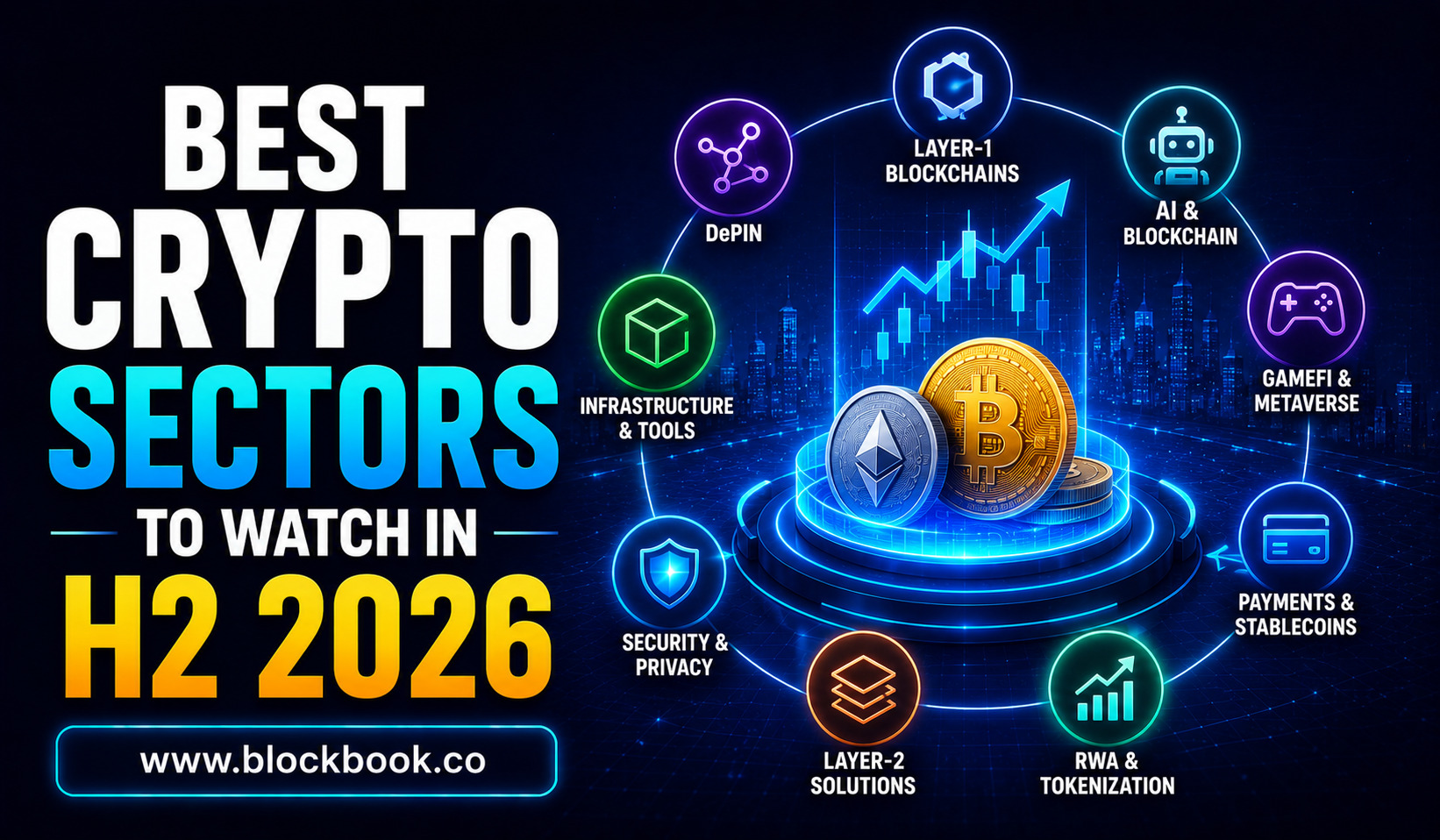
The crypto market is entering the second half of 2026 with a different mindset from previous cycles. Instead of one dominant narrative controlling the market, attention is increasingly moving toward sectors that combine blockchain technology with real-world use.
This shift matters because crypto investors are becoming more selective. Projects with active users, sustainable revenue and useful products may have a stronger foundation than tokens driven mainly by speculation.
Several sectors stand out for the rest of 2026, including real-world assets, stablecoins, DeFi, AI and DePIN, tokenized equities, prediction markets and consumer crypto. These categories have different growth drivers and risk profiles, making the H2 market more diverse than a simple Bitcoin-versus-altcoins story.
Why Crypto Sectors Matter in H2 2026
Crypto markets often move through narrative rotations. Capital can shift from established assets into emerging sectors when investors identify a new growth opportunity.
However, narrative alone may not be enough in the current environment. Recent market analysis increasingly emphasizes product-market fit, user activity and sustainable revenue as important factors separating promising projects from short-lived trends.
This means investors may pay greater attention to what a blockchain project actually does rather than simply how popular its token becomes.
The most interesting sectors for H2 2026 are therefore those where technology, demand and capital are beginning to overlap.
Real-World Assets Could Lead the Next Wave
Real-world assets, commonly called RWAs, remain one of the strongest sectors to watch.
RWA projects bring traditional assets such as government securities, commodities, funds, private credit and equities onto blockchain networks. Tokenization can potentially make these assets easier to transfer, settle and integrate with digital financial applications.
The sector has already expanded significantly. Research published during 2026 showed strong growth in tokenized assets, with tokenized Treasuries remaining an important part of the market while commodities and tokenized stocks gained ground.
The bigger opportunity is institutional adoption.
Financial institutions already manage enormous pools of capital. If blockchain becomes part of the infrastructure used to issue, settle or distribute financial products, RWA networks could benefit from a market far larger than crypto alone.
What to Watch in RWA
The most important signals include:
- Growth in tokenized asset value
- Institutional participation
- Trading volume
- Expansion beyond government securities
RWA is not without risk. Legal ownership, custody, redemption and regulation remain important considerations.
Stablecoins Could Become the Real Crypto Payment Story
Stablecoins have evolved far beyond being trading tools.
They are increasingly being considered for payments, remittances, settlements, payroll and cross-border transactions. This gives the sector a potentially enormous addressable market.
Stablecoins are particularly interesting because they connect crypto infrastructure with everyday financial activity.
A business does not necessarily need to believe in cryptocurrency speculation to benefit from faster blockchain-based settlement.
The H2 2026 opportunity could therefore be less about stablecoins as investment assets and more about the infrastructure surrounding them.
Wallets, payment platforms, merchant services and cross-border settlement systems could all become important parts of this ecosystem.
Why Stablecoins Matter to Other Sectors
Stablecoins can also support almost every other major crypto sector.
DeFi uses them for liquidity. RWA platforms can use them for settlement. AI agents may use them for automated payments. Consumer applications can use them to transfer digital value.
This makes stablecoins more than another crypto category.
They could become an underlying financial layer connecting multiple blockchain markets.
DeFi Could Make a Comeback
Decentralized finance has gone through several market cycles, but it remains one of crypto’s most established sectors.
DeFi allows users to trade, lend, borrow and manage digital assets through smart contracts rather than relying entirely on traditional intermediaries.
The next phase of DeFi may be more focused on sustainable applications than extremely high yields.
This could include decentralized exchanges, lending markets, stablecoin applications and derivatives.
The sector could also benefit from tokenized real-world assets. If traditional assets become available on-chain, DeFi protocols may provide markets where those assets can be used as collateral or traded.
The DeFi Metrics That Matter
Investors watching DeFi should look beyond token prices and consider:
- Total capital deposited
- Protocol revenue
- Active users
- Trading and lending activity
The key question is whether activity represents genuine demand or temporary incentives.
AI and DePIN: From Hype to Infrastructure
AI-related crypto projects attracted significant attention, but the next stage may focus more heavily on infrastructure.
Artificial intelligence requires computing power, data and specialized hardware. DePIN, or Decentralized Physical Infrastructure Networks, attempts to coordinate resources such as computing, storage, wireless networks and data through decentralized systems.
This creates a natural connection between AI and DePIN.
A decentralized network could potentially provide computing resources to AI developers, while token incentives encourage individuals and businesses to contribute hardware.
The opportunity is substantial, but the sector faces an important test.
Real customers matter.
A network with thousands of participating devices is not necessarily successful if nobody is willing to pay for the services those devices provide.
Why AI x DePIN Is Interesting
The strongest projects may be those that connect blockchain incentives with measurable infrastructure demand.
Important indicators include:
- Computing utilization
- Paying customers
- Network revenue
- Hardware participation
This could help separate genuine infrastructure businesses from projects relying primarily on token speculation.
Tokenized Stocks Could Expand Crypto’s Reach
Tokenized equities are another sector worth watching during H2 2026.
The basic idea is to represent traditional stocks or exchange-traded products through blockchain-based tokens or related structures.
This could create new possibilities, including extended trading hours, programmable settlement and integration with decentralized financial applications.
The market is still developing, and the legal structure behind tokenized equities matters enormously. A blockchain token does not automatically provide the same rights as directly owning a traditional security.
Nevertheless, tokenized stocks could introduce millions of traditional investors to blockchain-based markets.
That makes the sector strategically important.
Prediction Markets Could Attract More Users
Prediction markets allow users to trade contracts based on the outcomes of future events.
They can cover areas such as sports, economics, financial markets and other measurable events.
The appeal is straightforward: users are essentially trading probabilities.
Blockchain technology can make these markets accessible around the clock and allow participants to interact through digital wallets.
Prediction markets could attract substantial retail activity if liquidity and user experience continue improving.
However, regulation is a major uncertainty. The sector is receiving increased scrutiny, meaning legal developments could have a significant effect on future growth.
Consumer Crypto Could Finally Become Important
For years, crypto has struggled to reach mainstream consumers.
Wallets can be confusing. Seed phrases are intimidating. Network fees create friction, and users often need to understand technical concepts before completing simple transactions.
That could begin changing.
Embedded wallets, account abstraction, simplified interfaces and applications that hide blockchain complexity could make crypto much easier to use.
Consumer applications could include gaming, social platforms, creator economies, payments and digital ownership.
The biggest opportunity may come when users stop thinking about whether they are using blockchain.
If an application provides a useful service and blockchain simply operates behind the scenes, mainstream adoption becomes more realistic.
H2 2026 Crypto Sector Comparison
| Sector | Main Opportunity | Key Catalyst | Main Risk |
| RWA | Tokenization | Institutional adoption | Regulation |
| Stablecoins | Payments and settlement | Global adoption | Regulatory pressure |
| DeFi | On-chain finance | Liquidity and new assets | Smart-contract risk |
| AI + DePIN | Computing and infrastructure | AI demand | Weak real demand |
| Tokenized Stocks | Digital markets | Traditional finance integration | Legal structure |
| Prediction Markets | Event-based trading | Retail participation | Regulation |
| Consumer Crypto | Mainstream applications | Better user experience | User retention |
Which Crypto Sector Could Perform Best?
There is no guaranteed winner.
RWA may have the strongest institutional story because it connects blockchain with traditional financial markets.
Stablecoins could have the strongest practical use case because payments and settlement represent enormous global markets.
DeFi has an established ecosystem and could benefit from the expansion of tokenized assets.
AI and DePIN have strong technology narratives but must prove that token incentives can translate into sustainable commercial demand.
Consumer crypto has enormous potential but faces the hardest adoption challenge.
The best-performing sector could ultimately be the one that combines strong narrative momentum with real users, liquidity and revenue.
What Should Investors Watch in H2 2026?
Rather than following every new token launch, investors can focus on a few fundamental signals.
First, look for growing user activity. A sector gaining users without relying entirely on incentives is generally more interesting.
Second, examine revenue. Protocols and networks that generate meaningful fees have a clearer economic foundation.
Third, watch liquidity. Even a technically strong project can struggle if users cannot easily buy, sell or use its assets.
Finally, pay attention to regulation. Sectors such as RWA, stablecoins and prediction markets are particularly sensitive to policy developments.
Frequently Asked Questions
What is the best crypto sector to watch in H2 2026?
RWA, stablecoins, DeFi, AI infrastructure, DePIN and tokenized equities are among the most interesting sectors. No single category is guaranteed to outperform.
Is RWA still a strong crypto narrative?
Yes. Tokenization continues to attract attention because it connects blockchain infrastructure with traditional financial assets and institutional markets.
Why are stablecoins important in 2026?
Stablecoins are increasingly being used for trading, payments, settlement and cross-border transfers, giving them utility beyond cryptocurrency speculation.
Is DeFi coming back?
DeFi remains an important crypto sector and could benefit from improved infrastructure, stablecoin growth and the expansion of tokenized real-world assets.
Are AI crypto projects still worth watching?
AI remains relevant, but the market is becoming more selective. Projects with genuine users, useful infrastructure and sustainable revenue may be better positioned than purely speculative AI tokens.
What is the biggest risk for emerging crypto sectors?
The biggest risks include regulatory changes, weak adoption, excessive token inflation, security vulnerabilities and market speculation disconnected from real-world demand.
Final Thoughts
The best crypto sectors to watch in H2 2026 may not be the loudest narratives. The market is increasingly moving toward projects that can demonstrate actual utility.
RWA could connect traditional finance with blockchain. Stablecoins could become digital payment infrastructure. DeFi could provide the financial layer for tokenized assets, while AI and DePIN could help build decentralized digital infrastructure.
At the same time, tokenized stocks, prediction markets and consumer applications could introduce blockchain technology to entirely new groups of users.
The common theme is clear: utility is becoming more important.
For the rest of 2026, the strongest crypto sectors may be those capable of turning attention into adoption, liquidity and sustainable economic activity.
The next major crypto opportunity may not come from a completely new idea. It may come from an existing sector finally proving that blockchain can solve a real problem at meaningful scale.
About the Author