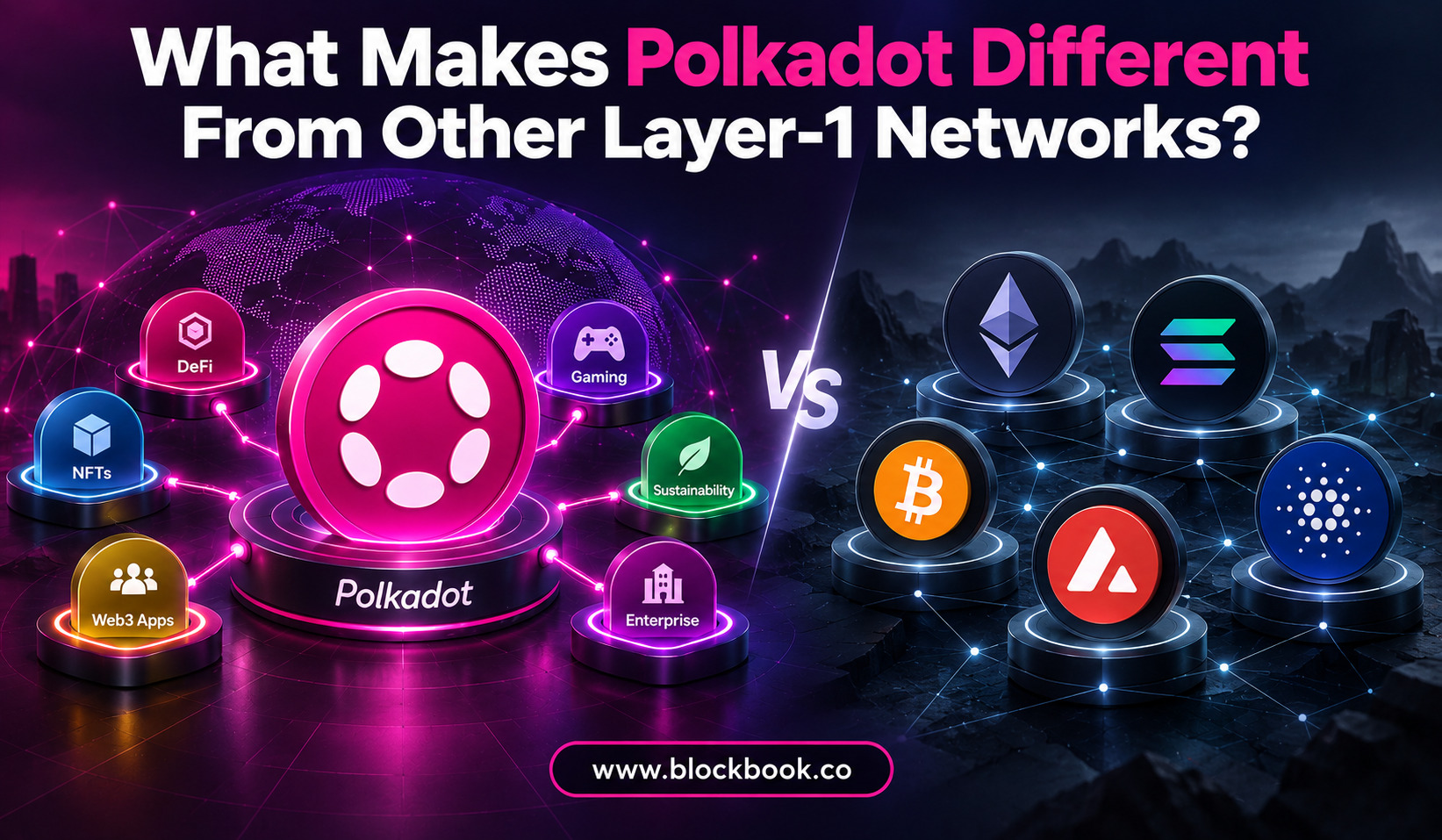
The Layer-1 blockchain sector has become one of the most competitive areas of the Web3 industry. Networks such as Ethereum, Solana, Avalanche and other blockchain platforms are designed to provide infrastructure for decentralized applications, digital assets, smart contracts and financial services. While they share some broad similarities, their architectures and approaches to scalability, security and interoperability can be significantly different.
Polkadot stands out because it was designed from the beginning around a multichain architecture. Rather than treating one blockchain as the place where every application must operate, Polkadot aims to coordinate multiple specialized blockchain environments through shared infrastructure and security.
This approach gives Polkadot a different position within the Layer-1 landscape. Its focus is not simply on increasing transaction throughput on one chain. Instead, the network attempts to create an ecosystem where specialized chains can operate in parallel and communicate with one another.
A Different Idea of What a Layer-1 Can Be
A conventional Layer-1 generally provides a base blockchain where applications, smart contracts and transactions are processed. Developers build on top of that network and use its consensus mechanism, execution environment and security model.
Polkadot takes a more modular approach. Its relay chain provides core coordination and security functions, while connected chains can specialize in different applications. Polkadot documentation describes the relay chain as responsible for functions such as block production, validator coordination, data availability and shared security.
This means Polkadot is not simply designed as one large blockchain competing on the same terms as every other Layer-1. Its architecture is intended to coordinate a collection of specialized environments.
That distinction becomes especially important as Web3 applications become more diverse. A decentralized finance application may need different infrastructure from a gaming network, identity system or tokenized asset platform.
Polkadot’s Multichain Architecture
The concept of multiple specialized chains working together is central to Polkadot. Parachains can operate in parallel while connecting to Polkadot’s shared infrastructure.
Instead of requiring each application to build an entirely independent blockchain with its own security network, a parachain can use Polkadot’s shared-security model. This allows developers to concentrate on the functionality of their application while participating in a larger ecosystem.
The architecture is therefore based on specialization. One chain does not necessarily need to provide every service. Different environments can be optimized for different requirements.
This approach also changes how scalability can be viewed. Rather than depending entirely on making one blockchain process an ever-growing number of transactions sequentially, Polkadot’s architecture uses parallel processing across connected environments.
Shared Security Is a Major Difference
Security is another area where Polkadot differs from many independent Layer-1 networks.
When developers launch a standalone blockchain, they generally need to establish their own validator or consensus system. The security of that network depends on participation, economic incentives and the design of its consensus mechanism.
Polkadot instead provides shared security to participating parachains. Its validator network is responsible for validating activity across the connected system. This means parachains do not necessarily have to create completely independent validator sets to secure their own networks.
For developers, this model can reduce one of the major challenges associated with launching a new blockchain. They can focus on specialized functionality while relying on the broader Polkadot security framework.
However, shared security does not mean that every risk disappears. Applications still need appropriate smart-contract security, economic design and operational safeguards. The model changes how network-level security is organized rather than eliminating the need for security engineering.
Interoperability Is Built Into the Architecture
Many blockchain networks now offer some form of interoperability, but Polkadot places cross-chain communication at the center of its architecture.
The network uses Cross-Consensus Message Format, commonly known as XCM, to describe messages between different consensus systems. XCM is designed to express instructions and interactions rather than simply function as a basic token-transfer mechanism.
This can allow connected environments to interact with assets, applications and other functionality across the ecosystem.
The distinction is important because interoperability becomes more powerful when it is programmable. Instead of creating a collection of isolated bridges for individual use cases, developers can build applications that understand cross-consensus instructions through a common messaging framework.
This is one reason Polkadot is often discussed as an interoperability-focused blockchain infrastructure rather than simply another general-purpose Layer-1.
Some of Polkadot’s distinguishing characteristics include:
- Multichain architecture with specialized environments operating in parallel.
- Shared security through Polkadot’s validator infrastructure.
- Native cross-chain communication using technologies such as XCM.
- Flexible computing resources through the network’s evolving coretime model.
Polkadot Compared With Traditional Layer-1 Models
The differences become easier to understand when Polkadot is compared with the general architecture of other Layer-1 networks.
Ethereum, for example, provides a general-purpose execution environment in which applications deploy smart contracts. Solana focuses heavily on high-performance execution within its own network. Avalanche uses a broader network architecture that can support application-specific chains and customized environments.
Polkadot’s model is different in that interoperability and shared security are deeply connected to its architecture.
| Area | Polkadot | Typical General-Purpose Layer-1 |
| Architecture | Multichain and modular | Primarily centered around one base chain |
| Security | Shared security for connected parachains | Generally provided by the individual network |
| Scaling approach | Parallel specialized environments | Primarily scaling the base execution environment |
| Interoperability | Core architectural objective | Often provided through additional protocols or bridges |
| Application design | Specialized chains and environments | Applications generally deploy on the main chain |
This table is a high-level architectural comparison. Individual Layer-1 networks differ considerably, so no single model represents every competing blockchain.
Flexible Computing With Agile Coretime
Polkadot’s development has also changed how projects access network resources. Earlier versions of the ecosystem were closely associated with parachain slot auctions. Projects competed for access to limited parachain slots through a structured auction system.
The network has since introduced Agile Coretime, which provides more flexible ways for projects to obtain computing resources. Polkadot documentation describes bulk coretime and on-demand coretime as mechanisms for accessing these resources.
The change reflects an important shift in the network’s philosophy. Blockchain applications do not all have the same computing requirements. Some may need consistent capacity, while others may experience short periods of intense demand.
Flexible coretime allows infrastructure access to become more closely connected to workload requirements.
For smaller projects, this can potentially make the ecosystem more accessible because they do not necessarily need to secure a long-term resource commitment before experimenting with their application.
Polkadot 2.0 and the Evolution of the Network
Polkadot 2.0 is generally used to describe a broader set of changes rather than a single upgrade. These developments include asynchronous backing, Agile Coretime and elastic scaling.
Asynchronous backing is designed to improve the efficiency of parachain block production. Elastic scaling allows workloads to use multiple cores when additional capacity is needed, while Agile Coretime introduces more flexible resource allocation.
Together, these developments show that Polkadot’s architecture is continuing to evolve.
The goal is increasingly focused on making decentralized computing more flexible rather than simply increasing the number of traditional parachain slots.
The Role of Specialized Chains
Another difference is the importance of application-specific infrastructure.
In a traditional smart-contract environment, developers generally build applications on top of the existing blockchain and accept its execution environment and limitations. Polkadot’s architecture gives developers the option of creating more specialized blockchain environments.
This can be useful when an application needs custom transaction logic, governance, execution requirements or economic mechanisms.
For example, a financial application may want infrastructure optimized for asset operations, while a gaming ecosystem could require a different execution model. Specialized environments can provide more control over these design decisions.
The trade-off is increased technical complexity. Building or operating specialized infrastructure can require more expertise than deploying a conventional smart contract.
External Blockchain Connections
Polkadot’s interoperability strategy also extends beyond its own connected environments. External blockchain networks operate under different consensus systems and security assumptions, meaning they require additional interoperability infrastructure.
Bridges can connect Polkadot with external networks. Polkadot documentation distinguishes these connections from communication between parachains because external networks do not automatically participate in Polkadot’s shared-security model.
This creates a layered interoperability strategy. Communication inside the Polkadot ecosystem can use its native infrastructure, while connections to external ecosystems require mechanisms designed to handle different security and consensus environments.
The distinction matters because blockchain interoperability is not simply a matter of moving tokens between addresses. Cross-network systems have to account for message verification, asset representation, transaction finality and security assumptions.
Potential Benefits for Web3 Developers
For developers, Polkadot’s architecture can provide several options that are not always available on a conventional Layer-1.
Projects can choose specialized infrastructure, participate in shared security and communicate with other connected environments. This can make it possible to build applications that use services distributed across multiple chains.
The broader ecosystem can also encourage composability. An application on one network could potentially interact with assets or functionality available on another without requiring both systems to operate identically.
However, developers still need to consider factors such as tooling, programming environments, community support, liquidity and user adoption when selecting blockchain infrastructure.
Challenges and Trade-Offs
Polkadot’s differences also create challenges. A modular multichain system can be more complicated to understand than a single blockchain. Developers need to consider cross-chain communication, specialized infrastructure and resource allocation alongside application development.
User experience is another consideration. Although interoperability is intended to reduce blockchain fragmentation, users can still encounter multiple wallets, assets, transaction fees and cross-chain processes.
Competition is also intense. Ethereum and its Layer-2 ecosystem, high-throughput networks such as Solana, and application-specific blockchain platforms all offer different approaches to scaling and Web3 development.
Polkadot therefore competes not only on technical architecture but also on developer adoption, applications, liquidity and ecosystem growth.
Why Polkadot’s Model Matters for Web3
The blockchain industry is moving toward a more fragmented but interconnected environment. Instead of one network necessarily dominating every application category, different systems can specialize in different tasks.
Polkadot’s architecture is designed for this environment. Its emphasis on shared security, specialized chains, interoperability and flexible computing resources provides a framework for applications that need more control than a conventional smart-contract deployment may provide.
Its model does not make other Layer-1 architectures obsolete. Instead, it represents a different set of trade-offs. Developers must consider whether specialization, shared security and cross-chain functionality fit their particular requirements.
As Web3 continues to mature, the comparison between Layer-1 networks may increasingly focus less on raw transaction numbers and more on architecture, interoperability, developer flexibility and the ability to support complex applications.
Conclusion
Polkadot’s biggest architectural distinction is its decision to treat blockchain development as a multichain problem rather than relying exclusively on one general-purpose execution environment. Parachains can specialize, Polkadot can provide shared security, and XCM can facilitate communication between different consensus environments.
The introduction of Agile Coretime, elastic scaling and other Polkadot 2.0 developments is further changing how projects can access and use network resources. Meanwhile, longer-term work such as JAM points toward an increasingly generalized model of decentralized computing.
For the Web3 industry, Polkadot represents a different Layer-1 philosophy: multiple specialized environments connected through common infrastructure. Whether that approach becomes increasingly important will depend on developer adoption, application growth, technical performance and real-world demand for interoperable blockchain services.
FAQs
What makes Polkadot different from other Layer-1 networks?
Polkadot is built around a multichain architecture in which specialized environments can operate in parallel while using shared infrastructure and security. Its design also places cross-chain communication at the center of the network.
Is Polkadot a Layer-1 blockchain?
Yes. Polkadot provides base-layer infrastructure and consensus while supporting connected specialized environments. Its architecture differs from a conventional single-chain Layer-1 because of its multichain design.
What are Polkadot parachains?
Parachains are specialized chains or blockchain environments connected to Polkadot. They can be designed for specific applications while participating in the network’s shared-security and interoperability framework.
What is XCM?
XCM stands for Cross-Consensus Message Format. It is a standardized messaging language designed to describe interactions between different consensus systems in the Polkadot ecosystem and beyond.
About the Author