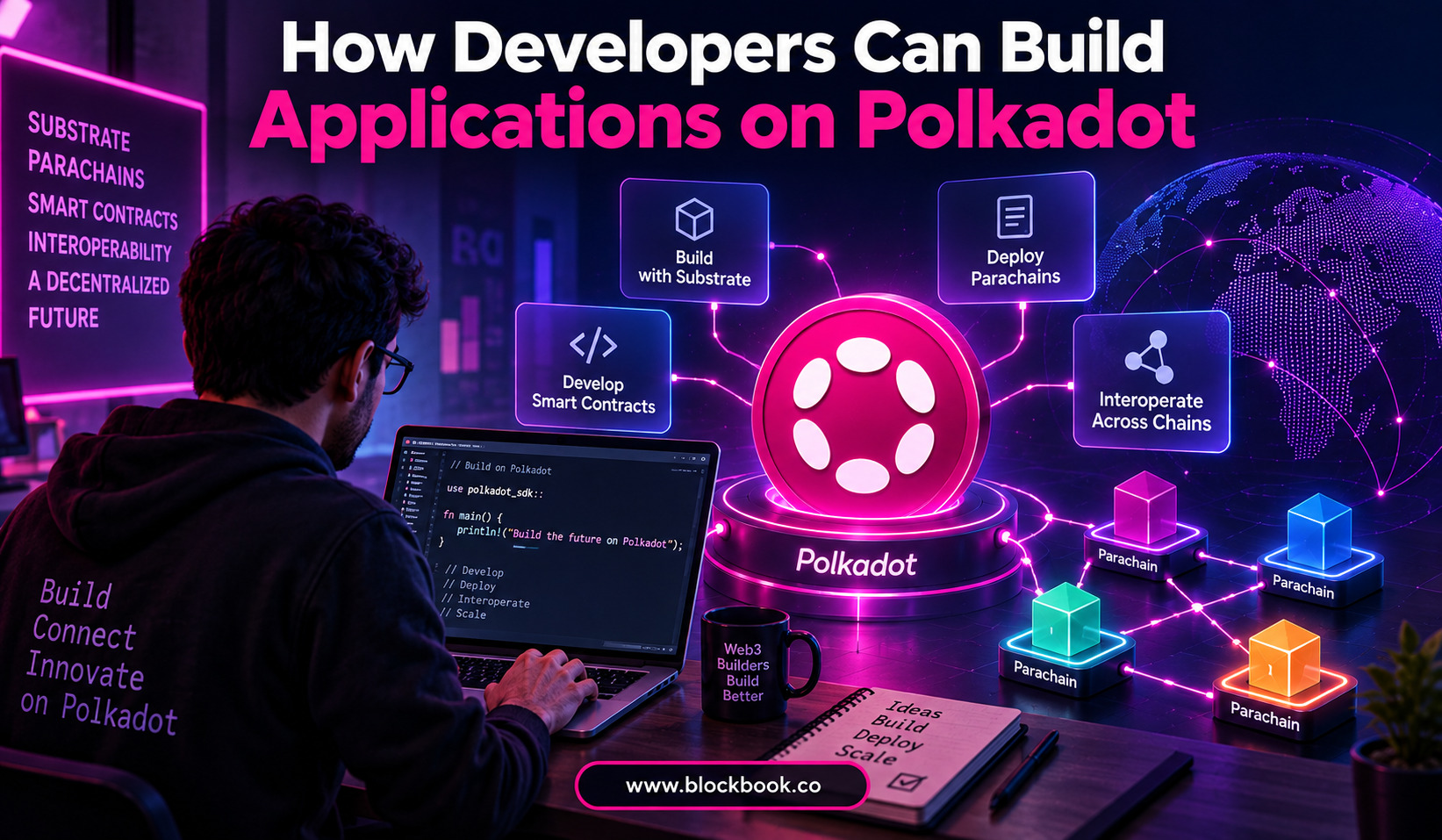
The Web3 development landscape is expanding beyond the idea of deploying applications on a single blockchain. Developers today can choose from smart-contract networks, Layer-2 solutions, application-specific chains and multichain platforms, each offering different approaches to performance, security and interoperability. Among these ecosystems, Polkadot has developed a distinctive model that gives developers several ways to build decentralized applications and specialized blockchain environments.
Polkadot is designed around a multichain architecture in which different environments can operate alongside one another while benefiting from shared infrastructure. This creates opportunities for developers who want to build applications that can interact across blockchain environments instead of remaining confined to one network.
Building on Polkadot requires an understanding of its architecture, available development frameworks, smart-contract options, testing environments and cross-chain communication technologies. For developers entering the ecosystem, the process can appear complex at first, but the underlying model is built around modularity and specialization.
Understanding the Polkadot Development Environment
Before creating an application, developers need to understand what makes Polkadot different from a conventional single-chain blockchain.
Polkadot’s relay chain provides core network functions such as validator coordination, consensus and shared security. Connected environments can then provide application-specific functionality. The network’s architecture is intended to allow different blockchain environments to operate in parallel rather than requiring every application to use one execution environment.
This creates two broad development paths. A developer can create an application using an existing smart-contract environment within the Polkadot ecosystem, or a project can build a more specialized blockchain environment when its requirements justify that approach.
The right choice depends on the application’s complexity, performance requirements, desired control and development resources.
Choosing Between Smart Contracts and a Specialized Chain
For many developers, deploying a smart contract is the simplest way to enter the Polkadot ecosystem. Smart contracts allow applications to use an existing blockchain environment without requiring the development team to create an entire blockchain.
This approach can be suitable for decentralized applications such as marketplaces, financial protocols, token systems and other Web3 services. Developers can focus primarily on application logic while the underlying network handles consensus and other infrastructure responsibilities.
A specialized chain offers considerably more control. Instead of building only the application layer, developers can customize aspects of the blockchain itself. This can be useful when an application needs custom transaction logic, specialized economics, unique governance or specific execution requirements.
Polkadot’s parachain model was created to support this type of specialization. Connected chains can participate in the broader ecosystem while benefiting from shared security and interoperability.
Developers generally consider these factors before selecting an approach:
- Application complexity and how much control is required over the underlying blockchain.
- Performance requirements, including transaction volume and execution needs.
- Interoperability requirements and whether the application needs to communicate with other chains.
- Development resources, including engineering time, infrastructure and maintenance requirements.
Using the Polkadot SDK
Developers who want to create customized blockchain environments can use the Polkadot SDK. It provides software components and frameworks for building blockchains that can participate in the broader Polkadot ecosystem.
The SDK approach allows teams to customize important parts of their network rather than starting from a completely empty codebase. Developers can work with modular components and adapt the blockchain according to the application’s requirements.
This modularity is one of the key ideas behind Polkadot’s development philosophy. Instead of forcing every project to use the same blockchain design, developers can select and configure components that make sense for their use case.
The process is more involved than deploying a smart contract, however. Teams need to understand runtime development, networking, consensus-related components and deployment infrastructure.
For that reason, the Polkadot SDK is generally more relevant to teams that need blockchain-level customization rather than developers simply looking to launch a conventional decentralized application.
Programming and Runtime Development
A major part of Polkadot development involves the runtime. The runtime defines the rules and logic that determine how a blockchain processes transactions and state changes.
The Polkadot SDK uses Substrate-based technologies and Rust is an important programming language within this development environment. Developers working on customized runtimes therefore need familiarity with Rust and the relevant Polkadot SDK tooling.
Runtime development differs from traditional smart-contract development because the developer has greater control over the underlying blockchain logic.
That flexibility can be powerful, but it also creates additional responsibility. Changes to a runtime can affect the behavior of the entire network, so testing and careful deployment are important parts of the development process.
Building Smart-Contract Applications
Developers who do not need a customized blockchain can instead build applications using a smart-contract platform available in the Polkadot ecosystem.
Smart-contract development generally follows a more familiar Web3 workflow. Developers create contract logic, compile the code, test it locally or on a development network, deploy it and then connect it to a front-end application.
The front end can communicate with the blockchain through appropriate libraries and wallet integrations. Users can then interact with the application through transactions signed by their wallets.
This route can reduce development complexity because the team does not need to maintain the full blockchain infrastructure.
The development workflow typically involves:
- Designing the application’s contract architecture.
- Writing and testing contract code.
- Deploying contracts to a suitable test environment.
- Connecting the contracts to the application’s front end.
Security remains essential throughout the process. Smart contracts can contain vulnerabilities that result in financial losses or unexpected behavior, so developers should conduct thorough testing and security reviews before deploying applications with real assets.
Cross-Chain Communication With XCM
One of Polkadot’s most important development features is its support for cross-consensus communication.
XCM, or Cross-Consensus Message Format, provides a standardized way to describe messages and instructions between different consensus systems. It is designed to support more than simple asset transfers and can express a variety of cross-chain operations.
For developers, this means an application does not necessarily have to operate as an isolated system.
A decentralized application could potentially interact with assets or functionality available on another connected environment. This creates opportunities for more composable applications in areas such as decentralized finance, gaming and digital assets.
Understanding XCM becomes increasingly important for developers who want their applications to take advantage of Polkadot’s multichain architecture.
Testing Before Deployment
Testing is one of the most important stages of blockchain application development. A bug in conventional software can often be corrected through an update, but blockchain applications may involve immutable smart contracts, financial assets and decentralized users.
Developers should therefore test their applications in controlled environments before deploying them to production.
Testing can cover transaction processing, contract behavior, user permissions, error handling, cross-chain messages and interactions with other applications.
For customized blockchain development, testing becomes even more important because changes to the runtime can affect the network’s fundamental behavior.
A development workflow can include local testing followed by deployment to a test network before production release. Developers can use these environments to identify problems without exposing users or valuable assets to unfinished software.
Connecting the Front End
A blockchain application is rarely just a smart contract or runtime. Most users interact through a website, mobile application or another front-end interface.
The front end needs to communicate with the blockchain and provide users with information about balances, transactions, contract interactions and application activity.
Wallet integration is also an important part of this process. Users need a way to connect their wallets, approve transactions and sign blockchain operations.
A well-designed interface can hide much of the technical complexity that exists underneath. This becomes particularly valuable in multichain applications because users may otherwise have to understand which network processes each operation.
Resource Management and Polkadot’s Newer Model
Developers building within Polkadot also need to understand how computing resources are allocated.
The network has introduced Agile Coretime as a more flexible approach to accessing computing capacity. Polkadot documentation describes both bulk and on-demand coretime options, allowing projects to obtain resources according to their requirements.
This represents a change from the earlier parachain-slot model and can provide developers with more flexible ways to plan infrastructure.
For applications with changing workloads, resource flexibility can be particularly relevant. A project may require greater capacity during periods of high activity and less capacity during quieter periods.
Polkadot’s broader development direction also includes technologies such as elastic scaling, which can allow workloads to use multiple cores when additional capacity is needed.
| Development Approach | Best Suited For | Main Consideration |
| Smart contracts | Standard decentralized applications | Less control over base infrastructure |
| Customized blockchain | Specialized applications | Greater development complexity |
| Cross-chain applications | Multichain services | Requires interoperability expertise |
| Polkadot SDK development | Custom runtime and network logic | Requires deeper blockchain knowledge |
Security Considerations for Developers
Security should be considered from the beginning of a Polkadot application rather than added immediately before launch.
Smart-contract developers need to examine access controls, transaction validation, economic logic and potential attack vectors. Projects handling digital assets should also consider how tokens are represented and transferred between environments.
Cross-chain applications require additional attention because messages can trigger actions beyond the application’s original environment. Developers must understand the assumptions behind the messaging system and design appropriate safeguards.
Customized blockchain projects have another layer of responsibility because errors in runtime logic can influence the operation of the entire chain.
Security audits, automated testing, code reviews and controlled deployments can help reduce the likelihood of serious problems.
Building for a Multichain Future
The most interesting opportunity for developers may be the ability to design applications that are not limited to one blockchain environment.
Instead of treating each blockchain as an isolated destination, developers can build applications that use different specialized environments for different functions. One part of an application could handle assets, another could provide specialized computation, while cross-chain messaging connects the components.
This approach can create more complex Web3 applications, but it also requires developers to think differently about architecture.
The future of blockchain development may increasingly involve modular systems in which applications use several networks rather than relying on a single chain for every operation.
Conclusion
Building applications on Polkadot can take several forms, from relatively straightforward smart-contract projects to highly customized blockchain environments. The network’s multichain architecture gives developers the flexibility to choose an approach based on their application’s requirements.
Smart contracts can provide a practical starting point for conventional decentralized applications, while the Polkadot SDK gives experienced teams greater control over blockchain-level functionality. XCM adds another important capability by enabling applications and chains to communicate across different consensus environments.
The introduction of Agile Coretime and other Polkadot 2.0 developments is also changing how developers can access computing resources. As the ecosystem moves toward more flexible and generalized decentralized computing, developers have an expanding set of tools for creating Web3 applications.
FAQs
Can beginners build applications on Polkadot?
Yes. Developers can start with smart-contract development, which generally requires less infrastructure knowledge than creating a customized blockchain. Developers seeking deeper customization can explore the Polkadot SDK.
What programming language is commonly used for Polkadot blockchain development?
Rust is an important language for Polkadot SDK and runtime development. Developers working with smart contracts may use different languages depending on the specific contract platform they choose.
What is the Polkadot SDK?
The Polkadot SDK is a collection of software components and development tools that can be used to build customized blockchain environments and runtimes.
What is XCM used for?
XCM is used to describe communication and instructions between different consensus systems. It supports cross-chain interactions within the broader Polkadot ecosystem.
About the Author