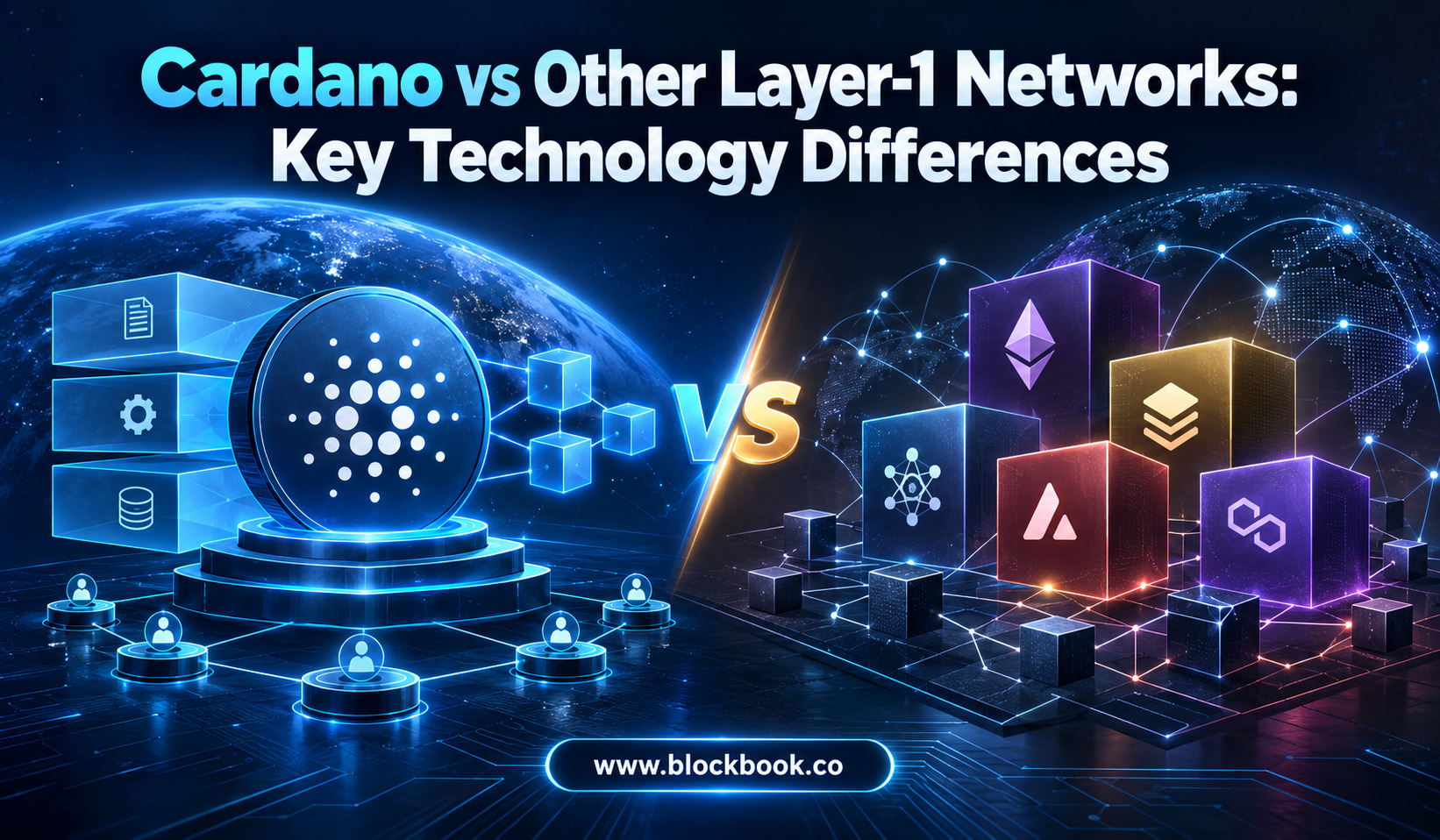
The Layer-1 blockchain sector has developed into a diverse technology landscape. Networks such as Cardano, Ethereum, Solana and Avalanche all provide infrastructure for decentralized applications, digital assets and Web3 services, but they approach the underlying technology in different ways.
These differences are not limited to transaction speeds or cryptocurrency prices. The architecture of a blockchain determines how transactions are processed, how smart contracts interact with data, how applications manage state, how validators reach consensus and how developers build decentralized applications.
Cardano has developed a particularly distinctive architecture through its extended unspent transaction output, or eUTXO, accounting model and Ouroboros proof-of-stake consensus protocol. Ethereum uses an account-based state model, while Solana’s architecture is designed around parallel transaction processing and its own runtime. Avalanche takes another route through a multi-chain architecture in which application-specific Layer-1 networks can operate with their own validator sets.
Understanding these differences is increasingly important as developers and businesses evaluate blockchain infrastructure for Web3 applications.
Cardano’s eUTXO Model Sets It Apart
One of the most important differences between Cardano and several other major Layer-1 networks is its accounting model.
Cardano uses an extended UTXO model. The system builds on the unspent transaction output design used by Bitcoin but adds programmable scripts and data to transaction outputs. According to Cardano’s documentation, the eUTXO model allows transaction validation to depend on the transaction itself and its inputs, together with relevant data and redeemers.
This creates a different programming environment from account-based networks.
Ethereum, for example, represents blockchain state through accounts. Its documentation identifies externally owned accounts and contract accounts, with contract accounts containing code and storage. Transactions can trigger contract execution and changes to account state.
Cardano instead treats UTXOs as discrete pieces of state that are consumed and replaced by transactions.
This difference affects how decentralized applications are designed. A developer moving from Ethereum to Cardano cannot simply transfer the same application architecture without modification. Cardano’s documentation explicitly notes that design patterns used on account-based blockchains do not translate directly to eUTXO systems.
For developers, this means the choice of blockchain can influence application architecture from the beginning.
Transaction Validation Works Differently
The eUTXO model also changes how transactions are evaluated.
Cardano documentation states that a transaction’s validity can be checked off-chain before it is submitted to the blockchain because validation depends on the transaction and its inputs. If another transaction has already consumed an expected input, however, the transaction may need to be rebuilt.
This provides a relatively explicit model for reasoning about transaction outcomes.
Ethereum’s account-based approach works differently. Contract execution can read and modify shared state, meaning a transaction’s behavior can depend on the state encountered during execution. Ethereum’s documentation describes contract accounts as code-controlled accounts whose code executes when called.
Neither model eliminates development challenges. Instead, they create different ones.
Cardano developers need to carefully manage UTXOs and transaction construction, while developers on account-based platforms need to reason about contract storage, account state and execution interactions.
The main architectural differences developers encounter include:
- Cardano: UTXO-based state with programmable validation.
- Ethereum: Account-based state with contract storage.
- Solana: Account-based state combined with a runtime designed for parallel execution.
- Avalanche: Multiple blockchain environments, including sovereign Avalanche L1s.
Cardano and Ethereum Take Different Paths
Ethereum remains one of the most important smart-contract platforms in the blockchain industry, but its architecture differs substantially from Cardano.
Ethereum’s account model allows smart contracts to maintain persistent storage and interact with other contracts through transactions. This architecture has supported a large ecosystem of decentralized finance applications, NFTs, DAOs and other Web3 services.
Cardano’s eUTXO model approaches smart contracts differently. Its Plutus platform uses validator scripts to determine whether particular UTXOs can be used. Cardano’s documentation describes Plutus Core as the scripting language used to implement the eUTXO model, with developers commonly writing smart-contract code in Haskell that is compiled into Plutus Core.
The difference becomes especially important when developers design application state.
An Ethereum application may organize its state around contract storage, while a Cardano application may distribute state across UTXOs and transactions.
Ethereum is also continuing to evolve its account model. Its current roadmap includes account-abstraction developments designed to provide users with more flexible smart-contract wallet experiences.
This illustrates an important point about Layer-1 comparisons: blockchain architectures are not static. Each network continues to introduce improvements while maintaining its core design principles.
Solana Focuses on Parallel Execution
Solana takes another approach to blockchain performance.
Its runtime was designed to process transactions in parallel when their state dependencies allow it. Solana’s Sealevel architecture was specifically developed to execute smart contracts concurrently, with transactions identifying the accounts they will read or write.
This is a fundamental difference from Cardano’s eUTXO architecture.
Cardano’s transaction model naturally separates independent UTXOs, while Solana explicitly identifies account access within transactions to determine opportunities for parallel processing.
Solana programs are compiled into sBPF and executed in a sandboxed runtime. Current Solana documentation states that programs are primarily written in Rust and execute within a defined computational budget.
For developers, this creates a programming environment centered on accounts, program execution and parallel transaction processing.
Cardano developers, by contrast, work with UTXOs, validator scripts and transaction inputs and outputs.
The two networks therefore pursue scalability through significantly different architectural choices.
Avalanche Takes a Multi-Chain Approach
Avalanche introduces another major variation in Layer-1 design.
Rather than relying exclusively on a single general-purpose blockchain, Avalanche supports a network of Layer-1 blockchains. Avalanche’s current documentation describes an Avalanche L1 as a sovereign network with its own rules concerning membership, economics and consensus.
This architecture allows projects to create specialized blockchain environments rather than placing every application on a single shared execution environment.
Avalanche’s consensus technology is also different. Its Snow family of consensus protocols uses repeated random sampling to reach consensus, while Snowman is used for linear blockchain structures. Avalanche documentation describes the system as providing probabilistic finality with low latency.
Avalanche L1s can also use Ethereum-compatible infrastructure. The official documentation states that Avalanche L1s can be deployed with Subnet-EVM, which supports Solidity smart contracts and Ethereum client functionality.
This gives developers a different option from Cardano: rather than adapting applications to an eUTXO model, developers can create or deploy within environments that preserve EVM compatibility while offering more control over network configuration.
Consensus Mechanisms Are Another Major Difference
The way a blockchain reaches agreement is another important technology distinction.
Cardano uses the Ouroboros family of proof-of-stake consensus protocols. Its documentation describes Ouroboros as a proof-of-stake system in which stake pools participate in block production according to stake-based leader selection.
The protocol has evolved through multiple versions, including Ouroboros Praos and later research into Ouroboros Leios.
Ethereum also uses proof of stake, but its consensus architecture is different from Cardano’s Ouroboros design. Ethereum transitioned from proof of work to proof of stake and uses validators who participate through its Beacon Chain-based consensus architecture.
Solana combines its Proof of History mechanism with Tower BFT and other components, while Avalanche uses its Snow-family consensus protocols. These different approaches reflect different assumptions about network coordination and performance.
| Technology Area | Cardano | Ethereum | Solana | Avalanche |
| State model | eUTXO | Account-based | Account-based | Varies by L1 |
| Smart-contract environment | Plutus | EVM | Solana runtime | EVM or other supported environments |
| Consensus | Ouroboros PoS | Proof of Stake | PoH + Tower BFT architecture | Snow family |
| Scaling approach | UTXO parallelism, Layer 2 and protocol research | Rollups and protocol upgrades | Parallel execution and high-performance runtime | Multiple sovereign L1s |
| Developer languages | Haskell and ecosystem tools | Solidity and others | Primarily Rust | Solidity and others |
| Network structure | Single primary ledger with extensions | Mainnet plus Layer-2 ecosystem | Single high-performance network architecture | Multi-chain/L1 ecosystem |
This table provides a high-level technical comparison; each ecosystem contains additional layers, implementations and scaling technologies.
Smart-Contract Development Is Different on Each Network
For developers, the differences between Layer-1 networks become particularly visible when building smart contracts.
Cardano’s validator model is based around the eUTXO architecture. Smart contracts determine whether particular transaction outputs can be spent according to defined conditions.
Ethereum developers generally work with Solidity and the EVM, where contracts can maintain persistent storage and call other contracts.
Solana developers primarily use Rust-based programs running within the Solana runtime. The runtime uses explicit account information to manage program access and supports parallel execution when transactions do not conflict.
Avalanche offers an additional route because developers can use EVM-compatible environments, allowing Solidity-based applications to be deployed with relatively familiar tooling.
This makes developer experience an important consideration when comparing networks. A project team already experienced with Solidity may have a different development path from a team interested in functional programming and UTXO-based architecture.
Scaling Strategies Are Not the Same
Layer-1 networks also differ in how they approach scalability.
Cardano’s eUTXO architecture can allow independent transactions to be validated in parallel when they do not consume the same inputs. Cardano documentation identifies this as one of the potential benefits of the model.
The ecosystem is also developing Layer-2 technologies and other scaling research.
Ethereum has increasingly emphasized Layer-2 rollups as part of its scaling strategy. Rather than processing every application interaction directly on Ethereum mainnet, rollups can execute activity elsewhere and settle results back to Ethereum.
Solana focuses heavily on high-performance execution at the network level, including parallel transaction processing.
Avalanche uses a multi-chain strategy in which separate L1s can provide dedicated execution environments and resources. Its documentation describes this as a way for applications to operate sovereign networks with their own rules.
These approaches represent different ways of addressing the same broader challenge: allowing blockchain applications to handle increasing demand without sacrificing the characteristics developers and users value.
Asset Handling Also Varies
The way assets are represented is another technical difference.
Cardano supports native assets directly within its ledger model. This means developers can create and transfer assets without necessarily implementing the basic asset itself through a smart contract.
Ethereum commonly represents fungible and non-fungible assets through smart-contract standards such as ERC-20 and ERC-721.
Solana uses its own token-program infrastructure, while Avalanche supports token systems through its various blockchain environments.
These differences affect development costs, wallet integration, transaction construction and application architecture.
For developers building tokenized applications, understanding how a network handles assets at the protocol level can be just as important as understanding its smart-contract language.
Interoperability Takes Different Forms
Interoperability is becoming increasingly important as applications operate across multiple blockchain ecosystems.
Cardano has pursued interoperability through sidechains, bridges and other infrastructure while maintaining its distinct ledger architecture.
Ethereum’s ecosystem has expanded through Layer-2 networks and cross-chain protocols.
Solana has developed bridges and cross-chain integrations, while Avalanche’s multi-chain design includes infrastructure for communication among Avalanche L1s. Avalanche’s documentation describes the P-Chain as maintaining information about validators across the Avalanche network and supporting native interoperability.
The technical challenge is not simply moving tokens between networks. Cross-chain systems must also account for message verification, validator assumptions, finality and security.
What These Differences Mean for Developers
Choosing a Layer-1 network is increasingly an architectural decision rather than simply a question of transaction fees.
A developer building a financial application needs to understand how smart contracts handle state. A gaming project may prioritize transaction throughput and execution speed. A business building a specialized blockchain may prefer control over validators and network parameters.
Developers comparing Layer-1 platforms should examine:
- The ledger and state model.
- Smart-contract languages and developer tooling.
- Consensus and validator requirements.
- Scaling and interoperability architecture.
The best technical fit depends on the application’s requirements rather than one universal blockchain characteristic.
Security and Predictability
Security is another area where architectural choices matter.
Cardano’s eUTXO model allows developers to reason about transaction validation using explicit inputs, outputs and scripts. Cardano documentation also highlights the ability to evaluate transaction validity off-chain before submission.
Ethereum’s account-based model provides considerable flexibility for composable smart contracts, but developers must carefully manage contract storage and interactions between applications.
Solana’s parallel execution requires developers to explicitly identify account access, while its runtime imposes computational constraints on programs.
Avalanche L1 developers gain control over network configuration, but that sovereignty also means they are responsible for operating and securing their own validator environment. Avalanche documentation notes that an L1’s performance depends on sufficient validator participation.
These examples show that greater flexibility can also introduce additional responsibilities.
Why Cardano’s Architecture Remains Relevant
Cardano’s technology differences are significant because they offer developers an alternative to the dominant account-based model.
The eUTXO approach provides explicit transaction boundaries and a different way of managing application state. Ouroboros provides Cardano’s proof-of-stake consensus foundation, while Plutus and related tools provide the smart-contract environment.
At the same time, Cardano is not isolated from broader blockchain development trends. Its ecosystem continues to work on scalability, interoperability, developer tooling and governance.
The result is a blockchain platform that occupies a distinct position within the Layer-1 landscape.
Conclusion
Cardano’s technology differs from other major Layer-1 networks at some of the most fundamental levels of blockchain architecture. Its eUTXO model gives developers a transaction-based approach to state management, while Ouroboros provides its proof-of-stake consensus foundation.
Ethereum’s account-based architecture offers a different model built around accounts, contract storage and EVM execution. Solana focuses on high-performance parallel execution, while Avalanche provides a multi-chain framework in which projects can create sovereign L1 environments.
These differences affect much more than technical documentation. They influence how developers write smart contracts, how applications manage state, how transactions are validated and how networks approach scalability.
For developers and businesses, the comparison is therefore best understood as a set of architectural trade-offs rather than a simple contest between blockchain networks. The right choice depends on the application’s requirements, development expertise, security model and desired infrastructure.
FAQs
What is the biggest technology difference between Cardano and Ethereum?
The most fundamental difference is the ledger model. Cardano uses an extended UTXO model, while Ethereum uses an account-based state model. This affects transaction processing, smart-contract design and application architecture.
Is Cardano an account-based blockchain?
No. Cardano uses the extended UTXO model, which is an extension of the UTXO approach used by Bitcoin.
How does Cardano compare with Solana?
Cardano uses eUTXO and Ouroboros proof of stake, while Solana uses an account-based architecture with a runtime designed for parallel execution. Solana programs are primarily written in Rust and compiled to sBPF.
How is Avalanche different from Cardano?
Avalanche emphasizes a multi-chain architecture in which projects can operate sovereign Avalanche L1s with their own validator sets and rules. Cardano instead has a primary blockchain architecture based on its eUTXO ledger and Ouroboros consensus.
About the Author