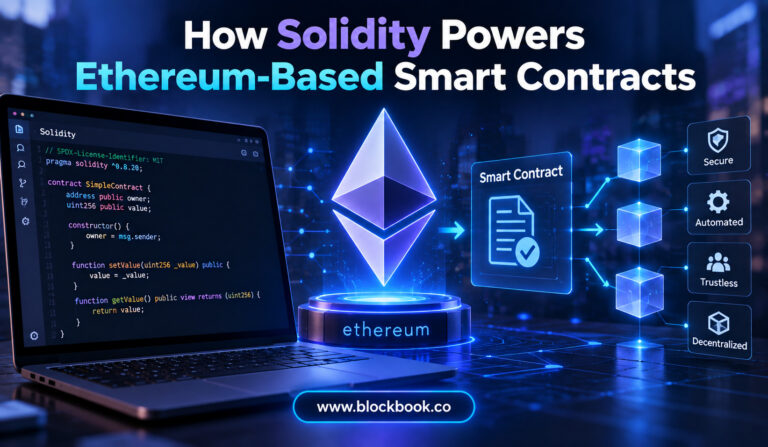
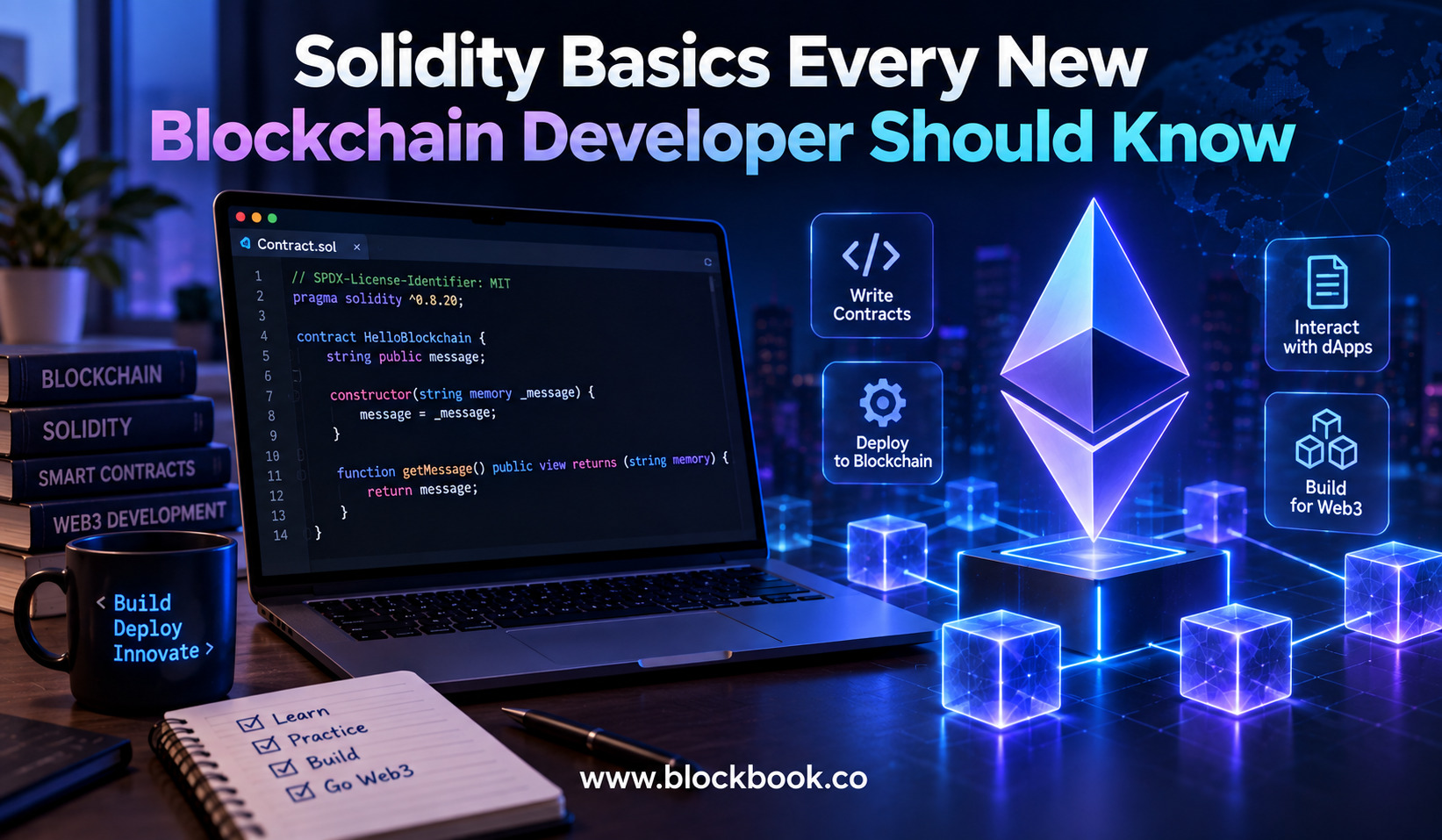
Blockchain development has moved beyond simply understanding cryptocurrencies. As decentralized applications, token platforms, decentralized finance protocols, gaming projects, and Web3 services continue to develop, smart contracts have become an important part of blockchain technology. For developers entering this field, learning Solidity is often one of the first major steps toward building applications that can interact with blockchain networks.
Solidity is a high-level, statically typed programming language designed primarily for writing smart contracts that run on the Ethereum Virtual Machine (EVM). Its syntax has similarities to languages such as JavaScript, Python, and C++, which can make it approachable for developers who already have programming experience. However, blockchain development introduces concepts that are different from traditional software development, particularly around permanent data, transaction execution, gas costs, and security.
For beginners, understanding Solidity is not simply about learning syntax. Developers also need to understand how contracts store information, how functions interact with blockchain data, how permissions work, and why seemingly small programming mistakes can create serious security problems.
Understanding Smart Contracts First
Before writing Solidity code, new developers should understand what a smart contract actually does. A smart contract is a program deployed to a blockchain that contains rules and functions for managing digital assets or data. Once deployed, users and other contracts can interact with it through transactions or calls.
Solidity provides the programming structure for creating these contracts. A contract can contain variables that represent stored information, functions that perform actions, events that provide information to external applications, and errors that explain why an operation failed. The official Solidity documentation describes contracts as being similar to classes in object-oriented programming, although their execution environment and data-storage model are very different.
This difference is important for beginners. A traditional application can often be updated or repaired directly on a server. A blockchain contract, once deployed, operates according to its deployed code and blockchain rules. Developers therefore need to think carefully about the logic before putting a contract into production.
Learn the Basic Structure of Solidity
A Solidity source file normally starts with a license identifier and a pragma statement that specifies the compiler version range intended for the code. The contract itself is then declared using the contract keyword.
A simple structure can look like this:
// SPDX-License-Identifier: MIT
pragma solidity ^0.8.0;
contract SimpleStorage {
uint256 public storedValue;
function setValue(uint256 newValue) public {
storedValue = newValue;
}
}
This small example introduces several important concepts. storedValue is a state variable, while setValue() is a function that changes the stored value. The public keyword makes the variable accessible through an automatically generated getter and allows the function to be called externally.
Beginners should become comfortable reading this structure before moving to more complicated decentralized applications.
Understand Solidity Data Types
Data types are another fundamental part of Solidity. Because Solidity is statically typed, developers generally specify the type of data a variable is expected to hold. Common types include unsigned integers such as uint256, signed integers, Boolean values, addresses, strings, and byte arrays.
The address type is particularly important in blockchain development because it represents an Ethereum-style account or contract address. Developers frequently use addresses to identify users, token holders, owners, or other contracts.
Solidity also provides reference types such as arrays, structs, and mappings. A mapping can be especially useful when a developer needs to associate one value with another. For example, a token contract might use a mapping to connect an address with its token balance.
Understanding these types helps developers design contracts more efficiently and reduces confusion when working with blockchain data.
State Variables and Blockchain Storage
One of the biggest differences between ordinary programming and Solidity is the importance of blockchain storage. State variables hold information associated with a contract. Changes to persistent contract state generally occur through transactions and consume blockchain resources.
Developers should therefore avoid treating storage like ordinary temporary memory. The choice of where data is stored can affect both contract behavior and gas consumption. Solidity also distinguishes between locations such as storage, memory, and calldata, each serving different purposes.
For beginners, the key idea is simple: storage is persistent, while temporary data can exist only during execution or a transaction. The Solidity documentation also distinguishes persistent contract storage from transient storage, which is cleared at the end of a transaction.
Functions Are the Main Building Blocks
Functions determine what a smart contract can do. A function can read information, change blockchain state, accept Ether, return values, or interact with another contract.
New developers should pay close attention to function visibility. Solidity supports four primary visibility levels for functions: public, external, internal, and private. Public and external functions can form part of a contract’s external interface, while internal and private functions restrict access within the contract hierarchy.
It is also important to understand function mutability. A view function can read blockchain state without modifying it, while a pure function does not read or modify contract state. A payable function can receive Ether.
These keywords are not just syntax. They communicate how a function is intended to behave and can help developers build clearer and safer contracts.
| Solidity concept | Basic purpose |
| uint256 | Stores unsigned integer values |
| address | Represents an account or contract address |
| mapping | Associates one value with another |
| struct | Groups related data |
| view | Reads state without modifying it |
| pure | Performs calculations without accessing contract state |
| payable | Allows a function to receive Ether |
| event | Creates blockchain logs for applications to monitor |
Learn Visibility and Access Control
Access control is one of the most important concepts for a smart contract developer. A function that changes important contract information should not automatically be accessible to everyone.
For example, an administrative function may need to be restricted to an owner or authorized account. Solidity supports modifiers that can be used to add conditions before a function executes. A modifier can check whether the caller has the required permission and then allow the function to continue.
However, beginners should understand that private does not mean secret. Solidity’s documentation specifically warns that restricting a variable or function with private or internal does not make the underlying information invisible to the outside world. Blockchain data can still be observable.
This is an important lesson for anyone coming from conventional application development.
Events Help Applications Track Activity
Smart contracts frequently need to communicate important activity to external applications. Events provide a mechanism for recording information in transaction logs.
For example, a token contract may emit an event when tokens are transferred. A decentralized application can then monitor those logs and update its interface accordingly. Solidity events are connected to the EVM’s logging functionality and can be accessed by applications through blockchain infrastructure.
Events are therefore an important bridge between smart contract activity and the user interface of a Web3 application.
Error Handling Is Essential
Smart contracts need to deal with invalid actions. Solidity provides mechanisms including require, revert, and assert, while modern Solidity also supports custom errors.
A developer might use an error when a caller does not have enough balance, lacks authorization, or provides invalid information. Custom errors can provide structured failure information while being more efficient than long string-based error messages in appropriate situations.
Beginners should make validation part of their normal development process rather than treating error handling as something added at the end.
Understand Gas Before Building Complex Contracts
Every blockchain transaction has computational costs. On EVM-compatible networks, these costs are generally discussed in terms of gas. Developers need to understand that contract operations are not free.
Writing large amounts of data to storage, performing unnecessary calculations, or designing inefficient functions can increase transaction costs. This means Solidity development involves more than making code function correctly. Developers must also consider how efficiently that code executes.
For new programmers, optimization should not come at the expense of readability or security. A simple and understandable contract is generally easier to review than code that has been aggressively optimized without a clear reason.
Security Should Be Learned Alongside Solidity
Smart contract security should begin with the first Solidity lesson. A contract may manage valuable digital assets, so coding errors can have consequences that are difficult to reverse.
Beginners should become familiar with concepts such as access-control mistakes, unsafe external calls, reentrancy, incorrect assumptions about transaction ordering, and arithmetic or validation errors. They should also learn how to test contracts before deployment.
Developers should avoid copying contract code from random online sources without understanding it. Libraries and established development tools can help, but every dependency and external contract interaction still needs to be understood.
Learn the ABI and Contract Interaction
Another important concept is the Application Binary Interface, commonly called the ABI. The ABI describes how external applications and contracts communicate with a Solidity contract.
When a decentralized application calls a contract function, information must be encoded into a format the EVM can process. The ABI provides the structure needed for this interaction. Solidity’s ABI specification explains how function calls, parameters, return values, events, and errors are represented.
A beginner does not need to memorize ABI encoding immediately. However, understanding that the frontend and smart contract communicate through defined interfaces becomes increasingly important when building complete Web3 applications.
Practice With Small Contracts
The fastest way to become comfortable with Solidity is to write small contracts instead of immediately attempting a complicated DeFi platform or NFT marketplace.
A beginner can start with a storage contract, then build a simple voting system, token balance tracker, crowdfunding contract, or basic payment contract. Each project introduces another part of Solidity while keeping the overall code manageable.
Tools such as Remix can also make the learning process easier because developers can write, compile, deploy, and interact with contracts through a browser-based environment. Solidity’s official documentation lists Remix among the available ways to work with the language.
What New Solidity Developers Should Focus On
The most useful learning path is to build a strong foundation rather than rushing toward advanced frameworks. New developers should first understand Solidity syntax and data types, then move into functions, storage, access control, events, errors, contract interaction, testing, and security.
A practical beginner roadmap includes:
- Learn basic Solidity syntax and data types.
- Build simple contracts and test their functions.
- Understand storage, memory, calldata, and gas.
- Learn events, errors, modifiers, and access control.
- Study common smart contract security problems.
- Practice deploying contracts on development or test environments.
This approach gives developers a foundation that can later be applied to token systems, decentralized applications, DeFi protocols, blockchain games, and other Web3 projects.
Why Solidity Knowledge Still Matters
Solidity remains an important skill for developers working with EVM-based blockchain applications. Its role extends beyond writing individual smart contracts because developers also need to understand how contracts communicate with wallets, decentralized applications, blockchain nodes, and other contracts.
The language continues to evolve, and the official documentation recommends using the latest released Solidity version for deployments in normal circumstances because newer releases contain improvements and security fixes. Developers should therefore avoid relying indefinitely on outdated tutorials and should check documentation for version-specific changes.
For someone starting a blockchain development career, Solidity is best viewed as a foundation rather than the complete skill set. Once the language basics are understood, developers can move toward testing frameworks, frontend integration, contract libraries, auditing techniques, and decentralized application architecture.
Conclusion
Learning Solidity is an important starting point for developers who want to enter EVM-based blockchain development. The fundamentals may look similar to conventional programming, but blockchain introduces a different environment where code interacts with permanent or transaction-based data and potentially valuable digital assets.
New developers should focus on understanding contracts, data types, functions, storage, visibility, events, errors, gas, and security before moving toward complex projects. Consistent practice with small contracts can turn these concepts into practical skills.
As the Web3 development ecosystem continues to evolve, developers who combine Solidity knowledge with strong programming fundamentals, testing practices, and security awareness can build a more reliable foundation for working on decentralized applications.
FAQs
What is Solidity used for?
Solidity is primarily used to write smart contracts for blockchain networks that use the Ethereum Virtual Machine. These contracts can manage data, digital assets, permissions, and application logic.
Is Solidity difficult for beginners?
Solidity can be approachable for developers with experience in programming languages such as JavaScript, Python, or C++. The bigger learning challenge is understanding blockchain concepts such as transactions, gas, storage, contract interactions, and security.
What should I learn before Solidity?
Basic programming concepts such as variables, functions, conditions, loops, data structures, and object-oriented programming can make Solidity easier to understand. Knowledge of blockchain fundamentals is also useful.
What is a Solidity smart contract?
A smart contract is a blockchain program containing predefined logic. Users or other contracts can interact with its functions, while relevant state changes are recorded according to the underlying blockchain’s execution rules.
What are Solidity events?
Events allow contracts to produce log information that external applications can monitor. They are commonly used to notify decentralized applications about activities such as transfers or other state-changing actions.
About the Author