Thousands of new tokens launch every single month, and a surprising number of them are created by people with no coding background at all. Somewhere between that reality and the image of a cryptocurrency as something only elite programmers can build sits the actual answer to a question a lot of curious people ask.
Here’s a straightforward look at whether you can create your own cryptocurrency, what it actually takes, and where the real difficulty lies.
Yes, you can create a cryptocurrency. Here’s the catch.
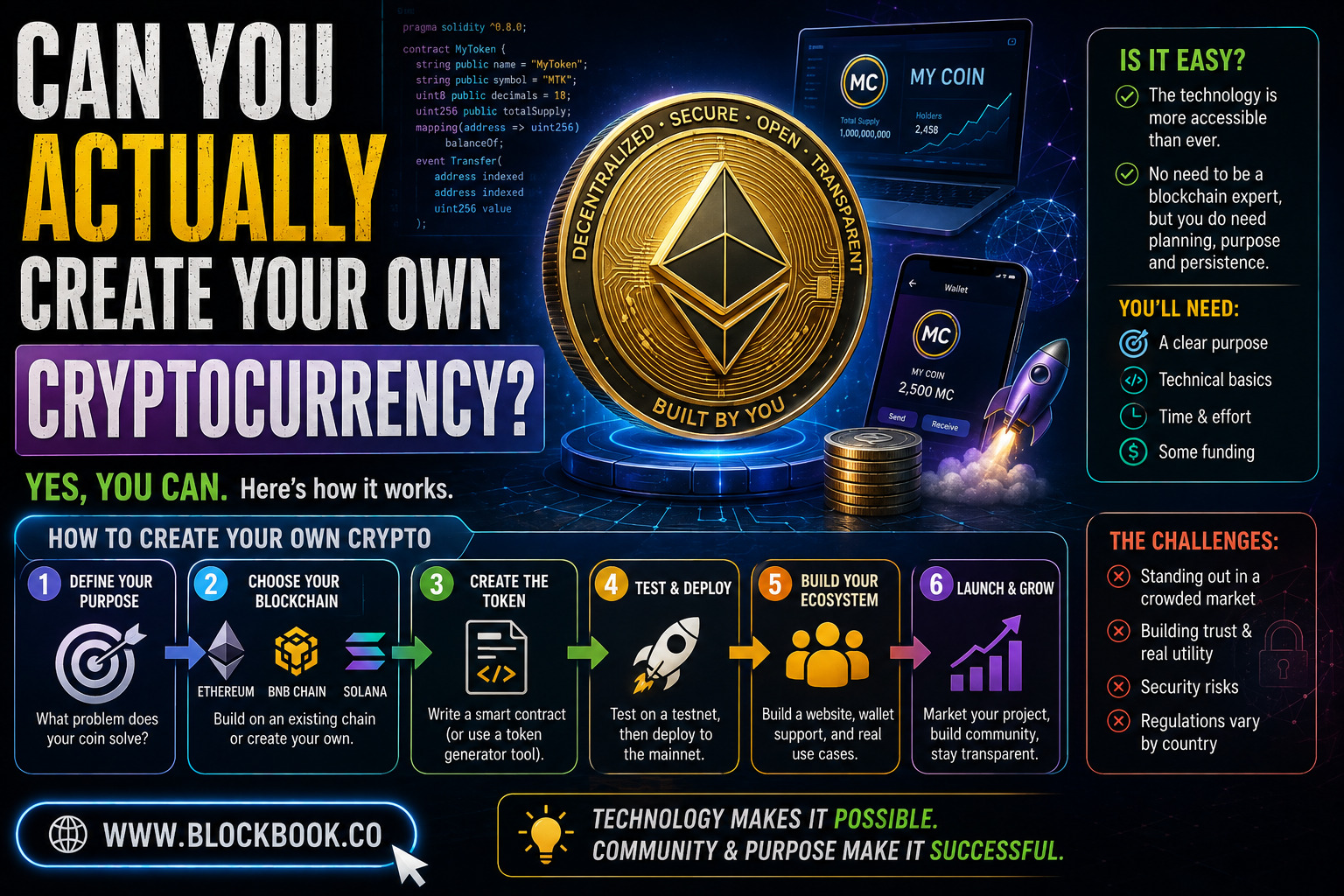
Technically, creating a token today is easier than it’s ever been. Platforms exist specifically to let someone launch a token in minutes without writing a single line of code. The catch isn’t creation, it’s everything that comes after: getting anyone to trust it, use it, or assign it real value.
There’s an important distinction worth understanding before going further: building a coin versus building a token.
A coin operates on its own independent blockchain, the way Bitcoin runs on the Bitcoin blockchain and Ether runs on Ethereum. Building a true coin means designing and launching an entire blockchain network from scratch, which requires real technical expertise in cryptography, distributed systems, and network security.
A token, on the other hand, is built on top of an existing blockchain, most commonly Ethereum, Solana, or BNB Chain, using that network’s existing infrastructure and security. This is dramatically simpler and is what the vast majority of new cryptocurrencies actually are.
How to create a token (the realistic path)
Several platforms let anyone generate a basic token by filling out a form: name, symbol, total supply, and a few optional features. The platform handles the underlying smart contract code automatically. This can take as little as 10 to 15 minutes and typically costs only the network’s transaction fee. This approach is genuinely accessible, but it also means the resulting token has zero built-in reason for anyone to value it. Creating it is the easy 5 percent of the work.
For more control, developers write their own smart contract, most commonly in a programming language called Solidity for Ethereum-based tokens. This lets a creator customize supply mechanics, transaction taxes, staking rewards, or other features that no-code platforms don’t offer. This path requires actual programming knowledge, or the budget to hire a developer who has it. It also introduces real risk: a poorly written smart contract can contain bugs that hackers exploit, and several well-funded projects have lost millions of dollars to exactly this kind of vulnerability.
Building an entirely new blockchain, rather than a token on an existing one, is a serious undertaking. It typically involves a team of experienced blockchain developers, a consensus mechanism (how the network agrees on transactions), security audits, and often years of development before launch. This path makes sense for projects with a genuine technical reason to need their own chain, not simply for the sake of having one.
The hard part nobody talks about enough
Nobody is required to believe your token has value, and most new tokens end up worth essentially nothing. A token also needs to be tradeable somewhere, which usually means providing initial funding into a trading pool yourself. Depending on how a token is marketed and sold, it may qualify as an unregistered security in certain jurisdictions too, which carries real regulatory risk. On the technical side, smart contract bugs and exploits have cost crypto projects billions of dollars collectively, and even experienced teams have shipped vulnerable code. And a real project needs continued development, community management, and communication, not just a one-time launch.
What actually makes a cryptocurrency worth something
Bitcoin has value because of a combination of factors: a fixed and provable supply, over fifteen years of continuous, secure operation, and broad recognition as the first and most established digital currency. Most tokens launched today have none of that history, which is exactly why the overwhelming majority lose most or all of their value within their first year.
A token backed by a genuine use case, real utility within an application, a governance function, or access to a specific service, has a meaningfully better chance of holding value than one created purely for speculation.
A realistic starting checklist
Decide whether you actually need a token, or whether the underlying idea would work better as a traditional business or app. Choose an existing blockchain to build on, rather than attempting to launch a new one as a first project. Define genuine utility, meaning a real reason someone would want to hold or use the token beyond price speculation. Get the smart contract audited by a reputable security firm before any real money is involved. And understand the legal requirements in your jurisdiction before marketing or selling the token to the public.
Frequently asked questions
How much does it cost to create a cryptocurrency?
A basic token through a no-code platform can cost as little as the network transaction fee, sometimes just a few dollars on cheaper blockchains. A custom smart contract with a professional security audit and a real development team can run into tens of thousands of dollars or more.
Do I need to know how to code to make a cryptocurrency?
Not for a basic token launched through a no-code platform. Custom features, and definitely launching an entirely new blockchain, require real programming and blockchain development expertise.
Is it legal to create your own cryptocurrency?
Creating a token is generally legal, but how it’s marketed, sold, and distributed can trigger securities regulations depending on the jurisdiction. It’s worth understanding local law, or consulting a professional, before selling any token to the public.
Can a cryptocurrency I create actually become valuable?
It’s possible but statistically rare. Most new tokens fail to gain meaningful adoption or value. Genuine utility, a real community, and consistent development are the closest things to a formula for a token surviving long term.
About the Author