FTX handled billions of dollars in daily trading volume and was backed by some of the biggest venture capital firms in the world. It collapsed within days in November 2022, and roughly one million customers were left waiting to find out whether they would ever see their funds again. If a platform that size could fail that fast, picking the right one matters more than most people realize.
Here is a practical breakdown of crypto exchanges, how they actually work, and what separates a platform likely to last from one that could disappear overnight.
What a Crypto Exchange Actually Does
A crypto exchange is a platform where people buy, sell, and trade cryptocurrency, usually converting traditional currency like dollars into Bitcoin, Ethereum, or other tokens. Behind the scenes, most exchanges also hold custody of user funds, meaning your crypto sits in the exchange’s wallets rather than your own until you withdraw it.
That custody arrangement is exactly what went wrong at FTX and several other collapsed platforms. Understanding it is the single most important thing when evaluating choosing a crypto exchange.
Centralized vs. Decentralized Exchanges
Centralized Exchanges (CEX)
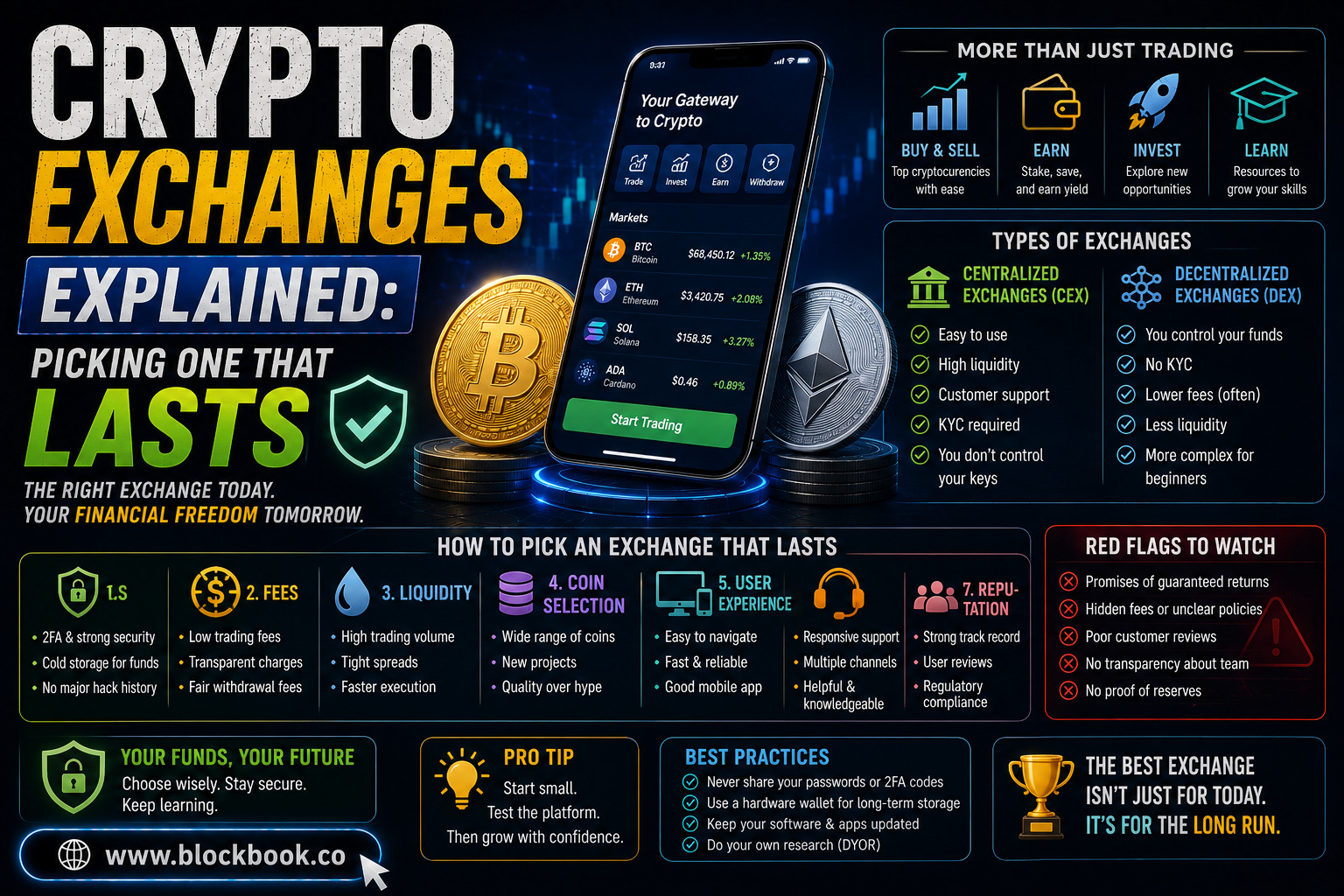
Centralized exchanges are run by a company, similar to a traditional brokerage. They handle identity verification, hold custody of funds, and typically offer the easiest experience for beginners, along with customer support if something goes wrong. Coinbase, Binance, and Kraken are examples of well-known centralized exchanges.
The tradeoff is trust. Users are relying entirely on that company to manage funds responsibly and not misuse customer deposits, which is precisely what failed at FTX.
Decentralized Exchanges (DEX)
Decentralized exchanges let users trade directly from their own wallets using smart contracts, with no company holding custody of funds at any point. Uniswap is one of the most widely used examples. This removes the risk of a company mismanaging customer deposits, but it shifts responsibility entirely onto the user, including security, transaction fees, and understanding how the interface works.
DEXs are generally considered safer from a custody standpoint but come with a steeper learning curve and less recourse if a user makes a mistake.
Red Flags That Suggest an Exchange Could Collapse
- Unclear or unverifiable proof of reserves. A trustworthy exchange can demonstrate, through independent audits, that it actually holds the assets it claims to on behalf of customers.
- Offering unusually high yields on deposits. Promises of guaranteed high returns on crypto held with the exchange were a warning sign at several platforms that later failed.
- No clear regulatory registration. Legitimate exchanges are typically registered with financial authorities in the countries where they operate.
- Opaque ownership or leadership. Difficulty finding basic information about who runs the company and how it is structured is a serious concern.
- A history of withdrawal delays or issues. Past problems getting funds out are one of the clearest practical warning signs available.
- Closely intertwined finances with a sister trading firm. This exact structure, an exchange informally sharing funds with a related trading company, was central to FTX’s collapse.
What a Trustworthy Exchange Actually Looks Like
- Regular, independently verified proof of reserves, showing customer assets are fully backed and not being used elsewhere.
- Clear regulatory licensing in the jurisdictions where it operates, rather than vague or unverifiable claims.
- Cold storage for the majority of funds, meaning assets are kept offline in secure storage rather than in wallets connected to the internet, which are more vulnerable to hacking.
- A long operating history without major security breaches, since a track record is one of the more reliable signals available.
- Transparent fee structures, without hidden costs buried in fine print.
- Responsive, real customer support, ideally with a documented history of resolving user issues.
How to Actually Evaluate an Exchange Before Signing Up
Check for Licensing and Regulation
Search for the exchange’s regulatory status in your country. In the United States, for example, legitimate exchanges typically register with FinCEN and may hold state-level money transmitter licenses. The absence of any regulatory footprint is a significant warning sign, not a neutral detail.
Look at Security Practices
A reputable exchange should clearly explain how it stores funds, generally a large majority in cold storage, and should offer two-factor authentication as a baseline security feature. Past security incidents are worth researching directly, since how an exchange responded to a breach often reveals more than the breach itself.
Read Independent Reviews, Not Just Marketing
Exchange marketing pages will always describe themselves as secure and trustworthy. Independent reviews, regulatory filings, and news coverage of past incidents provide a far more accurate picture than anything the platform says about itself.
Frequently Asked Questions
What is the safest type of crypto exchange to use?
There is no universally “safest” option, but centralized exchanges with verified proof of reserves, clear regulation, and a long operating history without major incidents are generally considered lower risk than newer, unregulated platforms.
Should I keep my crypto on an exchange or move it to a personal wallet?
For significant amounts, many experienced users move funds to a personal wallet they fully control, since exchange collapses like FTX demonstrated that funds held on a platform are only as safe as that platform’s management.
What is proof of reserves?
Proof of reserves is an independent verification, often through a cryptographic audit, showing that an exchange actually holds enough assets to cover what customers have deposited, rather than lending or using those funds elsewhere.
Are decentralized exchanges safer than centralized ones?
They remove the risk of a company mismanaging customer funds, since users retain control of their own assets throughout. However, they introduce different risks, including smart contract vulnerabilities and full personal responsibility for security, so “safer” depends on what kind of risk a user is trying to avoid.
About the Author