
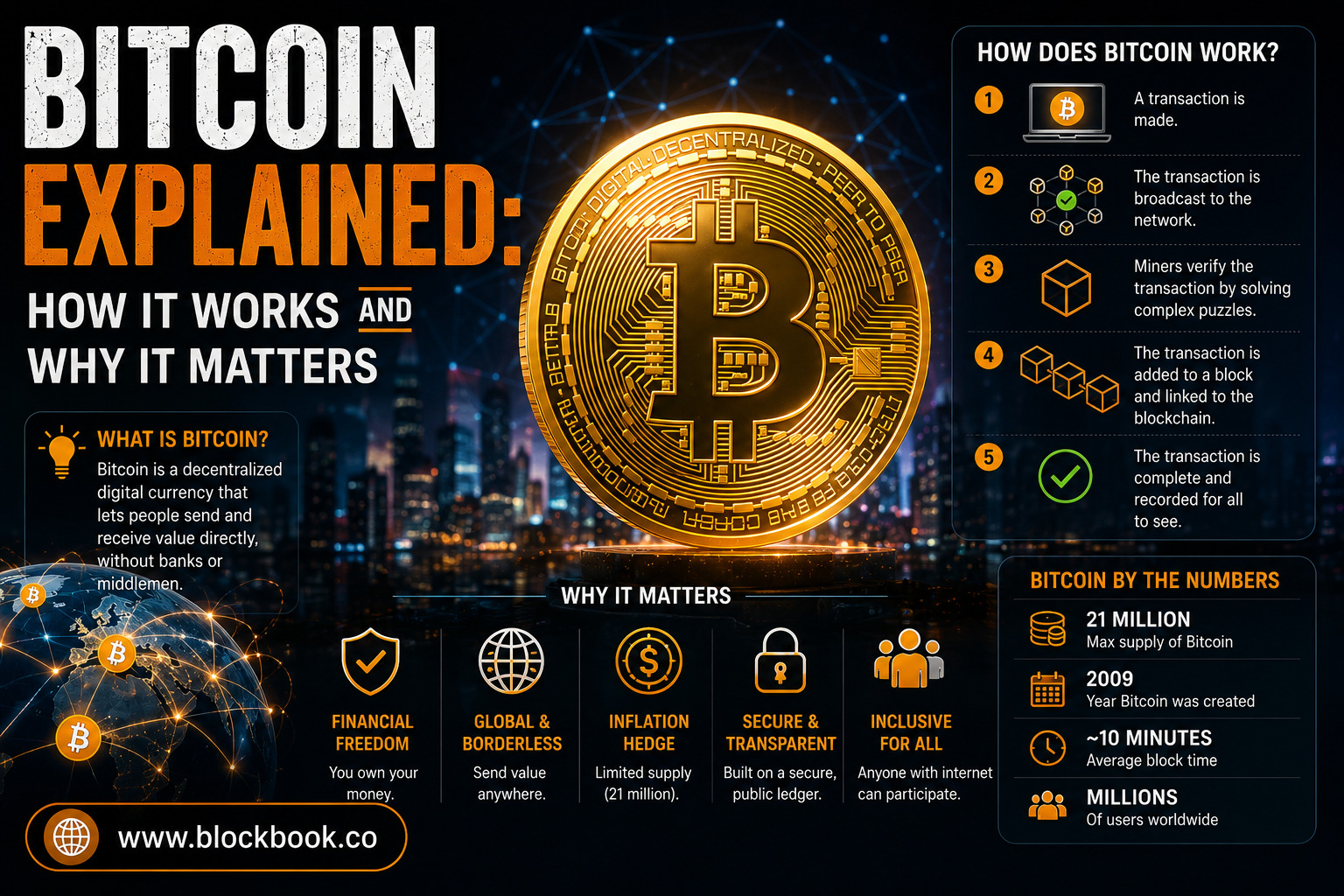
In January 2009, an anonymous creator mined the first fifty Bitcoin for a total value of essentially nothing. Today a single Bitcoin trades for tens of thousands of dollars, and the network processes hundreds of thousands of transactions a day without a bank, a government, or a company running the show. Understanding how Bitcoin works is the key to understanding why it has refused to go away.
What Bitcoin actually is
Bitcoin is a decentralized currency, which means no central bank, company, or government controls it. Instead, it runs on a network of thousands of computers around the world, all following the same set of rules written into open-source software.
That single fact explains almost everything unusual about Bitcoin. There’s no CEO to call, no headquarters to raid, and no “off switch.” The network keeps running as long as computers around the world keep participating in it, the same way the internet keeps running even though no single company owns it.
This is also why Bitcoin gets compared so often to gold. Both are scarce, both take real effort to produce, and both exist outside the direct control of any single government. The difference is that gold is dug out of the ground, and Bitcoin is mined with computing power.
How Bitcoin works under the hood
At its core, Bitcoin is a shared ledger called a blockchain. Every transaction ever made gets recorded on this ledger, and copies of it live on computers all over the planet instead of on one company’s server.
Picture a notebook that gets copied to ten thousand different people at once. Every time someone makes a new entry, all ten thousand copies update at the same time, and everyone can check that the new entry matches what everyone else recorded. That’s basically how the blockchain functions, just replace the notebook with cryptographically linked blocks of data. Each new “block” contains a batch of recent transactions, and it gets chained to the block before it using a cryptographic fingerprint. Change even one letter of old data and the fingerprint breaks, which is instantly obvious to the rest of the network. That’s what makes the blockchain so hard to tamper with after the fact.
New transactions don’t just appear on the blockchain automatically, they get added through a process called Bitcoin mining. Miners are computers competing to solve a difficult math puzzle, and whoever solves it first gets to add the next block and collect a reward in newly created Bitcoin, plus transaction fees.
This system is called proof of work, and it exists to prevent cheating. Solving the puzzle takes real electricity and real computing power, so faking a transaction or rewriting old records would require more computing muscle than the rest of the honest network combined. That’s an enormous and expensive ask, which is exactly the point.
The reward for mining a block gets cut in half roughly every four years, an event known as the halving. The most recent halving happened in April 2024, dropping the reward from 6.25 to 3.125 Bitcoin per block. This built-in scarcity is a big part of why Bitcoin behaves differently from currencies that governments can print more of whenever they choose.
Why Bitcoin has a hard cap of 21 million
Bitcoin’s code sets a maximum supply of 21 million coins, and no one can change that without convincing basically the entire network to agree to it, which has never happened and is unlikely to happen. As of 2026, more than 19.7 million Bitcoin have already been mined, leaving a shrinking pool of new coins to be released over the next century or so.
That fixed supply is the whole reason people call Bitcoin “digital gold.” Compare it to the US dollar, where the Federal Reserve can and does expand the money supply when it wants to stimulate the economy. Bitcoin can’t do that. Whatever the current supply is, the future supply is already mathematically predictable down to the exact block.
To put the scarcity in perspective: only 21 million Bitcoin will ever exist, roughly 19.7 million have already been mined as of 2026, the last Bitcoin isn’t projected to be mined until around the year 2140, and mining rewards keep cutting in half approximately every four years until then.
Why Bitcoin still matters in 2026
Skeptics have declared Bitcoin dead more times than anyone can count, yet it keeps showing up in headlines, portfolios, and now spot ETFs held by major asset managers. There are a few real reasons it has stuck around instead of fading out like so many internet-era experiments.
In countries dealing with runaway inflation, Bitcoin has become a genuine lifeline rather than a speculative bet. People in Argentina, Turkey, and Nigeria have turned to Bitcoin and other cryptocurrencies as their local currencies lost value fast, because a decentralized currency doesn’t care about a national central bank’s decisions.
Roughly 1.4 billion adults worldwide still don’t have access to a traditional bank account, according to World Bank estimates. All any of them need to use Bitcoin is an internet connection and a smartphone, a much lower bar than opening a bank account in a region with limited financial infrastructure.
And since spot Bitcoin ETFs launched in the US in early 2024, pension funds, hedge funds, and wealth managers have gained an easy, regulated way to hold Bitcoin exposure without managing a digital wallet themselves. That shift has pulled Bitcoin further into mainstream finance than it has ever been before.
Common misunderstandings about Bitcoin
A lot of confusion around Bitcoin comes from people mixing it up with the thousands of other cryptocurrencies that exist. Bitcoin is not the same as Ethereum, Dogecoin, or any random altcoin, even though headlines often lump them all together under the same “crypto” umbrella.
Bitcoin also isn’t anonymous, even though people sometimes assume it is. Every transaction is publicly recorded on the blockchain forever, so it’s more accurate to call it pseudonymous. Investigators have used blockchain analysis to trace and prosecute plenty of criminals who assumed Bitcoin was untraceable.
And Bitcoin mining isn’t quite the environmental disaster some headlines suggest either. Estimates on energy use vary, and this is genuinely a contested topic worth researching further, but a growing share of mining now runs on renewable or otherwise underutilized energy sources, including flared natural gas that would have been burned off anyway.
Frequently asked questions
How does Bitcoin actually work in simple terms?
Bitcoin runs on a public ledger called a blockchain, maintained by thousands of computers worldwide instead of one central authority, with new transactions verified and added through a competitive process called mining.
Is Bitcoin mining still profitable in 2026?
It depends heavily on electricity costs and the price of specialized mining hardware, since mining rewards keep shrinking every four years through the halving process while competition for those rewards keeps growing.
Can Bitcoin be hacked?
The Bitcoin network itself has never been successfully hacked since its 2009 launch, though individual exchanges, wallets, and users have been hacked or scammed many times, which is a different vulnerability entirely.
Why is Bitcoin called a decentralized currency?
Because no single company, bank, or government controls it, transactions are instead verified by a distributed network of independent computers all following the same open-source rules.
About the Author