Blockchain technology has developed far beyond the idea of a single network processing every transaction. Today, hundreds of blockchain networks serve different purposes, from decentralized finance and gaming to digital identity, payments and asset management. Yet this growth has created another challenge: many blockchains operate as separate ecosystems, making communication and asset movement between them more complicated than users expect.
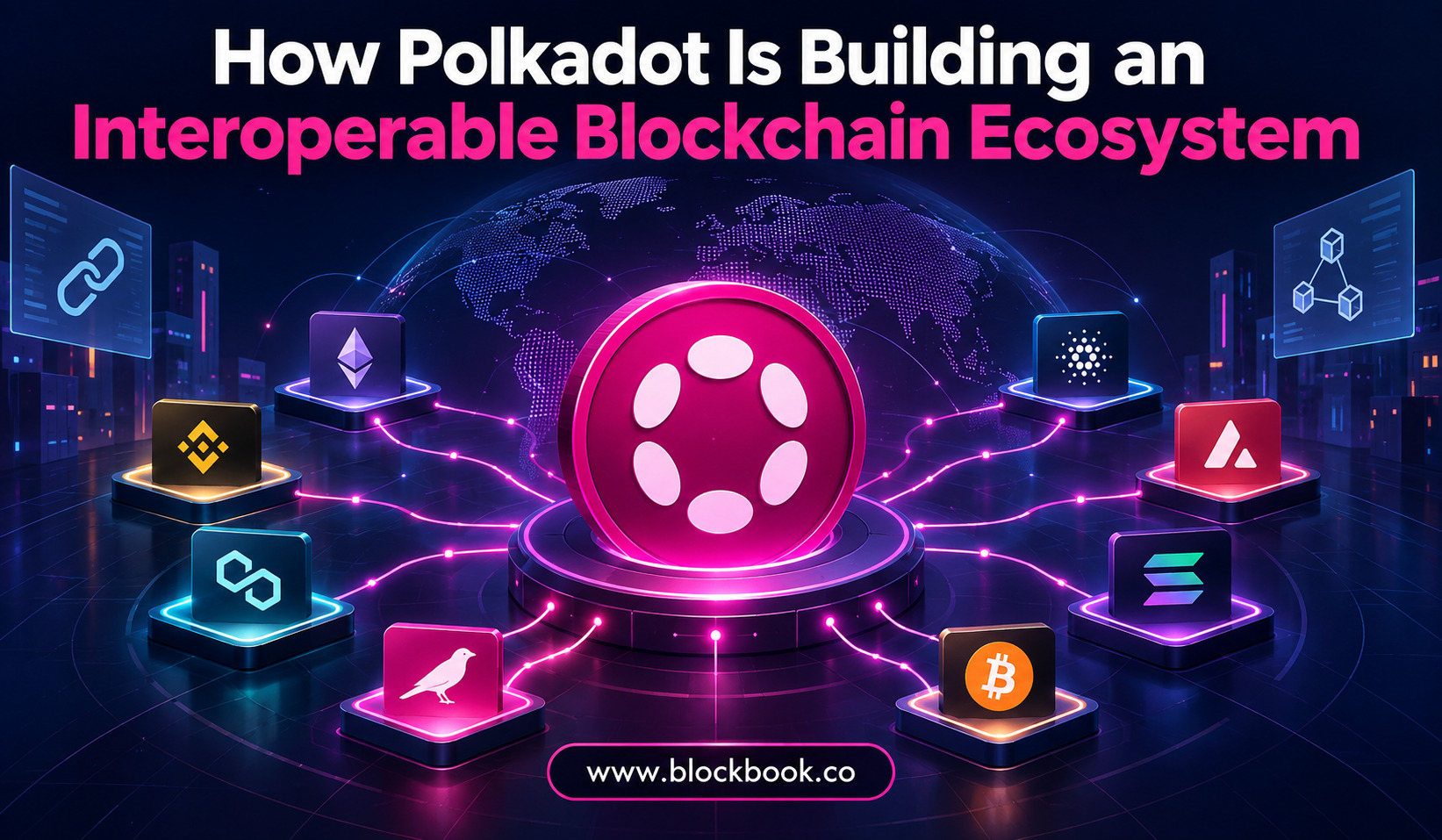
Polkadot is designed around a different approach. Instead of trying to make one blockchain handle every application, the network is built to connect multiple specialized chains and applications through shared infrastructure, security and cross-chain communication. This interoperability-focused architecture is intended to allow different blockchain environments to work together while maintaining their own specialized functions.
The Polkadot ecosystem has also been evolving. Its original parachain model is being expanded through developments commonly associated with Polkadot 2.0, including Agile Coretime, asynchronous backing and elastic scaling. At the same time, technologies such as Cross-Consensus Message Format, or XCM, provide a common way for different consensus systems to communicate.
Why Blockchain Interoperability Matters
The blockchain industry has traditionally developed around individual networks. Ethereum, Bitcoin and other Layer 1 platforms have their own architectures, applications, tokens and communities. While specialization can encourage innovation, it can also create isolated environments.
For users, this fragmentation can mean additional steps when moving assets or interacting with applications on different networks. Developers can face similar challenges because an application designed for one blockchain may not automatically communicate with another.
Interoperability attempts to solve this problem by creating mechanisms through which independent blockchain systems can exchange information or trigger actions. Instead of treating every blockchain as a completely separate island, interoperability creates connections between ecosystems.
Polkadot approaches this challenge at the infrastructure level. Its architecture separates responsibilities between a central coordination layer and specialized chains or applications. The relay chain provides core functions such as validator coordination, block production, data availability and shared security, while parachains can focus on their own specific use cases.
This structure allows developers to build specialized blockchain environments without necessarily having to create an entirely independent security system from scratch.
How Polkadot’s Multichain Architecture Works
One of the defining concepts in Polkadot is the parachain. A parachain is an application-specific chain or data structure that operates in parallel with other chains and can be validated through Polkadot’s validator infrastructure. Different parachains can therefore be designed for different applications while participating in the broader Polkadot ecosystem.
The important point is that these chains do not have to perform identical tasks. A network could focus on decentralized finance, another could concentrate on gaming, while another could specialize in assets, identity or other applications.
The relay chain provides the coordination and security layer connecting these environments. This creates a system in which specialization and interoperability can coexist rather than requiring every application to use exactly the same blockchain architecture.
Polkadot’s current architecture has also moved away from the original model in which parachains obtained long-term access to network resources through slot auctions. Agile Coretime instead allows computing resources to be allocated according to demand. The network documentation describes both bulk and on-demand approaches to purchasing coretime.
This change is important for interoperability because access to shared infrastructure becomes more flexible. Smaller projects do not necessarily need the same long-term resource commitment as a large application with continuous demand.
XCM: A Common Language for Blockchain Communication
Technology alone does not create interoperability. Different blockchain systems need a way to communicate instructions and understand what those instructions mean. This is where Polkadot’s Cross-Consensus Message Format, known as XCM, becomes important.
XCM is a messaging format designed for communication between consensus systems. It allows one system to express instructions that another participating system can interpret. Although XCM is closely associated with Polkadot’s parachains, its design is intended to be more general and can be used across different types of consensus systems.
This distinction is important. XCM is not simply a conventional bridge or a single network transport protocol. It defines the meaning and structure of messages, while different transport mechanisms can be used to deliver those messages.
For example, a cross-chain interaction could involve an asset being moved from one environment to another or an application requesting an action on a separate chain. XCM provides the language for describing the intended interaction.
The broader goal is to make blockchain communication more programmable. Rather than limiting interoperability to basic token transfers, cross-consensus messaging can support more complex interactions between applications.
Key elements supporting Polkadot’s interoperability include:
- Parachains and rollups that specialize in different applications while connecting to Polkadot’s infrastructure.
- XCM for expressing cross-consensus instructions and interactions.
- Shared security that allows connected chains to benefit from Polkadot’s validator network.
- Bridges and external interoperability technologies for connecting systems outside Polkadot’s shared-security environment.
Shared Security as an Interoperability Foundation
Interoperability becomes more useful when communication between networks does not require every application to independently establish trust relationships.
Polkadot’s model combines interoperability with shared security. Connected parachains can use Polkadot’s validator infrastructure rather than independently creating a complete validator security system.
This can be particularly relevant for newer blockchain projects. Establishing a secure network from the beginning can require significant economic resources, validator participation and technical infrastructure. Polkadot’s architecture attempts to separate application-specific functionality from the underlying security and coordination mechanisms.
The result is a model where a specialized chain can concentrate more heavily on its application while relying on the wider network for certain foundational functions.
Polkadot’s documentation describes the relay chain as deliberately minimal, with major responsibilities including block production, core scheduling, data availability and shared security. Other functionality can be handled by system chains and specialized chains, allowing the architecture to make greater use of parallel execution.
Polkadot 2.0 and More Flexible Computing
Interoperability is only one part of Polkadot’s development. The network is also changing how applications access computing resources.
Polkadot 2.0 introduces a model based around virtual cores and flexible coretime allocation. Instead of treating a computing core as something permanently assigned to one chain, resources can be allocated, split or used according to application requirements.
Asynchronous backing is intended to improve the efficiency of block production, while elastic scaling allows an application to use multiple cores simultaneously when additional capacity is required. Together with Agile Coretime, these changes are intended to make the network more flexible for different workloads.
This is relevant to interoperability because a multichain ecosystem needs more than communication channels. It also needs infrastructure capable of supporting different applications at different levels of demand.
A gaming application, for example, may experience periods of significantly higher activity than normal. A financial application could have different computational requirements. Flexible resource allocation gives developers more options than a fixed model in which every application receives exactly the same amount of network capacity.
| Feature | Role in the Polkadot ecosystem |
| Parachains | Specialized environments running in parallel |
| Relay Chain | Coordination, validation and shared security |
| XCM | Common format for cross-consensus communication |
| Agile Coretime | Flexible access to computing resources |
| Elastic Scaling | Ability to use multiple cores for higher workloads |
| Bridges | Connections with networks outside Polkadot’s shared-security environment |
Connecting Beyond the Polkadot Ecosystem
Polkadot’s interoperability ambitions are not limited to communication between its own parachains. External blockchain networks require different mechanisms because they do not automatically share Polkadot’s security model.
Bridges can provide connections between Polkadot and external blockchain ecosystems. Polkadot documentation distinguishes this situation from communication between parachains, where shared security and XCM provide the underlying framework.
This creates another layer of interoperability. Within the Polkadot environment, chains can communicate using common infrastructure. Outside that environment, bridges and other interoperability systems can connect separate consensus domains.
The technical challenge is significant because external networks may use different consensus rules, transaction models and security assumptions. Interoperability therefore has to account for differences rather than simply assume that every blockchain works in the same way.
From Chain-Centric to Application-Centric Development
Another important part of Polkadot’s evolution is a gradual shift from thinking exclusively about individual blockchains toward thinking about applications and computing services.
The Polkadot ecosystem’s own documentation describes this direction as a move from chain-centricity toward application-centricity. Under this model, blockchains remain important, but they become one possible way of delivering applications and services.
This could expand the range of developers that use Polkadot’s infrastructure. Instead of requiring every project to launch a conventional blockchain, the broader architecture can support different forms of computation and services.
The proposed JAM architecture represents a further stage in this evolution. JAM, short for Join-Accumulate Machine, is described by Polkadot documentation as a potential evolution of the relay chain. It is designed around a more generalized computational model rather than being limited to the current parachain-centered structure.
Importantly, JAM is a future-oriented development rather than a completed replacement that should be treated as already deployed. Its progression depends on Polkadot’s governance process and technical development.
What Interoperability Could Mean for Developers and Users
For developers, a connected blockchain ecosystem can reduce the need to build every feature independently. Applications may be able to use services, assets and functionality available elsewhere in the ecosystem.
For users, interoperability can eventually make blockchain applications feel less fragmented. Instead of thinking about which blockchain holds a particular asset or service, users may increasingly interact with applications while the underlying infrastructure handles cross-chain operations.
There are still technical and practical challenges. Cross-chain systems have to handle security, message execution, asset representation, fees, compatibility and user experience. Interoperability also increases the number of components that need to work correctly.
Polkadot’s development therefore focuses not simply on connecting chains, but on creating standardized communication and shared infrastructure that can support increasingly complex interactions.
The Road Ahead for Polkadot
Polkadot’s interoperability strategy is built around several connected ideas rather than a single technology. Parachains provide specialization, the relay chain coordinates shared security, XCM establishes a common communication format, and newer developments such as Agile Coretime and elastic scaling aim to make network resources more flexible.
The network’s longer-term direction could become even more generalized through JAM and other developments. According to Polkadot’s documentation, JAM is intended to maintain compatibility with existing Polkadot concepts while creating a more flexible environment for different services and computational workloads.
Whether this architecture becomes a major foundation for future Web3 applications will depend on adoption, developer activity, technical execution and the ability of applications to provide useful experiences to users.
For now, Polkadot represents one of the more ambitious approaches to the interoperability problem: rather than forcing every blockchain to become identical, it attempts to create infrastructure through which specialized networks can remain different while still communicating with one another.
Conclusion
Polkadot is building its interoperability strategy around a multichain architecture in which different applications can specialize without becoming completely isolated. Its parachain model, shared security, XCM messaging system and flexible coretime approach are designed to create a connected environment for blockchain applications.
As the ecosystem develops toward more generalized computing through initiatives such as Polkadot 2.0 and JAM, the definition of interoperability may expand beyond simple communication between chains. The larger objective is an environment where different forms of decentralized computation can work together through common infrastructure.
The success of this approach will ultimately depend on real-world adoption and the applications built on top of it. But the technical direction is clear: Polkadot is attempting to make interoperability a foundational part of blockchain infrastructure rather than an additional feature added after individual networks are built.
FAQs
What is Polkadot’s main purpose?
Polkadot is designed to provide secure, resilient computation and interoperability for applications and connected blockchain environments. Its architecture allows specialized chains to operate in parallel while using shared infrastructure.
What is XCM in Polkadot?
XCM stands for Cross-Consensus Message Format. It is a messaging format and language that allows different consensus systems to express and interpret cross-system instructions.
Are parachains separate blockchains?
Parachains are application-specific structures that operate in parallel and can be validated by Polkadot’s validator infrastructure. Many take the form of blockchains, although the architecture does not require every parachain to be a conventional blockchain.
What is Agile Coretime?
Agile Coretime is a mechanism for allocating Polkadot’s computing resources more flexibly. It replaces the previous emphasis on long-term parachain slot auctions with options including bulk and on-demand coretime.
Is JAM already replacing Polkadot’s current architecture?
No. JAM is described as a potential evolution of the relay chain and remains a development direction subject to technical work and Polkadot’s decentralized governance process.
About the Author