
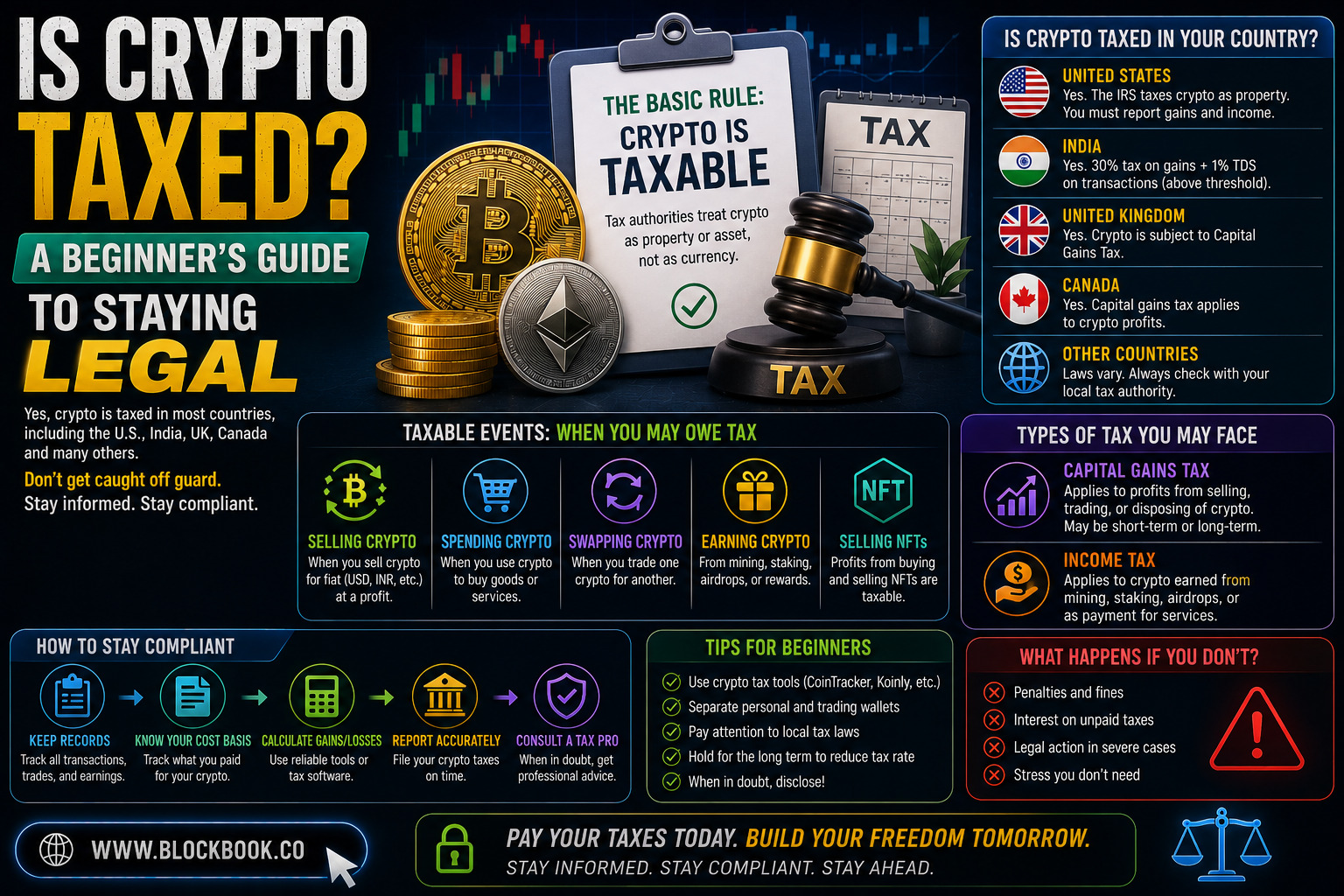
US crypto exchanges now have to send your transaction history straight to the IRS. The old idea that crypto was some untraceable gray area is done. If you’re wondering whether crypto is taxed, yes, almost always, and the IRS now sees your trading activity about as clearly as it sees your stock brokerage account.
This guide uses US rules as the main example, since they’re the most detailed and well documented. If you’re elsewhere, the core ideas still apply, but check your own tax authority’s guidance, because the specifics vary a lot by country.
One note before we start: this is general information, not personalized tax or legal advice. If your crypto activity is anything beyond simple, talk to a qualified tax professional.
Why crypto gets taxed this way
The IRS treats cryptocurrency as property, not currency. That classification has been in place since 2014, and it decides almost everything else about how your crypto gets taxed.
Because crypto is property, it follows the same basic tax logic as stocks or real estate. Selling it, trading it for another crypto, or spending it on something all count as a “disposal,” and disposals can trigger capital gains tax. That’s different from spending regular dollars, which isn’t a taxable event at all.
When crypto actually triggers a tax event
A lot of beginners assume taxes only kick in when you cash out to dollars. That’s wrong, and it’s one of the most common mistakes people make. These situations generally trigger a taxable event:
- Selling crypto for regular currency, like converting Bitcoin to dollars
- Trading one crypto for another, like swapping Ethereum for Solana, even without touching fiat
- Spending crypto on goods or services, since that counts as disposing of property
- Earning crypto through mining, staking rewards, or airdrops, taxed as ordinary income when you receive it
- Getting paid in crypto for work, treated like any other income
What doesn’t trigger a taxable event: buying crypto with dollars and holding it, or moving your own crypto between your own wallets. Neither of those counts as a disposal.
Capital gains: short-term vs. long-term
Once you know that selling or trading crypto is a taxable disposal, the next question is how much you owe. That depends on how long you held the asset first.
If you held it for a year or less before selling or trading, the profit is a short-term capital gain, taxed at your ordinary income rate, anywhere from 10% to 37% depending on your bracket.
Hold the same asset for more than a year, and the profit qualifies for long-term capital gains treatment instead: 0%, 15%, or 20%, depending on your income and filing status. It’s a real incentive built into the tax code for holding rather than trading frequently.
How mining and staking income gets taxed
Mining rewards, staking rewards, and airdrops work differently from a simple buy-and-sell trade, and beginners often miss this.
When you earn crypto through mining or staking, it counts as ordinary income at its fair market value the moment you receive it, whether you sell it right away or hold it. Earn a staking reward worth $1,000, and you owe income tax on that $1,000.
If you later sell those tokens, that’s a separate taxable event. Your cost basis is whatever the tokens were worth when you received them as income, and any gain or loss since then gets taxed under normal capital gains rules.
What you actually need to report
For a typical US filer, reporting crypto activity involves a few forms:
- Form 8949 records each disposal: date acquired, date sold, cost basis, proceeds, and gain or loss
- Schedule D totals up the numbers from Form 8949
- Schedule 1 or Schedule C covers income from mining, staking, or crypto received as payment, depending on whether it counts as a business
- Form 1040’s digital asset question has to be answered by every filer, no matter how small the activity
Starting in 2026, centralized US exchanges have to issue Form 1099-DA to both you and the IRS, reporting your gains and losses the way a stock brokerage does. That closes a lot of the old reporting gray area, but it also means any mismatch between the broker’s numbers and your own records is worth catching early.
Common mistakes beginners make
- Assuming crypto-to-crypto trades aren’t taxable. They are. Swapping one token for another is a disposal, same as selling for cash.
- Forgetting about gas fees. Paying network fees in crypto is technically its own small disposal, and while the amounts are usually minor, ignoring them throws off your cost basis over time.
- Not tracking cost basis across platforms. Move assets between exchanges, wallets, and DeFi protocols, and reconstructing accurate cost basis later gets genuinely hard.
- Ignoring small transactions. A small airdrop or a few dollars of staking rewards is technically reportable income, even if no tax form ever shows up for it.
- Assuming losses don’t matter. Selling at a loss can offset other capital gains, and within limits, ordinary income too, so track losses as carefully as gains.
Record-keeping that saves you headaches
- Download full transaction history CSV exports from every exchange and platform, ideally on a regular schedule rather than at tax time
- Log cost basis for every asset, including acquisition date, since holding period determines your rate
- Keep income events, like staking rewards, separate from capital gains events, like selling those same tokens later
- Keep records for at least three years, which is what the IRS generally expects, though some situations extend that window further
FAQ
Do I owe taxes if I just buy and hold crypto?
No. Buying and holding doesn’t trigger a taxable event. Taxes generally apply when you sell, trade, spend, or earn crypto, not when you sit on it.
Is trading one cryptocurrency for another taxable?
Yes. Swapping one crypto for another is a disposal of property, even with no fiat involved, and any gain or loss has to be reported.
How is crypto from mining or staking taxed?
As ordinary income, based on fair market value when you receive it. Sell those tokens later, and that’s a separate transaction under capital gains rules.
About the Author