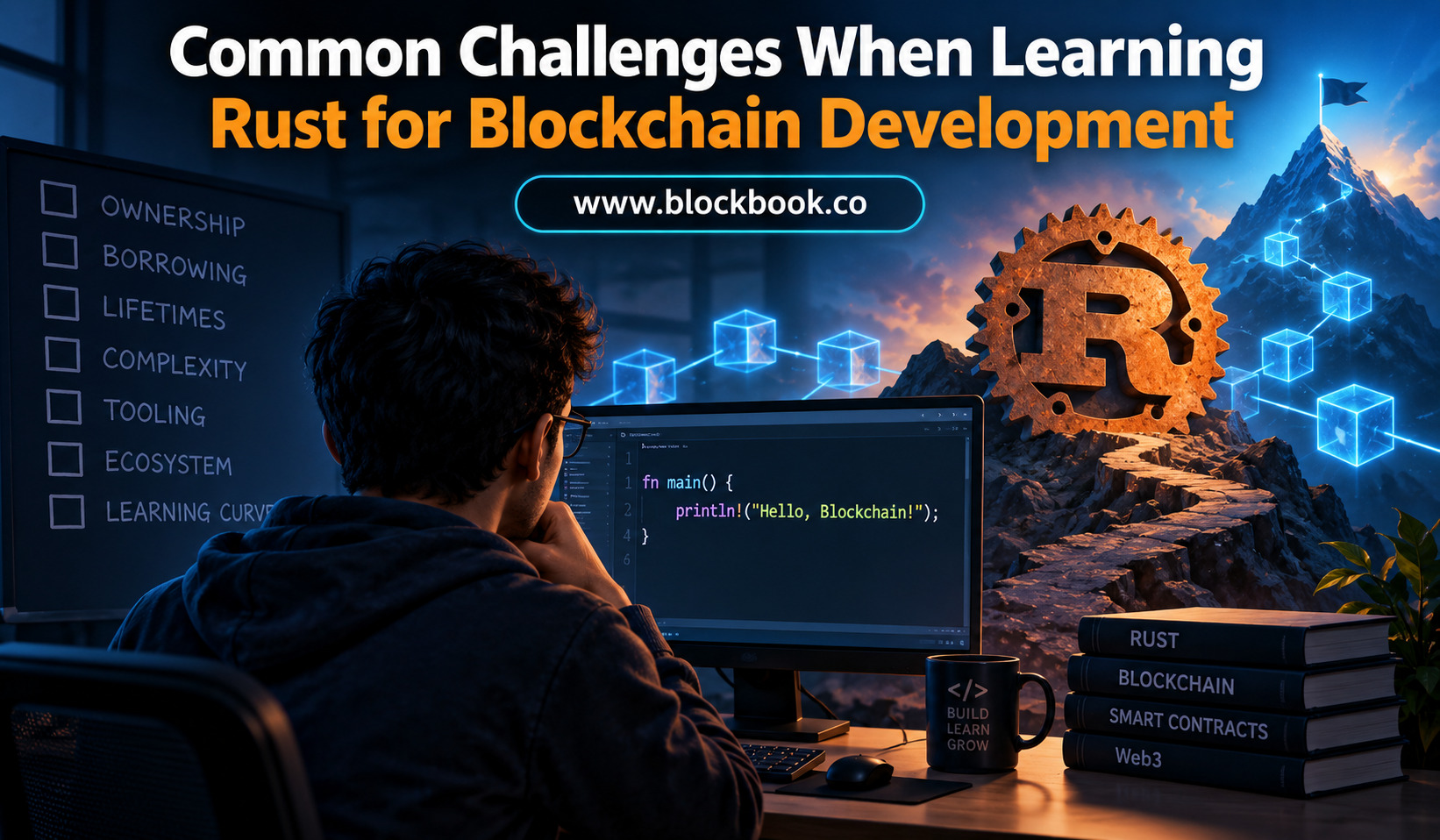
Rust has become an increasingly important programming language in the blockchain and Web3 development landscape. Its focus on performance, memory safety, and efficient resource management has attracted developers working on blockchain infrastructure, smart contracts, decentralized applications, and high-performance backend systems.
However, learning Rust for blockchain development can be more demanding than learning the language for general software development. Beginners are required to understand Rust’s programming model while also becoming familiar with blockchain concepts such as transactions, accounts, wallets, consensus, smart contracts, cryptography, and decentralized networks.
This combination can create a steep learning curve. Developers who understand the most common challenges before starting can build a more realistic learning plan and avoid becoming discouraged during the early stages.
Why Developers Are Learning Rust for Blockchain
Rust’s growing presence in Web3 is connected to its technical characteristics. The language provides memory-safety guarantees through its ownership and borrowing system while still allowing developers to build performance-oriented software.
These features are particularly relevant to blockchain infrastructure. A blockchain network may need to process transactions, communicate with multiple nodes, maintain state, and perform computationally intensive operations. Efficient software can help reduce resource consumption and support reliable execution.
Rust is also used across different blockchain ecosystems. Developers can encounter it in blockchain clients, infrastructure projects, smart-contract environments, development frameworks, and supporting tools.
However, the same features that make Rust attractive can make it challenging for beginners.
The Ownership and Borrowing System
The first major challenge for many new Rust developers is understanding ownership and borrowing. Developers coming from JavaScript, Python, or other garbage-collected languages may be accustomed to letting the runtime manage memory automatically.
Rust takes a different approach. Every value has an owner, and the language uses rules governing how values are moved, borrowed, and modified. The compiler checks these rules before the program runs.
At first, these concepts can appear restrictive. A beginner may write code that seems logically correct but receive compiler errors because a value has been moved, borrowed incorrectly, or accessed in a way that violates Rust’s rules.
For blockchain developers, learning this system is especially important because blockchain software often works with structured data, state, transactions, and account information. Once ownership and borrowing become familiar, they can help developers reason more clearly about how data moves through a program.
Understanding Lifetimes
Lifetimes are another Rust concept that can cause difficulty. They describe how long references remain valid and allow the compiler to verify that references do not outlive the data they point to.
Beginners sometimes encounter lifetime-related compiler messages before fully understanding why they occur. This can make early Rust projects feel more complicated than expected.
Blockchain development can add to this difficulty because developers may work with multiple data structures and references at the same time. Rather than trying to memorize lifetime syntax, new developers generally benefit from first understanding ownership and borrowing. Lifetimes become easier to understand when they are viewed as a consequence of Rust’s reference-safety model.
Learning the Rust Compiler
Rust’s compiler is an important part of the development experience. Instead of allowing many questionable patterns to reach runtime, Rust attempts to identify problems during compilation.
For beginners, frequent compiler errors can initially feel like an obstacle. In practice, compiler feedback is an important part of learning Rust. Developers gradually learn to interpret the error messages and modify their code accordingly.
A useful learning process involves:
- Reading the complete compiler message instead of focusing only on the final error line.
- Understanding why the compiler rejected the code.
- Making small changes and compiling again.
- Using compiler feedback as part of the development process.
This approach can take time, but it can eventually make Rust development more systematic.
Blockchain Concepts Add Another Learning Layer
Learning Rust is only one part of becoming a blockchain developer. Developers also need to understand how decentralized networks work.
Someone entering blockchain development may need to learn concepts such as blocks, transactions, wallets, public and private keys, digital signatures, consensus mechanisms, nodes, smart contracts, tokens, and blockchain state.
These concepts can be confusing when introduced simultaneously with a new programming language.
For example, a developer may understand how to write a Rust function but still not know how that function interacts with a blockchain transaction. Similarly, understanding Rust data structures does not automatically explain how blockchain accounts or contract storage work.
A better approach is to learn programming concepts and blockchain architecture progressively rather than attempting to master everything at once.
Understanding Blockchain-Specific Rust Frameworks
Rust blockchain development often involves specialized frameworks and libraries. These tools can simplify development, but they also introduce additional concepts.
For example, developers working with Solana may encounter frameworks such as Anchor. Other blockchain ecosystems have their own libraries, SDKs, APIs, and development environments.
Frameworks can make development easier by providing abstractions around repetitive tasks. However, beginners who rely entirely on abstractions without understanding the underlying blockchain model may struggle when something behaves unexpectedly.
It is therefore useful to understand the basic blockchain architecture before becoming heavily dependent on framework-specific features.
Managing Dependencies and Cargo
Rust projects commonly use Cargo for package management, compilation, testing, and dependency handling. Cargo is a central part of the Rust development workflow.
For beginners, dependency files and version compatibility can initially seem confusing. Blockchain projects can also have multiple dependencies that interact with specific versions of a framework, SDK, or blockchain client.
| Learning Area | Common Beginner Challenge | Useful Focus |
| Rust ownership | Understanding moves and borrowing | Practice small programs |
| Lifetimes | Understanding reference validity | Learn after ownership basics |
| Cargo | Managing packages and versions | Build small projects |
| Blockchain | Understanding decentralized execution | Study core concepts |
| Smart contracts | Handling state and transactions | Start with simple examples |
| Security | Identifying vulnerabilities | Study secure development practices |
Dependency management becomes particularly important as projects grow. Developers should understand what libraries their application uses and why those dependencies are required.
Difficulty With Smart-Contract Security
Blockchain programming introduces security concerns that are different from many conventional applications. A software bug can potentially affect assets, transactions, permissions, or blockchain state.
Rust’s memory-safety features can prevent certain classes of programming errors, but they do not automatically make a blockchain application secure.
Developers still need to understand authorization, input validation, state management, cryptographic assumptions, external interactions, and application-specific logic.
Some important security habits include:
- Test programs extensively before deployment.
- Validate inputs and permissions carefully.
- Understand the security model of the target blockchain.
- Review dependencies and third-party libraries.
- Study documented vulnerabilities and security practices.
Security learning should happen alongside programming rather than being treated as a final step.
Debugging Blockchain Applications
Debugging is another challenge for new blockchain developers. Traditional applications can often be run locally with predictable inputs. Blockchain applications introduce additional variables.
Transactions can fail because of incorrect account information, insufficient resources, invalid instructions, network conditions, or application logic. Developers may need to inspect logs and transaction information to determine what went wrong.
This requires a different debugging mindset. Instead of looking only at the source code, developers need to understand what happened across the application’s execution environment.
Working on small local projects can make this process easier. Developers can intentionally create simple failures and learn how the blockchain reports them.
Performance Optimization Can Be Complex
Rust is known for performance, but writing efficient Rust code requires understanding how programs use memory and computing resources.
Blockchain environments can add their own limitations. Depending on the platform, developers may need to optimize computational operations, storage access, transaction size, or other resource usage.
A beginner should not attempt to optimize everything immediately. First, the goal should be producing correct and understandable code. Performance improvements become more meaningful after the developer understands where actual bottlenecks occur.
This is particularly important because premature optimization can make code harder to maintain without delivering a meaningful performance improvement.
The Documentation and Ecosystem Learning Curve
Rust itself has extensive documentation, but blockchain development adds another layer of documentation. Developers may need to consult Rust documentation alongside blockchain-specific guides, SDK references, framework documentation, and API information.
Documentation can sometimes become difficult to follow when different versions of a framework or library use different APIs.
Beginners can reduce confusion by choosing one blockchain ecosystem and following its current documentation rather than jumping between multiple tutorials written for different versions.
Choosing the Right Learning Path
One of the most common challenges is trying to learn too many technologies simultaneously. A beginner may attempt Rust, Solidity, JavaScript, multiple blockchain networks, smart contracts, DeFi, and cryptography at the same time.
A focused approach is generally easier to manage. Developers can first build a foundation in Rust, then learn the architecture of their selected blockchain, and finally combine the two through small projects.
A practical progression could involve:
- Learning basic Rust syntax and data structures.
- Practicing ownership, borrowing, error handling, and modules.
- Building small command-line or backend applications.
- Studying the target blockchain’s architecture.
- Creating simple blockchain programs before attempting complex applications.
This approach allows each new concept to build on an existing foundation.
Rust Learning Challenges Can Become Long-Term Skills
Although Rust can be difficult initially, many of the concepts developers learn can become valuable beyond blockchain. Ownership, memory management, concurrency, error handling, and performance optimization are useful concepts across software engineering.
Blockchain development also introduces developers to distributed systems and security-oriented programming. Together, these skills can create a broader technical foundation.
The important point is that learning Rust for blockchain should not be viewed as a race. Developers do not need to understand every advanced feature before creating their first useful project.
Conclusion
Learning Rust for blockchain development can be challenging because developers are learning two technical disciplines at the same time. Rust introduces ownership, borrowing, lifetimes, strict compile-time checks, and detailed resource management. Blockchain adds concepts such as transactions, accounts, smart contracts, cryptography, decentralized networks, and security.
The initial learning curve can be reduced through a focused approach. Beginners should first establish a strong Rust foundation, then study one blockchain ecosystem and gradually build practical projects.
Rust’s complexity is closely connected to the level of control it provides developers. By learning the language step by step and understanding why its rules exist, developers can move from simply fixing compiler errors to designing more reliable and efficient blockchain software.
As blockchain ecosystems continue to develop, Rust remains an important skill for developers interested in performance-focused Web3 applications and infrastructure. The learning process may require patience, but the underlying programming knowledge can extend well beyond blockchain development.
Frequently Asked Questions
1. Why is Rust difficult for blockchain beginners?
Rust has concepts such as ownership, borrowing, lifetimes, and strict compile-time checks that may be unfamiliar to developers coming from higher-level languages. Blockchain development adds another layer of technical concepts.
2. Do I need to know Rust before learning blockchain development?
Not always. It depends on the blockchain ecosystem and the type of application you want to build. However, a solid Rust foundation is useful if your target platform relies heavily on Rust.
3. What is the hardest Rust concept for beginners?
Ownership and borrowing are commonly challenging because they work differently from memory management in many popular programming languages. Lifetimes can become difficult when developers begin working extensively with references.
4. Can Rust be used for smart contracts?
Yes. Several blockchain ecosystems support Rust-based smart-contract or blockchain-program development. The exact tools and programming model vary between networks.
5. Does learning Rust guarantee secure blockchain applications?
No. Rust can prevent certain programming errors, but developers still need to understand blockchain-specific vulnerabilities, authorization, input validation, cryptography, and application logic.
About the Author