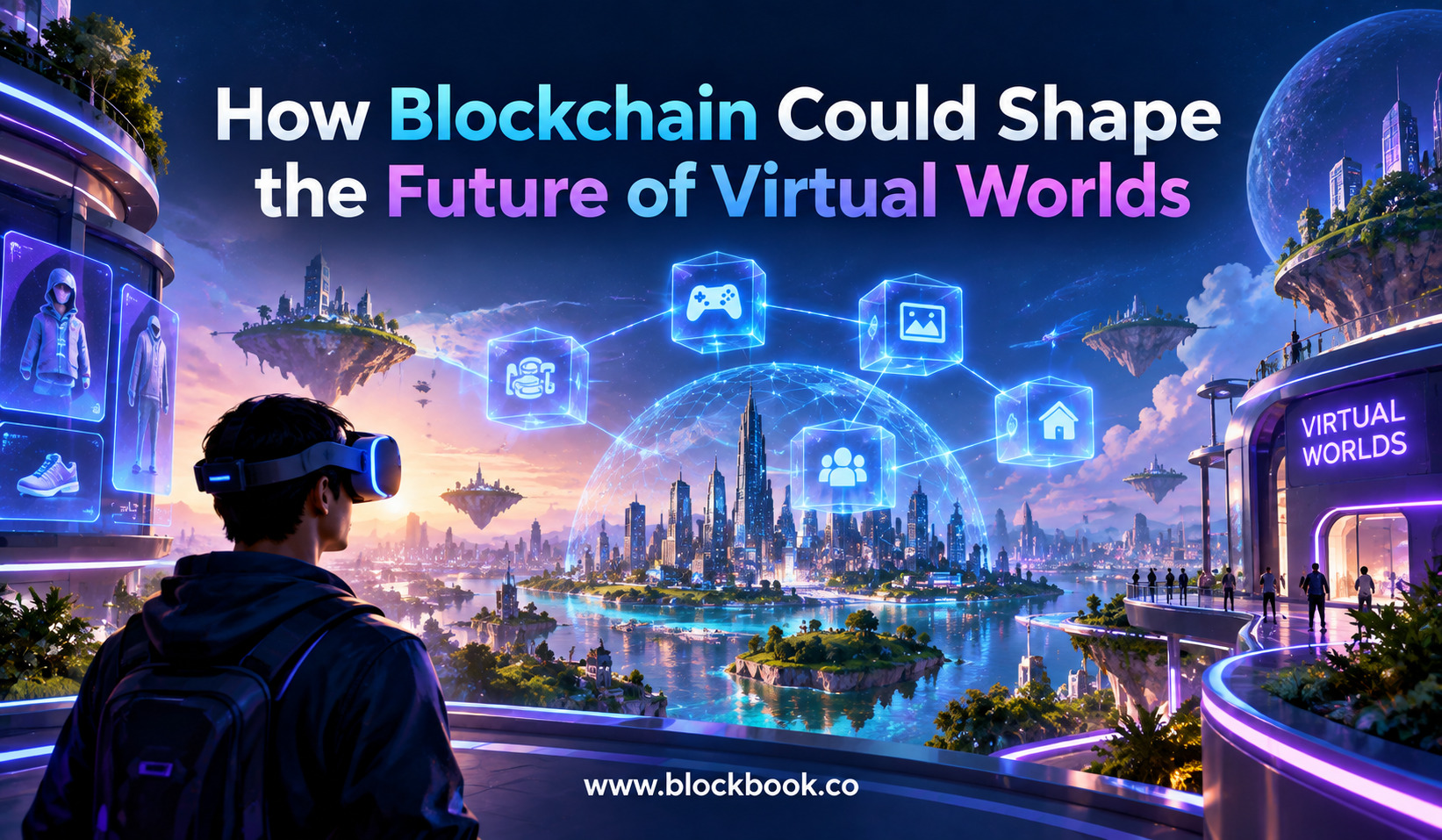
Virtual worlds are moving from simple online spaces toward more interactive digital environments where people can socialize, work, play games, attend events, create content, and participate in virtual economies. At the same time, blockchain technology is introducing new approaches to digital ownership, payments, identity, and community participation.
The combination of blockchain and virtual worlds has attracted significant interest across the broader Web3 industry. Blockchain does not automatically make a virtual world more immersive or technically advanced, but it can provide infrastructure for certain functions that traditionally depend on centralized platforms.
As virtual environments become more sophisticated, blockchain could influence how digital assets are created, transferred, owned, and used. Its potential role extends from virtual property and collectibles to decentralized marketplaces and community-driven platforms. However, challenges involving scalability, user experience, security, interoperability, and regulation will continue to influence how these ideas develop.
What Blockchain Brings to Virtual Worlds
Traditional virtual worlds generally depend on centralized databases. A company controls the platform, maintains user accounts, manages virtual items, and determines how transactions occur.
Blockchain introduces a different model. Instead of relying entirely on one company’s database, certain ownership and transaction records can be stored on a decentralized network. This can allow users to verify transactions and asset ownership independently of a single platform.
For virtual worlds, this could create new possibilities. A digital item such as an avatar accessory, collectible, virtual property certificate, or membership token could be represented on a blockchain.
The practical value depends on how the virtual-world platform is designed. Blockchain ownership alone does not guarantee that an asset will work across different virtual environments.
Digital Ownership Could Become More Portable
One of the most discussed possibilities is greater user control over digital assets. In conventional games and virtual platforms, an item purchased by a user is often tied to the company’s database. If the platform changes its rules or shuts down, the user may lose practical access to the item.
Blockchain-based assets can exist independently of a particular application’s internal database. A wallet can hold a token even when the user is not interacting with the original platform.
This does not mean that blockchain automatically solves digital ownership. A virtual item needs compatible software to display or use it. A token representing a 3D object is not useful in another virtual world unless that world understands the asset’s format and functionality.
Nevertheless, blockchain can provide an ownership layer that could support more open digital economies.
NFTs and Virtual Assets
Non-fungible tokens, or NFTs, are among the technologies most closely associated with blockchain-based virtual worlds. NFTs can represent unique digital assets and provide blockchain records showing token ownership.
In virtual environments, NFTs could represent a wide variety of items. Their use cases may include:
- Digital artwork and collectibles
- Virtual clothing and avatar accessories
- Event tickets and membership passes
- Virtual property and gaming assets
The value of these assets depends heavily on the platform, community, utility, and market conditions. An NFT does not automatically provide intellectual-property ownership over the content connected to it. Rights depend on the project’s terms and applicable agreements.
Blockchain Could Support Virtual Economies
Virtual worlds already have economies. Online games, social platforms, and virtual communities may contain currencies, marketplaces, trading systems, and digital goods.
Blockchain can introduce programmable tokens into these economies. Developers can create rules governing how tokens are issued, transferred, or used. Smart contracts can automate transactions without requiring every operation to be manually processed by a central platform.
For creators, this could create new ways to sell virtual products or establish community-based businesses. A designer might create digital clothing for avatars, while a virtual event organizer could issue blockchain-based access passes.
However, virtual economies also create financial risks. Token values can fluctuate significantly, and users may face scams, transaction fees, or security problems. Sustainable virtual worlds will need economic systems that provide genuine utility rather than depending entirely on speculation.
Smart Contracts Could Automate Digital Interactions
Smart contracts are another potential component of blockchain-powered virtual worlds. These programs execute predefined instructions when specific conditions are met.
In a virtual marketplace, for example, a smart contract could facilitate an asset transfer after payment is received. A virtual event could use programmable tickets, while a community platform could establish rules for distributing rewards.
Smart contracts can reduce dependence on manual processing for certain transactions. They can also make transaction rules visible and verifiable on supported blockchain networks.
However, smart contracts are software and can contain vulnerabilities. Developers must carefully test and audit contracts before using them for valuable digital assets or important virtual-world functions.
Interoperability Could Change Virtual Experiences
Interoperability is one of the most ambitious ideas associated with blockchain and virtual worlds. In theory, users could own a digital asset and use it across multiple compatible environments.
Imagine purchasing an avatar accessory that can appear in several games, social spaces, or virtual events. Instead of buying a separate version for every platform, the underlying asset could potentially be recognized across participating ecosystems.
This remains technically difficult. Different platforms use different graphics engines, blockchain networks, token standards, identity systems, and asset formats.
| Area | Traditional Virtual Worlds | Blockchain-Enabled Model |
| Ownership | Usually platform-managed | Can be recorded on blockchain |
| Digital payments | Centralized payment systems | Can include blockchain-based tokens |
| Asset transfer | Usually restricted to platform | Potentially transferable between compatible systems |
| Governance | Generally controlled by platform | May include community participation |
| Identity | Platform-specific accounts | Can include wallet-based identity |
| Marketplace | Platform-operated | Can use smart contracts and decentralized systems |
These are general models, and individual virtual-world platforms can use combinations of centralized and decentralized technologies.
Blockchain Could Support Creator Economies
The creator economy may become another important area of development. Virtual worlds depend on artists, developers, musicians, designers, storytellers, and other creators to produce experiences and digital assets.
Blockchain can provide mechanisms for creators to distribute digital products directly to audiences. Smart contracts can also be designed to automate specific payments according to predefined rules.
This could encourage new business models around virtual fashion, digital art, gaming assets, virtual events, and community memberships.
However, creators still need to consider platform fees, intellectual-property rights, user demand, taxes, security, and the costs associated with blockchain transactions.
Decentralized Governance in Virtual Communities
Some Web3 projects are exploring decentralized governance models in which token holders or community members participate in certain platform decisions.
For a virtual world, governance could potentially involve decisions about community rules, virtual events, marketplace policies, or development priorities.
This approach differs from conventional platforms where most important decisions are made internally by the company operating the service.
Decentralized governance is not automatically more effective. Voting systems need clear rules, and token-based voting can create questions about concentration of influence and participation. The design of the governance system is therefore just as important as the technology behind it.
Blockchain and Digital Identity
Identity could also become an important part of future virtual worlds. Users may maintain digital identities that connect different applications and communities.
Blockchain-based identity systems can potentially provide users with greater control over certain credentials or ownership records. A wallet, for example, can serve as an identifier for blockchain assets and transactions.
Privacy remains an important consideration. Public blockchain transactions can expose information that users may not want associated with their real-world identity. Future systems will need to balance verification, convenience, privacy, and security.
Scalability Remains a Major Challenge
For blockchain to support large virtual worlds, scalability will remain an important technical issue. Virtual environments can involve thousands or potentially millions of users generating interactions and transactions.
Putting every action directly on a blockchain would not necessarily be practical. Games, social environments, and real-time applications often require extremely fast interactions.
As a result, developers may use hybrid architectures in which blockchain handles ownership, settlement, or important state changes while conventional infrastructure handles real-time graphics and high-frequency interactions.
This approach could allow virtual worlds to benefit from blockchain without forcing every user action onto a decentralized network.
User Experience Will Determine Adoption
Blockchain technology can be technically impressive while still being difficult for mainstream users. Wallet management, private keys, transaction fees, network selection, and signing requests can create friction.
Future virtual worlds may need to hide much of this complexity behind familiar interfaces. Users should be able to participate in an experience without becoming blockchain experts.
Developers are therefore exploring approaches such as simplified wallets, account abstraction, embedded wallets, and alternative transaction models. The objective is to make blockchain features feel like part of the application rather than an additional technical burden.
Security and Trust
Virtual worlds could contain valuable digital items, financial assets, personal information, and social identities. Security will therefore remain central to blockchain integration.
Users can lose access to blockchain assets if private keys are compromised. Smart contracts can contain vulnerabilities, while fake marketplaces and phishing attacks can target virtual-world communities.
Developers will need to combine blockchain security practices with conventional application security, privacy protection, moderation, and account recovery systems.
Some of the most important areas will include:
- Secure wallet and account management.
- Smart-contract testing and auditing.
- Protection against phishing and fraudulent marketplaces.
- Clear user permissions and transaction interfaces.
The Role of AI and Immersive Technology
Blockchain is only one part of the future virtual-world technology stack. Artificial intelligence, virtual reality, augmented reality, cloud computing, advanced graphics, and spatial computing could have equally important roles.
AI can generate environments, create interactive characters, personalize experiences, and assist creators. Extended-reality devices can make digital environments more immersive, while cloud infrastructure can provide the computing power needed for large virtual experiences.
Blockchain could work alongside these technologies by providing ownership, payment, identity, or verification infrastructure.
What the Future of Blockchain-Powered Virtual Worlds Could Look Like
The future may not consist of one giant metaverse controlled by a single company. Instead, multiple virtual worlds could develop around different communities and purposes.
Gaming platforms may focus on digital economies, social environments may emphasize identity and interaction, and professional platforms may provide virtual collaboration spaces. Blockchain could connect selected elements of these environments through shared standards and decentralized infrastructure.
For this vision to become practical, several issues need continued development:
- Better interoperability between platforms
- Lower-friction blockchain experiences
- More scalable infrastructure
- Stronger security and consumer protection
Progress in these areas could determine whether blockchain becomes a foundational technology for virtual worlds or remains a specialized component used by particular platforms.
Conclusion
Blockchain could influence the future of virtual worlds by introducing new approaches to digital ownership, payments, identity, marketplaces, and community governance. NFTs and smart contracts can provide mechanisms for representing and transferring digital assets, while decentralized networks can create alternatives to fully centralized platform models.
However, blockchain is not a complete solution for building virtual worlds. Scalability, interoperability, security, privacy, usability, and economic sustainability remain significant challenges.
The most practical future may involve a combination of technologies. Blockchain could manage ownership and selected transactions, while cloud infrastructure, artificial intelligence, gaming engines, and immersive devices handle other parts of the experience.
As developers continue experimenting with these technologies, blockchain’s role in virtual worlds is likely to become clearer. The next stage of development will depend less on the concept itself and more on whether these systems can provide useful experiences that are secure, accessible, and valuable to everyday users.
Frequently Asked Questions
1. How can blockchain change virtual worlds?
Blockchain can provide systems for digital ownership, payments, asset transfers, identity, and certain governance functions. These capabilities can complement the immersive and social features of virtual environments.
2. Are NFTs necessary for the metaverse?
No. Virtual worlds can operate without NFTs. NFTs are one possible technology for representing unique digital assets and ownership records.
3. Can blockchain make virtual items transferable between games?
Potentially, but interoperability requires participating platforms to support compatible asset standards, formats, blockchain networks, and functionality. Blockchain ownership by itself does not guarantee cross-platform usability.
4. How can smart contracts help virtual worlds?
Smart contracts can automate predefined transactions and interactions, such as marketplace purchases, digital asset transfers, memberships, or certain reward mechanisms.
5. What are the biggest blockchain challenges for virtual worlds?
Scalability, interoperability, security, transaction costs, privacy, and user experience are among the major challenges developers need to address.
About the Author