Blockchain development is becoming increasingly diverse as developers build faster networks, decentralized applications, digital asset platforms, wallets, gaming systems, and blockchain infrastructure. While Solidity remains widely associated with Ethereum smart contracts, Rust has emerged as another important programming language in the blockchain ecosystem.
Rust was originally created as a systems programming language, with a focus on performance, reliability, and memory safety. These characteristics make it suitable for software that needs efficient resource management and predictable execution. As blockchain networks become more technically sophisticated, developers are using Rust for different parts of the blockchain stack, including network infrastructure, cryptographic components, developer tools, and on-chain programs.
For beginners, however, learning Rust for blockchain development requires more than understanding the language’s syntax. Blockchain technology introduces its own concepts, including distributed networks, transactions, consensus, wallets, cryptographic keys, and decentralized execution. Understanding how these ideas connect can make the learning process much easier.
What Is Rust?
Rust is a modern programming language designed for high-performance and reliable software. It provides low-level control over memory and system resources while using a compile-time ownership model to prevent many common memory-related programming errors.
Unlike languages that rely heavily on garbage collection, Rust uses ownership and borrowing rules to manage memory safely. The compiler checks these rules before the program runs. This can initially feel unfamiliar to beginners, but it becomes an important part of writing reliable Rust applications.
Rust is used outside blockchain as well, including in systems software, networking, command-line applications, developer tools, and performance-sensitive services. Its broader reputation has helped create an ecosystem that blockchain developers can build upon.
Why Rust Matters in Blockchain
Blockchain networks require software that can handle transactions, communicate with other nodes, execute programs, maintain state, and participate in consensus mechanisms. These tasks can place significant demands on infrastructure.
Rust offers a combination of performance and safety that can be useful for such environments. Developers have considerable control over system resources while the compiler provides checks that can catch certain classes of errors before deployment.
This is one reason Rust has gained attention among blockchain development teams. Its role is not limited to smart contracts. Rust can also be used for blockchain clients, node implementations, cryptographic libraries, wallets, indexing tools, and other supporting infrastructure.
The language is particularly relevant to developers interested in the technical foundations of blockchain rather than only decentralized application interfaces.
What Beginners Need to Understand First
Before writing blockchain applications in Rust, beginners should understand basic programming concepts. Variables, functions, loops, conditional statements, data structures, error handling, and modular programming provide the foundation for more advanced work.
Rust introduces several concepts that are especially important. Ownership determines how data is managed, borrowing allows references to data without transferring ownership, and lifetimes help the compiler understand how long references remain valid.
These concepts may seem difficult at first. However, learning them properly is important because they are central to Rust’s approach to memory safety.
Beginners should avoid rushing through ownership and borrowing simply to reach blockchain development faster. A strong Rust foundation can make blockchain frameworks much easier to understand later.
Rust’s Ownership Model
Ownership is one of Rust’s most distinctive features. In simplified terms, every value has an owner, and Rust uses specific rules to determine when that value can be accessed, moved, or removed from memory.
This system helps prevent problems such as use-after-free and certain forms of data races. Instead of discovering some memory-management problems while the application is running, developers receive compiler feedback during development.
For beginners, the important point is that Rust’s compiler is an active part of the development process. Developers often need to adjust how data is passed between functions or stored in structures to satisfy the language’s rules.
Although this can initially make simple programs feel more complicated, it can encourage developers to think carefully about how data moves through an application.
Understanding Blockchain Before Coding
Learning Rust alone does not make someone a blockchain developer. Beginners should also understand how blockchains operate.
A blockchain is a distributed system in which multiple participants maintain and verify shared information according to a defined protocol. Transactions are submitted to the network, processed according to its rules, and eventually included in the blockchain’s state.
Developers should become familiar with concepts such as:
- Blocks and transactions
- Nodes and validators
- Consensus mechanisms
- Public and private keys
- Wallets and digital signatures
- Blockchain state and execution
Understanding these fundamentals helps beginners see why blockchain software has different requirements from an ordinary web application.
Rust and Smart Contracts
Rust can be used for on-chain programs in several blockchain ecosystems, but the exact programming model varies between networks.
This is important for beginners because there is no universal “Rust smart-contract environment.” Different blockchain platforms can have different account models, execution systems, frameworks, development tools, and deployment procedures.
Some ecosystems provide Rust-based frameworks that simplify writing and testing on-chain programs. Developers need to learn the specific rules of the platform they choose instead of assuming that knowledge from one blockchain automatically applies to another.
Rust can therefore be thought of as a programming tool within multiple blockchain environments rather than a single standardized smart-contract platform.
Rust vs Solidity for Beginners
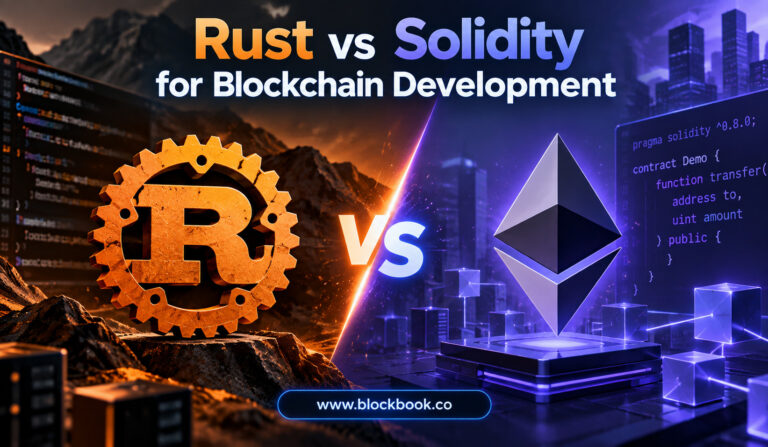
Solidity and Rust are both important in blockchain development, but they generally appear in different areas of the ecosystem.
| Feature | Rust | Solidity |
| Main blockchain role | Infrastructure and on-chain programs | Smart contracts |
| Common ecosystem | Several blockchain platforms | Ethereum and EVM-compatible networks |
| Programming style | Systems-oriented | Smart-contract focused |
| Memory model | Ownership and borrowing | Managed by the EVM environment |
| Performance control | High | Constrained by blockchain execution |
| Beginner challenge | Ownership and lifetimes | Blockchain concepts and contract security |
| Broader use outside blockchain | Extensive | Primarily blockchain-focused |
The choice between the two depends on what a developer wants to build. Someone interested in Ethereum smart contracts may prioritize Solidity, while someone interested in blockchain infrastructure or a Rust-based ecosystem may choose Rust.
Setting Up a Rust Development Environment
Beginners generally start by installing Rust’s official toolchain and learning how to create, compile, test, and run basic projects.
Rust’s package and build ecosystem makes it possible to manage dependencies and organize applications into projects. Developers can gradually move from simple command-line applications to blockchain-specific examples.
A beginner project might start with a basic transaction structure. The developer could then add validation, serialization, signatures, and other blockchain-related components.
The objective should be to understand each layer rather than copying a complete blockchain application without understanding how it works.
Learning Blockchain Frameworks
After gaining confidence with Rust fundamentals, beginners can explore blockchain-specific development frameworks. These frameworks provide libraries, testing utilities, templates, and other tools that reduce the amount of infrastructure developers need to create manually.
However, frameworks can also hide important concepts. Beginners should therefore study what happens underneath the framework rather than relying entirely on high-level abstractions.
Understanding how accounts, transactions, instructions, state, and program execution work will make it easier to debug problems later.
Testing Rust-Based Blockchain Applications
Testing is especially important when applications interact with blockchain networks. Developers should test normal operations as well as invalid inputs and unexpected transaction scenarios.
Rust’s built-in testing capabilities can be used alongside blockchain-specific testing frameworks. Developers can create tests that verify whether functions produce the expected results and whether application state changes correctly.
A useful beginner testing process includes:
- Test individual Rust functions.
- Test data structures and validation logic.
- Test blockchain-specific instructions or program behavior.
- Test failure cases and unexpected inputs.
Testing locally before interacting with a public network can save time and reduce unnecessary deployment costs.
Security Considerations for Beginners
Security should be part of blockchain development from the beginning. A program that manages assets or controls important blockchain operations can become a security target.
Rust’s memory-safety features can reduce certain categories of programming errors, but they do not automatically make blockchain applications secure. Developers can still introduce logic bugs, incorrect authorization, flawed economic assumptions, or unsafe interactions.
Beginners should learn about secure key management, input validation, authorization, transaction verification, and the security model of their chosen blockchain.
They should also understand that blockchain applications may operate in adversarial environments. Users may deliberately attempt to trigger unexpected behavior, so developers need to think beyond ordinary usage scenarios.
Building Practical Rust Blockchain Projects
The best way to learn is usually through progressively more challenging projects. Beginners should start with small applications that allow them to understand both Rust and blockchain concepts without becoming overwhelmed.
For example, a developer could create a simple transaction simulator before moving toward a basic on-chain program. Later projects could involve token interactions, wallet functionality, blockchain data processing, or decentralized application backends.
A practical learning path can look like this:
- Learn Rust fundamentals and ownership.
- Build small standalone Rust projects.
- Study blockchain architecture and cryptography basics.
- Select one Rust-supported blockchain ecosystem.
- Build and test small blockchain programs.
- Gradually explore more advanced infrastructure.
This approach gives beginners time to develop programming confidence before handling complex blockchain systems.
Challenges Beginners May Face
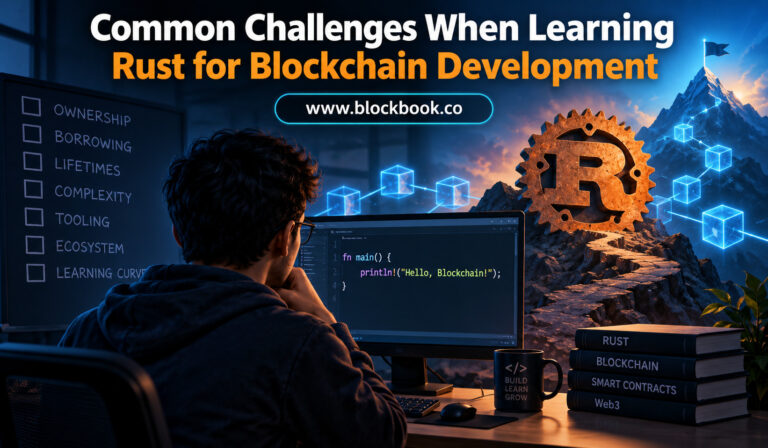
Rust’s strict compiler can be one of the biggest challenges for new developers. Beginners may encounter compiler errors involving ownership, borrowing, lifetimes, traits, or type mismatches.
Blockchain development introduces additional difficulties. Developers may need to understand cryptographic signatures, transaction formats, network communication, account structures, and decentralized execution at the same time.
Another challenge is ecosystem diversity. Rust-based blockchain platforms can use different development approaches, so beginners should choose one ecosystem and learn it deeply before attempting to understand several platforms simultaneously.
The learning curve can be demanding, but it also encourages developers to build a stronger understanding of both software engineering and blockchain architecture.
Career Opportunities With Rust and Blockchain
Rust skills can be useful across several areas of blockchain development. Developers may work on node software, blockchain infrastructure, wallets, cryptographic systems, developer tooling, indexing services, or on-chain programs.
Rust knowledge can also remain useful outside blockchain because the language is used in other systems-oriented software projects. This gives developers a broader technical foundation than learning a blockchain-specific language alone.
For beginners considering blockchain as a career path, combining Rust with knowledge of distributed systems, cryptography, databases, networking, and software testing can create a more comprehensive skill set.
Conclusion
Rust offers beginners an interesting entry point into blockchain development, particularly for those interested in infrastructure, high-performance applications, and ecosystems that support Rust-based on-chain programming. Its ownership system, memory-safety approach, and performance characteristics make it different from many traditional programming languages.
However, learning Rust for blockchain requires patience. Beginners need to understand both the language and the fundamentals of decentralized networks. Starting with basic Rust programming, followed by blockchain concepts and small practical projects, can create a more manageable learning path.
As blockchain technology continues to evolve, developers with strong systems-programming knowledge may find Rust useful across multiple areas of the ecosystem. Rather than replacing other programming languages, Rust is becoming another important tool for building the next generation of blockchain software.
FAQs
Is Rust good for blockchain development?
Yes. Rust is well suited to several blockchain development tasks because of its performance, memory-safety features, and low-level control. It is used in blockchain infrastructure and in certain on-chain development ecosystems.
Should beginners learn Rust before blockchain?
Learning basic Rust first can make blockchain development easier. Beginners should understand variables, functions, ownership, borrowing, data structures, and error handling before moving into advanced blockchain frameworks.
Is Rust harder than Solidity?
The difficulty depends on the developer’s background. Rust has concepts such as ownership and lifetimes that can take time to understand, while Solidity requires developers to learn smart-contract security and blockchain-specific execution concepts.
Can Rust be used to create smart contracts?
Yes, but support depends on the blockchain platform. Several ecosystems allow developers to write on-chain programs using Rust, with their own frameworks and execution models.
Is Rust useful outside blockchain?
Yes. Rust is used in systems programming, networking, developer tools, command-line software, backend services, and other performance-sensitive applications.
About the Author