
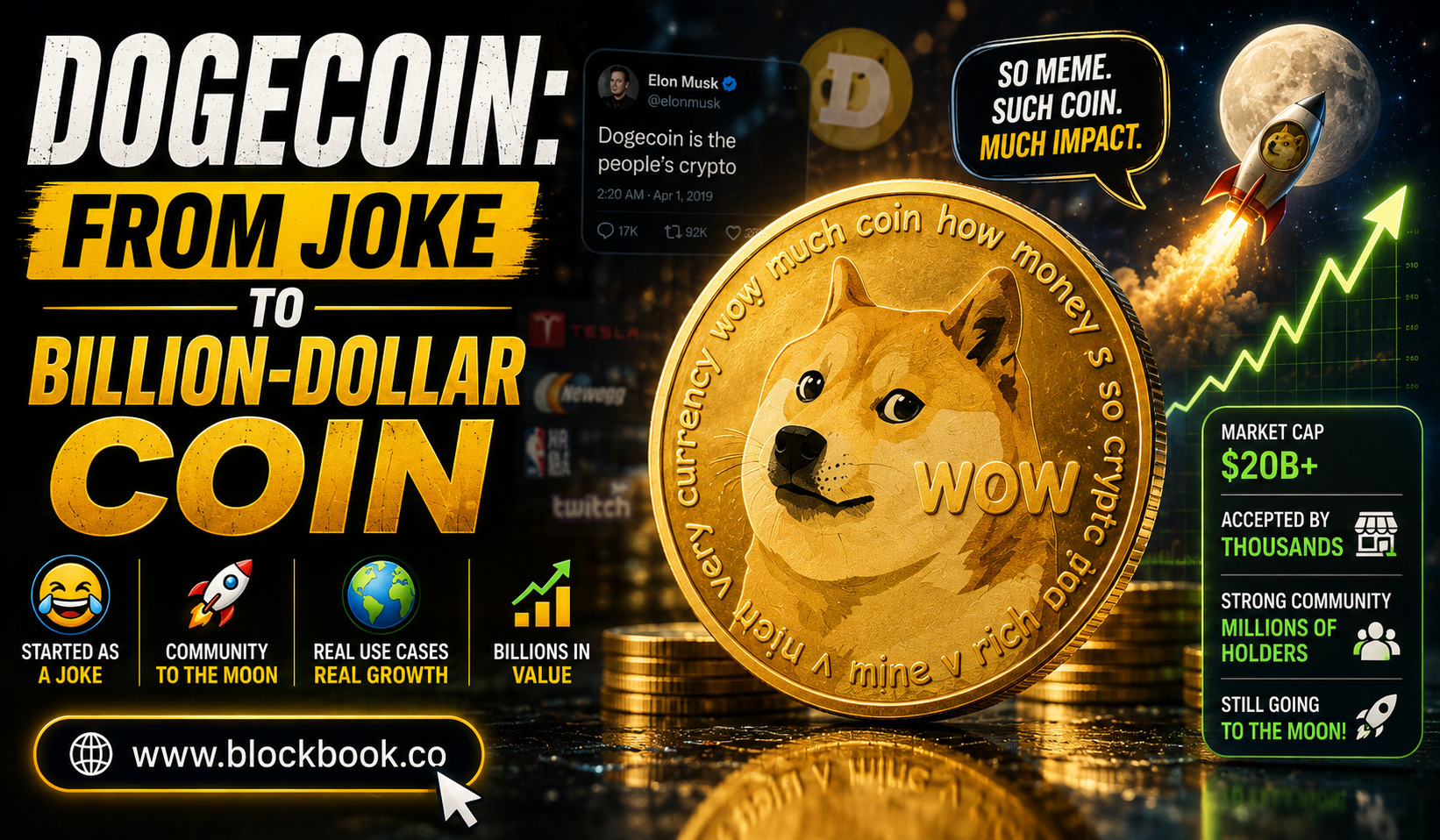
A cryptocurrency built in a few hours as a parody, featuring a Shiba Inu meme as its logo, now carries a market capitalization north of $11 billion and has its own regulatory classification from federal agencies. Dogecoin was never supposed to be taken seriously, and that’s exactly what makes its staying power so strange to explain.
This is the story of how an internet joke survived multiple crypto winters, a lawsuit seeking $258 billion in damages, and years of being dismissed by serious investors, and somehow ended up as one of the most recognized digital assets on the planet.
How Dogecoin started as a joke
In December 2013, software engineers Billy Markus and Jackson Palmer created Dogecoin as a lighthearted jab at the speculative frenzy already building around Bitcoin. They slapped the “Doge” meme, a Shiba Inu dog with broken internal-monologue captions, onto a simple cryptocurrency and released it without any grand vision attached.
Unlike Bitcoin, which was engineered around scarcity with a hard cap of 21 million coins, Dogecoin was designed to be abundant. There’s no maximum supply, and roughly 10,000 new coins get mined every minute. That single design choice tells you a lot about the project’s original intent: it was built to be fun and accessible, not a scarce store of value.
There was no venture capital round, no pre-mine reserved for founders, and no formal company behind it. It was, and largely still is, run by a decentralized group of volunteers and a nonprofit called the Dogecoin Foundation.
The 2021 explosion that changed everything
For years, Dogecoin traded for fractions of a cent and existed mostly as a tipping currency on Reddit. That changed dramatically in early 2021. Between January 28 and January 29 of that year, DOGE’s price jumped roughly 216% in a single day after comments from Elon Musk, and that was just the opening act.
The real peak came on May 8, 2021, when Dogecoin hit an all-time high around $0.73, briefly pushing its market capitalization above $88 billion. For a moment, a coin built as a joke was worth more than several well-established public companies. The rally was driven by a combination of Musk’s repeated social media posts, a wave of Reddit-fueled retail buying, and the broader speculative mania gripping crypto markets that year.
What followed was a familiar crypto story: a sharp, painful correction. DOGE lost the vast majority of its value over the following year as the broader market cooled, and it has never come close to reclaiming that May 2021 peak.
Why Dogecoin refused to disappear
Plenty of joke coins from 2013 and 2014 are long dead. Dogecoin is not, and the reasons why are worth breaking down.
Dogecoin has one of the most recognizable logos in all of crypto. That sounds trivial, but brand memory matters enormously in a market with thousands of competing tokens. Ask a random person on the street to name a cryptocurrency, and there’s a real chance they say Dogecoin before they say Ethereum.
Then there’s the Musk effect. Whatever else you think about the relationship, Elon Musk’s continued public support kept Dogecoin relevant far longer than it would have survived on community enthusiasm alone. Tesla has maintained the ability to accept DOGE for certain merchandise purchases since 2022, and Musk has repeatedly called it his favorite cryptocurrency. His influence on the price has weakened compared to 2021, but it hasn’t disappeared.
It’s also picked up real, if modest, merchant acceptance over the years. It’s been usable at AMC Theatres, tested in limited capacity at GameStop, and accepted for select Tesla products. None of this makes DOGE a mainstream payment method yet, but it’s more real-world utility than most meme coins ever achieve.
From meme to regulated asset
Perhaps the clearest sign that Dogecoin has moved beyond joke status came in March 2026, when a joint framework from the SEC and CFTC officially classified Dogecoin as a digital commodity, putting it in a regulatory category similar to how oil or gold gets treated rather than as an unregistered security. That kind of formal classification doesn’t happen for assets regulators consider irrelevant.
Institutional products followed. Dogecoin exchange-traded funds launched in early 2026, pulling in millions of dollars in inflows almost immediately, a notable milestone for a coin that spent its first several years as a punchline rather than an investable asset in traditional portfolios.
Dogecoin’s numbers today
As of early August 2026, Dogecoin trades in the neighborhood of $0.07, with a market capitalization sitting around $11 to $12 billion, keeping it among the ten largest cryptocurrencies by that measure. Its circulating supply has grown past 170 billion coins, a direct result of its uncapped, inflationary supply design.
A quick snapshot of where DOGE stands relative to its history: it hit an all-time high of approximately $0.73 on May 8, 2021; its current price of roughly $0.07 is down around 90% from that peak; its market cap sits around $11 to $12 billion; and its circulating supply has passed 170 billion coins with no maximum cap.
What Dogecoin’s survival says about crypto fundamentals
Dogecoin is an odd case study for anyone evaluating crypto assets on fundamentals alone, because by most traditional measures it shouldn’t still be relevant. It lacks the scarcity model that gives Bitcoin its value narrative. It lacks the smart contract functionality that gives Ethereum its utility case. What it has instead is community persistence, brand recognition, and a celebrity endorsement that has lasted far longer than anyone expected in 2013.
That doesn’t mean fundamentals don’t matter for Dogecoin; it means its particular fundamentals are social rather than technical. Community size, merchant adoption, and public figure association function as its version of active addresses and transaction volume. That distinction is genuinely useful for anyone applying an on-chain fundamentals framework across different types of crypto assets, since not every coin generates value the same way.
FAQ
Who created Dogecoin and why?
Software engineers Billy Markus and Jackson Palmer created Dogecoin in December 2013 as a parody of the speculative frenzy around Bitcoin, using the Shiba Inu “Doge” internet meme as its branding.
What was Dogecoin’s all-time high price?
Dogecoin reached an all-time high of approximately $0.73 on May 8, 2021, briefly pushing its market capitalization above $88 billion.
Is Dogecoin considered a security by regulators?
No. In March 2026, a joint SEC and CFTC framework classified Dogecoin as a digital commodity rather than a security, placing it in a category more similar to how commodities like oil or gold are regulated.
Does Dogecoin have a maximum supply?
No. Unlike Bitcoin’s fixed 21 million coin cap, Dogecoin has no maximum supply, and approximately 10,000 new coins are mined every minute.
About the Author