
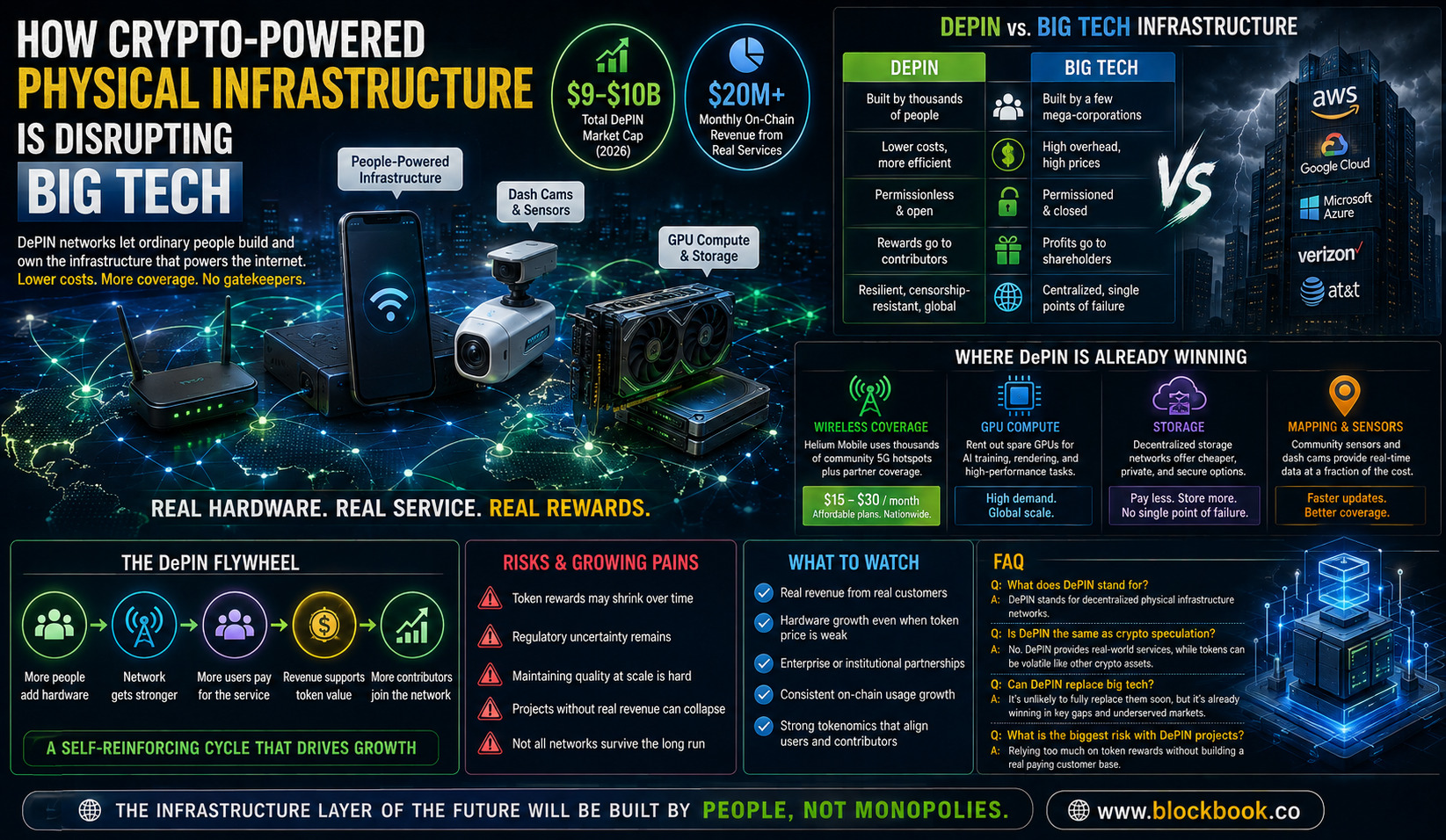
A network of ordinary people’s phones, routers, and dash cams is now quietly competing with billion-dollar telecom and cloud giants, and most of them don’t even realize it. This is the promise behind DePIN, or decentralized physical infrastructure networks, and in 2026 it has stopped being a crypto Twitter buzzword and started being actual infrastructure people pay to use.
DePIN takes the same blockchain incentive model that powers Bitcoin mining and applies it to real-world hardware: wireless hotspots, GPU compute, storage drives, mapping sensors. Instead of one company building and owning everything, thousands of individuals contribute their own equipment and get paid in tokens for the service it provides. The combined DePIN sector now sits somewhere around $9 to $10 billion in market value, and it’s generating tens of millions of dollars in monthly on-chain revenue from services people actually pay for, not speculation.
What DePIN Actually Means
The easiest way to picture DePIN is to imagine Airbnb, but for infrastructure instead of spare bedrooms. Rather than a hotel chain building every property itself, homeowners contribute rooms and get paid directly. DePIN does the same thing with wireless coverage, cloud storage, and compute power.
A device joins a network, does useful work such as routing wireless traffic or storing a file, and the blockchain verifies that the work actually happened before releasing a token reward. No central company decides who gets paid or how much; the protocol itself handles verification and payout, which removes a layer of overhead that traditional infrastructure companies carry as fixed cost.
This matters because building physical infrastructure the old way is brutally expensive. Laying fiber, building cell towers, and running data centers requires massive upfront capital that only a handful of companies can afford. DePIN flips that model by crowdsourcing the hardware from people who already own it.
Where DePIN Is Already Beating Big Tech
Talk is cheap in crypto, so the more interesting question is where DePIN has actual paying customers instead of just a whitepaper.
Wireless Coverage
Helium Mobile is probably the clearest example of DePIN competing directly with a legacy industry. It runs a hybrid network of community-deployed 5G hotspots combined with a partner carrier’s coverage for areas the community network doesn’t yet reach. In 2026 the service moved toward tiered consumer plans, generally reported somewhere in the range of $15 for a basic data plan up to $30 for an unlimited tier, undercutting traditional carrier pricing while still offering nationwide coverage.
This is a genuinely disruptive model because the biggest cost for a telecom company is building and maintaining towers. Helium’s community hotspots absorb part of that cost by turning ordinary people into micro infrastructure providers who get paid for coverage in their own neighborhood.
GPU Compute and Storage
AI demand has made GPU compute one of the most valuable resources on the planet, and centralized cloud providers can’t always keep up. DePIN projects focused on compute let anyone with a spare GPU rent it out for AI training or rendering jobs, similar to how a spare bedroom becomes rental income. This directly challenges the idea that only a handful of hyperscale cloud companies can supply serious compute power.
Storage networks work the same way. Instead of paying a centralized cloud provider for storage space, users pay a decentralized network of individual drive owners, often at a lower cost because there’s no massive corporate overhead sitting between the customer and the hardware.
Why This Threatens Big Tech’s Core Business Model
Big Tech’s advantage has always been scale. Amazon, Google, and the major telecom companies can absorb enormous infrastructure costs because they operate at a size no smaller player can match. DePIN attacks that advantage directly by distributing the capital cost across thousands of individual contributors instead of concentrating it in one balance sheet.
DePIN doesn’t need to beat Big Tech everywhere. It only needs to win in specific gaps where centralized infrastructure is weak or overpriced. Consider these areas where the model already has traction:
Rural and underserved regions, where building traditional towers or fiber lines isn’t profitable enough for telecom giants to bother
Emerging markets across parts of Africa, Latin America, and Southeast Asia where centralized infrastructure has historically failed to reach
Niche compute demand for smaller AI startups who can’t get priority access to hyperscale cloud GPUs
Mapping and location data, where community-sourced sensors can update faster and cheaper than a company sending out survey vehicles
None of this means AWS or Verizon is going away anytime soon. But it does mean the assumption that only giant corporations can build critical infrastructure is no longer automatically true.
The Token Incentive Flywheel
DePIN’s growth engine relies on a self-reinforcing loop that’s worth understanding if you’re trying to evaluate whether a given project is real or just hype.
A network launches and offers token rewards to anyone who contributes hardware
Early contributors join because the reward looks attractive relative to the cost of participating
As more hardware joins, the network’s service quality improves, attracting real paying customers
Revenue from actual usage supports the token’s value instead of pure speculation
A stronger token price attracts even more contributors, and the cycle continues
The projects worth paying attention to are the ones where step three and four are actually happening, meaning real customers are paying for a real service. A network that only has step one and two, with contributors joining purely for token rewards and no paying customers on the other end, is not disruption. It’s a subsidy program dressed up as infrastructure.
Risks and Growing Pains
None of this is guaranteed to work at scale, and beginners should go in with clear eyes. Token rewards can be generous early on and then shrink dramatically as a network matures, which sometimes causes contributors to drop out. Regulatory uncertainty around how these tokens should be classified also lingers in several jurisdictions.
There’s also a coordination problem that traditional companies don’t have to deal with: getting thousands of independent hardware owners to maintain consistent uptime and quality is genuinely harder than managing employees on a single payroll. A hotel chain can fire an underperforming manager. A decentralized network can only adjust incentives and hope contributors respond.
What to Watch Going Forward
If you’re trying to figure out whether a particular DePIN project has staying power, a few practical signals help separate substance from noise:
Is the network generating revenue from real customers, not just token emissions to contributors
Does hardware participation keep growing even during periods when the token price is weak
Has the project attracted any enterprise or institutional partnerships beyond retail crypto users
Is the on-chain data showing consistent usage growth month over month, rather than one-off spikes
FAQ
What does DePIN stand for?
DePIN stands for decentralized physical infrastructure networks. It describes blockchain-based systems that reward individuals for contributing real hardware, such as wireless hotspots, GPUs, or storage drives, to a shared network.
Is DePIN the same as regular cryptocurrency speculation?
Not exactly. While DePIN tokens can be traded and are subject to the same volatility as other crypto assets, the underlying networks are meant to provide an actual service, such as wireless coverage or cloud storage, rather than existing purely as a speculative asset.
Can DePIN actually replace big tech infrastructure?
It’s unlikely to fully replace major telecom or cloud providers in the near term, but it’s already competing successfully in specific gaps, such as underserved regions and niche compute demand, where centralized infrastructure is weaker or more expensive.
What is the biggest risk with investing in DePIN projects?
The biggest risk is that a project relies too heavily on token rewards to attract contributors without building a real paying customer base. Once reward emissions slow down, networks without genuine revenue tend to lose participants quickly.
About the Author