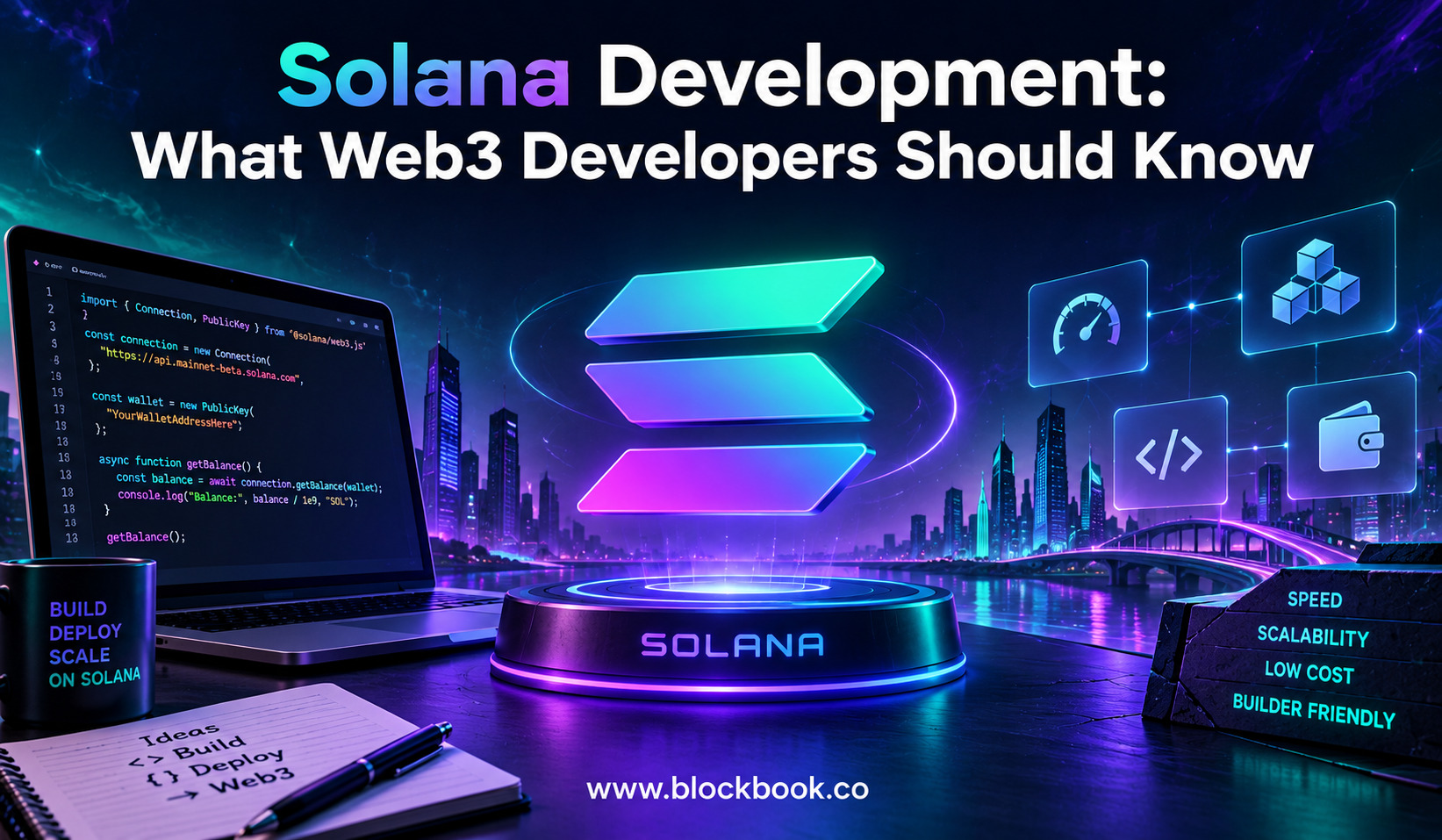
Solana has become an important development environment for teams building decentralized applications, financial platforms, games, marketplaces and other Web3 products. Its architecture is designed around high transaction throughput and efficient execution, giving developers a different environment from blockchains that rely more heavily on sequential transaction processing.
For developers entering the Solana ecosystem, however, understanding the network requires more than knowing that it is fast or inexpensive. Solana has its own programming model, account structure, transaction design, development tools and smart-contract framework. Developers who understand these fundamentals can make better decisions about application architecture, performance and security.
The growing interest in Solana development also reflects a broader change in Web3. Blockchain applications are increasingly expected to offer experiences closer to conventional digital products. Users want responsive interfaces, simple transactions and reasonable costs. This puts greater emphasis on the underlying infrastructure and the way applications interact with it.
Understanding Solana’s Development Model
One of the first concepts developers need to understand is that Solana programs are different from smart contracts on some other blockchain networks.
Solana uses programs to implement application logic, while account data is stored separately. A program generally operates on accounts that are provided to it by a transaction. This separation between executable logic and state is an important part of Solana’s programming model.
For developers coming from Ethereum, this can require a change in thinking. Instead of placing both application logic and state into a single contract-oriented structure, Solana applications commonly organize programs and accounts as separate components.
This model is closely connected to Solana’s ability to process transactions in parallel. Because transactions identify the accounts they will read or modify, the runtime can determine which operations have dependencies and which may be executed concurrently.
Rust Is a Major Part of Solana Development
Rust is one of the primary programming languages used for developing Solana programs. The language is known for emphasizing memory safety and performance, characteristics that fit a blockchain environment where efficient execution is important.
Developers do not necessarily need to become Rust experts before exploring Solana, but a solid understanding of Rust fundamentals can make the development process easier.
Solana development also has an ecosystem of frameworks and libraries that simplify common tasks. One of the most widely used frameworks is Anchor, which provides tools and conventions for developing Solana programs.
Anchor can reduce repetitive development work by helping developers define program instructions, accounts and validation rules in a structured way. It also provides tools for testing and interacting with programs.
Developers entering Solana should become familiar with:
- Rust fundamentals and Solana’s programming model
- Accounts, programs and transactions
- Solana’s command-line and development tools
- Testing, debugging and program security
Understanding these concepts is generally more useful than simply learning how to deploy a basic program.
Accounts Are Central to the Solana Model
Accounts are among the most important concepts in Solana development.
On Solana, accounts can hold data, SOL or executable program information. Application state is typically stored in data accounts, while programs contain the logic that operates on that state.
This structure gives developers considerable flexibility, but it also means that application architecture needs to be planned carefully.
A developer building a decentralized application needs to determine what information should be stored, which accounts each instruction requires and which accounts can be modified. These decisions can influence both security and performance.
The account model also affects transaction design. A transaction needs to provide the accounts required by the instructions it contains. Developers therefore need to understand account ownership, permissions and relationships between different pieces of application state.
Transactions and Instructions
Solana transactions contain instructions that tell programs what operations should be performed.
A single transaction can contain multiple instructions, allowing developers to combine related actions into one transaction where appropriate. This can be useful for applications that need several operations to occur together.
Each instruction identifies the program it wants to invoke and the accounts required for execution.
This design gives developers significant control over how application operations are structured. However, it also introduces additional responsibility. Incorrect account permissions or poorly designed instructions can create security problems or unexpected application behavior.
Developers should therefore treat transaction construction as an important part of application design rather than as a simple implementation detail.
Solana’s Parallel Execution Changes Application Design
Solana’s Sealevel runtime is designed to execute compatible transactions in parallel.
This is possible because transactions specify the accounts they will read and write. If two transactions do not conflict over the same writable state, the runtime can potentially process them simultaneously.
For developers, this means application architecture can influence performance.
An application that unnecessarily forces many operations to interact with the same account may create execution dependencies. On the other hand, a carefully structured state can allow more operations to be processed concurrently.
This is one reason Solana development requires developers to think about performance at the application-design level. Performance is not simply something the blockchain provides automatically; the way an application organizes its data and transactions can also affect how efficiently it operates.
Development Tools and Local Testing
Before deploying an application to the Solana mainnet, developers typically work with local or test environments.
The Solana command-line interface provides tools for interacting with the network, managing accounts and deploying programs. Developers can also use local validators and test networks to experiment without immediately exposing an application to production users.
Testing is particularly important for blockchain applications because deployed program logic can control valuable digital assets.
A strong development process should include unit testing, integration testing and security-focused testing. Developers should also test unusual transaction conditions rather than focusing only on successful transactions.
| Development Area | What Developers Need to Understand |
| Programming | Rust and Solana’s program model |
| Application state | Account structure and ownership |
| Transactions | Instructions, signatures and account access |
| Testing | Local environments and test networks |
| Deployment | Program deployment and upgrades |
| Security | Validation, permissions and edge cases |
Anchor Can Simplify Development
Anchor has become a popular framework within the Solana development ecosystem because it provides abstractions around many lower-level development tasks.
Without a framework, developers may need to handle significant amounts of account validation, serialization and instruction processing themselves. Anchor introduces conventions that can make these tasks easier to manage.
Its approach can be particularly useful for teams building applications with multiple instructions and complex account relationships.
However, developers should not assume that using a framework eliminates the need to understand Solana fundamentals. A framework can simplify development, but developers still need to understand what happens underneath the abstractions.
Learning the underlying account model, transaction structure and program execution environment remains valuable when debugging or optimizing an application.
Security Should Be Considered From the Beginning
Blockchain applications can handle financial assets, making security one of the most important areas of Solana development.
A program should validate the accounts it receives and verify that users are authorized to perform requested operations. Developers should carefully consider account ownership, signer requirements and writable permissions.
Business logic also needs to be examined. An application may be technically correct from a programming perspective while still containing an economic vulnerability.
Common areas developers should examine during security testing include:
- Account ownership and authorization checks
- Signer and permission validation
- Arithmetic and numerical edge cases
- Instruction and transaction assumptions
- External program interactions
Audits can provide an additional layer of review, particularly for applications that manage significant value. Nevertheless, an audit should complement—not replace—careful development and testing.
Managing Transaction Costs and Compute Resources
Although Solana is associated with relatively low transaction costs, developers still need to understand resource consumption.
Solana transactions have compute limits, and programs must operate within the resources available to them. Complex instructions can consume more compute than simple operations.
Developers therefore need to optimize program logic when necessary. Reducing unnecessary calculations, improving account handling and designing efficient instructions can help applications operate more effectively.
Application design can also influence transaction costs and user experience. If users need to sign multiple transactions for a simple action, the interface may become more complicated even if each transaction is inexpensive.
The goal should be to create a balance between efficient blockchain operations and a straightforward user experience.
Wallets and User Interaction
A Web3 application needs a way for users to connect their wallets and authorize transactions.
Solana has a broad wallet ecosystem, and developers can integrate wallet functionality into decentralized applications through established tools and libraries.
From the user’s perspective, the process should ideally be simple. A user may not need to understand accounts, programs or transaction instructions. The application interface should communicate what the user is signing and why.
This makes frontend development an important part of Solana application development. A technically efficient backend can still provide a poor experience if transaction failures, wallet prompts or account requirements are difficult to understand.
Data and Off-Chain Infrastructure
Not every piece of application data needs to live directly on-chain.
Blockchain storage can be valuable for information that requires decentralized verification or ownership, but applications often use off-chain systems for data that does not need blockchain security.
Developers may combine Solana programs with APIs, databases, indexing systems and other services. This hybrid architecture can provide a balance between decentralized verification and application performance.
The appropriate balance depends on the application. A financial protocol may require extensive on-chain logic, while a social application may keep most content off-chain and use blockchain infrastructure for ownership or payments.
Building for Scalability
Scalability should be considered from the beginning of a Solana project.
Developers should think about how application state will grow, how accounts will be organized and how transactions will behave as the user base expands.
Applications should also be designed to handle failures. Network requests can fail, transactions can be rejected and users can cancel wallet operations. A production application needs to communicate these conditions clearly instead of assuming every transaction will succeed.
A practical development workflow can include:
- Define the application architecture and account structure.
- Build and test core Solana programs locally.
- Connect the frontend and wallet infrastructure.
- Test transactions under different conditions.
- Conduct security reviews before production deployment.
This process helps teams identify architectural problems before they become expensive to fix.
Solana Development Compared With Ethereum Development
Developers familiar with Ethereum may find similarities between the ecosystems because both support decentralized applications and programmable blockchain logic. However, their development models differ in important ways.
Ethereum developers commonly work with Solidity and an account-based smart-contract model where contract storage and code are organized differently. Solana developers typically work with Rust or related tooling and a program-and-account architecture.
Neither approach eliminates the need for careful application design. The main difference is how developers are expected to structure application logic, state and transaction execution.
For developers moving between ecosystems, learning the underlying architecture rather than relying on familiar terminology can make the transition easier.
What Developers Should Watch in the Solana Ecosystem
The Solana development environment continues to evolve alongside the broader Web3 sector. Developer tools, frameworks, wallet infrastructure, data services and application platforms are continually being improved.
The ecosystem is also expanding beyond traditional cryptocurrency applications. DeFi remains significant, but developers are exploring gaming, payments, consumer applications, decentralized physical infrastructure and digital asset platforms.
This diversification could create new requirements for developers. Applications targeting mainstream users may prioritize simple interfaces, while financial applications may focus more heavily on security and transaction execution.
As a result, Solana development is becoming less about simply deploying a program and more about building complete products around blockchain infrastructure.
Conclusion
Solana development offers Web3 developers a performance-focused environment, but taking advantage of that environment requires an understanding of its unique architecture. Accounts, programs, instructions, transactions and parallel execution form the foundation of the development model.
Rust and frameworks such as Anchor can make the development process more approachable, while local testing, careful account design and security reviews remain essential for production applications.
As Web3 applications become more sophisticated, developers are increasingly expected to think beyond smart-contract code. User experience, wallet integration, off-chain infrastructure, scalability and security all play important roles in building a complete product.
Frequently Asked Questions
1. What programming language is commonly used for Solana development?
Rust is the primary language associated with Solana program development. Developers can also use ecosystem tools and frameworks that simplify application construction.
2. What is an account in Solana?
An account is a fundamental storage and state-management unit on Solana. Accounts can hold SOL, application data or program-related information, depending on their purpose.
3. What is Anchor?
Anchor is a development framework for Solana programs. It provides conventions and tools that can simplify account handling, instruction development, testing and other common tasks.
4. Is Solana development difficult for beginners?
The learning curve can be significant because developers need to understand Rust, accounts, programs, transactions and blockchain security. Developers familiar with programming can gradually learn these concepts through local testing and small projects.
About the Author